Toronto is Canada’s most commercially active city, and its street-level culture is more alive than most North American markets give it credit for. Queen Street West, Kensington Market, and the Distillery District aren’t just geographic coordinates. They’re places where people are genuinely paying attention to what’s around them, engaged with the visual environment, and open to brand encounters that feel like they belong in the city rather than being forced onto it.
Our team at American Guerrilla Marketing has been running experiential campaigns in Toronto alongside our core New York City operations for years. We understand how this city moves, which neighborhoods matter for which audience segments, and how to build brand activations that fit the Toronto market rather than importing a generic playbook. This guide covers what experiential marketing in Toronto actually looks like when it’s done well, which formats we use, and how we plan campaigns that earn attention in Canada’s biggest and most competitive urban market.
What Experiential Marketing Means in Toronto’s Context
Experiential marketing is a category that gets applied loosely, from elaborate branded installations at major festivals to a basic product sampling table outside a grocery store. In Toronto’s context, the most effective experiential programs sit at the intersection of physical presence, cultural relevance, and creative quality.
Why Street-Level Matters in Toronto
Toronto has a strong pedestrian culture, particularly in its core neighborhoods. The Queen West corridor, Kensington Market, the Annex, and the Distillery District all generate meaningful foot traffic from people who are actively moving through the neighborhood on foot, engaged with their surroundings. This is the audience that experiential marketing is designed to reach: people who are physically present and receptive, not scrolling past content on a screen.
Toronto’s advertising environment is also heavily saturated at the digital and traditional media level. Brands running standard digital campaigns, transit shelter buys, and OOH billboard programs are competing with hundreds of other advertisers for the same slots. A brand activation or guerrilla campaign in the right Toronto neighborhood stands out not because it’s louder but because it’s in a different register entirely.
The Social Amplification Factor
Toronto’s consumer base is highly socially active and genuinely interested in documenting interesting brand moments. A well-executed activation on Queen West or at the Distillery District doesn’t just reach the people who physically experience it. It reaches everyone those people share it with on Instagram, TikTok, and Twitter. This organic amplification potential means that the real reach of a well-designed Toronto experiential activation is significantly larger than the direct headcount suggests.
Experiential Marketing Formats We Deploy in Toronto
We use a range of formats in Toronto depending on campaign objectives, target audience, budget, and timeline. Here’s how we approach the major options.
Brand Activation Events
A brand activation in Toronto is a planned presence event, a moment where your brand creates something in a public space that invites participation, generates conversation, or delivers a direct experience of what you offer. This might be a product demonstration at the Distillery District, an interactive installation in Kensington Market, or a sampling event at a Queen West corner. The best activations create a moment that feels worth participating in rather than just another brand presence.
Street Team Programs
Our brand ambassadors work Toronto markets regularly, deployed at transit hubs (Union Station, Bloor-Yonge, Spadina), university campuses (U of T, Ryerson, York), market areas, and commercial corridors. Toronto street teams are trained for genuine engagement. The city’s consumer base is smart and direct. Scripted, salesy approaches land badly. Knowledgeable, conversational brand representatives who can actually talk about what they’re promoting land well.
Wheatpaste Poster Campaigns
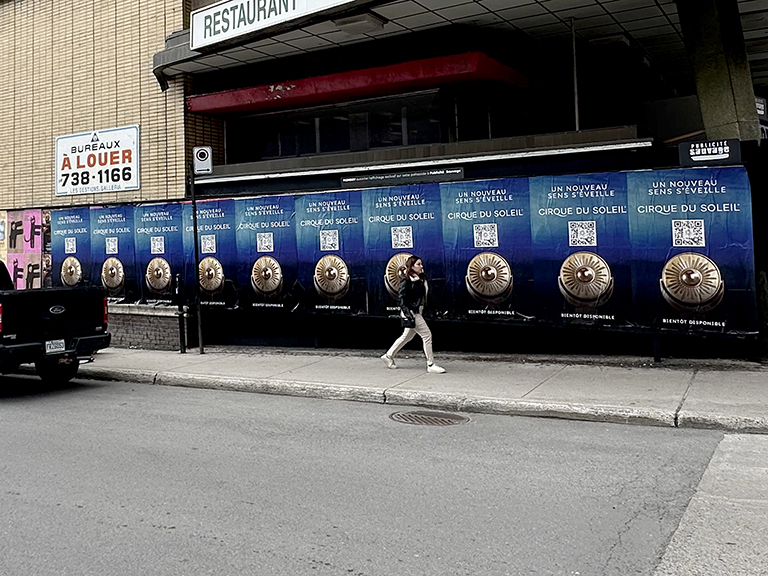
Toronto has a strong wheatpaste and street poster culture, particularly in the Queen West, Kensington, and College Street corridors. Our wheatpaste campaigns in Toronto use approved surfaces in these high-footfall cultural zones, with large-format prints that generate genuine visual impact. The organic social documentation of strong creative in Kensington or Queen West extends campaign reach significantly beyond the physical location.
Sidewalk Stencils
High-pedestrian zones in downtown Toronto, including King Street West, the St. Lawrence Market area, and the Harbourfront, see significant foot traffic from a broad consumer demographic. Sidewalk stencils placed at key pedestrian decision points in these areas generate exposures from people who are looking down while they walk, creating a distinctly street-level touch point that feels different from above-eye-level media.
LED Billboard Trucks
Our LED billboard trucks operate in Toronto and can be routed through the entertainment district, the financial core, or specific cultural neighborhoods depending on campaign targeting. Dynamic content capability allows us to adapt messaging by time of day and route, maximizing relevance across different audience concentrations throughout the campaign day.
Festival and Event Marketing
Toronto’s event calendar is dense. TIFF, Pride, Caribana, the Distillery’s seasonal markets, and dozens of neighborhood festivals create concentrated audience moments that are ideal for brand presence. We execute festival marketing programs in and around major Toronto events, both through official sponsorship activations and through strategically positioned street-level programs in the areas around event venues.
Toronto Neighborhoods: Where We Work and Why
Choosing the right neighborhoods is the most important strategic decision in a Toronto experiential campaign. Different neighborhoods reach different audience segments, have different creative cultures, and respond to different tactical approaches.
Queen Street West
Queen West is Toronto’s primary creative and cultural corridor, running from Spadina through Parkdale. The strip is densely lined with independent retailers, restaurants, galleries, and music venues. Foot traffic is strong throughout the day and evening, with the demographic skewing toward 25 to 40-year-old creative professionals, artists, and cultural consumers. Brand activations here work for fashion, music, food and drink, and lifestyle brands with genuine cultural credibility.
Kensington Market
Kensington is Toronto’s most concentrated bohemian neighborhood, a tight cluster of vintage shops, international food stalls, and independent businesses in the Dundas West corridor. It attracts a younger, alternative demographic that responds well to creative formats and poorly to corporate-feeling campaigns. Wheatpaste campaigns and street team programs in Kensington work best for brands with a genuine counterculture or independent business story to tell.
Distillery District
The Distillery is a premium heritage destination in the east end. Its cobblestone streets and Victorian industrial architecture make it one of the most photographed locations in Toronto. Brand activations here reach a mix of tourists, young professionals, and design-conscious consumers. The Distillery’s own event programming, including its Christmas market and summer festivals, creates regular audience concentration that makes it one of the highest-value activation locations in the city.
King West and Entertainment District
King West and the Entertainment District attract the largest concentration of premium consumer spending in Toronto, with a dense mix of upscale restaurants, clubs, hotels, and offices. Street team programs along King Street West and the surrounding blocks reach a high-income, 25 to 45-year-old audience in a leisure and dining context. This area works well for premium consumer brands, financial services, and tech companies targeting Toronto’s professional class.
Yorkville
Yorkville is Toronto’s luxury shopping and hotel district, attracting a high-net-worth consumer base that is smaller in volume but significantly higher in spend power than the Queen West or Kensington markets. Brand ambassador programs and high-end product sampling in the Bloor Street and Yorkville Avenue corridor reach this premium audience in a context where spending is already on their mind.
Toronto Guerrilla Marketing: Beyond Traditional Activations
Some of the most effective Toronto campaigns we’ve run weren’t traditional experiential activations. They were guerrilla programs that created brand presence through unexpected placement and format.
College Campus Programs
College marketing in Toronto operates at scale. The University of Toronto’s downtown St. George campus, Ryerson (now TMU), and OCAD University together represent hundreds of thousands of students concentrated in a few square miles of the downtown core. We run campus-adjacent street team programs, poster campaigns in campus corridors, and sampling activations at key student transit points that reach this audience in their daily environment.
Pride and Cultural Events
Toronto’s Pride festival is one of the largest in North America, with Church and Wellesley becoming the center of weeks of programming. Pride festival marketing in Toronto requires both cultural fluency and logistical precision. We’ve run programs during Toronto Pride that combine street team presence at the parade route with wheatpaste campaigns in the Church-Wellesley Village in the weeks leading up to the main events.
Planning a Toronto Experiential Campaign
A well-planned Toronto campaign follows a clear sequence. Here’s what the process looks like from initial brief to campaign delivery.
Strategy and Audience Mapping
Every Toronto campaign starts with a clear picture of who we’re trying to reach and where they spend their time. Toronto’s neighborhoods have distinct audience profiles. A campaign targeting 22 to 28-year-old fashion consumers needs a different location strategy than one targeting 35 to 50-year-old financial professionals. We map your target audience against Toronto’s neighborhood demographics before making any tactical decisions.
Format Selection
Based on audience location, campaign objectives, and budget, we recommend the specific combination of formats that will deliver the best results. A product launch might combine wheatpaste in Queen West with a weekend street team activation at Kensington Market. A brand awareness campaign might run LED trucks through the King West corridor alongside sidewalk stencils in the financial district. The format combination serves the goal.
Production and Logistics
Print production for Toronto poster campaigns is coordinated from our Brooklyn base and delivered to our Toronto crew before deployment. Street team recruitment and training is managed through our Canadian ambassador network, with brand briefings completed before any public deployment. Site approval coordination for locations requiring event site approvals is handled by our team.
Deployment and Documentation
Campaign deployment in Toronto follows the same documentation standard as our New York campaigns. Geo-tagged installation photos are delivered within 24 hours of overnight poster installations. Street team programs include daily briefing and debrief protocols with counts and interaction metrics. A full wrap report is provided within one week of campaign completion.
Coordinating Toronto Campaigns with US Programs
A significant number of our Toronto clients are American brands that treat Canada as an adjacent market to their primary US operations. For these clients, we build campaigns that coordinate across borders, with consistent creative standards but market-specific tactical execution.
Toronto is not a smaller New York. It has its own cultural identity, its own media environment, and its own advertising sensibility. A campaign that works in Brooklyn doesn’t automatically translate to Queen West. We work with clients to adapt their US campaign thinking for the Toronto market while maintaining brand consistency across both programs.
For brands running simultaneous New York and Toronto campaigns, we provide unified reporting that covers both markets under a single framework, making it straightforward to assess performance across the North American program rather than managing two separate agencies in two separate countries.
What Makes a Toronto Experiential Campaign Work
We’ve run enough campaigns in Toronto to have a clear sense of what separates programs that generate genuine results from those that check the marketing budget box without moving the needle. Here’s the honest breakdown.
Location Intelligence Over Location Guesswork
The most common mistake in Toronto experiential campaigns is selecting locations based on general knowledge rather than specific audience data. Queen West is broadly described as Toronto’s creative corridor, but the specific blocks that matter for a given brand’s target audience vary significantly. A streetwear brand should be between Ossington and Spadina. A health and wellness brand is better served by the Trinity Bellwoods area. A food brand launching a new product needs to be on the Harbord and College cluster rather than King West. We map target audience concentration against Toronto’s neighborhood demographics before recommending any location.
Timing Is Non-Negotiable
Toronto’s pedestrian patterns are strongly seasonal and strongly time-of-day dependent. Weekend mornings at Kensington Market are valuable. Weekday lunch hours at King and Bay are valuable for financial services brands. Thursday and Friday evenings on Queen West reach the cultural consumer demographic at its highest concentration. Campaigns deployed at the wrong time in the right location underperform as badly as campaigns in the wrong location entirely. We build timing into campaign planning from the first brief conversation, not as a last-minute scheduling decision.
Staff Quality Determines Outcome
In experiential marketing, the quality of the human interaction is everything. A well-designed activation with under-trained or insufficiently briefed ambassadors generates exposures but not engagement. We invest significantly in ambassador briefing for Toronto campaigns, ensuring that every street team member knows the brand, knows the product or offer, can answer questions intelligently, and understands what a successful interaction looks like. The difference in conversion rate between a well-briefed team and a minimally briefed one in the same Toronto location is consistently significant.
Creative That Belongs in the Neighborhood
Toronto’s cultural neighborhoods have strong visual identities. Campaigns that feel like they were designed for a generic urban environment rather than the specific neighborhood they’re deployed in get noticeably less engagement. Kensington Market creative needs a different aesthetic than King West creative. The Distillery District’s heritage character calls for a different visual register than the contemporary design of Ossington Avenue. We build neighborhood-specific creative variants when budgets allow, and at minimum we review creative for cultural fit before anything goes into production.
Toronto Experiential Marketing: Seasonal Considerations
Toronto’s climate is extreme by North American standards. Winter temperatures regularly drop below -15°C, which significantly affects outdoor campaign planning from November through March. Any agency telling you that Toronto outdoor campaigns work equally well year-round hasn’t actually run many of them.
Spring and Summer: Peak Season
May through September is when Toronto’s outdoor pedestrian culture is fully alive. Kensington Market, Queen West, Trinity Bellwoods, and the Harbourfront all generate maximum foot traffic. Street team activations, wheatpaste campaigns, and sidewalk stencil programs all perform at their best during this window. Toronto Pride in June creates the largest single-week concentration of culturally engaged consumers anywhere in the city. TIFF in September draws an international audience that creates premium opportunities for entertainment and lifestyle brand activations.
Winter: Adapting to the Elements
Winter campaigns in Toronto require adaptation. Outdoor street team programs need to be shorter in duration per shift and concentrated in indoor-adjacent locations: subway exits, PATH-connected venues, and indoor market spaces. Wheatpaste campaigns continue to work in winter but require weatherproofed materials and paste formulations that maintain adhesion in freezing conditions. The reduced outdoor competition in winter means campaigns that are properly equipped for the conditions actually perform better than their summer counterparts in certain metrics.
FAQ: Experiential Marketing in Toronto
What is experiential marketing and how does it work in Toronto?
Experiential marketing creates direct, physical brand encounters rather than passive media exposures. In Toronto, this means deploying brand activations in high-traffic neighborhoods, running street team programs at cultural events and transit hubs, executing guerrilla campaigns in cultural districts, and creating pop-up brand moments that generate genuine engagement and social sharing.
What neighborhoods in Toronto do you work in?
We work across Queen Street West, Kensington Market, the Distillery District, King West, Yorkville, College Street, Ossington, and the downtown core. Neighborhood selection is always based on your target audience’s concentration and movement patterns.
Do you run guerrilla marketing and street campaigns in Toronto as well?
Yes. Beyond traditional experiential activations, we run wheatpaste poster campaigns, street team deployments, sidewalk stencils, and LED billboard truck programs across Toronto. These guerrilla formats complement experiential activations as part of an integrated street-level campaign.
How far in advance do we need to plan a Toronto brand activation?
Street team and guerrilla campaigns in Toronto can be planned and deployed in two to three weeks. More complex experiential activations with branded structures, product demonstrations, or site approval-required locations need four to eight weeks of lead time. We work with your timeline and flag any constraints early.
Can you coordinate Toronto campaigns alongside US campaigns?
Yes. We regularly run coordinated campaigns that cover both US cities and Canadian markets simultaneously. Our operational infrastructure handles cross-border production logistics, crew coordination, and unified reporting for brands running integrated North American programs.
What does an experiential marketing campaign in Toronto cost?
Street-level guerrilla and street team campaigns in Toronto typically start around $7,000 to custom quote for a focused single-neighborhood deployment. Full experiential activations with branded structures and staffing run $15,000 to $50,000 or more depending on duration, location, and complexity.