
November 6, 2026
Driving Billboard: How It Actually Works
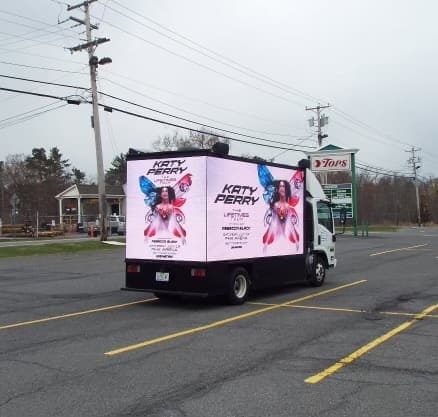
A driving billboard is a billboard that goes to the audience instead of waiting for it.
That is the entire proposition, and it is a genuinely good one in the right circumstances. It is also the source of nearly every mistake buyers make with the format, because the appeal of motion distracts from the question that actually decides the outcome: how many of the right people see the face, for how long, and in what frame of mind.
Motion is not automatically valuable. A fixed board on a commuting route is seen by the same people repeatedly, every day, without a driver. A driving billboard is seen by whoever happens to be on the street during the hours it runs. Those are different products and one is not simply the better version of the other.
I run these routes. What follows is the operational version: what the format is, where the value actually comes from, how a route is built, what the honest limitations are, and the campaigns where I tell people not to bother.
What counts as a driving billboard
Several different things get sold under the term and they behave differently.
Truck-mounted printed displays. A rigid vehicle body carrying large printed faces on both sides and the rear. The most common version and the most reliable.
Trailer-based Mobile Billboards. A towed unit carrying display faces, pulled by a separate vehicle. Lower overall height in some configurations, different manoeuvrability, and the unit can sometimes be left in position while the tractor does something else, subject to where that is permitted.
LED and digital vehicles. Screens rather than printed faces. Different behaviour entirely after dark, different power requirements, different failure modes.
Wrapped fleet and rideshare displays. Advertising on vehicles whose primary purpose is something else. The vehicle goes where its own job takes it, which means the advertising follows a route nobody chose for it. Incidental exposure, no route control.
The distinction that matters most for planning is between vehicles whose route you control and vehicles whose route you do not. A dedicated vehicle on a designed route is a planned media buy. Advertising on a vehicle doing its own job is opportunistic exposure. Both have a place, but conflating them produces disappointment.
Where the value actually comes from
Buyers usually say they want the format because it moves. When I push on why, the real reasons are almost always one of these three, and each implies a different plan.
Reaching places with no inventory
A lot of the locations brands care about have no fixed outdoor structures at all. Dense cores where the planning environment never allowed them. Campus edges. Event perimeters. Convention districts. Neighbourhood commercial strips.
A vehicle goes where the structure is not. This is the strongest argument for the format and the one I find most persuasive, because the alternative is often nothing.
Owning a moment rather than a period
Fixed outdoor sells time. A vehicle sells presence at a specific hour in a specific place.
If the objective is tied to a day, a doors-open time, a conference, a product launch or a game, a vehicle can be exactly where the crowd is while the crowd exists, then leave. Nothing else in outdoor does that. Boards cannot be aimed at a Tuesday evening, and posters, while excellent at sustained presence, cannot concentrate themselves at a gate for ninety minutes.
Being visibly deliberate
A fixed board is part of the landscape and people filter it out. A vehicle carrying one message, moving through a street people are standing on, reads as intentional. It gets noticed and sometimes photographed.
That effect is real but it decays. The first pass is interesting. The fourth pass in an hour on the same block is background, and past that it starts to irritate. Route design has to respect this, and I will come back to it because it is the most commonly ignored constraint in the format.
How a route is actually built
Route design is the product. Everything else is logistics.
Start from where the audience is at a specific hour
Not a neighbourhood. Not a demographic. A street, in a direction, at a time.
Pedestrian and vehicle density are not spread evenly through the day, they spike. Morning arrival, lunch release, evening outflow, doors open, doors close. The gaps between those spikes are thin, and a vehicle running through a quiet street is burning hours.
The honest shape of a good route is concentrated. Work the peaks hard, accept that the middle of the day on most corridors is low value, and position early for the outflow, which is frequently the single best window of the entire shift and the one most often missed because the vehicle went for fuel.
Walk or drive the corridor before committing
Satellite imagery and mapping tools lie about current conditions. They do not show the construction hoarding that went up last month, the bus lane now occupying the lane you planned to crawl in, the loading restrictions painted on the kerb, or the left turn that has been banned at peak.
Height restrictions matter and they are not always mapped. Parking structures, older underpasses, some downtown service streets and many historic districts are simply unavailable to a tall vehicle. Discovering this on the day wastes a shift.
Turn-around points matter more than people expect. A loop that requires a difficult turn at a congested intersection will cost ten minutes every circuit, and over a shift that is a substantial share of the time you paid for.
Design the loop for the right repetition
Here is the calculation that actually determines value.
A short tight loop passes the same point frequently. That builds frequency against the people standing there, which is useful when the audience is stationary, such as a queue, a plaza or an event perimeter. The risk is saturation. The same people seeing the same face eight times in an hour stop registering it and may start resenting it.
A longer loop covers more ground with less repetition. Better when the audience is itself moving and turning over, such as a retail corridor where the population of the street refreshes continuously.
Getting this wrong is the most common route failure. Short loops on corridors with high turnover waste the coverage. Long loops at a stationary event waste the frequency.
Build in the realities of a shift
Fuel. Driver breaks, which are required and have to be somewhere the vehicle can legally stop. Traffic contingency and an escape route when a corridor jams. Weather. And an alternative loop already scouted for when the primary becomes unusable.
A route plan without those is a wish, not a plan.
Crew and hours
A printed driving billboard is typically one driver per vehicle per shift. That is the baseline and it is genuinely simple.
The moment anything else is happening, the crew grows. Street Teams working alongside the vehicle, handing something over, scanning, managing a queue, are separate people with their own briefing, timing and supervision. A driver cannot run a route and manage a crowd at the same time, and we staff those separately and say so.
Shifts are built around when the audience exists rather than a tidy workday. Daytime retail routes concentrate on arrival, lunch and evening release. Event work is a different shape entirely: long staging, a short period of intense value, then a scramble to be in position for outflow.
Night work changes the format fundamentally. A printed face at night is only as visible as whatever light falls on it. Under good street lighting it reads perfectly well. On a dark stretch it is a grey rectangle. That is the honest case for illuminated vehicles and it is the one I will make.
Printed or illuminated
Buyers usually choose between these on which photographs better in a proposal. Wrong criterion. Choose on when your audience is outside.
Printed faces are right for daytime. Legible in direct sun, no power dependency, nothing can fail in a way that blanks your message, and the full panel area is yours. A printed face performs identically at hour one and hour nine.
LED vehicles are right when the audience is out after dark, when the creative needs motion or multiple sequential messages, or when the vehicle has to compete in an environment where every surface is already lit. In a dark corridor a lit screen is not comparable to a printed panel. It dominates.
The trade-offs on LED are real. Screens need power, which means generator and fuel logistics. Direct sun washes a screen out far more than the pitch suggests, so the daytime advantage is smaller than buyers assume. Usable screen area is generally smaller than a full printed side. And there is more that can fail mid-shift.
Default position: daytime and all-day coverage, print. Evening, night, dark environments or motion in the creative, LED. If the objective genuinely spans both and the scope supports one vehicle, we pick for the hours that matter most and say clearly what is being given up. The full operational detail on the illuminated side sits in our LED Trucks & Mobile Billboards service line.
Creative for a moving face
The viewing condition is harsher than almost any other format, and it varies within a single shift.
On a dense sidewalk corridor at crawling speed, the face is read from close range by someone walking. You can carry a little more detail and an actual line of copy.
On a multilane arterial at traffic speed, the face is read from much further away in a fraction of a second. Then you have a few words and a shape.
Designing one file and running it across both kinds of street is the most common creative error, and the result is unreadable on one of them.
Hard-earned rules.
Keep the important element high. The bottom band of any vehicle face is blocked constantly by parked cars, bollards, street furniture, bus shelters and other traffic. Anything load-bearing placed low will be hidden for much of the campaign.
Treat the rear face as a separate design. It has a different aspect ratio and a completely different audience: drivers stopped behind you, who have genuine dwell time. That face can carry more information than the sides.
Do not rely on a QR code on a side panel. People do not scan a moving target. On the rear face, in stopped traffic, a code can work. On a side in motion it is decoration. Say the name instead.
Contrast has to survive bad conditions: rain, dusk, shadow in a dense corridor, and the general visual clutter of a city street.
Measurement, honestly
This is where the category oversells hardest.
What you can know reliably: where the vehicle went, when, for how long, and at what speed. GPS tracking makes the route auditable, and any operator should provide it. You can also document the shift with timestamped photography.
What you cannot know reliably: how many people saw the face and registered it. Exposure estimates for moving media are modelled from traffic and pedestrian counts along the route with assumptions layered on top. That is reasonable planning methodology. It is not a measurement of attention delivered, and figures presented with high precision deserve scepticism.
My advice is to treat route verification as the deliverable you hold the operator to, and treat exposure estimates as a planning comparison rather than a result. If the campaign needs measurable response, build a mechanism that can actually capture it, which usually means people on the ground rather than the vehicle alone.
Permission and the grey area
I am not giving legal advice. What I can describe is operational reality.
Mobile advertising sits in a grey area across much of the country. The vehicle is on a public road, registered, insured and driven like any other commercial vehicle, which is unremarkable. The question that varies is whether a municipality treats a vehicle whose primary purpose is carrying advertising as a vehicle or as a sign.
Some cities have specific provisions addressing advertising vehicles. Some address stationary parking of them specifically. Some restrict particular districts, hours, or illuminated displays near residential frontage. Many have nothing on point and the matter is handled through ordinary parking and traffic enforcement. Enforcement is inconsistent even within a single city.
So the honest framing is that it varies by municipality, depends on how the vehicle is being used, and is a grey area rather than a settled yes or no.
What we do about it is practical. We research the specific jurisdictions on a route before confirming it, and flag where the posture is restrictive or unclear. We design around movement rather than prolonged stationary display where the posture is uncertain, since a moving vehicle is far less contentious than a parked one almost everywhere. Where a campaign genuinely needs a long hold in one position, we look for private property with an owner who can grant permission, which changes the character of the activation entirely. We brief drivers to comply immediately and without argument if asked to move, because no campaign objective justifies escalating a street interaction. And we document the shift as it runs.
What goes wrong
Traffic eats the route. The corridor with the most people also has the most congestion. A vehicle motionless in a jam is not a campaign. Plan loops with genuine escape options and accept lower theoretical exposure on a route that actually flows.
Saturation. Too many passes on the same block in the same hour. The audience stops seeing it.
Dead hours. A shift scheduled to fill a workday rather than hit the peaks.
The schedule nobody verified. Events start late, let out early, move gates and change entry flow. A plan built on a published schedule that nobody confirmed on the ground puts the vehicle in the right city on the wrong corner.
Route drift. Over a long flight, drivers naturally optimise for easier driving rather than for exposure. Without route discipline and GPS review, week three looks nothing like week one.
Weather. Rain does not damage a properly applied face but it empties sidewalks, which is the actual problem. Extreme cold and heat both affect application and adhesion, which shrinks the window for getting faces onto vehicles in the first place.
Shadow and sun angle. Dense corridors sit in shadow much of the day. Sometimes the right fix is simply reversing the direction of the loop so the face is on the lit side.
What we talk clients out of
Covering a whole metro with one vehicle. One vehicle covers one corridor well or several badly. Spread across a large market, most of the shift is transit between places where nobody sees it. I would rather own one corridor convincingly.
Using a driving billboard for sustained presence. If the objective is continuous presence in a defined area across weeks, a vehicle is a fragile and effort-heavy way to achieve it. Posters are in position every hour of every day with no driver, no fuel and no traffic risk. That is when I point people to Wheatpasting & Poster Campaigns, and sometimes that is the entire recommendation.
Dense creative. Four lines of copy, three logos, a code and a hashtag on a moving face is noise. One idea, large, placed high.
Illuminated screens for a daytime campaign. The screen wins the proposal and loses the street at noon.
Wrapping a vehicle that is doing another job and calling it a campaign. It is exposure, not a plan. If the route is not chosen, the media is not targeted.
Long flights with no refresh of thinking. A route that was right in week one may be wrong in week four because a venue closed, construction started, or the season changed. Routes should be reviewed, not set once.
Frequently asked questions
Is a driving billboard better than a fixed board?
Neither is better, they do different jobs. A fixed board builds frequency against the same commuters daily without a driver. A driving billboard reaches places with no inventory and can be aimed at a specific hour and place. Choose on whether your objective is sustained route frequency or presence at a particular moment.
How many hours should a vehicle run per day?
Aim at the peaks rather than filling a workday. Density spikes at morning arrival, lunch, evening outflow and venue doors, and the stretches between are thin. A shorter shift concentrated on real peaks usually outperforms a long flat day, because the quiet hours are mostly transit with nobody watching.
Can the vehicle park and stay in one place?
Sometimes, depending entirely on location and permission. Stationary kerbside display is the part of this format most likely to attract attention from local enforcement, and the posture varies by municipality and is applied inconsistently. Where a campaign needs a long hold, we seek private property with owner permission rather than relying on a public kerb.
How do I know the route was actually driven?
GPS tracking, which any operator should provide. It shows where the vehicle went, when, for how long and at what speed, and makes the route auditable against the plan. Combine it with timestamped photography from the shift. Treat route verification as the real deliverable, since exposure estimates are modelled rather than measured.
Should I choose printed panels or LED screens?
Decide on when your audience is outside. Print is better in daylight, needs no power, and cannot blank out mid-shift. LED is better after dark, in brightly lit districts, and when creative needs motion or several sequential messages. Direct sun washes screens out more than most buyers expect, so daytime LED is weaker than it sounds.
What creative works on a moving vehicle?
One idea, placed high on the face, sized for the viewing distance your route creates. The lower band gets blocked by parked cars and street furniture, so nothing important goes there. Design the rear face separately, because drivers stopped behind you have genuine dwell and can take in more detail than anyone walking past.
Request a campaign quote
If you are considering a driving billboard, tell us the objective, the city and the dates rather than the format. We will be straight about whether a vehicle is the right tool, what the route would realistically look like, and whether posters or ground-level work would serve the objective better.
Request a campaign quote and we will come back with corridors, hours, loop design and the constraints we already know about in your market.

Ready to Run Your Campaign?
Call us or email us. We’ll tell you exactly what we can do in your market and what it costs.
Related Services
Explore similar advertising solutions offered by American Guerrilla Marketing.
American Guerrilla Marketing — Los Angeles
Street-level campaigns in Los Angeles and nationwide. Wheatpasting, LED trucks, street teams, and more.
(646) 776-2770
Related Articles
-
How a Mobile Digital Billboard Truck Actually Gets Set Up
November 6, 2026
-
Marketing to College Students Off Campus: How It Installs
November 6, 2026
-
How Mobile Billboard Impressions Are Counted
November 5, 2026
-
LED Trucks and Mobile Billboards in Miami, Florida
November 5, 2026
-
Mobile LED Truck Advertising: Timelines and Routes
November 5, 2026