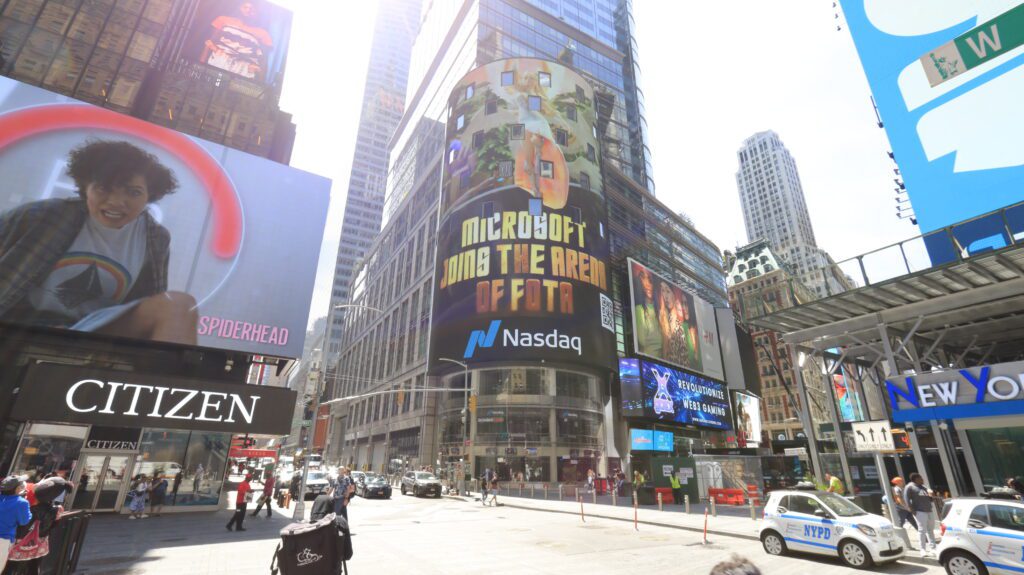
Digital billboard advertising has reshaped how brands buy out-of-home media. Where traditional static billboards locked advertisers into week-long vinyl rotations, digital out-of-home (DOOH) screens let our team swap creative in hours, daypart by audience segment, and layer programmatic buying logic on top of physical locations. The result is a format that sits somewhere between traditional OOH and digital display — with the scale and physical presence of the former, and the flexibility and measurability of the latter.
This guide covers everything brands and agencies need to understand about digital billboard advertising: how the screens work, what realistic CPMs look like across markets, how lead times compare to static OOH, what measurement options actually exist, and how to combine DOOH with street-level guerrilla tactics to extend reach and earn media coverage that no billboard alone generates. We deploy campaigns across 50+ U.S. markets and understand how DOOH fits — and where it falls short.
If you are evaluating DOOH as part of a broader outdoor media strategy, this is the field-tested breakdown. No filler, no vendor fluff. Just how the format actually works for brands that want results.
How Digital Out-of-Home Screens Work
DOOH screens are LED panels operated by outdoor advertising companies across highway corridors, urban intersections, transit hubs, gas stations, gym networks, and retail corridors. Unlike a printed vinyl that stays up for four weeks, digital screens rotate between multiple advertisers on a loop — typically 6 to 8 advertisers per loop with each advertiser receiving an 8 to 15 second slot.
Screen Types and Environments
Highway digital billboards are the most recognizable format: large LED panels along interstates and arterials, typically 14 feet by 48 feet. Urban spectaculars are smaller, often mounted on building facades or above retail strips, and generate denser pedestrian impressions. Place-based DOOH includes screens in gyms, bars, restaurants, and convenience stores — smaller audiences but contextually targeted. Gas station media networks (Fuelman, Freeosk, etc.) hit a captive audience mid-errand. Transit shelters and station dwell screens work for dense urban cores where commuters stand for 3 to 5 minutes.
Direct vs. Programmatic Buying
Direct buys go through the network operator — Lamar, Clear Channel, Outfront, or regional operators — with a specific screen, specific weeks, and a fixed rate. You know exactly where your ad appears. Programmatic DOOH goes through a demand-side platform (DSP) that bids on available inventory in real time across multiple networks. Programmatic offers flexibility and dayparting, but you get less control over which specific screens run your ad. Most serious campaigns use a hybrid: direct buys for hero placements, programmatic for scale.
Digital Billboard Costs and CPM Benchmarks
DOOH CPMs vary significantly by market tier, screen location, and audience volume. Understanding these ranges helps brands allocate budgets realistically and avoid overpaying for screens that underdeliver.
Market-by-Market Cost Ranges
In Tier 1 markets (New York, Los Angeles, Chicago), digital billboard CPMs range from $8 to $14 for premium highway and urban screens. In Tier 2 markets (Atlanta, Dallas, Miami, Seattle, Denver), CPMs fall to $5 to $9. In smaller markets, CPMs can drop to $3 to $6, but audience volumes are proportionally lower. A two-week direct buy on a single premium screen in a Tier 1 market typically runs $4,000 to $10,000. A programmatic DOOH campaign with $15,000 in spend can reach multiple screens across a metro area, but impression quality varies.
Minimum Spend Thresholds
Most operators require minimums. Direct buys often require a two-week minimum commitment per screen. Programmatic DSPs typically require $5,000 to $10,000 monthly minimums to access inventory at scale. For brands with smaller budgets, partnering with a full-service agency that aggregates buying power across clients reduces effective minimums and gets access to better inventory at better rates.
Production Costs
Static DOOH creative is inexpensive to produce — typically $200 to $500 per ad unit if design is already established. Video creative for screens that accept it runs higher: $1,500 to $5,000 depending on complexity. Dynamic DOOH that pulls in live data (weather triggers, sports scores, real-time inventory) requires API integration and ongoing management costs.
Planning and Lead Times for DOOH Campaigns
One of DOOH’s biggest advantages over static OOH is speed. Brands that need to react to a news cycle, product launch, or seasonal event can move much faster with digital than with printed vinyl.
Direct Buy Lead Times
A direct buy on a specific DOOH screen can launch in 2 to 5 business days once creative is submitted and approved. The operator reviews the file, uploads it to the rotation, and confirms the start date. Compare this to static billboards, which require 5 to 10 business days for printing and installation alone.
Programmatic Lead Times
Programmatic DOOH can activate in 24 to 48 hours if the DSP account is already live and creative assets are ready. For brands setting up programmatic DOOH for the first time, DSP onboarding, inventory planning, and targeting configuration add 1 to 2 weeks to the setup phase.
Creative Versioning
DOOH allows mid-campaign creative swaps without pulling and reprinting materials. Our team uses this routinely on multi-week campaigns to test message variants, update offers, or shift creative based on early performance signals. This flexibility alone makes DOOH preferable to static for any campaign running more than two weeks.
Measurement and Attribution for Digital Billboards
Attribution is the most frequently misunderstood aspect of DOOH. Unlike digital display advertising where impressions and clicks are tracked at the device level, DOOH measurement is probabilistic and derived from third-party data sources. Understanding what you can and cannot measure prevents inflated expectations and helps brands evaluate DOOH honestly.
Impressions and Audience Measurement
DOOH impression counts come from traffic data, mobility data, and audience measurement panels aggregated by companies like Geopath. These estimates capture the number of people likely to have seen the screen during your campaign window, segmented by demographics. They are solid enough for planning and comparison, but not as precise as pixel-level digital tracking.
Lift Studies and Brand Impact
Most major DOOH networks offer brand lift studies as an add-on: a panel of exposed and unexposed consumers is surveyed post-campaign for awareness, recall, and purchase intent shifts. These studies cost $3,000 to $8,000 and require minimum spend thresholds to achieve statistical significance. For brand campaigns where direct response is not the goal, lift studies are the best available measure of impact.
Foot Traffic Attribution
Some DOOH platforms integrate with foot traffic measurement tools that compare mobile device location data for people exposed to DOOH screens versus control groups. This can produce visit lift metrics for retail, restaurant, and venue campaigns. The methodology has limitations but is useful for categories where in-store conversion is the campaign goal.
Integrating DOOH with Street-Level Guerrilla Tactics
Digital billboard advertising creates reach and frequency at scale. Street-level tactics create direct interaction, earned media, and cultural conversation. Combined, they amplify each other in ways neither achieves alone. Our team regularly pairs DOOH campaigns with complementary ground-level activations to extend impact and drive social content.
DOOH Plus Wheatpaste and Wheatpasting
A large-format DOOH buy in a city center creates ambient awareness across commuter flows. Simultaneously deploying wheatpasting and poster campaigns in the same neighborhoods brings the brand down to eye level in the specific zones where the target audience lives, eats, and socializes. The effect is market saturation: consumers encounter the brand on the highway overpass and again on the wall outside the coffee shop. That layering compounds recall.
DOOH Plus LED Billboard Trucks
LED billboard trucks bring a moving DOOH screen directly into the environments a fixed screen cannot reach: festival grounds, parking lots, residential neighborhoods, event perimeters. Using an LED truck in tandem with a fixed DOOH buy fills geographic gaps and allows hyper-targeted neighborhood presence without the minimum commitment of a fixed screen deal.
DOOH Plus Sidewalk Stencils
When DOOH creates visual brand exposure at height, sidewalk stencils create it underfoot — at the exact moment a pedestrian is in motion, making decisions about where to walk, eat, or shop. The contrast between digital screen presence overhead and stencil presence at street level reinforces the brand across multiple sensory channels simultaneously.
Geographic Targeting and Market Selection
DOOH targeting begins with market selection. Not every market has the same screen density, audience measurement quality, or operator network. Understanding these differences prevents budget waste and helps brands prioritize investment.
High-Density Urban Markets
New York, Los Angeles, Chicago, San Francisco, and Miami have the densest DOOH networks, the best audience measurement infrastructure, and the most competition for premium inventory. Costs are highest here, but so are impression volumes and audience quality for consumer brands. Our campaigns in these markets combine fixed DOOH buys with street-level guerrilla marketing services to create surround-sound brand presence.
Secondary Market Opportunities
Markets like Nashville, Austin, Denver, and Charlotte offer DOOH at lower CPMs with strong demographic profiles for millennial and Gen Z consumers. Inventory competition is lower, and screen placement near high-traffic entertainment districts can deliver strong frequency for emerging brands with leaner budgets.
Campus and Event Corridors
College towns and event corridors (around arenas, stadiums, and convention centers) offer concentrated DOOH inventory that delivers massive impression volumes during specific windows — game days, concert weekends, graduation season. These corridors are ideal for brands with a strong student or event-adjacent audience, especially when combined with brand ambassador programs operating in the same zones.
Creative Best Practices for Digital Billboards
DOOH creative has different requirements than print or digital display. The viewing conditions — high speed, 6-second glance windows, ambient environment — demand a specific approach to copy, contrast, and message hierarchy.
The 6-Second Rule
A driver on a highway sees a billboard for approximately 6 seconds. That is enough time to register a brand name, one supporting message, and a simple visual. Creative that tries to communicate more than three elements fails at highway scale. Urban screens with pedestrian traffic allow slightly more dwell time — 8 to 12 seconds — but the principle holds: every element that is not essential should be removed.
Color and Contrast
DOOH screens are bright, but they compete with sunlight, other signage, and environmental visual noise. High-contrast backgrounds — dark on light or light on dark — outperform mid-range palettes. Brand colors that work in print may not translate to LED at scale. Always test creative at approximate viewing distance before finalizing production.
Dynamic Creative and Dayparting
Programmatic DOOH allows creative to change by time of day, weather conditions, or even live data triggers. A coffee brand can run “morning commute” creative at 7am and shift to “afternoon pick-me-up” messaging at 2pm. A retail chain can run a “3 miles ahead” directional message near highway screens approaching their exit. These dynamic elements require pre-planning and additional production, but they consistently outperform static variants in recall studies.
DOOH for Specific Campaign Types
Digital billboard advertising is not equally effective across all campaign types. Understanding where it excels — and where it is better supported by other formats — helps brands allocate budgets efficiently.
Product Launches
DOOH is ideal for product launches that need rapid mass awareness. A two-week blitz across key markets immediately before and after launch day creates the impression of ubiquity. Our team pairs these launches with street-level poster campaigns and brand ambassador sampling to add texture and direct consumer interaction to the launch window.
Event Marketing
For events — concerts, sporting events, trade shows, conferences — DOOH in the corridors around the venue during the 48 to 72 hours before the event drives awareness among the highest-intent audience. Combine with experiential marketing activations near venue entrances for a campaign that hits the same consumer multiple times in the same day.
Retail and Foot Traffic Campaigns
Retailers and restaurant chains use DOOH for directional campaigns — driving consumers in motion toward a nearby location. These campaigns work best when screen placement is within 2 miles of the target location and creative includes a clear address or directional indicator. Flyer distribution in the same trade area reinforces the outdoor impression at close range.
Frequently Asked Questions
How much does digital billboard advertising cost?
Digital billboard CPMs typically range from $4 to $14 depending on market size, screen location, and daypart. A two-week run on a single premium screen in a major market runs $3,000 to $8,000. Programmatic DOOH campaigns can start lower but require a DSP and minimum spend thresholds.
What is the difference between DOOH and traditional billboard advertising?
Traditional billboards are static printed vinyls that run for weeks or months on a fixed creative. DOOH screens rotate multiple advertisers on a loop — typically 8 to 15 seconds per slot — allowing dynamic creative, dayparting, and faster campaign turnaround.
How long does it take to launch a digital billboard campaign?
Direct buys on DOOH screens can launch in 2 to 5 business days once creative is approved. Programmatic DOOH campaigns can go live within 24 to 48 hours if the DSP is already configured and creative assets meet spec.
Can you target specific audiences with digital billboards?
Yes. Programmatic DOOH allows daypart targeting, weather-triggered creative, and audience-indexed screen selection using mobility data. You cannot target specific individuals, but you can target high-concentration zones for your audience segment.
What creative specs do digital billboards require?
Most digital billboard operators accept static JPG or PNG at 72 DPI with aspect ratios matched to the specific screen. Common formats include 14×48 feet (highway) and smaller urban ratios. Some screens accept video at H.264 MP4. Always confirm specs with the operator before final design.
Is digital billboard advertising effective for local businesses?
It depends on the market and campaign goal. For local businesses with high daily traffic patterns near their location, a well-placed digital billboard builds consistent awareness. Paired with street-level tactics like flyer distribution or sidewalk stencils, the combined reach is significantly stronger.