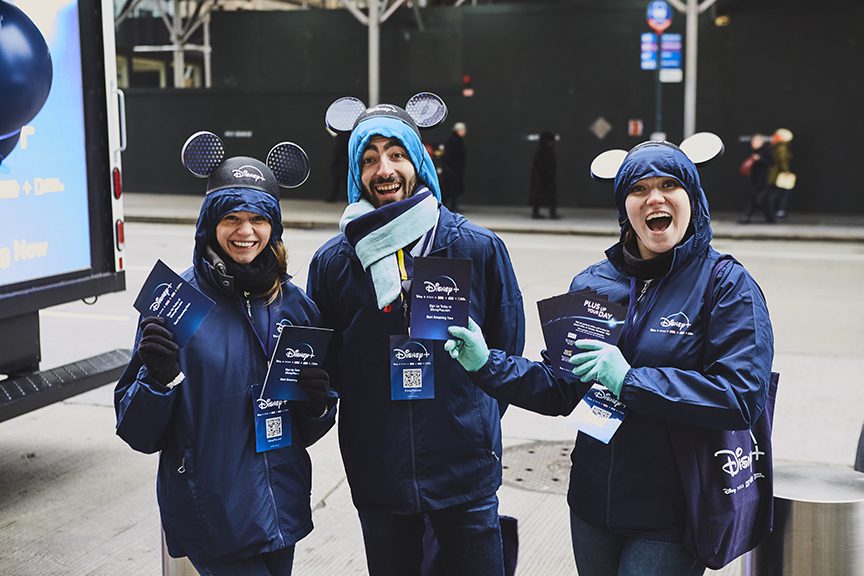
The show floor is a competition. Hundreds of booths, all spending money to draw the same crowd of attendees through banner walls, demo stations, branded giveaways, and standing presentations. The brands that win on the floor have usually already won before the hall doors open.
Convention street teams are the tool that creates that pre-show advantage. At American Guerrilla Marketing, our team deploys brand ambassadors into the public zones that surround every major convention , the hotel lobbies, the coffee queues, the shuttle stops, the pedestrian approach routes , and builds brand recognition in the thirty minutes before an attendee ever steps through the venue entrance.
By the time your audience reaches your booth, they have already heard your name, held your product, and been given a reason to find you. That is the difference street teams make.
What Makes Convention Audiences Different
Street team marketing at conventions operates differently than street-level campaigns in retail corridors or entertainment districts. Convention attendees are professionals with scheduled days and defined goals. They are there to source vendors, discover products, attend sessions, and make connections. They are not passive consumers browsing for entertainment.
This means convention street teams need a sharper approach. The opening interaction needs to be brief, relevant, and respectful of the attendee’s time. The message needs to be clear and specific, not a general brand story. The handoff needs to leave the attendee with something useful and a single clear next step.
Our brand ambassador training for convention deployments specifically addresses the professional context. We brief teams on your industry, your target persona, the specific conference and who attends it, and the tone that works for that audience. A team deployed at a healthcare convention sounds different from a team at a gaming expo or a financial services show, and they should.
Mapping the Convention Footprint for Street Team Deployment
Before any convention street team campaign, our team builds a full footprint map. We identify every point where attendees concentrate in public space during the event: hotel lobby departure windows, shuttle stop queues, coffee queues on primary pedestrian routes, restaurant district lunch clusters, parking garage exits, evening networking event entrances.
This map drives the deployment schedule. We assign team members to the highest-traffic zones during the peak activity windows for each zone. Morning hotel coverage runs from the first departure rush until the venue opens. Entrance coverage peaks in the forty-five minutes before sessions. Lunch coverage operates in the midday window. Evening coverage targets networking events and hotel bar gathering points.
The result is a full-day presence across the entire event footprint, not just a stationary presence at one spot on one side of the building.
The Street Team Handoff: What Works and What Wastes Money
The street team handoff is the single most important variable in a convention street team campaign. Everything else creates the opportunity. The handoff determines whether that opportunity converts into awareness, booth traffic, or a lead.
The best convention handoffs are fast and high value. A branded tote bag with a single-message insert and a QR code. A product sample in branded packaging with a booth number. A premium branded item that the attendee actually wants to keep. These travel into the venue, extend the brand impression, and create a conversation trigger when colleagues ask “where did you get that?”
The worst convention handoffs are thick packets of brochures, business cards with no context, and generic branded pens with no message. These get left on the nearest flat surface within sixty seconds. We push clients hard toward quality over volume at the handoff moment.
The verbal component matters just as much as the physical handoff. Our teams are trained to deliver a ten-second brand message with one specific action: “We’re at booth 412 and we have a demo running every thirty minutes , worth two minutes of your time.” That specificity is what makes the difference between a brush-off and a commitment.
Layering Street Teams With Outdoor Advertising
Street teams work better when the attendee has already seen your brand before the team approaches them. The brands that get the warmest team receptions are the ones whose names the attendee has already registered from other channels , an LED billboard truck they passed this morning, a wheatpasted poster on the block behind the hotel, a sidewalk stencil at the convention entrance.
This is why we consistently recommend multi-tactic campaigns rather than street teams in isolation. When someone gets approached by a brand ambassador and already has “oh, I saw your poster” running in the back of their mind, the engagement quality changes entirely. They are receiving third-party validation of the brand, not meeting it cold.
We build these multi-layer campaigns with coordinated creative, so the visual language across LED trucks, wheatpasted posters, sidewalk stencils, and brand ambassador materials all reinforces the same message and look.
Street Teams for Non-Exhibiting Brands
One of the most effective uses of convention street teams is for brands that have no official exhibition presence at the show. Major conventions charge tens of thousands of dollars for exhibitor booth space. Sponsorship packages at premium conferences can run into six figures. These price points put official presence out of reach for many brands.
Street teams in public zones around the convention circumvent this entirely. A well-deployed street team outside the entrance of a major show can make contact with as many attendees as a mid-tier booth at a fraction of the cost. There is no booth to design, no shipping logistics, no setup crew, no show services bill.
The tradeoff is that street teams in public zones cannot intercept every attendee, cannot guarantee attendees will seek them out, and cannot provide the in-person product demonstration that a booth enables. For brands that need a physical product demonstration, street teams outside the venue should drive traffic to an off-site activation nearby , a hotel suite experience, a nearby retail location, or a branded vehicle parked in the area.
We have run campaigns for brands that turned a convention appearance with no booth into a significant lead generation event through smart street team deployment and a compelling off-site experience that gave attendees a reason to leave the convention floor for twenty minutes.
Convention Street Teams for B2B Technology and SaaS Brands
B2B technology and SaaS brands face a particular challenge at conventions: they have no physical product to hand over. Software cannot be sampled in a hallway. Services cannot be experienced in a thirty-second interaction.
Our approach for B2B tech clients shifts the handoff objective from product trial to conversation booking. Street team ambassadors at tech conferences carry a simple offer: “We’re demoing our platform at booth X. It takes twelve minutes and we have a gift for anyone who comes through. Worth your time?” The offer trades specificity of time commitment and a reward for the attendee’s booth visit commitment.
We also help B2B tech clients deploy branded food and beverage items as the physical handoff vehicle. A branded coffee cup sleeve on the coffee cart two blocks from the entrance. A branded snack bag at the shuttle stop. A premium branded tote that becomes the attendee’s carry bag for the day. These create physical brand presence when the product itself cannot.
Multi-Day Street Team Management
Multi-day conventions require multi-day team management. Staffing the same team for three or four consecutive days creates fatigue, which directly affects energy, enthusiasm, and conversation quality. We plan staffing rotations that keep teams fresh and maintain consistent performance across every day of a multi-day event.
We also adjust deployment strategy day by day based on what we observe in the field. If a particular hotel lobby has unexpectedly high traffic on day one, we weight coverage there on day two. If a shuttle route turns out to be underutilized, we reallocate those resources to a higher-traffic zone. Campaign managers on the ground make these real-time calls and report adjustments back for client visibility.
How We Build Convention Campaigns That Actually Work
Our team at American Guerrilla Marketing has executed convention marketing programs at major trade shows across the country. We have deployed teams at shows in Las Vegas, New York, Chicago, Orlando, Atlanta, and every other major convention market. That field experience informs how we plan every new campaign: we know what works in the Javits Center neighborhood, how to navigate the hotel district around the Las Vegas Convention Center, and where to position teams for maximum impact at McCormick Place.
Every program we run is documented from start to finish. Before the show opens, we confirm every outdoor placement with geo-tagged photos. During the show, field supervisors submit timestamped shift logs that include deployment position, team size, and conversation or sample counts for each shift. After the show closes, we compile the full campaign documentation into a post-show report that gives clients proof of what was executed and the data they need to evaluate the program.
The documentation also creates the performance record that informs optimization of the next campaign. Which deployment locations generated the most qualified conversations? Which outdoor placements received the most engagement? Which shift timing produced the highest-quality audience encounters? These questions get answered over multiple campaigns, and the answers compound into a progressively more effective convention marketing program year over year.
Planning Your Convention Campaign Timeline
Convention marketing campaigns work best when they are planned against the full timeline: 8 to 12 weeks before the show for the most complex programs, 4 to 6 weeks for ambassador-only or outdoor-only programs. The earlier the planning begins, the more options are available for every element of the campaign.
The pre-show window (6 to 8 weeks out) is when pre-show meeting outreach campaigns should launch. Personalized outreach to registered attendees using the specific conference or show context achieves significantly higher response rates than generic outreach because the timing is immediately relevant to the recipient’s known upcoming plans. We build pre-show outreach sequences for clients as part of convention marketing engagements, segmenting by target buyer persona and show registration data where available.
Production of printed materials for wheatpaste campaigns and stencil programs requires 3 to 4 weeks from design approval to installation. LED truck route planning and driver coordination requires 1 to 2 weeks. Ambassador team recruitment and briefing requires 3 to 4 weeks for shows with specific professional audience requirements. Running all of these in parallel against the show date requires a planning timeline that starts at least 6 weeks before the first deployment day.
We provide campaign timeline planning as part of the proposal process: every proposal includes a production and deployment timeline that shows exactly what happens when, what deliverables are required from the client, and what our team is responsible for executing at each stage. This timeline planning prevents the last-minute scrambles that degrade campaign quality and limit creative options.
What do convention street teams do?
Convention street teams are trained brand representatives deployed in and around a convention venue to intercept attendees in public-facing spaces. They hand out branded materials, deliver product samples, direct people to a booth, engage in brief brand conversations, and create positive first exposures that carry into the show floor experience.
How are convention street teams different from booth staff?
Booth staff are reactive , they engage with attendees who come to them. Convention street teams are proactive , they go to where attendees are, in public spaces outside and around the venue, before the attendee decides whether to visit the booth. Street teams build awareness and intent that drives booth traffic.
What size team do you recommend for a major convention?
For a convention with ten thousand or more attendees, we typically recommend a core team of six to ten people deployed across two to three activation zones simultaneously. Smaller conventions with one thousand to five thousand attendees can be effectively covered with a team of four to six.
How do you train convention street teams for professional audiences?
Our convention street teams go through a brand briefing that covers your company, your key message, your target persona, common questions and objections, and the specific action you want attendees to take. Teams for professional conventions receive additional training on reading body language, professional introductions, and knowing when to engage compared to step aside.
Can street teams work for non-exhibiting companies?
Yes. Some of our most effective convention campaigns are for brands that have no booth presence at all. Street teams working the public zones outside a convention center can reach the full attendee population without requiring any official exhibitor status.
What should convention street teams hand out?
The most effective handouts are items that get carried into the venue , branded tote bags, useful accessories, snacks or beverages, or premium branded items with clear messaging. We advise against thick brochures that get tossed, and toward single-page inserts with a QR code and one clear call to action.
Do convention street teams need site approvals?
site-approval planning requirements vary by city and venue. Some municipalities require site approvals for commercial solicitation on public sidewalks. Our team researches and secures all required site approvals before every deployment. We design campaigns around aligned with site rules zones and never operate in restricted areas.
Frequently Asked Questions
What do convention street teams do?
Convention street teams are trained brand representatives deployed in and around a convention venue to intercept attendees in public-facing spaces. They hand out branded materials, deliver product samples, direct people to a booth, engage in brief brand conversations, and create positive first exposures that carry into the show floor experience.
How are convention street teams different from booth staff?
Booth staff are reactive , they engage with attendees who come to them. Convention street teams are proactive , they go to where attendees are, in public spaces outside and around the venue, before the attendee decides whether to visit the booth. Street teams build awareness and intent that drives booth traffic.
What size team do you recommend for a major convention?
For a convention with ten thousand or more attendees, we typically recommend a core team of six to ten people deployed across two to three activation zones simultaneously. Smaller conventions with one thousand to five thousand attendees can be effectively covered with a team of four to six.
How do you train convention street teams for professional audiences?
Our convention street teams go through a brand briefing that covers your company, your key message, your target persona, common questions and objections, and the specific action you want attendees to take. Teams for professional conventions receive additional training on reading body language, professional introductions, and knowing when to engage compared to step aside.
Can street teams work for non-exhibiting companies?
Yes. Some of our most effective convention campaigns are for brands that have no booth presence at all. Street teams working the public zones outside a convention center can reach the full attendee population without requiring any official exhibitor status.
What should convention street teams hand out?
The most effective handouts are items that get carried into the venue , branded tote bags, useful accessories, snacks or beverages, or premium branded items with clear messaging. We advise against thick brochures that get tossed, and toward single-page inserts with a QR code and one clear call to action.
Do convention street teams need site approvals?
site-approval planning requirements vary by city and venue. Some municipalities require site approvals for commercial solicitation on public sidewalks. Our team researches and secures all required site approvals before every deployment. We design campaigns around aligned with site rules zones and never operate in restricted areas.
How early should a brand start planning?
For most campaigns, the smart move is to start planning at least two to four weeks before the launch window so production, routing, staffing, and reporting are all lined up.
What makes one market perform better than another?
Market fit depends on audience density, neighborhood behavior, route efficiency, and whether the creative belongs in that setting. The busiest city is not always the best city.
Can AGM bundle this with other services?
Yes. AGM often combines this work with supporting formats so the campaign has stronger repetition and cleaner reporting across the whole run.
How does AGM quote pages like this?
We quote from official rate cards where they apply, then scope the remaining production, staffing, and routing details to the actual job.