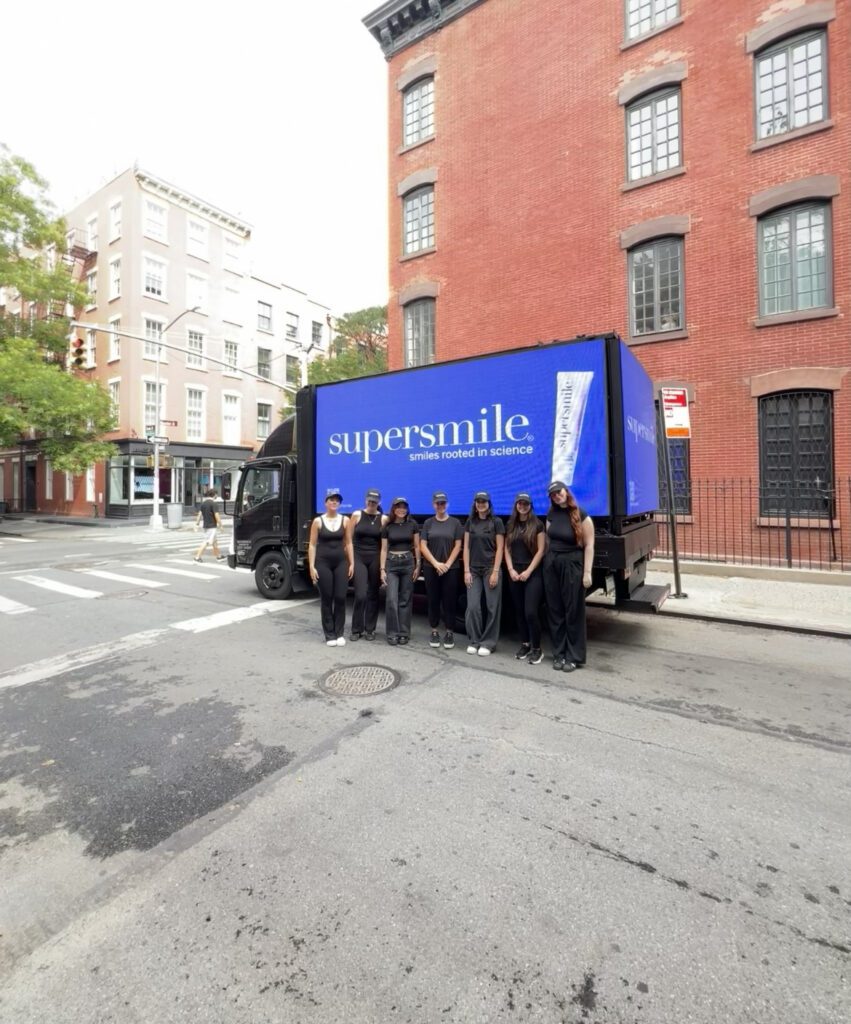
3 Side Truck Billboards: How Three-Sided Mobile Displays Work in 2026
When a single-sided truck is not enough, a 3-side billboard truck wraps your message around the entire vehicle. Pedestrians, cross traffic, and trailing drivers all see it at the same time.
Most outdoor advertising shows your message in one direction. A 3-side truck billboard breaks that limitation by putting your creative on the driver side, the passenger side, and the rear of the same vehicle. Every intersection becomes a three-way hit. Every stoplight gives three separate audiences a clear look at your ad. That is the core logic of 3-side truck advertising, and it is why brands turn to this format when they want density in a tight geography.
AGM has run 3-side truck campaigns in New York, Los Angeles, Chicago, Boston, Miami, and a dozen other markets. The format works differently depending on the city, the route design, and the time of day. This guide breaks down how 3-side trucks are structured, how routes are planned, what to expect from the execution, and what separates a well-run campaign from a wasted one.
A 3-side truck billboard is a vehicle — typically a box truck or a purpose-built advertising truck — with display panels covering three faces: both long sides and the rear panel. The front of the cab is not typically used for advertising because it faces away from traffic in most scenarios. The three panels that matter are:
Driver side (left): Faces oncoming traffic, pedestrians on the left sidewalk, and vehicles passing in the opposite lane.
Passenger side (right): Faces sidewalk pedestrians on the right, parked-lane traffic, and vehicles alongside the truck in the same direction.
Rear panel: Faces trailing traffic directly behind the truck — often the most sustained view because drivers follow trucks through lights and traffic.
The combination of these three faces means that at any given intersection, the truck’s advertising is visible to pedestrians crossing from both directions, vehicles stopped at the light in multiple lanes, and anyone sitting at a sidewalk cafe or looking out a window. In dense urban environments, this is a significant coverage advantage over single-sided options.
Static vs. LED Panels
Three-side trucks come in two panel types: static printed vinyl and LED digital. The choice matters operationally and creatively.
Static 3-side trucks use printed vinyl stretched over rigid frames. The creative is one fixed image per panel. Printing typically takes 2-4 business days, so the campaign needs to be planned in advance. Static panels are visually bold in daylight and readable in most weather conditions. They are generally less expensive per day than LED alternatives.
LED 3-side trucks use programmable digital panels on all three faces. The truck can rotate through multiple creative executions, run time-sensitive messaging, and display motion graphics or video. LED panels are particularly effective at night when static prints fade in low light. A full LED 3-side truck with high-resolution panels on all three faces requires more lead time to program but gives the campaign more flexibility once it is running.
AGM uses GPS tracking on all truck campaigns. At the end of a run, clients receive photo documentation, route maps, and a summary report showing where the truck traveled throughout the day. No guessing about coverage.
Panel Dimensions and Print Specs
Panel sizes are determined by the truck chassis. The most common 3-side truck in the AGM fleet is based on a standard box truck body. Dimensions vary slightly by provider and vehicle age, but these are typical working dimensions:
Panel
Typical Width
Typical Height
Notes
Driver side
20 ft
8 ft
Primary creative panel
Passenger side
20 ft
8 ft
Mirror or alternate creative
Rear panel
8 ft
8 ft
Trailing traffic view
Some campaigns run the same creative across all three panels. Others use the sides for a brand image and the rear for a direct call to action, like a phone number or URL. The rear panel is especially valuable for this because people following in traffic have time to read and act on a short message while stopped.
Print Requirements
For static campaigns, files need to be delivered print-ready. Typical specs:
File format: PDF, AI (outlined), or PSD (flattened)
Resolution: 150 DPI at full size (or 300 DPI at 50% scale)
Color mode: CMYK for outdoor print
Bleed: 0.5 inch on all sides beyond the trim edge
Key content should be kept at least 3 inches from the trim edge
For LED panels, the truck operator provides a pixel resolution spec for each panel. Creative is uploaded as MP4 video or a static image at the panel’s native resolution. AGM coordinates directly with the truck operator to confirm specs before any creative is produced.
Route Planning: How AGM Designs a 3-Side Truck Route
The truck itself is only one piece. What the truck does determines the campaign’s actual reach. Route planning is where the strategic work happens.
Target Area Definition
Before planning a route, AGM works with the client to define the target area. This is typically done by answering a few specific questions:
Which neighborhoods or zip codes contain the target audience?
Are there specific events, venues, or foot traffic generators the route should hit?
Are there competitor locations the route should cover?
What are the operating hours of the day — morning commute, lunch, afternoon, evening, night?
The answers shape a route that maximizes time in the right areas. A campaign targeting young professionals in Manhattan’s Flatiron district runs differently than one targeting families in Midtown on a weekend. Getting the geography right is more important than adding more truck hours.
Traffic Pattern Analysis
AGM uses street-level knowledge of each market to build efficient routes. In New York, this means knowing which crosstown streets move in the morning versus the afternoon, which avenues have the most pedestrian exposure on lunch hours, and which blocks near major transit hubs are viable for slow-moving or parked exposure.
In other markets, the calculus shifts. In Los Angeles, freeway-adjacent surface streets carry commuter traffic in specific windows. In Chicago, routes on Michigan Avenue and through River North hit a different demographic mix than routes through Wicker Park. AGM builds routes with this specificity because a generic “drive around downtown” approach wastes most of the day in low-yield areas.
On most 3-side truck campaigns, AGM targets a mix of moving and stationed time. Moving through an area builds wide coverage. Stationing near a venue entrance, event, or high-foot-traffic corner builds depth. A campaign that only moves never creates the sustained exposure that gets people to act.
Stationed vs. Moving Time
A parked 3-side truck at the right location is not dead time — it is concentrated exposure. A truck parked near a festival entrance or on a busy corner during a lunch rush can deliver more sustained exposure in one hour than two hours of driving through sparse blocks. AGM designs routes with planned stationed stops built in, not just a continuous loop.
Stationed time requires legal parking. In cities like New York, this typically means a paid parking spot, a loading zone during allowed hours, or coordination with an event organizer for on-site placement. AGM handles this logistics layer so the campaign does not get interrupted by ticketing or towing mid-day.
Markets Where 3-Side Trucks Work Best
Three-side truck advertising is a fundamentally urban format. It requires traffic density — both vehicular and pedestrian — to generate exposure. Markets where this format performs consistently well include:
New York City
The grid layout of Manhattan makes 3-side trucks especially effective. Perpendicular streets mean the truck’s side panels hit cross-traffic constantly. Midtown, the Financial District, SoHo, the Meatpacking District, and areas around major transit hubs like Penn Station and Grand Central are all high-value zones. Brooklyn’s Atlantic Avenue corridor and Williamsburg’s Bedford Avenue are strong options for specific demographics.
Los Angeles
LA requires a different strategy. The city spreads across a large geography, and driving routes are longer. High-value areas for 3-side trucks include West Hollywood’s Sunset Strip, the Beverly Hills retail corridor, Abbot Kinney in Venice, the Arts District in DTLA, and the Melrose Avenue strip. Evening routes capture the dense sidewalk traffic that LA generates in those areas from 5 PM onward.
Chicago
Chicago’s downtown loop is compact enough that a full-day truck route can saturate the area. The Michigan Avenue corridor, River North, Wicker Park, and the North Shore neighborhoods all work well for specific campaign targets. The lakefront parks create natural stationed opportunities during warm-weather events.
Miami
South Beach and Brickell are the two dominant zones for truck advertising in Miami. South Beach delivers dense pedestrian traffic along Ocean Drive and Collins Avenue, particularly on evenings and weekends. Brickell reaches a professional and financial-services audience during business hours.
3-Side Trucks for Events and Launches
Some of the most effective 3-side truck campaigns AGM has executed were tied to specific events or product launches. The format is well suited for this use case because it can be deployed quickly, can position near a venue, and can rotate through multiple creative messages if LED panels are used.
A 3-side truck positioned near a festival entrance for 4-6 hours creates sustained exposure to exactly the audience entering and exiting the event. This works for brands targeting the festival demographic, for artists promoting upcoming shows, and for local businesses trying to capture foot traffic that is already in the area.
Product Launches
For a product launch in a specific city, a 3-side truck covers the announcement geography in a single day. The truck can be deployed the day before a launch event, on launch day itself, or in the week following to extend awareness. LED panels allow the message to evolve in real time — a countdown creative on day one, a product feature creative on day two, a buy-now message on day three.
Sports and Arena Events
Major sports venues generate concentrated foot traffic before and after games. Routing a 3-side truck around the arena blocks during pre-game arrival and post-game departure hits a predictable, captive audience. AGM has executed campaigns around NBA, NFL, and MLB events using this approach in multiple cities.
Event campaigns require earlier booking. Parking near a major venue on game day is not something that can be arranged the day before. AGM builds the parking and access plan into every event-adjacent campaign before confirming dates.
What Can Go Wrong — and How to Prevent It
Three-side truck campaigns are field operations, and field operations have variables. Understanding the common failure points helps avoid them.
Mechanical Breakdowns
Trucks break down. A campaign that relies on a single vehicle with no backup plan is one mechanical issue away from a wasted day. AGM maintains relationships with multiple truck operators in each active market so that backup vehicles are available on short notice. When a truck issue occurs, rescheduling or substitution happens the same day when possible.
Print Delays
Static 3-side campaigns need printed vinyl panels. If the file arrives late, if there are print quality issues, or if the installer is unavailable, the campaign start date slips. AGM sets print deadlines based on the campaign start date with a buffer built in — typically artwork due 5 business days before the run date, with printing confirmed 2 business days in advance.
Route Execution Drift
Without GPS tracking, there is no way to verify that the driver actually ran the planned route rather than a more convenient one. AGM uses real-time GPS on all truck campaigns. If a driver deviates significantly from the planned route, the ops team is alerted and can intervene during the day rather than discovering the issue after the fact.
Weather
Heavy rain and high wind affect vinyl panels and can make truck driving conditions unsafe. Most weather delays result in rescheduling to the next viable day. LED campaigns are slightly more resilient to weather because the panels are sealed, but extreme wind or ice still grounds trucks. Campaign agreements should specify how weather delays are handled before the campaign starts.
Measuring Campaign Results
Three-side truck advertising is a field format. Results are documented through photo and video, not through click rates or digital analytics. At the end of every AGM truck campaign, clients receive:
Timestamped photos from the driver showing the truck in location throughout the day
GPS route maps showing the actual path traveled
A summary report with total hours of operation, stationed locations, and any notable observations
This documentation serves two purposes: it confirms the campaign ran as planned, and it gives the brand a record of the creative appearing in specific neighborhoods and locations. For campaigns tied to events, having photo documentation of the truck near the venue adds credibility to post-campaign reporting.
The 3-side truck occupies the middle of the mobile advertising spectrum: larger than a wrapped car, more coverage than a single LED panel, and more visually dominant than a walking board. For campaigns that need to cover a neighborhood or saturate a district in a concentrated day, it is often the most efficient format.
Creative Considerations for 3-Side Trucks
Truck advertising creative is seen at a distance, often by people in moving vehicles. The rules for what works are different from what works on a website or social ad.
Legibility at Distance
Text on a truck panel is read from 20-100 feet away by people who have 2-5 seconds to process it. Anything more than 7-9 words of headline copy will not be read in full. Serif fonts and thin letterforms disappear at distance. Bold, high-contrast sans-serif type works. White text on a dark background or black text on a bright background are the most reliable choices.
One Central Message Per Panel
The most common mistake in truck creative is trying to say too much. A brand name, one benefit statement, and a clear call to action is the maximum for a panel that will be seen for a few seconds. Anything beyond that goes unread. The rear panel, which gets the longest sustained view from trailing traffic, can carry slightly more information — but still needs to be readable at 30 feet.
Brand Recognition First
Truck panels work best as brand exposure tools. The goal is recognition and association, not conversion. A viewer seeing the panel is not going to stop their car, pull up a phone, and act in the moment. They are going to notice the brand, maybe remember a tagline, and potentially act later. Designing with this in mind means prioritizing brand identity (logo, color, visual system) over promotional detail.
How AGM Books and Executes 3-Side Truck Campaigns
The typical AGM 3-side truck campaign follows a defined process from initial inquiry to post-campaign reporting:
Brief and market selection: Client provides the target market, target dates, and campaign objective. AGM confirms truck availability and route feasibility.
Route design: AGM builds a route based on the target geography, desired stationed locations, and daily operating hours. The route is reviewed with the client before finalizing.
Creative production: Client provides artwork or AGM produces creative. Static campaigns require print production; LED campaigns require file upload to the truck operator.
Installation: For static campaigns, vinyl panels are printed and installed on the truck. LED campaigns require programming and a test run of the creative on the panel.
Campaign execution: The truck runs the agreed route with GPS tracking active. AGM’s ops team monitors execution in real time.
Reporting: Photos, GPS maps, and a summary report are delivered to the client within 48 hours of campaign completion.
Lead time for static 3-side truck campaigns is typically 7-10 business days from confirmed booking. LED campaigns can move faster if creative is already available. Rush bookings are possible in some markets with reduced lead time, though availability is not guaranteed on short notice.
Common Questions About 3-Side Truck Campaigns
Before signing off on a campaign, most clients have a set of practical questions. The answers below reflect how AGM actually handles these situations:
Can the truck run in multiple cities on the same campaign?
Yes, but not with the same truck. Multi-market campaigns require contracting trucks in each city. AGM coordinates operators in each market, which means creative needs to be print-ready or uploaded to the truck in each city. Multi-market campaigns are common for national brand launches. The logistics require more planning but the structure is straightforward.
What happens if the truck is not available on the planned date?
AGM confirms truck availability before accepting a booking. If an operator issue arises after booking, AGM identifies a backup operator in the same market. In cases where no substitute is available in time, the campaign is rescheduled to the next viable date at no additional cost to the client.
Can the campaign run at night?
LED 3-side trucks are well-suited for nighttime runs because the panels are illuminated. Static vinyl panels rely on ambient light and are less effective after dark unless the truck is in a well-lit area. If nighttime coverage is a priority, an LED truck is the right choice.
How many trucks should a campaign use?
This depends on the geography and the timeline. A single truck running a focused route in one neighborhood for a full day can deliver strong coverage of that area. Two trucks in the same area double the density. For large cities where the target geography spans multiple distinct neighborhoods, running 2-3 trucks on coordinated but separate routes is often more effective than trying to cover everything with one vehicle.
3-Side Trucks as Brand Presence in Competitive Markets
In markets where every block already carries significant outdoor advertising — fixed billboards, transit posters, digital OOH screens — a 3-side truck creates a different kind of advertising presence. It is not stationary. It does not share space with other advertisers on the same structure. It is a moving object that announces itself as its own medium, carrying one brand’s message from three directions simultaneously through the areas where your audience is concentrated.
For brands competing in category-dense markets, this singularity has value. A fashion brand that runs a 3-side truck through SoHo is the only fashion brand on that truck. It does not share the medium with competitive advertising. The full visual impact of the truck — all three faces, 160+ square feet of creative surface — is exclusively devoted to one brand’s message. In advertising environments where clutter is a constant challenge, the 3-side truck offers a form of uncontested dominance on the medium that most formats cannot provide.
Combining 3-Side Trucks with Other Mobile Formats
The most effective campaigns often combine the 3-side truck’s street-level dominance with complementary formats that cover access points the truck cannot reach. Understanding how the 3-side truck fits into a larger campaign structure helps in maximizing total campaign impact.
3-Side Truck + Walking Billboard
While the 3-side truck covers the street network and vehicle traffic environment, walking billboard carriers cover the pedestrian zones — festival grounds, transit concourses, venue interiors — where the truck cannot go. The visual elements of both formats can share the same creative system, creating a coordinated visual language that a viewer encounters in multiple contexts throughout the day or event.
A truck campaign creates a moving announcement. Poster campaigns in the same neighborhoods create a sustained presence after the truck has moved on. Running a 3-side truck in a neighborhood for three days while simultaneously running street-level posters in the same area for two weeks creates both the truck’s bold initial announcement and the posters’ ongoing ambient presence. The truck drives the awareness; the posters sustain it.
3-Side Truck + Social Media
Photo documentation from a 3-side truck campaign is natural social media content. Images of a well-branded truck on an iconic street, or near a recognizable landmark, perform well as organic brand content. Planning the social strategy alongside the truck route — identifying which locations will produce the most compelling social photos and briefing the driver or photographer on capturing them — extends the campaign’s content value beyond the field hours.
AGM often coordinates social media content creation as part of 3-side truck campaigns for clients who want to use the field documentation as organic social content. Identifying the 3-5 photo locations that will produce the most shareable images is a simple planning step that significantly increases the campaign’s total content output.
The Economics of 3-Side Truck Advertising
Understanding the economic structure of 3-side truck advertising helps in evaluating quotes accurately and identifying where spending decisions have the most impact on results.
The key cost drivers in a 3-side truck campaign are:
Market: New York and Los Angeles day rates for 3-side trucks are higher than in Chicago, which is higher than in mid-size markets like Nashville or Denver. Market selection is the largest single cost lever.
Panel type: LED panels cost more than static vinyl per day. The premium is real (typically 50-100% higher per day) and is justified for nighttime campaigns or multi-creative needs.
Campaign duration: Per-day costs are relatively consistent across campaign lengths. Running two days costs roughly twice as much as running one day. Discounts for longer campaigns exist but are modest (typically 10-15% for 5+ day campaigns).
Print production: Static vinyl campaigns require print production that is a one-time cost per campaign. If the same creative runs on multiple campaign days or in the same market within a short period, the print production cost can be shared across multiple days.
Route complexity: A campaign with multiple stationed stops, event adjacency logistics, and cross-borough routing requires more planning work than a standard city-loop route. The planning cost is typically reflected in the agency management fee rather than the truck day rate.
Frequently Asked Questions
Can the truck run in multiple cities on the same campaign?
Yes, but not with the same truck. Multi-market campaigns require contracting trucks in each city. AGM coordinates operators in each market, which means creative needs to be print-ready or uploaded to the truck in each city. Multi-market campaigns are common for national brand launches. The logistics require more planning but the structure is straightforward.
What happens if the truck is not available on the planned date?
AGM confirms truck availability before accepting a booking. If an operator issue arises after booking, AGM identifies a backup operator in the same market. In cases where no substitute is available in time, the campaign is rescheduled to the next viable date at no additional cost to the client.
Can the campaign run at night?
LED 3-side trucks are well-suited for nighttime runs because the panels are illuminated. Static vinyl panels rely on ambient light and are less effective after dark unless the truck is in a well-lit area. If nighttime coverage is a priority, an LED truck is the right choice.
How many trucks should a campaign use?
This depends on the geography and the timeline. A single truck running a focused route in one neighborhood for a full day can deliver strong coverage of that area. Two trucks in the same area double the density. For large cities where the target geography spans multiple distinct neighborhoods, running 2-3 trucks on coordinated but separate routes is often more effective than trying to cover everything with one vehicle.