
November 19, 2026
Out of Home Marketing: How It Actually Works
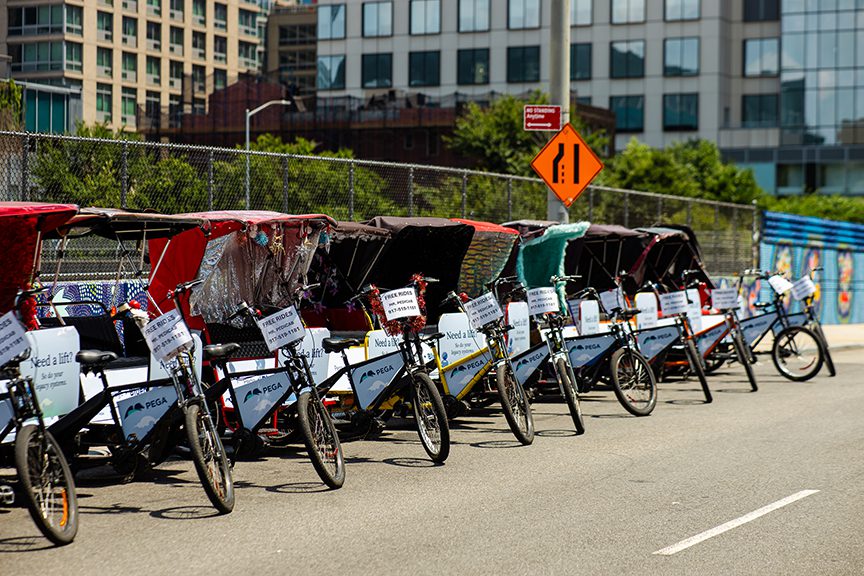
Out of home marketing is defined by a negative. It is all the advertising that reaches someone when they are not at a desk and not holding a screen they chose to look at. That definition covers a bulletin over a freeway, a poster on a construction hoarding, a decal under someone's feet, a screen in a lift lobby and a truck parked outside a stadium. Grouping those together is useful for a budget line and almost useless for a plan.
The question that actually matters is not which out of home ads to buy. It is what your audience is doing physically at the moment you reach them.
Somebody driving at speed has about two seconds and one hand on a wheel. Somebody waiting for a train has four minutes and nothing to do. Somebody walking a retail street is scanning at eye level and moving at their own pace. Somebody standing in a queue outside a venue is bored, close, and can act on their phone right now.
Those are four completely different advertising problems. The formats that work for one are wasted on another. I have watched more campaigns fail from that mismatch than from any other cause, including bad creative.
I work the street-level side of out of home advertising media. That is posters, snipes, decals, projection, vehicles and people. I also plan around the fixed inventory constantly, because most good campaigns use both. What follows is how I think about the category when somebody puts a brief in front of me.
Sort your formats by audience state, not by format family
Industry lists organise out of home by what the thing is. Billboards, transit, street furniture, place-based, digital. That ordering helps vendors sell and does not help you plan.
Sort by what the person is doing instead.
**Moving fast, in a vehicle.** Highway bulletins, large roadside structures, and mobile screens on routes. The audience is captive but distracted and distant. You get a logo, a very short phrase and maybe a location. Nothing else survives.
**Moving slowly, on foot.** Posters, snipes, hoarding, street furniture, wallscapes on pedestrian streets. Eye level, close, repeatable. This is where you can put an actual idea rather than just a name, and where repetition across a corridor compounds hardest.
**Waiting.** Transit platforms, shelters, lift lobbies, terminals, queue lines. Long dwell, short distance, high attention. This is the only out of home environment where longer copy, a QR code or a detailed offer genuinely works, because the person has time and nothing competing for it.
**Standing at a decision point.** Sidewalk decals outside an entrance, posters on the approach to a venue, a street team at a door. The audience is within metres of acting. The job here is not awareness, it is conversion.
**Gathered for something else.** Events, festivals, games, campuses on a big weekend. Dense, emotionally engaged, and usually competitive, because everyone else wants the same crowd.
Write your objective, pick the state that matches it, then choose formats. Doing it the other way around, starting with a format you liked, is how plans end up incoherent.
What each format actually gives you, honestly
**Fixed large-format structures.** Scale and credibility. Weeks of repeated exposure to the same commuters. Guaranteed, documented placement at a known location. Slow to book, inflexible on dates, and only useful where the structures happen to exist.
**Digital screens.** Speed, day-parting, creative flexibility, and rapid changes. You share a rotation, so your creative is on screen for a share of each loop. Excellent for time-sensitive messaging and for anything that benefits from changing by hour or by weather.
**Transit.** Long dwell and a genuinely captive audience. Inventory is contract-controlled and sells in defined packages, and production specs are exacting.
**Posters and snipes.** Density in walking corridors, fast to deploy, geographically precise to the block. Survivability varies with surface and weather, placement sits in a grey area that depends on ordinance and permission, and documentation is the only real proof. Nothing else gets you saturation inside a specific neighbourhood this quickly.
**Sidewalk decals and stencils.** Proximity conversion. Only works where people are already standing or walking slowly. Underrated and under-bought, because planners think in terms of things at eye level and forget people look down constantly on a crowded sidewalk.
**Projection.** Scale plus motion with nothing left on the surface. Short-duration, weather-exposed, dependent on finding a clean light-coloured wall with an unobstructed throw. Outstanding as an accent and weak as a campaign backbone.
**Mobile screens on vehicles.** Location on demand. A vehicle covers routes with no structures, shows up at specific moments and leaves. You trade duration for control. Hours rather than weeks.
**Street Teams.** The only two-way format. Highest depth, lowest reach, highest operational load.
How a real out of home plan comes together
Here is the sequence I use, in order, because the order prevents most mistakes.
**Define the geography precisely.** Not the city. The corridors, neighbourhoods, venues, campuses and routes. If you cannot name them, the first job is to find out where your audience physically is. A plan built on a metro area is a plan built on nothing.
**Establish the window and whether it moves.** A fixed, close date eliminates most static inventory immediately. A flexible date opens it up. This single fact changes the shape of everything.
**Pick the dominant audience state.** From the four above. Most campaigns have one primary and one secondary.
**Build the broad layer.** Whatever reaches the most of your audience over the longest period. Usually fixed inventory or a vehicle route depending on the market.
**Build the dense layer.** Street-level media saturating the specific corridors, so the people who matter most see it repeatedly within their own neighbourhood.
**Build the conversion layer.** Media at the point of action. Decals at the door, posters on the approach, a team at the entrance.
**Decide the documentation standard before you start.** What you will receive as proof, when, and in what format. Agreeing this afterwards never goes well.
**Produce creative per format, not once.** This is the step most often skipped and most costly. A single asset resized does not work across a bulletin, a poster and a decal. Each needs its own crop, type weight and amount of copy.
Crews, nights and what the production side looks like
The part of out of home that buyers rarely see is the physical labour, and it governs the schedule more than anything else.
Street-level installation happens overnight, roughly between eleven at night and five in the morning. The reasons are practical. Sidewalks are empty, parking exists, delivery vehicles are not blocking the surfaces, and a crew can work an entire block without stepping around pedestrians.
A poster team is two people. One applies, one spots, carries and documents. They work a planned route of clustered surfaces, because driving between scattered placements destroys the hourly rate. Routing is the actual skill. Pasting can be taught in a night. Knowing which forty surfaces in a given neighbourhood are viable this month takes local knowledge built over time.
Application is a paste coat on the surface, the poster laid from the top down with air swept out, then a coat over the face. The over-coat is what makes it hold. Skip it and the corners lift within days.
Clean plywood hoarding is the best surface in the business. Porous, flat, eye level and with a known lifespan from the construction schedule. Painted smooth concrete is good. Brick is worse than people expect, because the mortar lines create voids the paper bridges rather than sticks to. Dusty surfaces, anti-graffiti coatings and heavy existing buildup all fail.
Every placement is photographed before the crew moves on. The photo log is the deliverable.
Decal application needs a clean, dry, warm-enough surface, which often means pressure washing a patch first and waiting. That adds real time per placement and surprises people who assumed a sticker goes down in a second.
Projection needs dark, a wall, a legal place to put the rig and a power source, plus someone watching it the whole time.
Vehicle formats need routing against traffic patterns, and dwell points that are genuinely viable for a vehicle to stand in. A route that looks efficient on a map can be useless in practice, because the vehicle spends the productive hours stuck where nobody is walking. Good routes are built around where the screen will be seen while stationary or slow, not around total distance covered.
One more thing about night work that affects your schedule. Crews cannot be extended indefinitely. There is a hard end to the window, set by the street waking up, and it does not move. If a route runs long, the remaining placements roll to the next night rather than getting rushed at dawn. This is why a campaign with a large surface count across a wide geography takes multiple nights, and why anybody promising a whole city in a single evening is either working a very small list or not planning to document it.
Weather and seasons
Out of home is the only channel where the forecast is a production input.
Paste needs to cure. Rain during application cancels the night. Rain hours later is fine. Freezing temperatures prevent curing altogether, which means winter campaigns in Chicago, Minneapolis, Boston or Denver need adjusted products, warmer windows within the night and honest expectations about hold time.
Strong sun fades print faster than anyone expects, which matters in Phoenix, Las Vegas and southern markets in summer if a brand colour carries the creative.
High wind stops large-format installation on structures entirely, because a crew on a catwalk is handling something that behaves like a sail.
Humidity slows curing in Gulf and southeast markets, reducing placements per night.
Seasonality changes the audience, not just the install. College corridors empty between terms. Downtown districts are busiest midweek. Resort markets invert between seasons. A perfect plan executed in the wrong month reaches nobody.
Permission, ordinance and the grey area
Fixed inventory comes with its permissions already handled by whoever owns the structure. That is part of what you are paying for and it is a genuine advantage.
Street-level out of home is a grey area. Rules vary by municipality and often by district inside the same city. Enforcement is inconsistent in both directions. Whether a specific placement is a problem depends on who owns the surface, what the local ordinance says, and whether permission was obtained. I am not going to describe anything as legal or illegal, because that depends on local facts and it is not advice I am in a position to give.
What I will describe is risk reduction, which is a real operational discipline rather than a disclaimer.
We work private surfaces with owner permission wherever the campaign allows it, which means property managers, construction firms, independent retail and venue operators. We exclude residential frontage, places of worship, memorials, historic facades and any surface that would be damaged on removal. We commit to a removal pass at the end of a run and we actually do it, because an operator who strips the hoarding gets invited back and an operator who leaves paper shredding in the weather closes the corridor for everybody. We document everything.
Brands with strict risk postures can run permission-only campaigns. Smaller surface count, longer lead time, no ambiguity. That is a legitimate way to buy this and I would rather set the expectation early.
What we talk clients out of
**Spreading a fixed quantity across too many cities.** Out of home works on frequency within a geography. Three cities done properly beats eight done thinly, every time.
**Copy written for a page.** The most common revision we request is less text and bigger type. If it cannot be read at the real viewing distance, the placement is wasted.
**QR codes in the wrong state.** They work where people are waiting or standing still. They fail on a poster six feet up across a street and they fail completely at driving speed. Match the mechanism to the audience state.
**One asset across all formats.** Covered above, and worth repeating because it is the most expensive shortcut in the category.
**Buying a format because it photographs well.** Projection is the usual culprit. It is a superb accent and a poor backbone.
**Measuring with a single impression number.** If someone hands you one confident figure with no methodology, ask how it was derived. Precise impression counts for street formats are estimates.
**Launching into a dead week.** Holiday weekends, term breaks and the quiet season in a resort market all produce campaigns that ran perfectly in front of nobody.
Measuring out of home without pretending
What is genuinely reliable:
Documented placement. Proof of posting on fixed inventory, play logs on digital, and geotagged timestamped photographs on street-level work, plus a mid-run survivability pass showing real attrition.
Geographic lift. Compare treated areas against comparable untreated areas across the same window. For physical media this is the most honest performance read available.
Unique mechanisms. Campaign-specific URLs, landing pages or codes. They undercount, because many people who see a poster search the brand name later, but consistent undercounting still allows comparison between runs.
Search and direct traffic by region during and after the window. Brand search volume in a treated market, compared against both its own baseline and an untreated market, is one of the clearest signals available for physical media, because a poster cannot be clicked but it can be remembered and typed later.
Foot traffic or store visit data, where you have access to it, compared across treated and untreated locations.
A control market. This is the discipline most buyers skip and the one that makes everything else interpretable. Run the campaign in one geography, deliberately not in a comparable one, and watch the difference. Without a control you are left comparing a campaign period against a previous period, which confounds your media with the season, the news, your own promotions and everything else happening that month.
What is directional at best: traffic-count-derived exposure estimates. Useful for comparing one corridor against another. Not a hard impression count, and anybody presenting it as one is overselling.
Where to start if you have never bought this
Pick one geography you can describe in street names. Run a dense layer there for a meaningful period rather than a thin layer everywhere. Document it properly. Measure with a geographic comparison. Then expand into what worked.
Most of the campaigns I would call successful started smaller than the client originally wanted and went deeper.
For a walking geography the backbone is normally [Wheatpasting & Poster Campaigns] . For a driving geography or a specific moment it is [LED Trucks & Mobile Billboards](/services/led-trucks-mobile-billboards). For the last few metres before someone acts, [Sidewalk Decals & Stencils](/services/sidewalk-decals-stencils) does work that nothing at eye level can.
Frequently asked questions
What counts as out of home marketing?
Any advertising reaching people outside the home and away from a screen they chose. That includes fixed billboards, digital screens, transit, street furniture, posters and snipes on street-level surfaces, sidewalk decals, projection, vehicle-mounted screens and staffed street activity. The useful distinction is not the format family but what the audience is physically doing when they encounter it.
Which out of home format should I start with?
Start from your audience state. Driving audiences need large-format or vehicle media with very short copy. Walking audiences need street-level posters at eye level. Waiting audiences tolerate longer messages and respond to scannable mechanisms. People at a decision point need media within metres of the action. The objective and the geography select the format.
How quickly can an out of home campaign go live?
Static structures typically need six to eight weeks covering availability, creative to spec, production and the installation round. Digital screens are considerably faster. Street-level poster campaigns and vehicle routes can often run within a couple of weeks in markets where the corridors are already known. A fixed, close launch date usually rules out static inventory.
Is street-level posting permitted?
It is a grey area that varies by municipality and sometimes by district, and enforcement is inconsistent. Whether a placement is a problem depends on surface ownership, local ordinance and permission. We reduce exposure by working permissioned private surfaces, avoiding sensitive locations, documenting every placement and committing to removal. We do not offer legal advice on it.
How do I prove the campaign actually ran?
Insist on documentation as a contractual deliverable. Fixed inventory produces proof of posting photographs, digital produces play logs, and street-level work produces geotagged, timestamped photographs of every placement logged against the route. Add a mid-run pass reporting what is still standing, because attrition on street media is real and should be reported rather than hidden.
Can out of home be targeted precisely?
Geographically, yes, and street-level formats are the most precise of all because placement is chosen rather than rented. Demographically it is indirect: you target places, and the places carry audiences. Digital screens add day-parting and contextual triggers. Nothing in the category targets individuals, which is part of why it works as a brand medium.
Request a campaign quote
Tell us the corridors, the dates and what your audience is doing when you want to reach them. We will tell you which formats fit, which we would leave out, and what the documentation will look like when it is finished.
Request a campaign quote.

Ready to Run Your Campaign?
Call us or email us. We’ll tell you exactly what we can do in your market and what it costs.
American Guerrilla Marketing — Los Angeles
Street-level campaigns in Los Angeles and nationwide. Wheatpasting, LED trucks, street teams, and more.
(646) 776-2770
Related Articles
-
Out of home ooh advertising: How It Actually Works
November 24, 2026
-
OOH Advertising Companies: How It Actually Works
November 23, 2026
-
Out of home campaigns: How It Actually Works
November 18, 2026
-
OOH Media: How It Actually Works
November 18, 2026
-
Digital ooh advertising: How It Actually Works
November 16, 2026