
November 24, 2026
How Sidewalk Decals & Stencils Runs in Cleveland
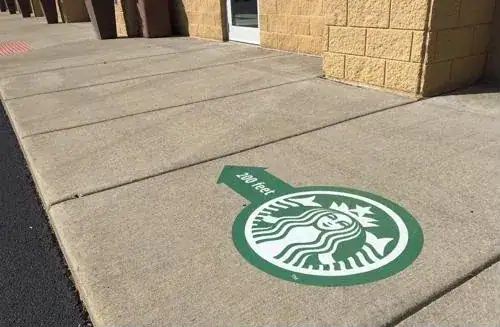
The ground plane is the most demanding surface we work on anywhere, and Cleveland is one of the harder cities to work it in.
Everything else we install lives on a vertical face. It gets rained on and it dries. Ground graphics get walked on, rained on, pooled on, scraped, gritted and in this city plowed. The surface does not get a rest and it does not get to dry out the way a wall does.
That is not an argument against the format in Cleveland. Done in the right months, on the right frontage, decals and stencils do something no vertical format can, which is to sit directly in the path of somebody who is already looking down at a wet sidewalk.
It is an argument for a narrower, more honest plan than most briefs arrive with. The two things I end up correcting most often on Cleveland decal jobs are the season and the ownership of the pavement. Both are specific to this city and both decide whether the campaign is worth running at all.
Here is how the format actually runs here.
Your working season is roughly May to September
Street-level work in Cleveland has a season, and for ground graphics it is tighter than it is for anything vertical.
The city has a humid continental climate with four hard-edged seasons, and cloud is the baseline condition. Cloudy days are the norm and January is typically the gloomiest month. Spring is genuinely unpredictable, swinging between mud-season rain and late snow, and it does not settle until the lake breeze stabilises things around May. Summers are warm and humid, moderated by that breeze.
For a wall, spring unpredictability is an inconvenience. For a decal it is disqualifying, because application needs a dry, clean, fully cured surface and a dry window afterwards. A March morning in Cleveland can look workable and leave a film of moisture in the concrete that stops adhesion dead.
So the honest frame is this. May through September is the working season. Early October is often fine and sometimes not. April is a gamble that occasionally pays. November through March is not a decal window in this city, and I will explain exactly why rather than just asserting it.
Salt, plows and freeze-thaw
Three separate mechanisms destroy ground graphics in Cleveland, and they stack.
Plowing. This is the blunt one. Sidewalk and plaza clearing scrapes a blade or a brush across the exact plane the graphic occupies. A decal does not survive it. Stencilled work on concrete fares a little better because it sits in the surface rather than on it, but the abrasive pass still takes the edges.
De-icing salt and grit. Salt spray off the arterials coats everything low through the winter, and the grit carried with it is abrasive underfoot. Ground graphics take that abrasion directly and continuously. Even where a decal survives the plow, the salted, gritted pedestrian traffic over it wears the print surface in a way that looks shabby long before the material actually fails.
Freeze-thaw. Lake-effect snow is the local mechanism. Cold Canadian air crossing Lake Erie picks up moisture and dumps wet, heavy snow on the southern shore. That snow sits, melts into the concrete, and refreezes. Water that has worked under the edge of a decal and then frozen lifts it from below. Cleveland can also lock into long sub-freezing stretches, including an unusually long run of days without a thaw in February 2026, which is exactly the condition that drives that cycle hardest.
There is one piece of good news and it is worth knowing because it changes material choices. Cleveland’s persistent cloud means UV load is low. Fade is a slow problem here. A ground graphic that survives the water, the salt and the traffic will keep its colour, which is the reverse of what happens in high-sun markets where print surfaces go chalky in weeks. In Cleveland the limiting factor is water and abrasion, never sun.
Lake moisture and the dry window
This is the thing that catches crews who have not worked a lake city.
Lake moisture keeps surfaces damp longer than the forecast suggests. A sidewalk in Ohio City can read as dry to the eye and to the back of your hand and still carry enough moisture in the pour to reject adhesive. The forecast describes the air. Concrete lags the air, and near the lake it lags it by longer.
Morning dew is the practical version of this problem. A crew that shows up at 6am to work an empty sidewalk finds a surface that will not take material, and the window where the concrete is dry and the pedestrian traffic is still thin can be narrow in the shoulder months.
What we do about it: we test the substrate rather than the sky, we prefer mid-morning in the shoulder season over dawn, and we build alternate dates into any job sitting outside the June to August core. Clients who need a hard, immovable date in a Cleveland spring need a format that is not surface-gated.
Where the walkable ground actually is
Ground graphics only work where people walk. Cleveland is a city of separate neighbourhood commercial strips rather than one continuous downtown, and the amount of genuinely walkable, graphic-worthy pavement is smaller than the city’s size suggests.
East 4th Street downtown. The best decal frontage in Cleveland, and it is not close. A short pedestrianised block that functions as the heart of downtown dining, with no vehicle traffic over the surface and a dense, slow-moving crowd looking around rather than hurrying. Short, so a run there is concentrated rather than extended. It is also a managed, curated environment, which matters for permission.
West 25th Street, Ohio City. The densest bar, brewery and food concentration on the near west side, in the orbit of the West Side Market. Real sidewalk traffic at a real walking pace. The sidewalk here is public frontage in most stretches, which pushes the work onto private forecourts, entries and plazas rather than the open pavement.
Detroit Avenue through Gordon Square. Detroit-Shoreway sits between Lake Erie and I-90, roughly West 45th to West 85th, with Gordon Square as the retail hub and the Capitol Theatre and Near West Theatre anchoring it. Detroit Avenue is an arterial, so foot traffic concentrates in front of venues rather than flowing continuously. Decals work at the venue entries, not along the strip.
University Circle. Museums, green space and Case Western Reserve University, with a genuine college-town feel. Campus and institutional walkways are the best ground surfaces in the city after East 4th, because they are private or institutionally controlled and they carry concentrated pedestrian flow. The entire district follows the academic year and empties over summer, which collides directly with the decal season. That tension is real and I address it below.
Tremont. Tree-lined Victorian streets, a notable density of churches, and a concentrated gallery and independent restaurant scene. One of the oldest neighbourhoods in Ohio. The ground here is residential in character and the commercial frontage is interspersed. It is a weak decal district despite being a strong district.
Edgewater. Lakeside, beach access, outdoor lifestyle, seasonal traffic. The paths get real summer use. They also get sand, water and lakefront exposure, and the audience is recreational. We rarely recommend it.
The Warehouse District near East 4th adds bar and shopping traffic downtown and works as an extension of a downtown buy rather than a destination for one.
Sidewalk ownership decides the whole campaign
This is the question that kills more Cleveland decal briefs than weather does, and most clients have never considered it.
A public sidewalk is public right-of-way. We treat public infrastructure in Cleveland as closed, and that includes the pavement, not just the poles and signposts above it. Ohio municipalities generally regulate signage through a zoning sign code and separately police material affixed in the public right-of-way, and a decal on an open city sidewalk sits squarely in the second category.
I am not going to tell you whether that is legal or illegal. It is a grey area, it varies by municipality, enforcement is inconsistent, and the outcome depends on who owns the surface, what the local ordinance says and whether permission exists. What I can tell you is that we do not plan around unsanctioned placement here, because Cleveland’s enforcement character is complaint-driven and neighbourhood-mediated, and a complaint in a district this socially connected attaches to the brand rather than to the crew.
So the workable inventory is private ground. In practice that means:
Building forecourts, entries and setbacks where the private parcel extends to the building line. Interior courtyards and plazas. Managed district surfaces downtown, where building management and district management can grant consent on ground that looks public but is not. Campus and institutional walkways in University Circle. Event grounds and venue frontage during a run, where the operator controls access.
The venue route is the one most clients underuse. In Gordon Square and Tremont, which are self-consciously arts districts with active neighbourhood development organisations, approaching the theatres, galleries and bars directly is a far better route than approaching cold, and those operators frequently control the ground immediately outside their doors. Culture-aligned content gets welcomed there in a way straight commercial content does not.
Removal is part of the permission, not an afterthought. We agree the lift date in writing before application, and we lift clean. On a format that lives underfoot, leaving degraded material down is the fastest way to lose a district permanently.
Crew reality: daylight work in a split city
Decal work inverts the normal rhythm. Posting happens at night. Ground graphics need light, a dry surface and a thin pedestrian flow at the same time, and those three things do not overlap for long.
Cleveland is a multi-trip city. The corridors are individually walkable and genuinely separated: Ohio City and Tremont sit west across the Cuyahoga from downtown, Gordon Square is further west along Detroit Avenue, and University Circle is well to the east. A crew walks within a district and drives between them. Plan a full day per two districts, not per city.
Weekday daytime downtown has an office population and steady movement, which is good for the audience and awkward for application. Early weekend mornings downtown are the opposite: the district is quiet, the ground is accessible, and the crowd arrives later the same day. That is usually the best downtown window in the warm months.
Parking shapes the rest. Downtown is predominantly paid lots and decks with some metered street parking. Ohio City and Tremont have narrow residential streets with heavy resident parking, so a small vehicle and a short carry is the only realistic model. Gordon Square along Detroit Avenue is easier, being an arterial strip with more kerb availability.
Event days override the schedule. On Browns, Guardians and Cavaliers days the downtown decks fill and the surrounding streets become unworkable. We schedule around the sports calendar, which for a format targeting event crowds means installing a day or two ahead rather than on the day.
What goes wrong, and what we talk Cleveland clients out of
Winter decals. The most common ask and the firmest no. Plowing alone settles it. We offer a spring date or a different format rather than take a booking that will be scraped off the ground inside a week.
Open public sidewalk placement. Clients see the best-trafficked pavement in Ohio City and want it. That pavement is public right-of-way. We move the plan to private frontage, forecourts and venue-controlled ground, and the campaign is usually better for it because those positions sit at decision points rather than in the middle of a walking flow.
University Circle in July. This is the genuine conflict in Cleveland decal planning. The best private walkable ground in the city after East 4th sits in a district that runs on Case Western Reserve’s academic terms and collapses over the summer, which is the peak decal season. If students are the audience, the window is September into October and then April into early May, and the April end of that is weather-exposed. We say this up front rather than discovering it in the debrief.
Edgewater beach paths. Sand, water, recreational mindset and no commercial frontage. It comes up because the lakefront sounds appealing in a brief. It does not perform.
Long run lengths. Ground graphics in a salted, high-abrasion city have a shorter useful life than clients assume even in summer. We would rather plan a sharp run tied to a specific window than promise a long sit that will look tired at the end of it.
Stencil work in Tremont. Tremont’s streetscape is old, residential in character and carefully regarded by the people who live there. We will run permissioned work at venue frontages. We will not put stencil work across a Tremont streetscape, and we will say why rather than quietly declining.
Fixed April dates. Cleveland spring is a gamble for surface-dependent work. We book windows with alternates.
Timing against the Cleveland calendar
Guardians baseball at Progressive Field is the steadiest recurring downtown footfall generator of the warm months, and it overlaps almost exactly with the decal season. For downtown ground work it is the single most useful rhythm in the city.
Browns home season at Huntington Bank Field opens in September and runs into winter, concentrating large crowds downtown and on the lakefront. The early part of that season still sits inside a workable installation window. The later part does not. Huntington Bank Field stadium concerts in late spring and summer draw comparable crowds inside the good season.
Late summer brings the Cleveland National Air Show on the lakefront and the Great Lakes Burning River Fest, both established recurring events in good decal weather.
The Cleveland International Film Festival runs in April downtown and marked its 50th year in 2026. It is a strong audience in a managed downtown environment, and it sits right on the edge of the workable window, so it needs alternate dates built in. The Cleveland Thyagaraja Festival, an annual Indian classical music festival, also falls in early April with the same caveat.
The Great Big Home and Garden Show in late January into early February is a rare midwinter convention-scale draw. It is a real audience and it is outside the ground-graphics season entirely. That is a case for a different format, not a case for pushing decals into February.
Where street teams make the format work harder
Ground graphics are directional by nature. They sit at a decision point and they point somewhere. That makes them a natural partner for Street Teams & Experiential rather than a standalone buy.
In Cleveland the pairing solves a specific local problem. The city’s walkable districts are small and separated, so a decal run in any one of them reaches a contained audience. Adding a street team on the same frontage during the hours that district is actually busy, which is mid-evening in Gordon Square and later on West 25th, turns a passive surface into a conversation and extends the reach beyond the people who happened to look down.
It also helps with permission. A venue operator in Gordon Square or a building manager downtown is often more comfortable granting ground access for a defined activation window than for a graphic that sits for weeks unattended, because the removal commitment is immediate and visible.
If the budget only supports one layer and the audience is event-driven, I would usually put it on the team rather than the ground. If the audience is daily and repeated, the ground wins.
Frequently asked questions
How long does a sidewalk decal last in Cleveland?
In the May to September season on permissioned private frontage, a well-applied decal holds a useful run, and the city’s heavy cloud cover means colour stays good because UV load is low. Life is limited by foot traffic abrasion rather than sun. Outside that season, plowing, de-icing salt grit and freeze-thaw cut lifespan dramatically, which is why we do not install in winter.
Can you put decals on Cleveland sidewalks?
Not on open public right-of-way, which is how most city pavement is classified. We work private ground: building forecourts and setbacks, courtyards and plazas, managed downtown district surfaces, institutional walkways in University Circle, and venue frontage. Posting rules are a grey area that varies by municipality and depends on ownership, ordinance and permission, so we work with documented owner consent only.
What is the best Cleveland location for ground graphics?
East 4th Street downtown, by a clear margin. It is a pedestrianised block at the centre of downtown dining, with no vehicle traffic across the surface and a slow-moving crowd. University Circle’s institutional walkways are the strongest alternative during academic terms. West 25th Street works at private forecourts and entries rather than on the open pavement.
Why can’t the campaign run in winter?
Three things stack. Sidewalk plowing scrapes the exact plane the graphic occupies. De-icing salt and grit abrade the print surface under foot traffic. Lake-effect snow melts into the concrete and refreezes, lifting material from under its edges. Cleveland can also hold long sub-freezing stretches, which drives that freeze-thaw cycle hardest.
Do decals and stencils damage the surface?
Not when the material and the removal are specified correctly, which is why the lift date goes into the permission agreement before anything is applied. We remove on the agreed date and we lift clean. In Cleveland’s small, socially connected districts, leaving degraded material on the ground costs access to that neighbourhood for future work.
How far ahead should a Cleveland decal campaign be booked?
Far enough to sit inside the June to August core, or with genuine alternate dates if it falls in April, May, September or October. Cleveland spring swings between rain and late snow and does not stabilise until around May, and application needs a dry, cured substrate. We also check the sports calendar, because event days make downtown access unworkable.
Request a campaign quote
Bring us two answers and we can plan a Cleveland ground campaign quickly: which district your audience actually walks, and whether your dates can move.
We will tell you where the private frontage is, what the season allows, how long the run realistically holds against salt and foot traffic, and when we think the ground is the wrong plane for what you are trying to say.
Request a campaign quote and we will build it around the pavement we can actually get permission for.
Livy Phillips American Guerrilla Marketing Nationwide poster, snipe, decal, projection and LED truck campaigns americanguerrillamarketing.com

Ready to Run Your Campaign?
Call us or email us. We’ll tell you exactly what we can do in your market and what it costs.
Related Services
Explore similar advertising solutions offered by American Guerrilla Marketing.
American Guerrilla Marketing — Los Angeles
Street-level campaigns in Los Angeles and nationwide. Wheatpasting, LED trucks, street teams, and more.
(646) 776-2770
Related Articles
-
Sidewalk Decals & Stencils: South Nashville Metro
November 23, 2026
-
Sidewalk Decals & Stencils in Madison: How It Runs
November 23, 2026
-
Sidewalk Decals and Stencils in Scottsdale
November 23, 2026
-
Window Decal Advertising for Retail: Field Guide
November 22, 2026
-
Sidewalk Decals & Stencils in San Francisco
November 20, 2026