
November 3, 2026
How Festival Poster Campaign Timing Gets Installed
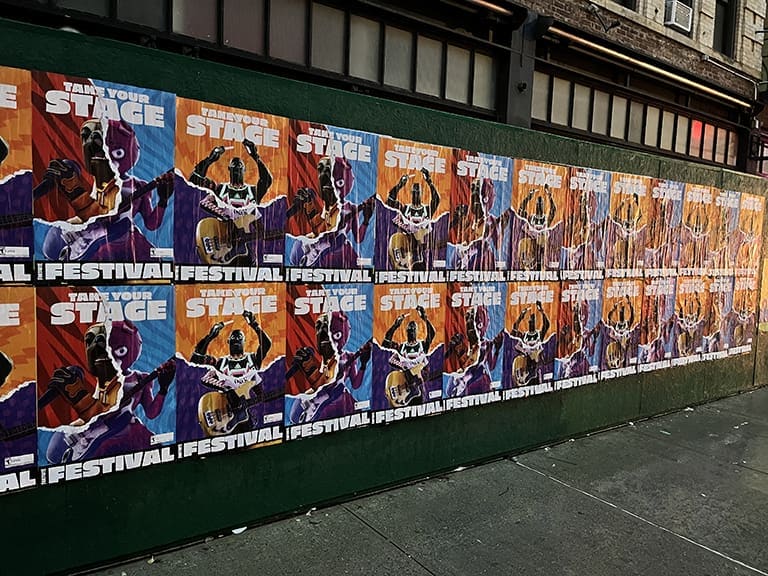
Festival marketers ask me the same question in different words every year. When should the posters go up?
The answer they expect is a number of weeks. The answer that is actually true is that a festival poster campaign is not one install, it is three or four distinct moments, each with a different job, and the mistake is treating the whole thing as a single date on a calendar.
Festivals are unusual in out of home because they have more hard dates than almost any other category. Lineup announce. Presale. General on sale. Tier price changes, which I will not be discussing in numbers but which are real calendar events. Final lineup additions. Daily schedules. Then the event itself.
Each of those is a reason to be on a wall, and they are not all the same campaign.
This is how we sequence festival poster work, what each phase is actually trying to do, and where the timing goes wrong.
The announce window is where posters matter most
If a festival only runs street work once, I want it at announce.
The reason is specific to how ticket buying works. At announce, a festival is competing for a decision that has not been made yet. People have not allocated their summer. The lineup lands, and over the following days and weeks people decide whether this is the one they are doing.
Posters do something during that window that digital does not. They make the festival feel like it is already part of the city. A person who sees the lineup on nine walls in their neighborhood over two weeks has absorbed a sense that this event is happening, that other people are going, that it is a real fixture rather than an ad they were served.
That perception is most valuable at exactly the moment the decision is open.
By contrast, posting heavily in the final week before an event reaches an audience that has already decided. The people walking past have either bought or they have not, and a poster is unlikely to generate a last minute ticket purchase from someone who was not already considering it.
So my default recommendation is to weight the campaign toward announce and on sale, not toward the event date. That is backwards from most festival marketing instincts, which treat the final push as the big moment.
There are exceptions, and I will get to them, because event week work has a real job. It is just a different job.
The four phases and what each one does
Phase one is announce. The creative carries the lineup or the headliners, the dates and the on sale information. This is the biggest install of the campaign and it should hit the walking corridors of the markets the festival draws from. Density matters here more than anywhere, because you are trying to create the impression of ubiquity during a decision window.
Phase two is on sale support. If the on sale is separated from the announce by a meaningful gap, a refresh pass that updates the message to the on sale date is worth doing. In practice this is often the same corridors with a revised poster, and it is very efficient because the surfaces are already sourced and the permission conversations have already happened.
Phase three is mid cycle sustain. For festivals with long sales windows, which is most of them, there is a dead stretch between on sale and the event where nothing is happening. Posters here do steady work keeping the event present. The honest truth is this phase has the weakest return of the four, and it is the first one I cut when the scope needs to shrink.
Phase four is event proximity. Usually the final two weeks. The job here is not selling tickets to strangers, it is building anticipation among people who already have them, reaching the local market for any remaining inventory, and importantly, establishing presence for the following year. A festival that is visible in a city during its own week builds recognition that pays off at the next announce.
Phase four is also when the creative can change character entirely, from information to atmosphere, because the audience already knows what the event is.
Most festivals I talk to want to put everything into phase four. I push them toward one and two.
Which markets and which corridors
Festivals have an unusual geography problem. A destination festival draws from many markets and sits in one. A city festival draws mostly from its own metro.
For a destination event, the market list should follow where tickets actually sell, and most festivals have that data from previous years. That is a real advantage over most categories, and it should be used. If a disproportionate share of attendees come from three cities, those three cities are the campaign, not a national spread.
I push hard against the national thin approach for the usual reason. Street posting works through repetition in a confined geography, and spreading a fixed surface count across many markets buys exposure without repetition. Nobody sees it twice and the mechanism never engages.
Within a market, the corridors are the walking neighborhoods where the festival’s audience actually spends time. For most music festivals that means the same areas that matter for music campaigns generally. In Los Angeles, the walking blocks of Echo Park, Silver Lake, parts of downtown and the stretches of Fairfax where people linger. In New York, the Lower East Side, Williamsburg, Bushwick, the East Village. In Chicago, Wicker Park, Logan Square and Pilsen. In Austin, the walkable stretches east of the interstate and along South Congress. In Atlanta, around Little Five Points and the Edgewood corridor.
The pattern everywhere is the same. Find where the audience walks slowly, and post there. Boulevards where everyone is driving at speed are the wrong surface for a poster, and that is what the other formats are for.
For a city festival, there is an additional consideration: the neighborhoods around the venue itself. Local presence near the site builds goodwill and attendance from people who will walk or take short transit, and that audience converts more readily than anyone further out.
Lead times, and why announce timing is tight
Here is where festival campaigns get operationally difficult.
The announce date is usually confidential until it happens, and the creative contains the lineup, which is the most sensitive asset the festival has. That means the print file cannot exist in final form until very close to the announce, and sometimes a single artist change forces a revision days out.
Meanwhile, the install needs sourced surfaces, confirmed permissions and a crew routed and scheduled, all of which take real time.
The way through is to separate the two tracks completely.
Surface sourcing, permission conversations and corridor walking happen on their own timeline, well in advance, based on the market list alone. None of that work requires the creative to exist. It only requires knowing which cities and which corridors.
Print and install get scheduled against the announce date, with the file arriving as late as it has to.
The constraint this creates is on stock selection. Normally surface type informs paper choice, and a late file compresses that. In practice we handle it by standardizing stock across the campaign based on the surfaces we have already sourced, which is a small efficiency loss and entirely worth it for the confidentiality.
The other constraint is weather. An announce date is fixed by marketing, not by forecast, and announce dates for summer festivals frequently fall in winter or early spring in northern markets. That is genuinely the hardest install condition we work in.
Weather, surfaces and what actually holds
Paste needs to set. That is the whole constraint in one sentence, and everything else follows from it.
Rain during the set window is the primary enemy. Hard freeze changes how the paste behaves and weakens the bond, which matters enormously for winter announce installs in Chicago, New York, Boston, Minneapolis or Denver. Extreme heat dries the paste too fast and causes adhesion problems on dark surfaces that have been in sun all day, which matters for summer event week installs in Phoenix, Austin or Atlanta.
We schedule install windows with fallback nights rather than committing to a single date far out. Any operator who guarantees you a specific install night months in advance, in any season, is not describing how the work functions.
For an announce install this means posting across a short span of nights in the announce week rather than attempting everything on announce day. Nobody walking a corridor perceives which night a given wall went up, so a campaign that goes live across three nights reads identically to one that went live in a single evening.
On surfaces, the rules do not change. Smooth, sealed, vertical surfaces hold best. Construction hoarding is the best surface available in street advertising. Painted plywood is excellent. Smooth concrete and sealed masonry are good.
Rough brick is poor, because paste contacts only the raised points and wind lifts the poster quickly. Dusty or chalky surfaces are poor, because the paste bonds to the dust rather than the wall and peels away as a sheet. Flaking paint we refuse, because removal takes the old finish with it.
For festivals specifically, hold time interacts badly with the long sales cycle. A poster installed at a winter announce will not still be looking good at a summer event. That is not a failure of the install, it is physics. Festivals that want presence across the whole cycle need multiple passes, which is exactly why I describe this as four phases rather than one campaign.
Crew reality
The install itself is straightforward and it helps to know what it looks like.
Small teams, usually pairs. Two hands on the paste and brush, one person managing the stack and watching the sidewalk. Larger campaigns scale by adding teams and splitting corridors, not by adding people to a single wall.
The work runs at night or in the pre dawn hours. Empty sidewalks, parking available, nobody walking through the work, and hours of set time before daylight and foot traffic arrive.
Route density determines efficiency. Twenty surfaces across eight walkable blocks is a good night, because the crew walks between them. Twenty surfaces spread across a metro means the night is mostly driving and parking, and the campaign looks scattered because it is.
For multi market festival announces, there is a routing question most clients do not think about. Hitting four markets in the same week requires either four crews or a travel plan, and travel days are days. A campaign that needs simultaneous presence in four cities is a different operation from one that can roll across a week, and the simultaneous version costs more in scope for reasons that have nothing to do with posters.
I ask festivals whether simultaneity actually matters to them. Usually it does not, and the answer saves them scope they can spend on density instead.
Permission, ordinance and the grey area
Whether a poster may be affixed to a given surface depends on who owns it, what the local ordinance says about posting on that kind of surface, and whether permission exists for that wall. That varies by municipality, and enforcement varies even within a city.
It is a grey area. I will not tell you a placement is legal or illegal, and I will not quote ordinance language I have not verified.
Festivals carry one specific exposure that most clients do not, which is that the event itself usually needs a working relationship with the host city. A festival that generates posting complaints in the city it operates in has created a problem in a relationship it genuinely depends on.
So for festival work, and particularly in the host city, I push toward explicit permission harder than almost anywhere.
How we reduce risk: we prioritize private surfaces with identifiable ownership, we favor construction hoarding where a contractor can give a real yes, we document every placement photographically with location logs, we contract removal as a deliverable with a date, and we decline placements that would read as damage.
Removal matters more for festivals than most clients realize, because the event date is a natural deadline that everyone in the city is aware of. Posters for an event that happened six weeks ago are the most visible form of neglect in this business. We book removal at the same time we book install.
What we talk festivals out of
We talk festivals out of weighting everything toward event week. The decision window is at announce.
We talk festivals out of national thin coverage, for the repetition reasons above. Use your actual ticket geography and go deep in the markets that produce attendees.
We talk festivals out of putting the full lineup in small type on a poster. A thirty name lineup poster is a beautiful object at arm’s length and unreadable at twenty feet. The wall version needs the headliners at a size that works from across a street, the festival identity, the dates and the on sale information. The full lineup belongs on the site.
We talk festivals out of simultaneous multi market installs when simultaneity brings no actual benefit.
We talk festivals out of mid cycle sustain when the scope is tight, because it is the weakest of the four phases and the money does more work at announce.
We talk festivals out of expecting attributable ticket sales from posters. Scan rates from sidewalk posters are modest by nature, and attributing a ticket purchase to a wall seen three weeks earlier is not something any measurement system does honestly. The effect is on the decision environment, not on a click path.
And we talk festivals out of skipping removal. Always.
Where other formats fit a festival cycle
Posters carry announce and on sale. Two other formats earn their place at specific moments.
Projection Advertising is the one I most often add at announce, because an announce is a moment and projection is a moment format. A large projection on a blank wall on announce night produces a single striking image that travels on social far beyond the people who physically saw it, and for an event whose audience lives online that secondary reach is the actual value. Nothing is attached to anything, which changes the permission picture. The honest limits are that it needs darkness, dry weather, a clean large surface and a power plan, and it exists only while the projector runs.
LED Trucks and Mobile Billboards fit event week and the venue approach. During the festival itself, a truck can run routes near the site, through the neighborhoods where attendees are staying, and along the arterials that posters cannot reach. For an event with a fixed location and fixed dates, controllable timing and routing is worth a lot.
Street Teams and Experiential work fits on site and at adjacent moments, where handing something to a person already inside the audience is a better use of attention than any wall.
The sequencing I prefer: posters for the announce and on sale weeks, projection for announce night itself, trucks and teams for event week.
Frequently asked questions
When should festival posters go up?
Weight the campaign toward announce and on sale rather than event week. At announce the audience is still deciding how to spend their summer, and poster repetition during that window shapes the decision environment. By the final week before an event, most people walking past have already decided, so late posting does less work on ticket sales even though it builds next year recognition.
How many markets should a festival campaign cover?
Use your actual ticket geography rather than a national spread. Street posting works through repetition in a confined area, so a fixed surface count spread thin across many cities buys exposure without frequency and the mechanism never engages. If a disproportionate share of attendees come from three markets, those three markets are the campaign.
Can the lineup poster show the full lineup?
Not effectively. A full lineup in small type reads beautifully at arm’s length and not at all from across a street. The wall version needs headliners at a size legible at distance, the festival identity, the dates and on sale information. Put the complete lineup on the website where people who want it will look for it.
How does a confidential announce date affect the install?
It separates the two tracks. Surface sourcing, permission conversations and corridor walking happen well in advance based on the market list alone, since none of that requires the creative. Print and install then get scheduled against the announce date with the file arriving late. The tradeoff is standardizing paper stock in advance rather than matching it per surface.
Will posters from a winter announce still be up at a summer event?
No, and they should not be expected to. Posters weather, get covered by other posting activity and eventually fail, which is why a long sales cycle needs multiple passes rather than one install. That is the reason I describe festival work as four phases. Treating it as a single install guarantees a thin looking campaign for most of the cycle.
What about removal after the festival ends?
We book removal at the same time as the install, as a contracted deliverable with a date. Festivals carry more exposure here than most clients because the event date is publicly known, so leftover posters read as obvious neglect. A festival also usually depends on a working relationship with its host city, which makes post event cleanup worth treating seriously.
Request a campaign quote
If you have an announce date and a ticket geography, send both over along with the event dates and whether the host city needs separate treatment from your feeder markets.
We will tell you which corridors are worth walking in each market, how the phases should be weighted given what you want to spend the scope on, and what the weather realistically allows for an announce in that season.
If your announce falls in a hard weather window, we will tell you that and plan fallback nights rather than promising a date we cannot control.
Request a campaign quote and we will start with your calendar.

Ready to Run Your Campaign?
Call us or email us. We’ll tell you exactly what we can do in your market and what it costs.
Related Service
Explore similar advertising solutions offered by American Guerrilla Marketing.
American Guerrilla Marketing — Los Angeles
Street-level campaigns in Los Angeles and nationwide. Wheatpasting, LED trucks, street teams, and more.
(646) 776-2770
Related Articles
-
Wheatpasting and Poster Campaigns in Orlando, Florida
November 3, 2026
-
American Poster Sizes: How They Actually Work on the Street
November 3, 2026
-
Wheatpasting & Poster Campaigns in Chicago, Illinois
November 3, 2026
-
Activation Successful: What It Actually Takes to Pull Off a Great Brand Activation
September 12, 2026
-
Bathroom Advertising | American Guerrilla Marketing
September 12, 2026