
November 11, 2026
How Outdoor Projection Advertising Actually Gets Installed
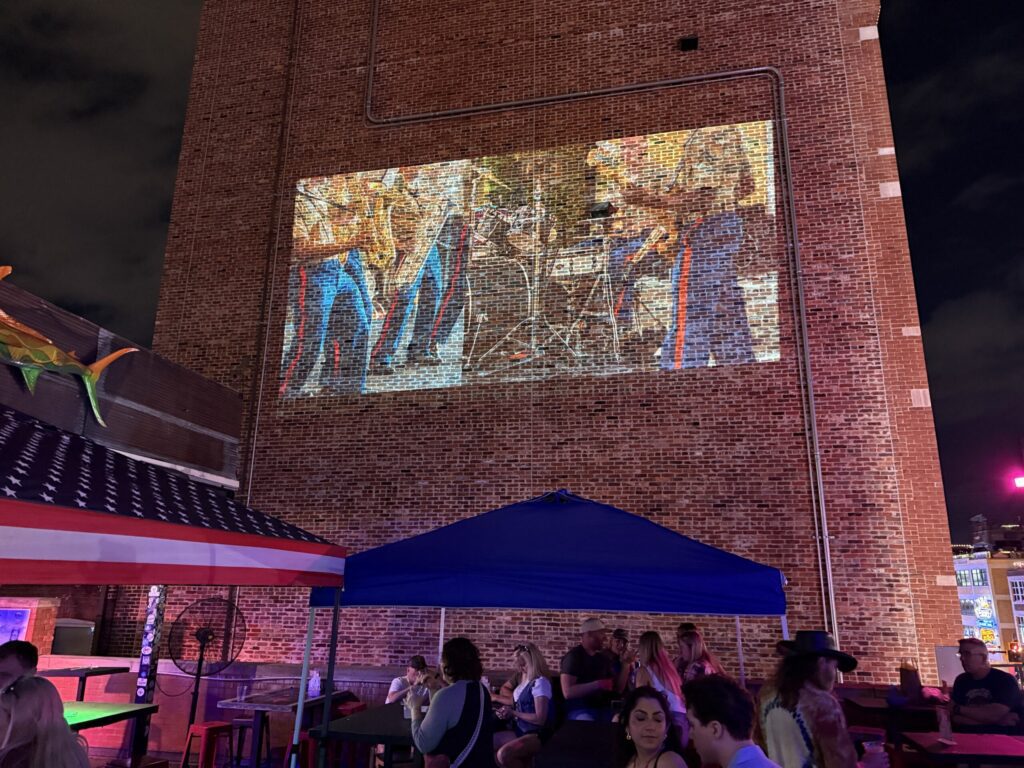
Outdoor Projection Advertising photographs better than almost anything else we do, and it is the format buyers understand the least.
The pitch in people's heads is simple. A projector points at a building, a logo appears four storeys tall, crowds stop and film it. That version exists. I have stood under it. But the gap between that image and the night it took to produce it is where most projection campaigns go wrong before anyone turns a machine on.
Projection is not a print format. There is no artwork that gets stuck to a wall and left there. It is a live production. Something has to carry the projector, something has to power it, somebody has to aim it, somebody has to stay with it for the entire run, and the whole thing has to be struck and loaded out before the street fills up.
That means a projection night is closer to a small film shoot than to a poster run. Crew, vehicle, power, sightline, permission, weather, and a back up plan for the moment the perfect wall turns out to have scaffolding on it that was not there during the scout.
I want to walk through how an install actually goes, in order, from the scout to the load out. Not the brochure version. The version with the parts that cost you the night if you skip them.
If you are shopping projection and you only read one section, read the one on surfaces. That is where most campaigns are won or lost, and it is decided days before the truck rolls.
Nobody projects on a wall they have not scouted
Every projection job starts with a scout, and the scout happens at night.
A daytime photo of a building tells you almost nothing useful. It does not tell you how much ambient light hits that wall after dark. It does not tell you that a street lamp sits directly in front of it, washing the lower third into grey. It does not tell you that the building across the street has floodlights that come on at ten. It does not tell you that the surface you thought was flat is actually broken by a fire escape, a downspout and three air conditioning units.
So we go out at the hour the campaign would run and we look.
What the crew is reading on a scout: the wall colour and texture, the amount of competing light, the available throw distance, where the projector can physically sit, whether that position is on private ground or public, whether a vehicle can stop there, whether power is available or whether we are running from a generator or batteries, and what the sightlines look like from where the audience will actually be standing or driving.
We photograph the position. We measure the throw. We note the obstructions. And often we walk away and recommend a different wall two blocks over, because the famous building is a bad canvas and the anonymous one is a great one.
Surfaces: what holds an image and what eats it
A projected image is light landing on a surface, so the surface is half of your creative.
Large flat light coloured concrete or render. Best case. Smooth, pale, high reflectivity. Images look clean, colour holds, text stays readable.
Pale brick. Good, with a caveat. Mortar lines break fine detail, so simple bold artwork survives and intricate artwork turns to mush.
Dark brick, dark stone, dark painted surfaces. These absorb light. You can throw everything you have at a dark wall and get a dim, muddy result. I talk clients off dark surfaces constantly, and they always push back until they see the test.
Glass and heavily glazed facades. The image mostly passes through or scatters. A curtain wall tower is one of the worst projection targets in a city, and it is almost always the building a client asks for first.
Reflective and metal cladding. Hot spots and glare. Unpredictable.
Water, smoke and mesh. Specialist effects rather than reliable advertising surfaces. They look incredible in the right conditions and vanish in a light breeze.
The other half of the equation is ambient light. A perfect pale wall under a bank of street lamps will underperform a merely decent wall on a dark side street. Urban cores are bright. That brightness is the single most underestimated variable in projection, and it is why the same rig looks spectacular in one block and disappointing in the next.
Lumens, throw and why bigger is not automatically better
People ask about lumens first. It is the wrong first question, but it matters.
Brightness requirement is a function of three things: how big you want the image, how far the projector sits from the wall, and how much ambient light is competing. Change any one of those and the answer changes.
A modest rig on a dark alley wall at short throw can look brilliant. A powerful rig on a brightly lit boulevard, throwing a hundred feet onto grey stone, can look washed out. The machine is not the campaign. The placement is.
Throw distance drives everything physically. Long throw means you need somewhere to put the projector that is far from the wall, and in dense cities that usually means across a street, which means you are either on private property with permission, in a vehicle, or on a rooftop. Short throw lets you sit close, which is easier logistically but limits image size and makes the beam easier for pedestrians to walk through.
Keystone and lens shift correct for angle, but correction costs you resolution and brightness. Aiming square at the wall always beats fixing it in software. On a tight street you often cannot aim square, so you accept some correction and you design the artwork knowing that.
The rig, the vehicle and the power
A typical urban projection setup involves the projector, a stand or vehicle mount, a media source, cabling, and power.
Power is the constraint people forget. If there is no building supply available with permission to use it, we are running from a generator or a battery system in the vehicle. Generators make noise, and noise at 11pm on a residential block is how a good night turns into a complaint. Battery systems are quieter and have a finite run time, which has to be planned against the length of the projection window.
The vehicle matters more than the projector in a lot of jobs. A van that can park legally in the right spot, with the rig mounted and aimed from inside, solves the position problem, the power problem and the security problem at once. Mobile projection also lets you hit several walls in one night instead of camping on one.
Security is real. A projector on a stand on a public sidewalk is an expensive object in an uncontrolled environment. Somebody stays with it. Always.
How the night actually runs
Here is the shape of a standard single site projection night.
Pre call, late afternoon. Rig check, content check on the actual playback machine, cable inventory, confirm the permission contact and the parking plan.
Arrival, roughly an hour before go time. Position the vehicle, set up, run power, get a rough image on the wall. The first image is always wrong. It is always too high, too small, or clipped by a cornice.
Alignment, twenty to forty minutes. This is the part clients never budget for mentally. Someone walks out to the audience position and calls adjustments back. Focus, framing, keystone, brightness. On a textured wall you also tune contrast, because what looks right on a laptop looks flat on concrete.
Run. Two to four people on site depending on complexity. One on the rig and playback, one on the street watching the image and the public, one on the vehicle and power, and on bigger nights someone on documentation.
Documentation. Stills and video, from the audience sightline, not from behind the projector. If the client is paying for a projection night, the footage is a large part of what they take away from it, and that footage needs to be shot properly rather than grabbed on a phone at the end.
Strike and load out. Faster than set up, usually twenty to thirty minutes. Nothing is left behind, because nothing physical was ever attached to the building in the first place.
Our usual run window is somewhere between full dark and about 2am. Earlier gets you audience but less contrast. Later gets you contrast but fewer people. Most campaigns want the overlap, which in practice means the first few hours after dark.
Weather, the thing that cancels nights
Projection is the most weather sensitive format we operate.
Rain is the obvious one. Light drizzle is survivable with proper protection on the rig, and it can actually make the beam visible in a way that photographs well. Heavy rain ends the night, both for equipment safety and because the image on a soaked wall loses contrast.
Fog does something interesting. It makes the beam itself visible, which looks dramatic, but it scatters the image and softens the edges. Some campaigns love that. Text heavy campaigns do not.
Wind matters for stability if the rig is on a stand rather than in a vehicle, and it matters a lot for any temporary screen or mesh.
Cold shortens battery life noticeably. Heat makes projectors work harder and fans run louder.
Then there is the one nobody thinks about: summer. Late sunset in June means a projection night in a northern city might not have usable darkness until well after nine. In December the same city is dark by five. Seasonal daylight is a scheduling fact that changes what hours your audience and your darkness overlap, and in some markets that overlap is the whole campaign.
Permission, ordinance and the grey area
Projection sits in an unsettled space, and I am going to describe it honestly rather than tell you where the line is.
Projecting an image onto a building you do not own or control is a grey area. Rules vary by municipality. Some cities address projected images in their sign ordinances, some do not address them at all, and enforcement is inconsistent between neighbourhoods, nights and officers. Nothing is attached to the building and nothing is left behind, which is a meaningful difference from physical formats, but it does not resolve the question of whether the building owner consents to their facade carrying your message.
How we reduce risk:
We seek permission from the property owner of the projection surface wherever it can be obtained. We also need permission or a lawful position for wherever the projector sits, which is often a separate owner entirely.
We prefer private surfaces and partner walls. A building owner who wants the activity is worth more than a dramatic wall that does not know you exist.
We keep content clean of anything that could be read as defacement, obstruction or a hazard, and we never project onto roadways, traffic signals or anything that interferes with drivers.
We keep a contact on site who can speak to anyone who asks, and we shut down and move rather than argue. A projection rig can relocate in minutes, which is one of the format's genuine advantages.
We document the night so the client has a record of what ran, where and when.
What we do not do is offer legal advice or tell a client a jurisdiction is safe. That conversation belongs with their counsel.
What we talk clients out of
Glass towers. Every time. The landmark building with the glazed facade is the one clients want and the one that will not hold an image.
Dense paragraphs of copy. Projected text is read at distance, at night, often by people in motion. One idea, large, high contrast. If there is a URL it needs to be short enough to remember before the light changes.
Tiny logos in a corner. If the brand is not the image, people will film the pretty animation and not remember who paid for it.
Projection as the only format. A projection night is an event. It produces a moment and a lot of content. It does not produce the repeated exposure that builds recognition over weeks. Clients who want both usually pair a projection night with Wheatpasting & Poster Campaigns so the neighbourhood carries the message after the rig has gone home.
Unrealistic image size. Doubling image width does not double brightness requirement, it roughly quadruples it. Clients who want the whole building often get a better result owning a clean section of it.
Booking one night with no weather contingency. If the only night available is the night of the launch and it rains, there is no campaign. We build an alternate date in or we tell the client the risk plainly.
Scouting by photo. I have been sent a daytime phone picture and asked to confirm a wall. I will not confirm a wall I have not seen after dark.
Where this format genuinely earns its place
Launch nights and premieres, where the point is a moment and the content it generates. Venue and event adjacency, where you can reach a queue or a crowd that is already gathered. Mobile projection runs that hit several districts in one night and create the sense that something is happening across a city. Campaigns where a physical install is impossible or unwelcome, since nothing touches the surface.
It is a high impact, short duration format. Treat it that way and it performs. Treat it as a substitute for sustained presence and it disappoints.
Building content that survives a wall
Content for projection has to be made for projection. Artwork built for a screen almost never survives the trip outdoors, and the fixes are not subtle.
Contrast is the first thing to get right. A wall is not a black background. Dark areas of your design do not read as dark, they read as whatever colour the wall is. So anything that relies on deep blacks, subtle shadows or dark on dark detail will disappear. Design for bold shapes on an absence of light rather than for a backlit screen.
Colour shifts with the surface. Project onto warm toned brick and every cool colour pulls warm. Pale grey concrete is the most neutral canvas most cities offer. We will often adjust the content on site once we see it on the actual wall, which is another reason alignment time exists.
Motion reads better than stills, but slow motion reads better than fast. People are walking past. A loop that resolves in four seconds works. A loop with rapid cuts turns into flicker at distance.
Aspect ratio should be built to the wall, not to a standard. If the usable clean section of a facade is a wide band between a cornice and a row of windows, the content gets built to that band. Projecting a standard rectangle and letting the top third fall across windows wastes most of the image.
We ask for source files rather than flattened exports where possible, because on site adjustment is normal and flattened artwork leaves nothing to adjust.
Frequently asked questions
How does outdoor projection advertising actually get installed?
There is no permanent install. A crew scouts the wall after dark, positions a projector at the required throw distance, supplies power from a building feed, generator or vehicle battery system, aligns and focuses the image from the audience sightline, runs the content for the booked window, documents it, then strikes and loads out. Nothing is attached to the building and nothing is left behind.
What kind of surface works best for projection?
Large, flat, pale surfaces with low ambient light. Smooth concrete and render are ideal. Pale brick works with bold simple artwork because mortar lines break fine detail. Dark brick, dark stone and glass facades absorb or scatter the light and produce weak results. Competing street lighting matters as much as the wall itself, so a modest wall on a dark block often beats a landmark under floodlights.
How many people does a projection night need?
Usually two to four. One runs the rig and playback, one watches the image from the audience position and manages public interaction, one handles the vehicle and power, and larger nights add someone for photography and video. Somebody stays with the equipment at all times. Set up runs about an hour, alignment takes twenty to forty minutes, and strike takes twenty to thirty.
What time of night does projection run?
From full dark until roughly 2am, with most campaigns concentrating in the first few hours after sunset where darkness and foot traffic overlap. Seasonal daylight changes this a lot. A northern city in June may not be usably dark until well after nine, while the same city in December is dark by late afternoon, which shifts the whole schedule.
Is projection advertising allowed on buildings?
It is a grey area that varies by municipality. Some sign ordinances address projected images and some do not mention them, and enforcement is inconsistent. Nothing is attached and nothing is left behind, but building owner consent is still the central question. We work from property owner permission where possible, keep a contact on site, avoid anything affecting roadways, and relocate rather than argue.
What happens if the weather turns?
Light drizzle is workable with the rig protected, and it can make the beam more visible. Heavy rain ends the night for equipment safety and because a soaked wall loses contrast. Fog softens edges, which suits some creative and ruins text heavy work. We plan alternate dates for weather sensitive bookings and tell clients plainly when a single night carries real risk.
Book the night properly
If you have a building, a date or a city in mind, the useful next step is a conversation about the surface, the ambient light, where a projector can legally and physically sit, and whether projection alone will carry what you need or whether it should anchor something longer running.
Request a campaign quote and tell us the market, the dates and what the image needs to do.

Ready to Run Your Campaign?
Call us or email us. We’ll tell you exactly what we can do in your market and what it costs.
Related Service
Explore similar advertising solutions offered by American Guerrilla Marketing.
American Guerrilla Marketing — Los Angeles
Street-level campaigns in Los Angeles and nationwide. Wheatpasting, LED trucks, street teams, and more.
(646) 776-2770
Related Articles
-
Milwaukee Projection Advertising: Permits and Corridors
November 13, 2026
-
Is an Out-of-home Advertising Agency Worth It? An Honest
November 13, 2026
-
OOH Advertising Scope: A Field Guide From the Crew
November 13, 2026
-
Guerrilla Projection: How It Actually Works on the Street
November 13, 2026
-
Projection Advertising in New York City
November 13, 2026