What’s the Average Size of a Poster? Dimensions by Use Case | AGM
The average poster size in the United States is 24 x 36 inches for outdoor and campaign use, and 18 x 24 inches for indoor applications. These two sizes collectively account for the majority of marketing posters produced in the US. But average varies meaningfully by use case – the average street campaign poster is a different size than the average cinema lobby poster, the average retail store display, or the average academic conference poster. Knowing the average for your specific application is what matters.
At American Guerrilla Marketing, we produce and deploy campaign posters across 50+ US markets. Every campaign we execute involves a size decision that reflects the specific placement environment, viewing distance, and production budget. This guide covers the average poster size across every major use case, with the practical context that makes the data useful rather than just a list of numbers.
Understanding averages helps you set expectations and avoid ordering formats that are significantly outside the norm for your application – which typically means paying more than necessary or getting less visual impact than your format should deliver.
18 x 24 accounts for majority of indoor venue posters
Retail store display
22 x 28 in
18 x 24 to 24 x 36
22 x 28 matches most retail frame hardware
Cinema lobby (one-sheet)
27 x 40 in
Fixed standard
No variation in theatrical format
Academic conference poster
36 x 48 in
A0 to 40 x 56
36 x 48 portrait is US academic average
Event/concert (outdoor)
24 x 36 in
18 x 24 to 36 x 48
Same as general outdoor campaign average
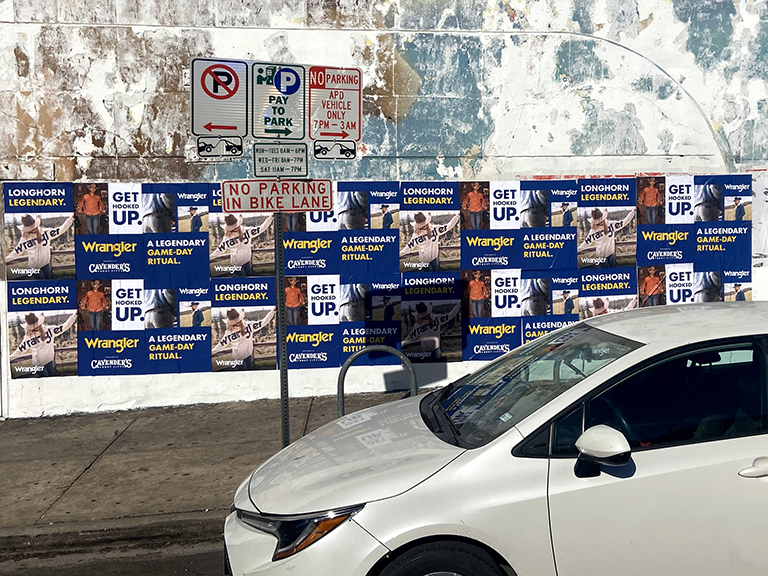
Wheatpasting campaign
24 x 36 in
18 x 24 to 48 x 72
24 x 36 is by far the most common
Home wall display
24 x 36 in
18 x 24 to 36 x 48
24 x 36 fits standard retail frames
Average Outdoor Poster Size: 24 x 36 Inches
The average outdoor poster size for street campaigns, event promotion, and outdoor advertising is 24 x 36 inches. This is not a guess or a round number – it is the size that dominates US outdoor poster production because it delivers the right visual impact for street-level viewing distances at the most competitive production cost.
Why 24 x 36 is the outdoor average
At 24 x 36, a poster is readable from 20-25 feet under typical urban street conditions. A headline at 150pt font is legible across a two-lane street. The format is large enough to stop attention in a visually competitive environment but not so large that per-unit costs make it impractical for campaigns covering multiple locations. Our wheatpasting campaigns use 24 x 36 as the average and primary format for outdoor street placements in New York, Los Angeles, Chicago, Austin, and every other market we serve.
Above and below the outdoor average
Some outdoor campaigns use formats above or below the 24 x 36 average. The 18 x 24 is used when cost per unit must be lower or when placements are at close outdoor distances (under 10 feet). The 36 x 48 and 48 x 72 are used when premium locations justify the cost premium and maximum visual scale is the priority. But these are deliberate departures from the average, not alternatives to it. Start with 24 x 36 and move up or down with specific justification.
Average Indoor Poster Size: 18 x 24 Inches
For indoor campaign applications, the average poster size is 18 x 24 inches. This is the format that best matches indoor viewing conditions – distances of 5-12 feet, lighting that is more controlled than outdoor, and display hardware that is typically sized for a moderate rather than large format.
Indoor averaging across venue types
If you averaged the size of every poster at a music venue, bar, coffee shop, gym, restaurant, and retail store in a US city, the average would be close to 18 x 24. The distribution includes some 11 x 17 (high-volume, lower-budget events) and some 24 x 36 (premium venue displays), but the center of the distribution is 18 x 24. It is the format that works in the most indoor environments without modification or compromise.
Our street team operations for music and entertainment clients distribute 18 x 24 posters to venue contacts as the standard format for indoor distribution packages. The size works in the bathroom frame, the stage-facing wall, the bar back, the window facing the street, and the entrance door. That cross-context utility is what makes it the indoor average.
Average Retail Poster Size: 22 x 28 Inches
In retail environments, the average is driven by display hardware rather than viewing distance calculations. The 22 x 28 inch format matches the standard US retail poster display frame, which is why it is the retail average. Designers and print vendors who regularly produce retail campaign materials default to 22 x 28 for exactly this reason.
The practical caveat: not all retail chains use the same display hardware. Some large-format retailers have 24 x 36 floor standing displays. Some specialty retailers use custom frame sizes. Before specifying the average 22 x 28 for a retail campaign, confirm the specific display dimensions with the retail partner’s marketing or visual merchandising team.
Average Conference Poster Size: 36 x 48 Inches
For academic and professional conference poster sessions, the average size is 36 x 48 inches in portrait orientation. This is above the street campaign average because conference poster sessions have different display requirements: larger boards with more content, displayed in environments where close-reading is expected and the viewer can spend time with the material. The 36 x 48 provides enough surface area for a full academic research layout.
The conference average of 36 x 48 is converging with the international metric standard A0 (33.1 x 46.8 inches) as more US conferences accept international participants and specifications. For conferences that accept either format, the choice should be based on which your print vendor prices more competitively and whether your content has already been designed to one specific size.
Average International Poster Size
The average international poster size for campaign work is A1, which is 594 x 841 mm (23.4 x 33.1 inches). This is the ISO metric equivalent of the US 24 x 36 average – the format that dominates campaign production in Europe, Asia, Australia, and most countries that use the metric system. The A1 is slightly smaller than the US 24 x 36 in both dimensions, but the functional role in a campaign is the same.
For brands running campaigns in both US and international markets, the practical implication is that you need two separate average-size files: one at 24 x 36 for US vendors and one at A1 (59.4 x 84.1 cm) for international vendors. The A1 is not a direct scale of the 24 x 36 – the aspect ratios are slightly different and the designs need explicit adaptation rather than simple scaling.
How Campaign Size Decisions Affect Average Campaign Performance
Choosing a format significantly above or below the average for a specific application creates predictable performance gaps. Understanding what the average delivers helps explain why departures from it require justification.
Below-average size for the environment
Using 11 x 17 where 24 x 36 is the average for outdoor street campaigns produces significantly reduced impression counts per dollar spent because the smaller format’s visual footprint does not compete effectively. Viewers at 15+ feet do not register the poster at all. The cost savings from the smaller format do not compensate for the lost visibility.
Above-average size for the environment
Using 36 x 48 where 18 x 24 is the average for indoor venue applications produces posters that are physically too large for most venue display surfaces. They create installation difficulties, look out of scale in the environment, and cost 3-4 times as much as the average format without proportional impact gains. The extra size delivers nothing the viewer cannot get from the 18 x 24 at indoor distances.
Matching average to environment
The averages exist because campaigns that used smaller and larger formats converged on these sizes through practical experience. When our team plans a campaign, the starting point is always the average for the specific environment: 24 x 36 for outdoor, 18 x 24 for indoor, 22 x 28 for retail. Deviations from the average require specific justification – a budget constraint, a display hardware requirement, or a location that specifically rewards an above-average format.
Average Poster Size for Common Campaign Budgets
The average format for a given campaign budget shifts as the quantity required changes. Here is how the average plays out at different budget levels for a typical street campaign.
Small budget (under $500 total print)
At this budget, the average format that maximizes coverage is 11 x 17 or 18 x 24. At 24 x 36, a $500 budget typically produces 100-150 posters – enough for 5-10 well-covered locations. At 18 x 24, the same budget produces 200-300 posters – enough for 15-25 locations at 2-3 posters per location. The average format shifts down when the priority is coverage breadth at limited budget.
Mid-range budget ($500-$2,000 total print)
At mid-range budgets, 24 x 36 becomes the practical average format. A $1,500 budget typically produces 400-600 posters at 24 x 36, covering 20-40 locations. This is where the average outdoor format delivers the best balance of coverage, impact, and cost.
Larger budget ($2,000+)
At larger budgets, a mixed-format approach becomes possible and is typically the average for professional campaign execution. Primary locations get 24 x 36 or larger; secondary locations get 18 x 24; saturation areas get 11 x 17. The average over the full run may still be approximately 24 x 36 due to volume weighting, but the campaign uses multiple sizes deliberately matched to specific placement tiers.
Average Poster Size in Practice: Field Notes from Campaign Execution
Numbers and averages only tell part of the story. Here is how the average poster size plays out in actual campaign execution, based on the campaigns our team runs across US markets.
Average size on a New York campaign
In New York City, street-level campaigns run primarily at 24 x 36 inches because the visual competition is intense and smaller formats do not perform at street distance in high-density environments. A typical NYC outdoor campaign run is 500-2,000 posters at 24 x 36, placed across 20-80 locations depending on budget and density requirements. Secondary indoor coverage in bars, venues, and retail uses 18 x 24 at the same design. The average across the full run by unit count is slightly below 24 x 36 because the 18 x 24 indoor component adds more units at smaller size, but the outdoor campaign anchor is firmly at the 24 x 36 average.
Average size on an event promotion campaign
For concert and event promotion across a major US city, the average poster size in the distribution run is typically 18 x 24 when you weight by unit count. This is because the indoor venue distribution component (bars, coffee shops, gyms, university bulletin boards) is typically 2-3x the unit count of the outdoor component. The outdoor placements are at 24 x 36 for visual impact; the indoor placements are at 18 x 24 for cost and compatibility with indoor display hardware. A run of 300 outdoor (24 x 36) plus 800 indoor (18 x 24) produces a unit-count average between the two sizes.
Average size on a brand awareness campaign
Brand awareness campaigns for consumer products, apps, and lifestyle brands tend to run exclusively at 24 x 36 for the outdoor component without the indoor supplemental component that characterizes event campaigns. This makes the average size across the full run 24 x 36. The goal of brand awareness is consistent visual exposure at maximum street impact – which argues for the larger format at every outdoor placement rather than splitting the budget between formats.
How to Calculate Your Average Poster Size for Budget Planning
If you are planning a multi-format campaign and want to predict the average cost per poster, use this calculation approach:
Step 1: Determine your location mix. For a typical 30-location street campaign: 15 outdoor street walls (24 x 36) x 3 posters per location = 45 outdoor posters. 15 indoor venues (18 x 24) x 5 posters per venue = 75 indoor posters. Total: 120 posters.
Step 2: Calculate the weighted average. If 24 x 36 costs $4.50/poster and 18 x 24 costs $2.80/poster: (45 x $4.50) + (75 x $2.80) = $202.50 + $210.00 = $412.50 total print cost. $412.50 / 120 posters = $3.44 average cost per poster. This weighted average helps you compare campaign options accurately.
Step 3: Add installation. Installation cost also varies by size. Our team quotes installation by the poster plus a location fee – the per-poster cost at 24 x 36 is higher than 18 x 24 due to the additional paste and time required. Factor installation into your average cost calculation alongside print to get a true campaign cost per impression.
The Relationship Between Average Size and Campaign Effectiveness
The average poster size for a use case exists because campaigns that used different sizes converged on these averages through practical experience. The 24 x 36 outdoor average is not arbitrary – it represents the point at which visual impact per dollar invested is maximized for outdoor street placements at typical viewing distances. Significantly below the average (using 11 x 17 for outdoor) sacrifices too much visual impact. Significantly above the average (using 48 x 72 for all locations) costs too much per unit to maintain adequate coverage density.
The average works because it is the equilibrium between impact and economics. Campaigns that depart significantly from the average for their use case – going much smaller or much larger – typically produce suboptimal results for the investment. The average format is the average because it is where the investment-to-impact ratio peaks for the specific application context. Our guerrilla marketing team has executed campaigns across hundreds of markets and consistently finds that the average formats outperform departures from the average at comparable budget levels.
The exception is a campaign with a specific creative reason to use a non-average format. A brand whose identity is built around scale might deliberately use only 36 x 48 and larger for every outdoor placement, accepting the higher per-unit cost as part of the brand expression. A high-volume saturation campaign for a new app launch might deliberately use 11 x 17 to maximize location count within a fixed budget, accepting the reduced individual impact in exchange for ubiquity. These are strategic departures from the average, not defaults. The average exists as a starting point; knowing when and why to depart from it is the strategic skill.
What’s the average size of a poster?
The average poster size in the US is 24 x 36 inches for outdoor and street campaigns, and 18 x 24 inches for indoor applications. These two sizes account for the majority of posters produced in US marketing campaigns.
What is the average size of an indoor poster?
The average indoor poster size is 18 x 24 inches. This size works for bar and venue promotion, retail windows, event flyers, and indoor displays at distances of 5-12 feet. For close-range indoor applications, 11 x 17 is also common.
What is the average size of an outdoor poster?
The average outdoor poster size for street campaigns is 24 x 36 inches. This is the format used for wheatpasting, outdoor event promotion, and street-level brand campaigns. For large-impact premium locations, 36 x 48 is above the average but commonly used.
What is the average poster size for a 24×36?
The 24 x 36 inch format is the average and standard US campaign poster. At 24 inches wide by 36 inches tall, it represents 864 square inches of display surface and is the most widely produced poster size in the US marketing industry.
What is the average poster size by use case?
Average poster sizes by use case: street campaigns – 24 x 36; event/venue promotion – 18 x 24; retail store display – 22 x 28; cinema lobby – 27 x 40; conference/academic – 36 x 48; large outdoor – 36 x 48 to 48 x 72.
Is 24×36 the average poster size?
Yes, 24 x 36 inches is the average and most common poster size for outdoor and street campaign use in the US. It is the size most print vendors price as their standard baseline and the format that fits the majority of outdoor poster display hardware.
What is the average international poster size?
The average international poster size for campaigns is A1 (594 x 841 mm / 23.4 x 33.1 inches). This ISO metric format is the international equivalent of the US 24 x 36 and is the standard in Europe, Asia, Australia, and most of the rest of the world.
Campaign Architect — American Guerrilla Marketing
Frequently Asked Questions
What’s the average size of a poster?
The average poster size in the US is 24 x 36 inches for outdoor and street campaigns, and 18 x 24 inches for indoor applications. These two sizes account for the majority of posters produced in US marketing campaigns.
What is the average size of an indoor poster?
The average indoor poster size is 18 x 24 inches. This size works for bar and venue promotion, retail windows, event flyers, and indoor displays at distances of 5-12 feet. For close-range indoor applications, 11 x 17 is also common.
What is the average size of an outdoor poster?
The average outdoor poster size for street campaigns is 24 x 36 inches. This is the format used for wheatpasting, outdoor event promotion, and street-level brand campaigns. For large-impact premium locations, 36 x 48 is above the average but commonly used.
What is the average poster size for a 24×36?
The 24 x 36 inch format is the average/standard US campaign poster. At 24 inches wide by 36 inches tall, it represents 864 square inches of display surface and is the most widely produced poster size in the US marketing industry.
What is the average poster size by use case?
Average poster sizes by use case: street campaigns – 24 x 36; event/venue promotion – 18 x 24; retail store display – 22 x 28; cinema lobby – 27 x 40; conference/academic – 36 x 48; large outdoor – 36 x 48 to 48 x 72.
Is 24×36 the average poster size?
Yes, 24 x 36 inches is the average and most common poster size for outdoor and street campaign use in the US. It is the size most print vendors price as their standard baseline and the format that fits the majority of outdoor poster display hardware.
What is the average international poster size?
The average international poster size for campaigns is A1 (594 x 841 mm / 23.4 x 33.1 inches). This ISO metric format is the international equivalent of the US 24 x 36 and is the standard in Europe, Asia, Australia, and most of the rest of the world.