What Size Are Posters? Every Standard Format Explained
We have hung tens of thousands of posters across New York, LA, Chicago, and beyond. Here is the complete answer on poster sizes, from the smallest table-top format to the largest outdoor formats we use in the field.
Poster sizes vary widely depending on where the poster is going and what it needs to accomplish. A poster on a coffee shop bulletin board is not the same as a poster on a construction wall in SoHo. A movie poster in a cinema lobby is not the same as an event flyer on a telephone pole in Williamsburg. The format follows the function.
We get this question constantly. Clients planning their first outdoor campaign ask it. Designers working on print specs ask it. Even print shops ask it when clients come in with vague instructions. So we put together this guide. It covers every major poster size we use, the contexts where each one works best, and the specs you need before you go to print.
No fluff. Just the real dimensions and the reasoning behind them.
Most poster campaigns in the US rely on a handful of standard sizes. These sizes are common because print shops stock them, frames are built around them, and advertisers know how to plan around them. Stepping outside these standards adds cost and complication. Staying within them keeps production fast and affordable.
The most common sizes in US poster campaigns are:
11 x 17 inches (tabloid size) – event flyers, inside venues, small-format street work
18 x 24 inches – the standard street poster, neighborhood campaigns, community boards
24 x 36 inches – movie posters, large retail displays, construction hoarding
27 x 40 inches – the official one-sheet movie poster used in theaters
40 x 60 inches – oversized outdoor posters, building side campaigns
These five cover the majority of poster applications we encounter. The work we do most often falls in the 18×24 and 24×36 range. Those two sizes fit most outdoor surfaces, most print budgets, and most campaign strategies.
Small Format Posters: 8×10 to 11×17
Small format posters work best indoors. Think bulletin boards, windows, bar countertops, and front-of-house display racks. At 8×10 inches, a poster is closer to a large photograph. At 11×17, it reads like a proper flyer but stays manageable on a crowded board.
We use 11×17 for indoor venue support during campaign launches. When we run a street poster campaign in a neighborhood, we often back it with 11×17 placement inside relevant businesses on the same block. The interior piece reinforces the outdoor message. Different audience moment, same campaign.
Print costs for small format are low. A 500-piece run of 11×17 posters is inexpensive. Turnaround is fast. These are also the sizes most commonly printed by office-grade laser printers for guerrilla-style rapid deployment campaigns.
Field Note: 11×17 Is more than a Backup Size
We treat 11×17 as a primary placement format in tight urban environments. Storefronts on Bleecker Street in Manhattan have limited wall space. A well-placed 11×17 at eye level in a high-foot-traffic window gets more views than a 24×36 buried in a cluttered alley. Size matters less than placement.
Mid-Range Poster Sizes: 18×24 and 24×36
These two sizes are the backbone of outdoor poster campaigns. We run more 18×24 and 24×36 posters than any other format combined. They fit most available wall surfaces. They are large enough to read from the street. They are small enough to hang without a crew of three people.
The 18×24 poster is approximately 1.5 feet wide by 2 feet tall. It gives designers enough space to work with large typography and bold graphics. At eye level on a flat wall, a 24×36 reads from 20 feet away. That range covers most sidewalk viewing distances in dense urban neighborhoods like the Lower East Side, Wicker Park in Chicago, or Echo Park in LA.
For paste campaigns, 24×36 is our sweet spot. It is large enough to command attention. It is still a single piece of paper, so hanging is straightforward. It fits standard wide-format inkjet printers without splicing. And it is recognizable as the “standard” size for most of our clients because it matches the classic movie poster format.
When we plan campaigns in high-density neighborhoods, we carry a mix of 18×24 and 24×36. The 18×24 goes on narrower surfaces and tighter spaces. The 24×36 goes on larger flat walls where we want a bigger impact per placement.
The 27×40 one-sheet is the standard for movie theater poster frames. Those frames are built to exact specs. If you are producing posters for cinema lobby display, 27×40 is the size. No other size fits those frames without custom modification.
At 40×60 inches, a poster becomes a major visual presence. This is the format we use for high-impact placements on building walls in neighborhoods like Bushwick in Brooklyn or the Arts District in LA. At this scale, you are more than competing with other posters. You are competing with the architecture.
Anything bigger than 40×60 requires panel work. Multiple poster sections are printed and hung to create a single seamless image. We have run campaigns with panels covering entire building-side walls in Manhattan. These are not single sheets of paper. They are grids of 24×36 or 40×60 panels aligned at installation to read as one image from street level.
Panel work requires precise planning. Alignment matters. The print file has to be split at the correct seams. And the hanging crew needs to be experienced. A misaligned panel set is immediately obvious from the street. It undermines the whole campaign.
Planning Large Format: Always Account for Bleed
Every poster size we print includes at least 0.25 inches of bleed on all sides. This means the actual print file is larger than the finished trim size. A 24×36 poster file is 24.5×36.5 at minimum. Without bleed, you get white edges at the trim line when the paper shifts slightly in the press or cutter. Always build in bleed before sending files to print.
How Poster Sizes Vary by Industry
Different industries have adopted different standard sizes based on their specific needs. Knowing which industry conventions apply to your campaign helps you avoid printing the wrong size.
Music and Entertainment
Concert posters typically run 11×17 or 18×24. These sizes fit the bulletin boards, windows, and telephone poles where they are most commonly placed. Record stores, music venues, and coffee shops have all built their display systems around these sizes. Promotional campaigns for album releases often use 18×24 for street placement and 24×36 for retail environments.
Film and Television
The film industry standardized on 27×40 for the one-sheet. Teaser posters, advance posters, and final release posters all run 27×40 for cinema display. Outdoor transit campaigns use different formats based on the specific media buy. Subway posters in New York City are typically 40×60 or custom sizes based on MTA specifications.
Retail and Brand Campaigns
Retail environments typically use 18×24 and 24×36. Window graphics, endcap displays, and in-store promotional posters all fall in this range. Larger format floor-to-ceiling displays in flagship retail locations use custom sizes that fit the specific architecture of each store.
Street-Level Outdoor Advertising
Our world runs on 18×24 and 24×36 primarily, with 40×60 and panel work for high-impact locations. Street-level outdoor advertising favors these sizes because they are practical to transport, fast to hang, and large enough to read from sidewalks and passing cars.
Portrait vs. environment Poster Orientations
Standard poster sizes are most commonly printed in portrait orientation (taller than wide). Movie posters, event posters, and most street posters are portrait. But environment orientation (wider than tall) works well in specific contexts.
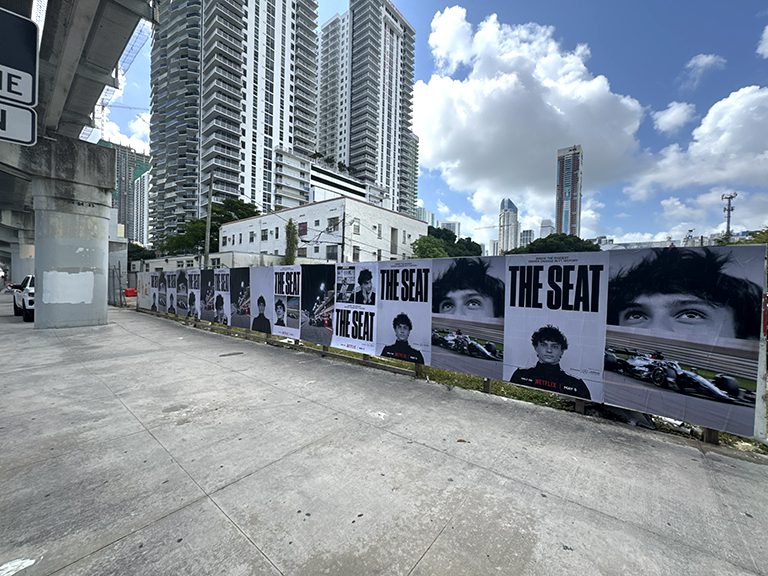
environment posters work well at eye level on long horizontal surfaces like construction hoarding, below windows, and along fencing. A 36×24 environment poster (the same dimensions as a 24×36 rotated) fills a horizontal space much more naturally than a portrait poster placed sideways.
When we specify posters for a campaign, we always ask about the target surfaces before deciding on orientation. A wall that is 8 feet wide and 4 feet tall calls for environment. A standard wall panel that is 3 feet wide and 6 feet tall calls for portrait. The surface drives the format decision.
Resolution Requirements by Poster Size
Every poster size has a minimum resolution requirement for clean print output. Ignoring resolution specs is how campaigns end up with blurry, pixelated images that embarrass the brand and waste the print budget.
The standard rule is 300 DPI (dots per inch) at final print size for high-quality output. But for large format outdoor posters, 150 DPI at print size is often sufficient because viewers see the poster from a greater distance. A 40×60 outdoor poster designed at 150 DPI will look sharp from the sidewalk even though it would look soft up close.
For small and medium format posters (11×17, 18×24, 24×36), always design at 300 DPI or higher. Viewers get close to these formats. A fuzzy image at close range looks unprofessional. File size will be large. That is fine. Do not compress your design files to save storage and compromise print quality.
Color Mode for Poster Printing
Poster files sent to commercial print shops must be in CMYK color mode, not RGB. Screens display RGB. Printing presses use CMYK. An RGB file will look different on press than it did on your monitor. Colors shift, sometimes dramatically. Convert to CMYK before sending files.
This applies to every poster size. 11×17 files need CMYK just as much as 40×60 files. The size does not affect the color mode requirement. What changes with size is ink coverage and paper cost. Larger posters use more ink. Factor that into print budgets.
How We Choose Poster Size for a Campaign
We do not pick a poster size based on preference. We base it on the specific campaign requirements, target locations, and budget. Here is how we approach size selection for a new campaign.
First, we identify the target locations. What surfaces are available in the target neighborhoods? What are their dimensions? A utility pole or light post has less usable surface than a flat wall. A construction barrier has more. We measure or estimate wall surfaces before finalizing poster size.
Second, we consider viewing distance. How far away will people be when they first see the poster? If the poster is on a busy sidewalk where pedestrians walk within 3-5 feet of it, an 18×24 reads perfectly. If the poster is on a building wall across a wide street, you need 24×36 or bigger for the message to land.
Third, we consider print budget. Larger posters cost more per unit. A 40×60 poster can cost three to four times as much as an 18×24 on the same paper stock. When budget is limited, more 18×24 placements often outperform fewer 40×60 placements in terms of total campaign reach.
Fourth, we confirm production logistics. Who is printing? What format does their equipment support? How are the posters being transported and stored? Large format posters require different handling than small format. Rolled posters need tubes. Flat posters need protective sleeves. The logistics have to work before we commit to a size.
International Poster Sizes: ISO A-Series
Outside the United States, the ISO A-series paper standard is the basis for most poster sizes. These are metric sizes based on a consistent aspect ratio that allows halving and doubling across sizes.
The most relevant ISO sizes for poster work are:
A4: 210 x 297 mm (8.3 x 11.7 inches) – roughly equivalent to US letter, used for small indoor posters internationally
A3: 297 x 420 mm (11.7 x 16.5 inches) – between US tabloid and letter, common for event flyers in Europe
A2: 420 x 594 mm (16.5 x 23.4 inches) – close to US 18×24, widely used for street poster campaigns internationally
A1: 594 x 841 mm (23.4 x 33.1 inches) – close to US 24×36, the main large-format poster size internationally
A0: 841 x 1189 mm (33.1 x 46.8 inches) – very large, equivalent to roughly 33×47 inches
US-based brands running campaigns in Europe or Asia should specify ISO sizes. Most international print shops work on the A-series system. Ordering US sizes from international printers adds cost and confusion.
Frequently Asked Questions
What size are most posters?
The most common poster sizes are 18×24 and 24×36 inches. These cover the majority of street-level outdoor campaigns, retail display posters, and event promotion. For indoor venues and small spaces, 11×17 is the most common format.
What is the standard outdoor poster size?
For street-level outdoor poster campaigns, the standard size is 24×36 inches. This format is large enough to command attention from sidewalk distance and small enough to hang as a single piece without panel work. For tighter spaces, 18×24 is the second most common outdoor size.
How big is a movie poster?
Movie theater one-sheets are 27×40 inches. This is the industry standard for cinema lobby frames. Promotional materials for the same film may appear in different sizes outdoors, in retail, or in transit advertising, but the one-sheet is always 27×40.
What is the smallest useful poster size for outdoor use?
We consider 11×17 the smallest useful size for outdoor placement. Anything smaller disappears in the visual noise of a busy street. Even 11×17 needs strong, bold typography and minimal text to read effectively outdoors. For maximum readability from the sidewalk, 18×24 is more reliable.
What resolution do I need for a 24×36 poster?
Design at 300 DPI for a 24×36 poster. This gives you sharp output at close viewing distances. The final file size will be large, which is expected for high-resolution large-format print files. Do not reduce DPI to shrink file size before sending to print.
Can I print a poster in a size not on this list?
Yes. Custom sizes are available from most commercial print shops. The cost is usually higher because custom sizes require custom cuts. If you have a specific wall size you need to fill, we can help you spec a poster to match. Custom sizing is common in our campaign work.
B-series sizes are an ISO standard intermediate between A-series sizes. B1 is 707 x 1000 mm (about 27.8 x 39.4 inches), which is close to the US one-sheet. B-series is used in some European markets and in Japan. In the US, B-series sizes are less common for poster work.