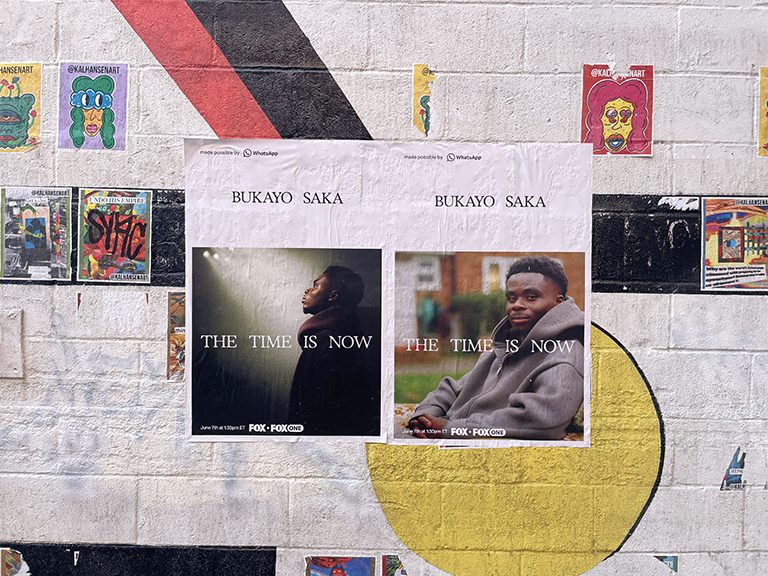
The typical poster size in the United States is 18 inches by 24 inches. That is what you get when you walk into most print shops and ask for a poster without specifying a size. It is the format that most graphic designers open when they start a new poster document. It is the size that most venue windows, bulletin boards, and retail display frames were built to accommodate.
For outdoor campaigns and large-format applications, the typical size steps up to 24 inches by 36 inches. Both formats are genuine industry standards with deep roots in print production, display hardware, and cultural usage across the United States.
We produce poster campaigns for clients in New York, Los Angeles, Chicago, Miami, and dozens of other markets. We know which dimensions are typical in each context and why. This guide tells you everything you need to know about typical poster sizes and how to choose the right one for your campaign.
The word “typical” means the most frequent. When you look across all of these contexts and find the format that appears most often, it is 18×24. That single format spans event promotion, retail, academic use, and general indoor campaigns. It is not always the best format, but it is reliably the most typical.
What “Typical” Means in Practice
Typical is not the same as optimal. The typical size became typical because it solved the most common problems in the most cost-effective way. But if your campaign has specific requirements that differ from the typical, you should not default to typical just because it is familiar.
Here is when you should stick with the typical 18×24:
Your placements are primarily in indoor venues with viewing distances under 15 feet
You are distributing posters through partner venues that handle their own placement
Your print budget favors lower per-unit cost over maximum visual impact
Your campaign is in a context where 18×24 is the recognized norm (music, local events)
Here is when you should move away from the typical 18×24:
Your primary placements are outdoor and compete with heavy visual noise
Your viewing distance exceeds 15 feet consistently
Your brand position calls for a format that signals more investment and visual ambition
Your placements are on large surfaces that make 18×24 look undersized
Typical Is a Starting Point, Not a Finish Line
We always ask clients to think about their placement surfaces before settling on typical sizes. The typical answer is often the right answer. But we have run campaigns where moving from 18×24 to 24×36 doubled the engagement with the poster material without significantly increasing production costs because we were running low total quantities anyway. Know your context before you commit to typical.
The Typical Poster Size for Each City’s Street Culture
Typical sizes vary slightly by market based on the dominant surfaces, pedestrian density, and visual culture of each city:
New York City
New York is poster-dense. The visual competition is intense in neighborhoods like the East Village, Williamsburg, Bushwick, and Bedford-Stuyvesant. The typical street campaign size in New York leans toward 24×36 for outdoor placements because anything smaller gets overwhelmed by the surrounding visual environment. For indoor venue placements, 18×24 remains typical.
Los Angeles
Los Angeles spreads across a much larger geography with more car-oriented viewing contexts. In pedestrian-dense neighborhoods like Silver Lake, Echo Park, Koreatown, and the Arts District, 18×24 and 24×36 are both typical. In car-oriented corridors, posters need to be larger to catch moving viewer eyes. The typical size for a car-facing placement in LA is often 24×36 or larger.
Chicago
Chicago neighborhoods like Wicker Park, Logan Square, and Pilsen have strong poster cultures with dense foot traffic. In these areas, 18×24 is typical for venue-based campaigns and 24×36 is typical for outdoor street-level placements. The flat, wide sidewalks and regular building facades of Chicago’s grid make both sizes work cleanly.
Austin
Austin’s music and events scene is one of the densest per capita in the country. The typical poster size in Austin’s venue-heavy East 6th Street and Red River Cultural District corridors is 18×24. For the outdoor visual environment during major music festivals, 24×36 becomes typical for premium placements.
How Typical Poster Sizes Relate to Print Costs
Cost is a major reason why the 18×24 became typical. Here is a straightforward breakdown:
Size
25 pieces
100 pieces
500 pieces
11 x 17
$35 – $75
$80 – $175
$250 – $500
18 x 24
$75 – $175
$175 – $350
$500 – $1,100
24 x 36
$150 – $350
$350 – $700
$1,000 – $2,500
36 x 48
$250 – $600
$600 – $1,500
$2,000 – $5,000+
These are rough estimates based on standard gloss text stock at commercial print shops. Prices vary significantly by vendor, geography, and substrate. The point is the relationship: each size step roughly doubles the cost. The 18×24 occupies the sweet spot where you get genuine poster-scale impact without doubling into large-format territory.
Typography and Design for Typical Poster Sizes
Designing for typical poster sizes requires understanding how type scales to real-world reading distances. Here is a practical guide:
Poster Size
Min. Headline Size
Min. Body Copy Size
Max Readable Distance
11 x 17
48 pt
18 pt
8 feet
18 x 24
72 pt
24 pt
15 feet
24 x 36
96 pt
36 pt
25 feet
36 x 48
144 pt
48 pt
40 feet
These minimums assume a bold sans-serif typeface and high contrast between text and background. Serif fonts and low-contrast designs may need to be even larger to reach the same reading distances.
The Biggest Typography Mistake in Poster Design
The most common mistake we see in submitted poster files is type that is beautiful on screen but invisible at the actual viewing distance. Always print a physical test at the actual output size and walk back to your anticipated viewing distance. If you cannot read it clearly, the type is too small. Fix it before your full print run.
Typical Poster Size for Special Contexts
Window Posters
Window posters at retail locations and venues are typically 18×24 for small windows and 24×36 for larger glass panels. The poster should cover 50 to 75 percent of the visible window area for maximum impact without fully blocking the view.
Door Posters
Standard interior and exterior commercial doors are 36 inches wide. A 24×36 poster fits comfortably on a door without overlapping the frame. An 18×24 fits with plenty of margin and looks proportional on a door. Both are typical door placement sizes.
Elevator Lobby Posters
Elevator lobby walls in commercial buildings are typically 8 to 10 feet tall. A 24×36 poster hung at eye level on an elevator lobby wall looks intentional and professional. A 36×48 creates an even stronger visual presence in larger lobbies. The 18×24 can look small in high-ceilinged lobby spaces.
What is the typical poster size in the United States?
The typical poster size in the U.S. is 18 inches by 24 inches for indoor and general applications. For outdoor and high-visibility campaigns, 24 inches by 36 inches is the typical large format. Both sizes are widely available and recognized as standard across the industry.
Is 18×24 the only typical poster size?
No. The 18×24 is the most universally typical, but other sizes are typical in specific contexts. The 22×28 is typical for retail floor stands. The 27×40 is typical for film and theater. The 24×36 is typical for outdoor campaigns. The right typical size depends on your industry and placement context.
What is the typical movie poster size?
The typical U.S. movie poster size is 27 inches by 40 inches. This one-sheet format has been the industry standard in American theaters for over a century. It is the size that theater display hardware and transit advertising systems are designed around.
What resolution do I need for a typical 18×24 poster?
Set up your 18×24 file at 150 DPI for viewing distances of 10 to 15 feet. That is a file size of 2,700 by 3,600 pixels. For close-up or gallery-quality viewing, use 300 DPI (5,400 by 7,200 pixels).
How much does it cost to print a typical poster?
A typical 18×24 poster costs $1.50 to $3.50 per piece in quantities of 100 at a standard commercial print shop. A 24×36 costs $3.50 to $7 per piece at the same quantity. Online print shops offer lower pricing but longer shipping times.
Does the typical poster size work for outdoor campaigns?
The 18×24 can work for outdoor placements close to the viewer (under 10 feet). For most outdoor street-level campaigns where viewing distance is 10 to 25 feet, the 24×36 is a more appropriate typical outdoor size. The larger format maintains readability at greater distances.
Can I mix typical and non-typical poster sizes in one campaign?
Absolutely. Many effective campaigns use a mix of 18×24 for indoor placements and 24×36 for outdoor placements. The designs can share visual elements while the sizes are optimized for each placement context. Mixing sizes is a smart strategy, not a compromise.
What is the typical poster size for a trade show?
For trade show applications, 24×36 is typical for individual tabletop panels and small booth displays. Full-height booth backdrops typically use 36×48 or larger. Tabletop tri-fold boards unfold to 36×48. Always check the dimensions of your specific trade show display hardware before ordering.
Frequently Asked Questions
What is the typical poster size in the United States?
The typical poster size in the U.S. is 18 inches by 24 inches for indoor and general applications. For outdoor and high-visibility campaigns, 24 inches by 36 inches is the typical large format. Both sizes are widely available and recognized as standard across the industry.
Is 18×24 the only typical poster size?
No. The 18×24 is the most universally typical, but other sizes are typical in specific contexts. The 22×28 is typical for retail floor stands. The 27×40 is typical for film and theater. The 24×36 is typical for outdoor campaigns. The right typical size depends on your industry and placement context.
What is the typical movie poster size?
The typical U.S. movie poster size is 27 inches by 40 inches. This one-sheet format has been the industry standard in American theaters for over a century. It is the size that theater display hardware and transit advertising systems are designed around.
What resolution do I need for a typical 18×24 poster?
Set up your 18×24 file at 150 DPI for viewing distances of 10 to 15 feet. That is a file size of 2,700 by 3,600 pixels. For close-up or gallery-quality viewing, use 300 DPI (5,400 by 7,200 pixels).
How much does it cost to print a typical poster?
A typical 18×24 poster costs $1.50 to $3.50 per piece in quantities of 100 at a standard commercial print shop. A 24×36 costs $3.50 to $7 per piece at the same quantity. Online print shops offer lower pricing but longer shipping times.
Does the typical poster size work for outdoor campaigns?
The 18×24 can work for outdoor placements close to the viewer (under 10 feet). For most outdoor street-level campaigns where viewing distance is 10 to 25 feet, the 24×36 is a more appropriate typical outdoor size. The larger format maintains readability at greater distances.
Can I mix typical and non-typical poster sizes in one campaign?
Absolutely. Many effective campaigns use a mix of 18×24 for indoor placements and 24×36 for outdoor placements. The designs can share visual elements while the sizes are optimized for each placement context. Mixing sizes is a smart strategy, not a compromise.