What Is the Regular Poster Size? The Definitive Answer
The regular poster size depends on what you’re doing. For street campaigns, it’s 24×36. For schools, it’s 22×28. For movies, it’s 27×40. Here’s the complete breakdown.
What is the regular poster size? This question comes up in almost every conversation before a new campaign kicks off. And the answer isn’t one number. “Regular” is context-dependent.
In advertising and outdoor marketing, regular means 24×36 inches. That’s the format our crews order, the format most print shops stock as a default, the format that dominates street campaigns in New York, Los Angeles, Chicago, and every other major US market. It’s been the workhorse of outdoor poster advertising in the US for generations, and it’s still the right choice for most commercial campaigns.
In schools and offices, regular means 22×28 inches, the standard poster board you buy at the craft store. In movie theaters, regular means 27×40 inches, the one-sheet. Each context has its own definition of regular.
This guide covers all of them, so you know exactly what “regular” means in your specific situation. It also covers the real-world application of these sizes across different campaign types and environments, because knowing the dimension is only the starting point.
Regular Poster Size for Advertising Campaigns: 24×36
When our clients ask for a regular poster for a street campaign, we deliver 24 inches by 36 inches. That’s the baseline. It’s the format that fits most urban posting surfaces, prints efficiently, and delivers enough visual impact to stop a pedestrian from a reasonable distance.
24×36 became the advertising standard for reasons rooted in print technology. Large-format printers use 24-inch rolls as one of the most common widths. A 24×36 portrait poster uses that roll perfectly, edge to edge, with no horizontal waste. The height of 36 inches is also a natural cut for most roll-fed printers, minimizing paper consumption per sheet.
On the design side, 24×36’s 2:3 aspect ratio is one of the most aesthetically balanced proportions in common use. It’s close to the golden ratio. It mirrors the proportions of 35mm film photography. Designers gravitate toward it naturally, and clients recognize the format as “real” advertising because they’ve grown up seeing it on walls.
Field Standard: For any outdoor campaign posting on walls, construction boards, or building surfaces, 24×36 is the regular poster size. If a client says “give me a poster,” we assume 24×36 unless they tell us otherwise. It’s the running default in US advertising.
Regular Poster Size Reference Table
Here’s a quick-reference table showing what “regular” means across different contexts.
Different industries settled on different “regular” poster sizes because of the physical constraints of their display environments.
Theater chains built display cases with inside dimensions that accept 27×40-inch sheets. Once thousands of theaters installed those cases, the poster size was locked in. You can’t change the display hardware across thousands of locations, so the 27×40 one-sheet became permanently “regular” for theatrical display.
Print roll widths standardized at 24 inches (among other widths) for large-format inkjet printers in the 1990s and 2000s. A 24-inch roll makes a 24×36 portrait poster with zero waste. That efficiency made 24×36 the economical default for advertising runs, and “regular” in advertising language reflects that.
School supply manufacturers settled on 22×28 because it fits comfortably on a school desk, holds a reasonable amount of content for a student project, and travels easily without a special tube or carrier. Those practical constraints made 22×28 the dominant school poster board format at retail.
There’s no central authority deciding these standards. They emerged from practical pressures in each industry. Once running, the standards become self-reinforcing because equipment, frames, and display hardware are built around them, which makes any deviation expensive.
The Most Common Regular Poster Size for Each Placement Type
Let’s get specific about placement types. What size is “regular” for each physical location where posters appear?
Construction Wall Panels
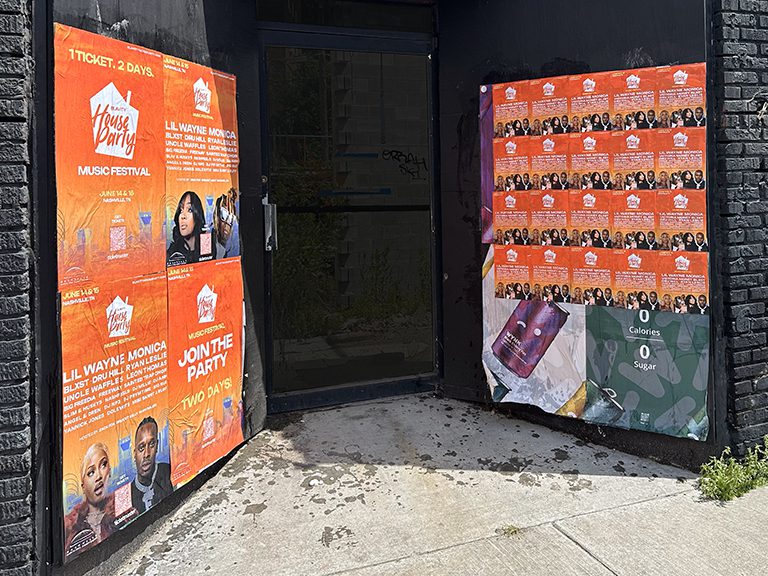
Construction hoarding (the plywood fencing around active building sites) is one of our primary posting surfaces in cities like New York. A standard plywood panel is 4 feet (48 inches) wide by 8 feet (96 inches) tall. For this surface, regular means 24×36, tiled in two columns of three (6 posters per panel) or two columns of two (4 posters) depending on the available height.
Utility Poles and Street Furniture
Utility poles are narrow, usually 4 to 8 inches in diameter. At this scale, regular means 11×17. Anything wider wraps awkwardly around the pole surface. 11×17 wraps neatly, with the poster content visible on two faces of the pole as pedestrians approach from different directions.
Bar and Restaurant Windows
A standard bar or restaurant window in a neighborhood like the East Village in New York or Wicker Park in Chicago has a glass pane typically 24 to 36 inches wide and 40 to 60 inches tall. Regular for this context is 11×17, placed at eye level without obstructing the view into the space. Some venues will accept 18×24 if the window is large enough.
Music Venue Hallways and Bathrooms
Inside a venue, wall space is typically 8 to 10 feet tall and available in sections between doors, emergency exits, and HVAC equipment. Regular for this environment is 18×24, the classic concert poster format. Two or three 18×24 pieces tiling vertically on a narrow wall section creates a gallery-like display.
Record Shop Windows and Interior Walls
Record shops on 6th Street in Los Angeles, on the Lower East Side in New York, and in neighborhoods like Wicker Park in Chicago typically display 12×18 or 18×24 promotional pieces alongside album art. Regular for this context is 18×24, sized to fit the standard display racks used by labels and distributors.
Regular Poster Size and Printing: What to Order
Once you’ve running what “regular” means for your campaign, the printing conversation becomes straightforward.
For a 24×36 street campaign poster:
Paper: 80 to 100 lb satin or uncoated text stock
Resolution: 150 DPI minimum (file = 3,600 x 5,400 pixels at 150 DPI)
Color mode: CMYK
Bleed: 0.125 in on all sides
Typical cost: $1.50 to $4.00 per sheet in 500+ unit runs
For an 18×24 concert poster:
Paper: 80 to 100 lb uncoated or satin stock (matte is popular for concert art)
Resolution: 150 DPI minimum (file = 2,700 x 3,600 pixels at 150 DPI)
Color mode: CMYK
Bleed: 0.125 in on all sides
Typical cost: $1.00 to $3.00 per sheet in 250+ unit runs
For an 11×17 interior poster:
Paper: 80 lb gloss or satin text stock
Resolution: 150 DPI (file = 1,650 x 2,550 pixels at 150 DPI)
Color mode: CMYK
Bleed: 0.125 in on all sides
Typical cost: $0.50 to $1.50 per sheet in 500+ unit runs
Regular Poster Size in Context: How Campaigns Actually Use These Dimensions
Understanding the standard dimensions is only half the equation. The other half is understanding how campaigns deploy these sizes in the real world. Here’s what regular poster size usage looks like in actual street-level campaigns.
The Two-Size Campaign
The most common format for professional street campaigns is the two-size approach: a large anchor size (24×36) for high-visibility locations and a smaller secondary size (11×17 or 18×24) for volume coverage. The anchor pieces run in 50 to 100 key locations. The secondary pieces run in 500 to 2,000 locations across the target area. The anchor creates impact. The secondary creates saturation. Together they build both awareness and presence.
The Single-Size Volume Campaign
When budget is the primary constraint, many campaigns go single-size at 11×17 in high volume. A $1,500 print budget at 11×17 produces 1,000 to 2,000 copies. That many copies, placed intelligently across a target neighborhood, creates genuine saturation. A poster that appears ten times between a consumer’s home and their coffee shop becomes a recognized brand presence within a week.
The Premium Single-Placement Campaign
For brands with access to high-quality wall space and premium display locations, the regular size steps up significantly. A 27×40 placed at a key location in SoHo, on Fairfax in LA, or on Wicker Park’s main drag commands attention from a block away. These premium single-placement programs work best for brands that already have high awareness and are using outdoor to reinforce and elevate rather than introduce.
How Regular Poster Size Choices Affect Campaign Outcomes
The choice of poster size has downstream effects on several campaign outcome metrics that are worth thinking through before you finalize your specs.
exposures per day: A 24×36 in a high-traffic location might reach 3,000 to 8,000 exposures per day. An 11×17 in the same location reaches the same audience but commands less attention from each passerby. Size correlates positively with impression quality, even if not with impression count.
Recall rate: Larger formats generate stronger recall because they are more visually dominant in the environment. Post-campaign recall surveys consistently show higher unprompted brand recall associated with 24×36 and larger formats versus 11×17.
Photography and documentation: A 24×36 poster on a quality wall creates a clean, shareable image. A cluster of 11×17 posters creates a different visual texture. Think about what the campaign documentation will look like before choosing your size, especially if you’re planning to document the campaign for social or press purposes.
Posting durability: Larger posters on wheat-paste applications tend to survive weather better than smaller ones because they have more surface area adhering to the wall. An 11×17 applied in wind or rain is more likely to tear or detach than a 24×36 applied correctly. For longer-running campaigns (two weeks or more), size up to improve durability.
Why Regular Poster Size Has Stayed Consistent Over Decades
In an industry that reinvents itself constantly, it’s worth asking why standard poster sizes haven’t changed much in fifty years. The formats that were regular in the 1970s are largely the same formats that are regular today. This stability is not inertia. It reflects the fact that the underlying constraints that created these sizes haven’t changed either.
The human visual system hasn’t changed. A 24×36 poster is still visible from 50 feet because human eyes and the physics of light haven’t changed. The relationship between poster size and viewing distance that determined the 24×36 standard in the first place still holds today.
Urban street architecture hasn’t changed much either. The width of a sidewalk, the height of a construction hoarding, and the spacing between building facades in a dense urban neighborhood are similar now to what they were in 1975. The physical environment that determines where posters can go and how they get seen hasn’t been fundamentally altered by digital technology. Cars are in the road, people are on the sidewalk, and posters are at eye level on walls. That hasn’t changed.
Print technology has actually reinforced the standard sizes. Large-format inkjet printers optimized their roll widths and cut mechanisms around the formats that were already in demand. The equipment standardized around the poster formats rather than the formats changing to accommodate new equipment. As a result, the 24×36, 18×24, and 11×17 formats are genuinely optimized for current print production in ways that arbitrary alternative sizes would not be.
The practical lesson: don’t fight the standards unless you have a specific creative or logistical reason to do so. The regular poster sizes are regular because they work in the environments where they’re placed, at the production costs that make campaigns viable, and at the visual scale that reaches human audiences in real urban spaces. Those fundamentals don’t become outdated just because the advertising world adds new channels every year.
Frequently Asked Questions
What is the regular poster size for a business?
For outdoor business advertising, 24×36 inches is the regular size. For interior window or lobby placements, 11×17 or 18×24 is more common. The right size depends on the specific placement location and viewing distance.
What is the regular poster size for events?
For outdoor event promotion, 24×36 is the regular outdoor size. For interior venues and window placements, 18×24 or 11×17 is standard. Large outdoor events with available wall space may go to 27×40 or larger.
Is regular poster size the same worldwide?
No. The US regular poster size for advertising is 24×36 inches. In Europe, the equivalent is A1 (23.4×33.1 inches). In Japan, the B2 format (20.1×28.7 inches) is common. Each region has its own regular size based on local printing and display infrastructure.
How do I know if my poster is the regular size?
Measure it. Or check the dimensions in your file (canvas size in Photoshop, document size in Illustrator). If you’re designing a poster and haven’t set a size yet, set it to 24×36 inches for outdoor use, or 11×17 for interior use, as a starting point.
What frame fits a regular 24×36 poster?
A standard 24×36 frame, available at IKEA, Target, and Michael’s, fits a regular 24×36 poster. These frames are widely stocked in black, white, and natural wood finishes. Prices range from $15 to $80 depending on material and brand.
What is the regular poster size for a school project?
School projects use 22×28 inch poster board as the regular size. This is the standard foam-core or cardboard board sold in school supply sections at major retailers. It’s not a printed poster; it’s a physical board you write or draw on.
Can I request a custom size instead of the regular size?
Yes. Most print shops will produce custom sizes, but they charge more for non-standard cuts due to paper waste and additional setup. For a one-off piece, custom sizing is usually worth the premium. For a campaign run of 500 or more, sticking to regular sizes saves meaningful money.