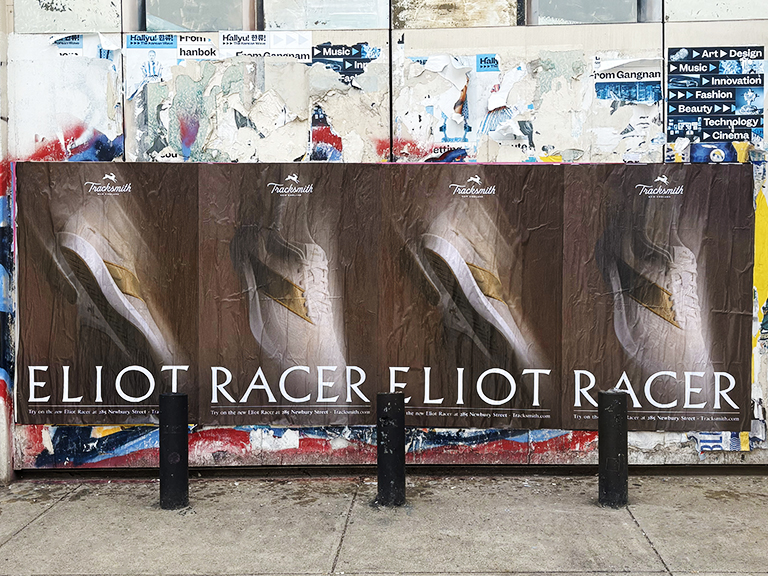
The size of a standard poster in the United States is 18 inches by 24 inches. That is the benchmark. Most print shops stock this size as their go-to format. Most designers use it as their starting canvas when someone asks for a poster. Most venues, event organizers, and retail businesses recognize it as the normal format without any explanation needed.
For outdoor campaigns and high-traffic placements, the standard steps up to 24 inches by 36 inches. Both formats are genuine standards. Which one is “the” standard for your campaign depends on where you are placing your posters and what you need them to do.
We have placed tens of thousands of posters across New York City, Los Angeles, Chicago, Miami, and other U.S. markets. We know which standard size works where and why. This guide covers everything you need to make a confident decision about your poster size.
The Two Standard Poster Sizes: A Side-by-Side Comparison
Feature
18 x 24 inches
24 x 36 inches
Width
18 inches (1.5 feet)
24 inches (2 feet)
Height
24 inches (2 feet)
36 inches (3 feet)
Surface area
432 sq inches
864 sq inches (2x larger)
Aspect ratio
3:4
2:3
Readable from
Up to 15 feet
Up to 25 feet
Best context
Indoor, events, windows
Outdoor, storefronts, high-traffic
Standard frames available
Yes, widely
Yes, at art/framing stores
Typical per-unit cost
$1.50 – $3.50 (100 pcs)
$3.50 – $7 (100 pcs)
These two sizes cover the majority of standard poster production in the United States. Learn both and you will be prepared for virtually every campaign scenario you encounter.
What Makes a Poster Size “Standard”?
Standard does not mean universal or required. It means that enough users in enough contexts have converged on a size to make it widely supported by the supply chain. A size becomes standard when:
Print shops stock media at that size and price it competitively
Frame manufacturers produce products for that exact dimension
Display hardware (floor stands, sign holders, bulletin boards) accommodates it
Design software includes it as a preset template option
Enough campaigns use it that audiences recognize it as a legitimate poster format
Both 18×24 and 24×36 pass all five tests. The 11×17 format passes most of them (strong in print and software, but weaker in frame and display hardware availability at retail). The 22×28 passes them strongly in the retail context. The 27×40 passes them in the film and entertainment context.
Standard Poster Size for Different Campaign Types
Concert and Music Events
The standard for music event posters is 18×24. This has been true for decades. Walk through any music neighborhood in any major U.S. city and you will see 18×24 posters everywhere. In Brooklyn, in Wicker Park, in East Nashville, on the blocks surrounding venues in Portland or Seattle. The 18×24 is the size of the concert poster world.
When acts reach a larger scale and campaigns extend to outdoor placements, 24×36 is used for key locations. But the standard indoor concert poster is 18×24.
Retail Promotions
For retail campaigns using floor stand displays, the standard is 22×28. That size matches the slot dimensions on most commercial point-of-purchase display hardware. For retail window displays, the standard is 18×24 for smaller windows and 24×36 for larger glass panels. In-store campaigns need to account for display hardware specifications before printing.
Film and Entertainment
The film industry uses 27×40 as its standard one-sheet. This has been the theatrical standard for over a century. Entertainment venues, transit advertising cases, and lobby display systems are all built around this size. For non-theatrical entertainment promotions (album releases, streaming shows, events), brands often default to 18×24 or 24×36 instead of the 27×40 film format.
Brand Awareness Campaigns
For general brand campaigns in urban markets, 24×36 has become the preferred standard because it delivers the visual scale needed to compete with other elements in a visually dense environment. In less competitive visual environments (smaller cities, quieter neighborhoods), 18×24 can serve brand awareness campaigns effectively.
How We Choose Between the Two Standards
When a client is deciding between 18×24 and 24×36, we ask three questions: Where exactly are the posters going? Who is the audience and how fast are they moving? What is the print budget? Indoors, under 15 feet, budget-sensitive: 18×24. Outdoors, over 15 feet, impact-focused: 24×36. When you have the budget and the placements warrant it, both sizes together is the strongest answer.
The Standard Poster Size for Indoor vs. Outdoor Use
The indoor-outdoor distinction is the most important factor in choosing a standard poster size. Here is how it plays out in real campaigns:
Standard Indoor Placement Sizes
Inside venues, retail spaces, lobbies, and cafes, the viewing distance is almost always under 15 feet. People walk past posters at arm’s length. They are moving slowly or stopped. They have time to read more content. The 18×24 standard is ideal here because it carries enough visual information for a complete message without being overpowering in a medium-sized interior space.
In larger interior spaces like hotel lobbies, event halls, or office building common areas, 24×36 is a better standard choice. The space is bigger, the ceiling is higher, and the viewing distance is longer. A 24×36 fills the visual field proportionally in these spaces where an 18×24 might look underdeveloped.
Standard Outdoor Placement Sizes
Outdoors, everything changes. The competition for visual attention is intense. Signage, storefronts, vehicles, and other posters all compete at the same time. Viewing distances range from 10 feet (close sidewalk passing) to 100 feet or more (reading from across a wide street or intersection). For standard outdoor poster campaigns, 24×36 is the baseline. Anything smaller tends to disappear.
For very high-traffic intersections or placements where viewers are approaching from significant distance, even the 24×36 standard may benefit from being supplemented with larger pieces. But for most street-level outdoor campaigns, the 24×36 is the right standard format.
Standard Poster Size: Print Production Essentials
When you order a standard poster print, here is what you need to know:
Spec
18 x 24 Standard
24 x 36 Standard
File format
Print-ready PDF or TIFF
Print-ready PDF or TIFF
Color mode
CMYK
CMYK
Resolution
150-300 DPI at final size
150-300 DPI at final size
Bleed
0.125 inch all sides
0.125 inch all sides
Safe zone
0.25 inch inside trim
0.25 inch inside trim
Typical paper stock
100 lb gloss text
100 lb gloss text or photo
Outdoor finish
UV laminate required
UV laminate required
Standard Poster Size in New York City Campaigns
In New York City, the standard poster size question has a clear answer on the street: 24×36. The density of competing visual content in Manhattan, Brooklyn, and Queens makes the 18×24 harder to defend in outdoor street contexts. The city is visually loud. A standard 18×24 can get swamped by surrounding signage, storefronts, and other posters.
For indoor NYC venue campaigns, 18×24 is the right standard. Bars, clubs, coffee shops, and record stores in Brooklyn’s Bushwick or Williamsburg, in the East Village, and in Bed-Stuy all use 18×24 as their standard for event and show promotion. It fits on walls, in windows, and on bulletin boards without dominating a room.
On scaffolding boards along avenues in Midtown and the Lower East Side, we run 24×36. The viewing angle is from the sidewalk across several feet of pavement. The 24×36 is legible. The 18×24, in that context, competes less effectively.
On construction fences along blocks in SoHo, in Greenpoint, on Atlantic Avenue in Brooklyn, and along portions of Flatbush, we size up based on the fence height and run. If there’s 6 feet of vertical clearance and the fence runs 30 feet, 24×36 creates a strong horizontal presence. If the clearance is tighter or the run shorter, 18×24 clustered in a tight grouping also works.
The street team reads the wall before posting anything. The standard is a starting point. The location is the final decision-maker.
Designing Effectively at Standard Poster Size
Getting the size right is the first step. Getting the design right at that size is what determines whether the poster actually communicates. Here is what we know about designing at standard poster dimensions.
Lead With One Thing
A standard poster has limited real estate. The most effective designs commit to one primary visual and one primary message. The primary visual should fill a significant portion of the canvas. The primary message should be in large, confident type that reads from across the room or from across the sidewalk. Everything else, dates, websites, supporting details, lives in a secondary visual hierarchy below the primary message.
Posters that try to say too many things say nothing. Every element you add to a poster competes with every other element for the viewer’s attention. The best posters are not the ones that fit the most information. They are the ones that communicate the most clearly with the fewest elements.
Type Size for Street Reading
Here is a practical rule: the minimum headline size for a 24×36 outdoor poster is 100-point type. At 150 DPI, that is approximately 2 inches of type height on the printed poster. At 15 feet, 2-inch type is comfortably legible. At 25 feet, you want at least 3 inches of headline type.
For 18×24 indoor posters where viewing distance is under 10 feet, 60 to 80-point type is the practical minimum for headlines. Secondary copy can drop to 30 to 40-point type. Anything below 24-point should be considered invisible for any viewer beyond 5 feet.
Color Contrast Is Not Optional
Posters exist in visually competitive environments. Your design needs to win the attention competition before it can communicate anything. High contrast between text and background is the most reliable way to do that. Black on yellow, white on black, red on white, yellow on dark navy. These combinations read from distance and in low light. Soft pastel-on-pastel designs may look attractive on screen. They disappear on the street.
Brand Mark Placement
The brand mark is not the hero of the poster. The message is the hero. The brand mark is the signature that tells viewers who is sending the message. It belongs at the bottom or in a secondary position within the layout, not dominating the canvas. An oversized logo reduces the space available for the message that will actually capture attention and communicate value. Lead with the message. Sign it with the brand.
Standard Poster Sizes Across Different U.S. Markets
The standard poster size doesn’t change from city to city. But how that size performs in different markets does change, based on wall availability, foot traffic density, visual competition, and local permitting environments. Here’s a quick breakdown of how the two main standards play in different U.S. markets.
New York City
As covered above, 24×36 is the outdoor standard for most NYC street campaigns. The density and visual competition of Manhattan, Brooklyn, and Queens makes larger formats the practical default for street-level work. Indoor venue campaigns default to 18×24. The city has some of the most active poster placement markets in the country, with scaffolding, construction fencing, and utility structures all serving as placement surfaces for 24×36 poster campaigns throughout all five boroughs.
Los Angeles
Los Angeles is a driving city, which shapes the poster environment significantly. With less pedestrian density than New York, street poster campaigns are more concentrated in specific walkable corridors: Silver Lake, Echo Park, Fairfax Avenue, Melrose, Venice, and the Arts District. In these neighborhoods, 24×36 is standard for outdoor placements. In the dense bar and club environment of Hollywood and West Hollywood, 18×24 is the go-to for indoor venue promotion.
Chicago
Chicago has a strong poster culture concentrated in neighborhoods like Wicker Park, Bucktown, Logan Square, and the Wicker Park corridor. The visual environment is somewhat less dense than New York, which means 18×24 can hold its own in many outdoor positions that would demand 24×36 in Manhattan. For major thoroughfares like Milwaukee Avenue or Division Street, 24×36 is still the preferred standard for maximum visibility.
Austin and Nashville
Both cities have active music and event poster cultures. The standard format in both markets is 18×24 for most music and event promotions. 24×36 is used for higher-profile campaigns and outdoor activations, but the visual competition is lower than in coastal markets, making 18×24 a stronger competitive choice in these cities than it would be in New York.
Ordering Standard Poster Sizes: A Practical Checklist
Before you place any poster print order, run through this checklist to avoid the most common and most costly mistakes.
Canvas size: Is your file set to the exact finished poster dimensions (18×24 or 24×36) with 0.125-inch bleed on all four edges?
Color mode: Is your file in CMYK, not RGB?
Resolution: Is your resolution 150 DPI or higher at the final output size?
Safe zone: Are all critical design elements at least 0.25 inches inside the trim line?
File format: Are you submitting a print-ready PDF with bleed marks, not a JPG or PNG?
Proof: Have you requested a digital proof before approving the full run?
Quantity: Is your quantity sufficient for your placement plan plus 10-15% overage for damage and loss?
Stock: Have you specified your paper stock explicitly (e.g., 100 lb gloss text, satin, UV laminate for outdoor)?
Turnaround: Have you confirmed the production and delivery timeline in writing?
Print corrections cost time and money. Running through this checklist before submission catches the issues that cause reprints before they become problems.
What is the size of a standard poster?
The standard poster size in the United States is 18 inches by 24 inches for most indoor and general applications. For outdoor and high-visibility placements, 24 inches by 36 inches is the standard large format. Both are widely recognized and produced by print shops across the country.
Is there one universal standard poster size?
The 18×24 comes closest to a universal standard. It appears in more contexts than any other single format. But the 24×36 is equally standard for outdoor campaigns, and the 22×28 is standard for retail in-store displays. The right standard depends on your specific application.
What is the standard poster size for a concert?
Concert posters are standardized at 18×24 inches for indoor venue use. For outdoor and high-profile placements, 24×36 is the standard upgrade. Both sizes are used across the music industry, with 18×24 being more common for general event promotion.
Can I order a standard poster from any print shop?
Yes. Both 18×24 and 24×36 are widely available at commercial print shops, online vendors, and local printers. These sizes are stocked in quantity by most large-format printing operations. You can typically get standard sizes with 1 to 3 business day turnaround at most commercial vendors.
What resolution do I need for a standard 18×24 poster?
At 150 DPI (appropriate for most poster viewing distances), design your file at 2,700 by 3,600 pixels. At 300 DPI (for close-up or gallery-quality viewing), design at 5,400 by 7,200 pixels. Always set your file to the actual output size in inches, not a scaled-down version.
Is the standard poster size the same for all countries?
No. The U.S. standard (18×24 and 24×36) uses inches. Europe and most of the world use the ISO A-series (A3, A2, A1). The proportions differ between systems. U.S. standard sizes are not interchangeable with ISO sizes without adjustment.
What paper stock is used for a standard poster?
The most common stock for standard poster printing (18×24 or 24×36) is 100 lb gloss text. This gives bright colors, crisp print quality, and reasonable durability for indoor use. For outdoor use, add a UV-resistant laminate over any paper stock to extend its weatherproof life.
Can I mix 18×24 and 24×36 in the same campaign?
Yes, and many campaigns benefit from this. Use 24×36 for high-visibility outdoor placements on walls, fences, and scaffolding where impact at distance matters. Use 18×24 for indoor venue, window, and bulletin board placements where viewing distance is shorter and budget efficiency matters. A mixed-size campaign covers both contexts without requiring two separate design concepts if your master file is set up with the right proportional relationship between the two sizes.
How many standard posters do I need for a neighborhood campaign?
For a single neighborhood blitz, 50 to 100 posters at 18×24 or 24×36 is a reasonable starting quantity. For a city-wide campaign across multiple neighborhoods or districts, 300 to 1,000 pieces at each size level is typical. Quantity scales with the number of placement locations in your target area.
Before placing any standard poster order: set your canvas to 18×24 or 24×36 with 0.125-inch bleed on all sides. Confirm CMYK color mode. Verify resolution is 150 DPI or higher at final output size. Proof your text one final time. Specify your paper stock and finish with the vendor. Confirm quantity and turnaround date in writing. These steps take ten minutes and prevent costly reprints.
Frequently Asked Questions
What is the size of a standard poster?
The standard poster size in the United States is 18 inches by 24 inches for most indoor and general applications. For outdoor and high-visibility placements, 24 inches by 36 inches is the standard large format. Both are widely recognized and produced by print shops across the country.
Is there one universal standard poster size?
The 18×24 comes closest to a universal standard. It appears in more contexts than any other single format. But the 24×36 is equally standard for outdoor campaigns, and the 22×28 is standard for retail in-store displays. The right standard depends on your specific application.
What is the standard poster size for a concert?
Concert posters are standardized at 18×24 inches for indoor venue use. For outdoor and high-profile placements, 24×36 is the standard upgrade. Both sizes are used across the music industry, with 18×24 being more common for general event promotion.
Can I order a standard poster from any print shop?
Yes. Both 18×24 and 24×36 are widely available at commercial print shops, online vendors, and local printers. These sizes are stocked in quantity by most large-format printing operations. You can typically get standard sizes with 1 to 3 business day turnaround at most commercial vendors.
What resolution do I need for a standard 18×24 poster?
At 150 DPI (appropriate for most poster viewing distances), design your file at 2,700 by 3,600 pixels. At 300 DPI (for close-up or gallery-quality viewing), design at 5,400 by 7,200 pixels. Always set your file to the actual output size in inches, not a scaled-down version.
Is the standard poster size the same for all countries?
No. The U.S. standard (18×24 and 24×36) uses inches. Europe and most of the world use the ISO A-series (A3, A2, A1). The proportions differ between systems. U.S. standard sizes are not interchangeable with ISO sizes without adjustment.
What paper stock is used for a standard poster?
The most common stock for standard poster printing (18×24 or 24×36) is 100 lb gloss text. This gives bright colors, crisp print quality, and reasonable durability for indoor use. For outdoor use, add a UV-resistant laminate over any paper stock to extend its weatherproof life.