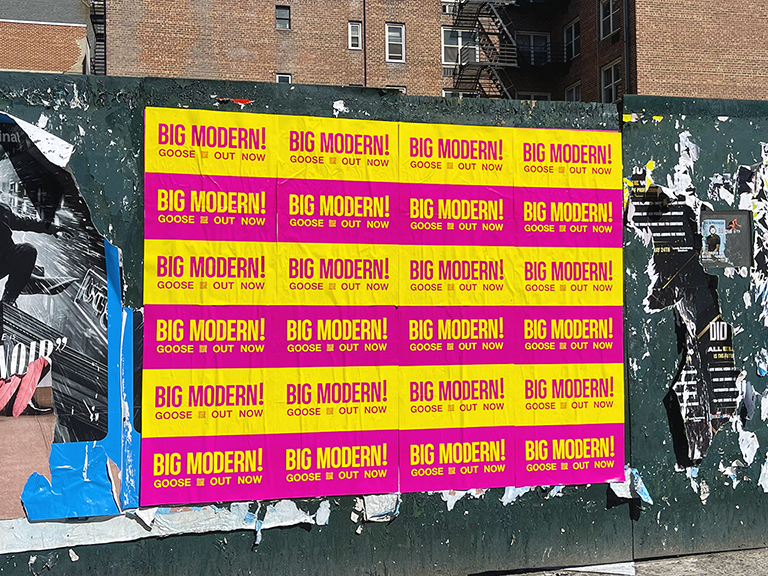
An 8 sheet is a large outdoor advertising format: 5 feet wide by 11 feet tall (60×132 inches). Here’s how it’s used, where it shows up, and how it fits in a real campaign.
The 8 sheet poster is an outdoor advertising format with roots in the billboard industry. It’s larger than anything you’d print on a standard large-format inkjet, and smaller than a full billboard. The format sits in a specific niche in outdoor advertising that’s worth understanding if you’re planning a large-scale urban campaign.
We work in outdoor poster campaigns across New York, Los Angeles, Chicago, Miami, and other major US markets. While our core work involves hand-posted campaign formats in the 11×17 to 24×36 range, we understand the full spectrum of outdoor formats including the 8 sheet. Here’s everything you need to know.
The 8 sheet poster measures 60 inches wide by 132 inches tall in standard US dimensions. That’s 5 feet wide by 11 feet tall.
Some sources describe the 8 sheet as 60×120 inches (5×10 feet). The exact dimensions can vary slightly depending on the display structure and the outdoor advertising company that owns the surface. The general range is 60 to 66 inches wide by 120 to 132 inches tall.
The name “8 sheet” refers to the original production method: the design was printed across 8 individual sheets of paper that were pasted together on the display structure to create the full image. Modern production typically prints the full design in fewer pieces using large-format printing equipment, but the “8 sheet” name persists as an industry term.
8 Sheet Dimensions at a Glance: Standard 8 sheet poster: 60 inches wide x 120 inches tall (5 feet x 10 feet). Some structures use 60×132 (5×11 feet). Always confirm the specific structure dimensions with the outdoor advertising vendor before producing artwork.
Where 8 Sheet Posters Are Used
8 sheet displays appear in specific urban environments. They’re not the same as a billboard (which is typically 14×48 feet) and they’re not the same as the standard paste-up poster (which is 24×36 or similar). The 8 sheet occupies a midpoint in scale.
Common 8 sheet locations include:
Parking lot perimeter fences and walls
Retail strip mall exterior walls
Transit kiosk and bus shelter backlit panels (not all, just some large-format shelters)
Urban fence panels in high-traffic pedestrian zones
Walls adjacent to parking garages in dense urban areas
Outdoor gym and grocery store exterior wall panels
The 8 sheet format is particularly common in neighborhoods with mid-height commercial buildings and open wall surfaces at street level. In cities like Los Angeles, 8 sheet panels are mounted on the sides of strip mall buildings along major commercial corridors like Wilshire Boulevard, Pico Boulevard, and Crenshaw. In New York, they appear in outer borough neighborhoods along commercial arterials.
How 8 Sheet Compares to Other Outdoor Advertising Formats
Outdoor advertising has a hierarchy of sizes. The 8 sheet fits in the middle of that hierarchy.
Format
Dimensions (inches)
Dimensions (feet)
Area (sq ft)
Standard paste-up poster
24 x 36
2 x 3
6
Two-sheet / transit panel
40 x 60
3.3 x 5
16.7
8 Sheet poster
60 x 120
5 x 10
50
16 Sheet poster
120 x 120
10 x 10
100
30 Sheet billboard
144 x 336
12 x 28
336
Bulletin billboard
168 x 576
14 x 48
672
The 8 sheet at 50 square feet is significantly larger than a transit panel (16.7 sq ft) but far smaller than a standard bulletin billboard (672 sq ft). It’s a format for high-traffic pedestrian areas where you want more visual impact than a standard poster but don’t have access to billboard-scale inventory.
Producing Artwork for an 8 Sheet Poster
If you’re producing artwork for an 8 sheet display, the scale requires a different approach than a standard campaign poster.
At 60×120 inches, the 8 sheet is viewed primarily from a distance. Pedestrians passing by on a sidewalk might be 5 to 15 feet away. Drivers passing in a car on a nearby road might be 20 to 50 feet away. Design for distance: large type, simple imagery, minimal text.
The rule of thumb for outdoor advertising is that you should be able to read the key message in three seconds or less while moving. On an 8 sheet, that means a maximum of seven words in the headline, one simple visual, and a short URL or brand logo.
Resolution requirements differ at this scale. Because viewers don’t get close enough to inspect fine detail, 72 to 150 DPI at full size is often acceptable. Most professional outdoor production houses work at 100 DPI for structures in the 8 sheet to 30 sheet range. Always confirm the production house’s specific requirements before submitting files.
File sizes can be very large at 100 DPI and 60×120 inches: 6,000 x 12,000 pixels. At 150 DPI: 9,000 x 18,000 pixels. These are large files that may require a high-performance workstation and storage to handle efficiently.
Design Rule for 8 Sheet: Three seconds. Seven words. One image. If your 8 sheet design can’t be understood in three seconds by a driver passing at 25 mph, it’s too complex. Strip it down. The scale creates visual power. Don’t compete with it using crowded design.
8 Sheet vs. Paste-Up Campaign Posters: Different Tools
We want to be clear about the distinction between the 8 sheet outdoor format and the paste-up poster campaigns we run.
An 8 sheet is a contracted outdoor advertising placement. You pay a vendor who owns a specific display structure for a period of time (typically 2 to 4 weeks). The vendor installs your printed material on their structure and maintains it for the contract period. Pricing is typically in the range of $500 to $2,500 per location per month depending on market and traffic.
A paste-up street campaign at 24×36 uses approved or negotiated surfaces on private or commercial property. Our crews place posters by hand on walls, construction boards, and other approved surfaces in target neighborhoods. The cost is in the printing and labor rather than in a contracted placement fee.
Both have their place in an outdoor campaign. 8 sheet provides long-duration, high-impact placements in specific contracted locations. Street paste-up campaigns provide broad geographic coverage across many locations with a shorter display window. The strategic choice depends on campaign goals, budget, and geography.
8 Sheet Poster Networks in Major US Cities
Outdoor advertising companies operate networks of 8 sheet display structures in major US markets. These networks allow advertisers to buy placements across multiple structures at the same time, creating a coordinated outdoor presence within a city or neighborhood.
In Los Angeles, 8 sheet structures are common in South LA, East LA, and the San Fernando Valley, areas with high pedestrian and vehicle traffic but less of the premium billboard inventory found in West Hollywood and downtown. In Chicago, 8 sheet panels appear along transit corridors in neighborhoods like Logan Square, Pilsen, and South Side. In New York, outer boroughs including Queens, the Bronx, and Staten Island have 8 sheet inventory that complements larger billboard campaigns in Manhattan.
For campaigns targeting specific neighborhood demographics, 8 sheet networks provide a cost-effective way to achieve scale in non-premium markets. The format reaches foot traffic and commuter traffic in residential commercial corridors that billboard structures don’t always penetrate.
Combining 8 Sheet with Street-Level Campaign Posters
The most effective outdoor campaigns don’t rely on a single format. They layer multiple formats to create multiple exposures across the same geographic area. An 8 sheet in a key location provides one type of impact. A coordinated run of 24×36 campaign posters in the surrounding neighborhood blocks provides a different and complementary type of impact.
The 8 sheet delivers: scale, duration, and a landmark-like presence in the locations where the display structures exist. The street-level paste-up poster delivers: coverage, frequency, and neighborhood penetration across a wider footprint. Together, they reinforce each other. The viewer who sees the 8 sheet on their commute and then encounters the same brand’s street-level posters in their neighborhood gets two distinct physical exposures from the same campaign. That repetition drives recall in ways a single format cannot.
When we plan campaigns that combine outdoor formats, the 8 sheet typically anchors the most heavily trafficked corridors while street-level formats penetrate the residential and neighborhood blocks where the 8 sheet structures don’t exist. The 8 sheet functions like a billboard in terms of its role in the plan: a high-impact, long-duration anchor that establishes brand presence at a landmark scale. The street-level work fills in the neighborhood fabric around it.
What to Know Before Buying 8 Sheet Outdoor Inventory
If you’re considering an 8 sheet buy as part of your outdoor campaign, here are the practical details that affect how you plan and budget.
Vendor Relationships
Most 8 sheet inventory is held by a small number of outdoor advertising companies in each market. In major markets, the dominant vendors include national OOH media companies, major outdoor advertising companies, and large outdoor media networks, among others. Each vendor controls different structures in different neighborhoods. To access a specific 8 sheet location, you need to work with the vendor who owns that structure. Independent media buyers can help navigate inventory across multiple vendors.
Contract Length
Standard outdoor advertising contracts for 8 sheet placements run in four-week periods. Most vendors require a minimum of one four-week flight. Multi-month buys at the same structure typically command a better per-period rate. For launch campaigns, one or two four-week flights at a key location are typical. For sustained brand awareness programs, three to six months at a network of locations can make strategic sense.
Production and Delivery Lead Time
Once the contract is signed, the vendor will provide print specifications and a delivery deadline. You typically need to deliver production-ready printed materials (either printed panels or a digital print file the vendor will produce) at least seven to ten business days before the campaign launch date. Rush placements are sometimes possible but add cost and risk.
Proof of Posting
Most reputable outdoor vendors provide proof of posting, which is a photograph documenting that your creative is live at the contracted location. Request this for every placement. It is the standard accountability mechanism in the outdoor advertising industry and is how you confirm your buy was actually executed correctly.
8 Sheet Poster Design: Practical Specifications
Getting the production file right for an 8 sheet requires attention to a few specific details that differ from standard poster production.
Trim and Bleed
Like any printed piece, an 8 sheet needs bleed around the edges. Typical outdoor bleed is 0.5 inches to 1 inch on all sides, larger than standard poster bleed because the print is trimmed or folded at a larger scale. Confirm the exact bleed requirement with your production vendor.
Safe Zone
Keep all critical content, including the headline, logo, and any phone number or URL, at least 2 to 3 inches inside the trim edge. At 60-inch scale, the safe zone needs to be proportionally larger than on a 24×36 poster. Content too close to the edge risks being obscured by the display frame, the paste seam, or weathering at the edges of the structure.
Color Calibration
Outdoor printing often uses UV-resistant inks on vinyl or specialized paper substrates. Colors can shift slightly in outdoor printing compared to standard CMYK offset printing. If color accuracy is critical for your brand, request a proof print from your production vendor and review it in natural daylight before approving the full production run.
8 Sheet Posters and the Digital Out-of-Home Transition
The outdoor advertising industry is shifting rapidly toward digital formats. Many 8 sheet structures that were historically static are being converted to digital displays. A digital 8 sheet uses an LED screen the approximate size of the traditional static format (5×10 feet) but delivers rotating creative rather than a single static image.
Digital 8 sheet displays have significant implications for campaign planning. On the positive side, digital formats allow multiple advertisers to rotate through the same screen in a scheduled loop, which reduces the cost per advertiser per location. You’re buying a share of the screen time rather than the full panel for the contract period.
The trade-off is that your creative is only visible for a portion of each loop. A standard digital out-of-home display loop might rotate six to eight advertisers, meaning your creative is visible roughly 12 to 16 seconds out of every 90 to 120 seconds of loop time. Passing pedestrians and vehicles may not see your creative at all depending on timing. The share-of-voice model is less impactful per impression than a static placement where your creative is always visible.
For campaigns where brand presence and duration matter more than cost efficiency, static 8 sheet placements are still available in most markets and remain the stronger choice. For campaigns where cost per impression is the primary objective and the creative translates to a short-attention format, digital 8 sheet can be an efficient entry point into large-format outdoor advertising.
Art direction for digital 8 sheet is somewhat different from static. Animation is possible and often more attention-grabbing in a digital format. However, text-heavy or slow-reveal designs don’t work in the short display window. The three-seconds, seven-words rule is even more important for digital than for static.
Choosing Between 8 Sheet and Street-Level Campaign Formats
This is the decision most brand campaign managers face when planning a large-scale outdoor presence. Here is how we think through it.
Choose an 8 sheet buy when: You need guaranteed long-duration placement at specific high-traffic locations. You are targeting commuter and vehicle traffic in addition to pedestrians. You want a premium format that delivers at a scale no paste-up campaign can match. Your creative is designed for distance viewing with a simple, high-impact message. You have the budget for contracted outdoor media in addition to or instead of street-level distribution.
Choose a street-level paste-up campaign when: You need broad geographic coverage across many neighborhood blocks. You’re targeting pedestrian audiences in specific cultural corridors. Your budget favors production and distribution costs over contracted placement fees. You need speed, flexibility, and the ability to change creative mid-campaign. You’re activating in a culture-forward context where handcrafted, grassroots aesthetics strengthen rather than undermine the brand message.
The two formats are not in competition. They work best when layered. An 8 sheet on a major commercial corridor establishes a high-visibility anchor point for the campaign. Street-level posters in the surrounding neighborhood blocks build frequency and penetrate residential areas that the 8 sheet doesn’t reach. Together, they create the kind of multi-layered outdoor presence that drives brand recall across a target market.
Budget permitting, running both formats at the same time in the same campaign window produces measurably better recall than either format alone. When the audience encounters both, they reinforce each other in memory. That reinforcement is the difference between a campaign impression that fades quickly and one that sticks.
Frequently Asked Questions
What is the size of an 8 sheet poster?
An 8 sheet poster is typically 60 inches wide by 120 inches tall (5 feet x 10 feet), with some structures running to 60×132 inches (5×11 feet). Exact dimensions vary by the display structure owner; always confirm before producing artwork.
Why is it called an 8 sheet?
The name comes from the original production method: the image was printed across 8 separate sheets of paper that were pasted together on the display structure. Modern production uses fewer, larger prints, but the “8 sheet” name is retained as an industry term.
What is an 8 sheet display panel used for?
8 sheet displays are used for outdoor advertising in pedestrian-heavy commercial areas. They appear on parking lot fences, strip mall exterior walls, and urban fence panels in high-traffic neighborhoods. They’re common for local and regional advertising campaigns.
How does an 8 sheet compare to a standard billboard?
An 8 sheet (5×10 feet / 50 sq ft) is much smaller than a standard billboard. A 30-sheet billboard is 12×28 feet (336 sq ft) and a bulletin billboard is 14×48 feet (672 sq ft). An 8 sheet is a pedestrian-scale format; a billboard is a vehicle-scale format designed for drivers at speed.
What DPI should an 8 sheet poster file be?
Most outdoor production houses accept 8 sheet artwork at 72 to 100 DPI at full size. Because viewers don’t get close enough to see fine pixel detail, lower resolution files work at this scale. Always confirm the specific vendor’s DPI requirements before submitting.
How much does an 8 sheet outdoor advertising placement cost?
Costs vary widely by market, location, and duration. In major urban markets, 8 sheet placements typically run $500 to $2,500 per location per four-week period. In smaller secondary markets, pricing can be lower. Network buys (multiple locations) often come with volume discounts.
Can I use the same artwork for a 24×36 poster and an 8 sheet?
Not directly. The aspect ratios are different (24×36 is 2:3 portrait; 8 sheet 60×120 is 1:2 portrait). A 24×36 design scaled to 8 sheet dimensions would be distorted or require significant reformatting. Design for each format separately based on its specific dimensions and viewing distance.