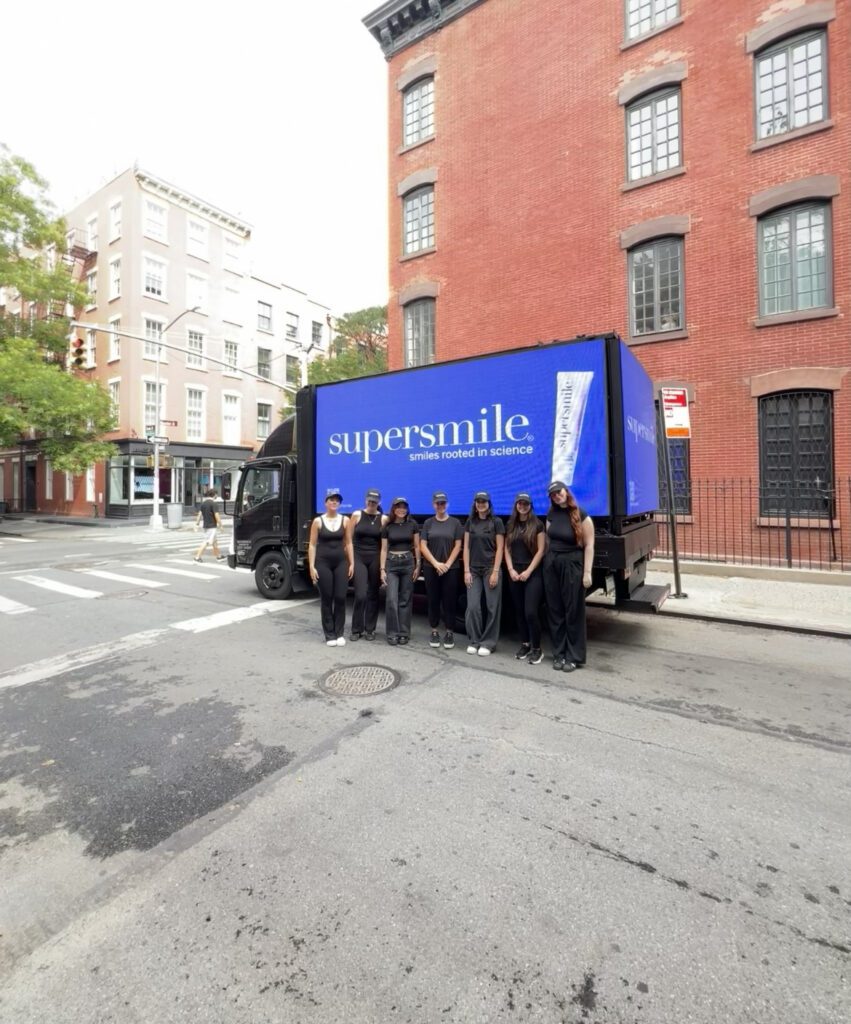
Chicago Mobile Marketing Agency | LED Trucks & Street Teams
A parked billboard stays in one place. A moving one covers every corner of Chicago in a single day. This is how mobile marketing actually works in this city.
Mobile marketing in Chicago works because the city’s grid is built for it. Long, flat, high-visibility corridors run from the lakefront through the Loop, up North Michigan Avenue, across the entertainment districts, and out into the neighborhoods. A vehicle with a message on it can cover North Michigan Avenue in the morning, circle the United Center on game day afternoon, hit the Wicker Park corridor in the evening, and reach Wrigleyville before the last inning. That kind of geographic reach in a single day is not possible with any static outdoor format.
We’re American Guerrilla Marketing. We run mobile marketing campaigns in Chicago and across the country. We place LED billboard trucks, branded vehicles, and mobile sampling units. We also run the street team side of mobile campaign work: crews that move with the truck, distribute materials, and create ground-level interaction alongside the mobile impression. This guide covers how we approach mobile marketing in Chicago specifically, what the formats look like on the ground, and what realistic campaigns cost in this market.
Mobile marketing is not one thing. It covers LED trucks with full-motion video displays, static wrapped vehicles, branded sampling vans, and even street team crews operating as moving units rather than stationed at fixed corners. The right format depends on the campaign goal and the audience you’re trying to reach. We’ll walk through each.
LED trucks are the highest-impact mobile format we run in Chicago. A full LED billboard truck carries a 14-foot-wide by 8-foot-tall full-motion video display on the back panel, often with additional side panels. At night, these displays are impossible to miss on any Chicago street. During the day, high-brightness LED panels maintain visibility even in direct sunlight on the open corridors of the Mag Mile and Lake Shore Drive.
Our standard Chicago LED truck circuit hits the following corridor sequence, adjusted based on campaign goals and timing:
North Michigan Avenue from the Chicago River bridge north to Oak Street, the full Mag Mile corridor with the city’s highest combined tourist and business foot traffic
State Street through the Loop from Wacker down to Congress, the retail and transit spine of downtown
Wacker Drive east to west, captures the river-view corridor where commuter and tourist traffic converges
North Damen Avenue through Wicker Park and Bucktown, for campaigns targeting the young adult creative demographic
Clark Street through Lincoln Park and Lakeview, residential affluent corridor and Wrigleyville approach
Western Avenue and Chicago Avenue, secondary corridors for neighborhood saturation campaigns
For event-specific campaigns, we adjust the circuit to concentrate near the venue in the hours before showtime. For a United Center event, that means the approach corridors on Madison Street from the Loop west toward the arena. For a concert at the Chicago Theatre on North State Street, that means State Street itself and the cross streets feeding into the venue from transit hubs.
Field note: Chicago’s grid makes LED truck route planning unusually clean compared to markets with complex street layouts. We can lay out a route that covers 40+ miles of high-value street corridor in an eight-hour deployment day without backtracking or losing time to navigation complexity. That efficiency translates directly to impression volume per dollar spent.
Branded Vehicle Campaigns
Not every mobile campaign calls for an LED truck. Branded vehicle campaigns use wrapped cars, vans, or trucks with static vinyl-printed creative. They cost less than LED trucks, they can park legally in locations where a truck cannot, and they work well for campaigns where the brand presence needs to feel integrated into the neighborhood rather than announced loudly to it.
A wrapped van parked on Damen Avenue in Wicker Park during the lunch and afternoon hours does something different than an LED truck circling the block. The van is ambient. People walk past it multiple times. It becomes part of the visual fabric of the block. That’s a different kind of impression, lower intensity but higher frequency for the specific pedestrians on that block.
We use branded vehicles for campaigns where the goal is neighborhood immersion rather than mass reach. A retail brand opening a Wicker Park location might run a wrapped van parked near the location for the two weeks before opening. A food and beverage brand might run a branded sampling van that parks near the lakefront on summer weekends and operates as both a distribution point and a moving awareness vehicle when traveling between locations.
Mobile Sampling Units
Sampling campaigns in Chicago work particularly well when the sampling vehicle is itself part of the brand experience. A branded Airstream or a custom-wrapped van creates a visual installation that draws people to it, rather than requiring the crew to chase people down. The vehicle is the attraction. The sample is the reward.
We’ve run mobile sampling campaigns on the Chicago Riverwalk during summer weekends, at the Navy Pier approach on North Lake Shore Drive, and at the lakefront access points between Oak Street Beach and North Avenue Beach. Summer weekends on these corridors produce sustained foot traffic from 10 AM through 7 PM, and a well-positioned sampling vehicle with strong branded creative and an engaged crew can generate thousands of meaningful brand interactions in a single weekend day.
For colder weather campaigns, the sampling strategy shifts to indoor-adjacent corridors: the underground pedway system connecting Loop buildings, the transit hubs at Clark and Lake or Chicago and State, and the indoor food court areas of the Millennium Park pavilion. Chicago’s underground pedway, which runs for miles through the Loop connecting hotels, office towers, and transit stops, is an underused sampling corridor that few agencies outside Chicago even know exists.
Street Teams as Mobile Units
Traditional street team campaigns station crews at fixed corners for the duration of a shift. Mobile street team campaigns are different. Our mobile crews move on a planned circuit, hitting specific corners, transit stops, and gathering points at planned intervals rather than staying in one place all day.
This approach works well in Chicago because the L stop network creates predictable pedestrian concentration points at very specific times. We can plan a mobile crew circuit that hits the Clark and Division stop during the 5 PM commute surge, moves to the Damen stop on the Blue Line for the early-evening bar traffic, and finishes on Milwaukee Avenue in Wicker Park for the late-evening dining and entertainment crowd. One crew, one shift, three distinct audience moments.
Mobile Format
Best Use Case
Typical Daily Cost Range
Ideal Duration
LED Billboard Truck
Mass reach, event campaigns, album or product launches
Targeted demographic reach, event support, distribution
$500 – $1,200/day
1-7 days
Planning a Chicago Mobile Marketing Campaign
The most important planning question for a Chicago mobile campaign is: who is the target audience and where does that audience move in the city? Chicago’s neighborhoods are distinct enough that a circuit optimized for reaching a 25-to-34-year-old creative professional looks nothing like a circuit optimized for reaching a 45-to-60-year-old affluent consumer or a 18-to-24-year-old college student.
Once we know the audience, we build the route. Then we build the timing: which days of the week, which hours of the day, and what event calendar factors should shape the schedule. A campaign running during a major concert week at the United Center gets different circuit weighting than the same campaign running during a standard non-event week.
We also build in documentation from the start. Every mobile campaign we run produces field photos and video from the truck or vehicle in motion, from crew interactions, and from the environments the campaign moves through. That documentation becomes campaign content that extends the reach of the field work into social media and internal reporting.
Campaign planning note: For LED truck campaigns timed to specific events, we recommend booking two to three weeks in advance. Chicago has a packed event calendar from April through October, and truck availability during major concert weeks, sporting event clusters, and festival periods can be limited. Earlier booking gives us more flexibility in route planning and crew scheduling.
Combining Mobile with Static Formats
The most effective Chicago campaigns we run combine mobile formats with static outdoor placements. A poster campaign in Wicker Park creates ambient presence over two to three weeks in the neighborhood. An LED truck deployment on the week of a product launch event creates a high-intensity impression spike citywide. Together, they produce a campaign that has both depth in the target neighborhood and broad market awareness during the key window.
We plan these combinations as an integrated strategy rather than separate line items. The poster campaign and the truck circuit are coordinated so the geographic coverage is complementary, not duplicative. The messaging is consistent across both formats so the audience gets the same brand signal whether they encounter it on a corner poster or on the side of a moving truck on North Michigan Avenue.
Chicago’s Event Calendar and Mobile Campaign Timing
Chicago runs one of the densest major event calendars of any American city from April through October. Understanding that calendar is core to effective mobile marketing planning in this market.
Lollapalooza in Grant Park is the single highest-concentration outdoor event in Chicago, drawing 400,000 attendees over four days in late July or early August. The approach corridors to Grant Park, Columbus Drive, Michigan Avenue south of the museum campus, and Lake Shore Drive, carry extraordinary pedestrian and vehicle traffic during that weekend. An LED truck running these corridors on Lollapalooza weekend reaches an entertainment-focused, brand-receptive audience at one of the highest densities in the city’s annual calendar.
Taste of Chicago, running in the same general Grant Park area, creates a similar corridor concentration. The Chicago Air and Water Show in mid-August draws lakefront crowds to Lincoln Park and the North Avenue Beach area. The Chicago Jazz Festival, the Chicago Blues Festival, and the Millennium Park concert series create recurring summer moments when specific areas of the city handle dramatically above-average foot traffic.
During the NBA and NHL seasons, United Center game nights generate concentrated pre- and post-game traffic on Madison Street between the Loop and the arena. During the baseball season, Wrigley Field on Clark and Addison handles Cubs game foot traffic on the north lakefront corridor. These event-specific concentrations are predictable and plannable. We maintain a current Chicago event calendar and use it in every mobile campaign timing discussion.
Winter in Chicago is a different story. From December through March, outdoor pedestrian activity drops significantly on corridors that run exposed to the lakefront wind. The underground pedway system and the L station corridors become more important. But winter is also the period when brands face less competition from other outdoor campaigns, which means the impression share that a mobile campaign generates is relatively higher even with lower absolute pedestrian counts.
Measuring Mobile Campaign Performance in Chicago
Mobile marketing campaigns produce real-world exposures, not digital click data. Measuring the output requires thinking about the right metrics for the format.
For LED truck campaigns, we estimate impression counts based on traffic volume on the corridors the truck traverses, adjusted for time of day and day of week. The Chicago Department of Transportation publishes traffic count data for major corridors, and we use that data alongside our own field observations to build realistic impression estimates for specific routes.
For street team and sampling campaigns, we report on direct interaction counts: how many products were sampled, how many promotional cards were distributed, how many conversations the crew had. These numbers are harder to aggregate into total impression counts but they represent genuine brand interactions with specific individuals, which is a different and often more valuable metric.
For branded vehicle campaigns, impression measurement relies on the vehicle’s route and duration. A van parked on a high-traffic block for four hours generates a measurable impression count based on the foot traffic passing the block during that window. We document the vehicle’s positioning and timing so post-campaign impression estimates are based on actual field data rather than model assumptions.
What Makes Chicago a Strong Market for Mobile Marketing
Chicago is built for mobile marketing in ways that most cities are not. The flat grid, the dense L station network, the lakefront parks, and the concentrated retail and entertainment corridors all create conditions where mobile campaigns produce strong results.
The Grid Delivers Consistency
Chicago’s strict north-south, east-west grid means route planning is clean and predictable. Streets run long and flat with minimal deviation. An LED truck on Milwaukee Avenue can run from Jefferson Park down to the six corners in Wicker Park and then continue to the Near West Side without a single confusing turn. That predictability makes impression volume estimates more reliable because the truck spends less time on transitions and more time on high-traffic corridors.
The L Creates Audience Concentration Points
Chicago’s elevated train network puts high volumes of pedestrians in predictable locations at predictable times. The Belmont stop on the Red Line handles commuter surges every weekday morning and evening. The Division stop on the Red Line sees concentrated late-night traffic on Thursday through Saturday. The Damen stop on the Blue Line sits at the heart of the Wicker Park bar and restaurant district. These L stop corridors are reliable targets for mobile campaigns because the audience concentration is built into the infrastructure, not dependent on event programming.
The Lakefront Corridor Is Seasonally Unmatched
From April through October, the lakefront trail and park system from Lincoln Park down to Hyde Park carries more sustained recreational foot traffic than almost any comparable urban environment in the US. The 18-mile trail is heavily used by cyclists, joggers, and walkers on weekday mornings and throughout weekends. The lakefront access points at Oak Street, North Avenue Beach, Fullerton, Montrose, and 31st Street Beach each create natural gathering zones where mobile sampling and street team campaigns can reach an outdoor-active, lifestyle-oriented audience at high volume.
The Neighborhoods Are Genuinely Distinct
Unlike some major cities where the neighborhoods blend into continuous commercial strips, Chicago’s community areas maintain strong individual identities. Pilsen is different from Wicker Park. Bronzeville is different from Logan Square. This neighborhood-level distinction means mobile campaigns can be precisely targeted to specific consumer segments by routing through the right areas rather than carpeting the whole city. A brand targeting young Latino consumers concentrates its mobile presence in Pilsen, Little Village, and the 26th Street corridor. A brand targeting affluent families concentrates in Lincoln Park, Lakeview, and the Mag Mile adjacent shopping streets. The targeting is geographic and it is precise.
Street-Level Marketing in Chicago: The Neighborhood Intelligence Advantage
Every well-executed Chicago campaign starts with the same foundation: genuine knowledge of how specific neighborhoods function as marketing environments. This knowledge cannot be acquired from demographic data alone. It comes from actual field presence: knowing that the lunch window on North Michigan Avenue produces different foot traffic than the same window on South Michigan Avenue, knowing that Wicker Park’s weekend afternoon traffic peaks differently than its Thursday evening foot traffic, knowing which specific blocks in the West Loop produce the highest density of Amazon and tech worker engagement during the midday hours.
This is what separates Chicago marketing companies and agencies that have done real work in the city from those that plan Chicago campaigns the same way they plan campaigns in other markets: by applying generic foot traffic models and demographic averages to a city whose neighborhood-by-neighborhood reality does not match the averages. Chicago is a city of specific neighborhoods with specific cultures, and the brands that win in Chicago are the ones that respect that specificity in every format they run.
The intelligence advantage also applies to Chicago’s events calendar. The Taste of Chicago in Grant Park brings one million people over five days in July. Lollapalooza in August adds 100,000 per day to Grant Park and the surrounding neighborhoods for a four-day window. The Chicago Jazz Festival, the Chicago Blues Festival, and the Chicago Gospel Music Festival each concentrate specific demographic audiences at the lakefront in specific summer weekends. The Milwaukee Avenue Arts Festival, the Wicker Park Fest, and the Logan Square Farmers Market each create neighborhood-level concentration moments that savvy brands use as anchors for activation work. Knowing these calendar moments and having the operational capability to deploy into them is the difference between a reactive Chicago presence and a proactive one.
Physical marketing in Chicago also benefits from the city’s strong neighborhood identity culture. When a brand activates in Pilsen with a mural that references the neighborhood’s mural tradition, or runs a street team in Boystown with creative that acknowledges the neighborhood’s LGBTQ culture, or shows up in Hyde Park with an activation that engages the university community’s intellectual character, it is telling the neighborhood: we know you, specifically. That specific knowledge is received as respect, and it earns a quality of brand engagement that generic campaigns cannot achieve regardless of budget.
Campaign Architect — American Guerrilla Marketing
Frequently Asked Questions
What is a mobile marketing campaign in Chicago?
A Chicago mobile marketing campaign uses vehicles, LED billboard trucks, branded wrapped vans, sampling units, or mobile crew teams, to carry brand messages across the city’s street network. The campaign reaches audiences in the natural flow of their daily movement rather than requiring them to come
How does an LED truck campaign work in Chicago?
An LED truck carries a full-motion video display and runs a pre-planned route through target Chicago corridors. We plan the route based on the target audience, the campaign timing, and any event-specific opportunities. The truck covers multiple neighborhoods in a single day, generating exposures o
What Chicago neighborhoods and routes do your LED trucks cover?
Standard Chicago routes include the Mag Mile (North Michigan Avenue), State Street, Wacker Drive, North Damen Avenue in Wicker Park, Clark Street in Lincoln Park and Lakeview, and event-specific approaches to venues like United Center and the Chicago Theatre. Routes are customized for every campaign
Can a mobile marketing campaign work in Chicago’s winter weather?
Yes, with format adjustments. LED trucks operate year-round. Winter campaigns often focus on Loop corridors and transit-adjacent zones where outdoor exposure is shorter but foot traffic remains high. Indoor-adjacent formats like the pedway sampling approach are particularly strong in winter months w