Austin’s outdoor advertising market is shaped by a distinctive mix of tech industry growth, music and arts culture, and two of the country’s most valuable annual media moments in SXSW and ACL.
Austin is one of the fastest-growing advertising markets in the United States and one of the most interesting. The city’s combination of tech industry growth, a deeply embedded music and arts culture, a strong food and entertainment scene, and one of the most concentrated annual media moments in the country, South by Southwest, creates an advertising environment that rewards brands who understand what makes Austin distinct.
Outdoor advertising in Austin occupies a specific place in this market. The city’s geography, its climate, its festival calendar, and its specific neighborhood cultures all create outdoor advertising dynamics that are different from those in other Texas cities and different from those in coastal markets. Understanding those dynamics is the starting point for running outdoor campaigns that actually work here.
We are American Guerrilla Marketing. We have run campaigns in Austin and understand the specific opportunities and challenges this market presents for outdoor and street-level advertising. This guide covers everything brands need to know to plan and execute effective outdoor advertising in Austin.
Austin has grown from a mid-size Texas college town into a major metropolitan area with over 2.2 million residents in the metro area. The technology industry’s migration to Austin, driven by relocations of corporate offices from California-based companies including Tesla, Oracle, and Apple’s expansion, has dramatically shifted the city’s economic and demographic profile. Austin now has a higher concentration of technology industry professionals than any major city outside Silicon Valley and the Seattle area.
The original Austin culture, the music industry centered on Sixth Street and the Rainey Street bar district, the University of Texas community, the arts and creative community of East Austin, persists alongside and in tension with the tech industry influx. This cultural tension is relevant for advertising: campaigns that feel native to Austin’s original character are received differently than campaigns that feel like they were designed for a generic tech city. The most effective advertising in Austin navigates both dimensions of the city’s identity.
Austin’s outdoor climate is an advantage for outdoor advertising in a way that few US cities can match. The city has over 300 days of sunshine per year, mild winters that do not significantly reduce pedestrian activity, and genuinely excellent conditions for outdoor advertising across most of the calendar year. The summer months from June through August are hot enough to reduce outdoor foot traffic during midday hours, but morning and evening foot traffic remains strong year-round.
South by Southwest: The Annual Media Moment
South by Southwest is the defining annual advertising moment in the Austin market and one of the most concentrated media moments in any US city. SXSW brings approximately 300,000 attendees to Austin for two weeks in March, including a concentration of technology press, entertainment journalists, music industry professionals, and marketing practitioners that rivals any conference or event in the country. The earned media potential of well-executed brand presence during SXSW is extraordinary.
Brands that activate during SXSW compete with hundreds of other brands for the attention of the same media and content creator audience. The successful SXSW brand activations are the ones that understand how to create genuine news value rather than just presence. A brand that does something genuinely interesting, unexpected, or useful for SXSW attendees will be covered by the press that matters. A brand that simply sets up a booth or runs a standard poster campaign will be ignored in the noise.
Outdoor and guerrilla advertising during SXSW needs to account for the specific geography of the event. The Congress Avenue corridor through downtown Austin, the Sixth Street entertainment district, the Rainey Street bar district, and East Austin are the primary SXSW activity zones. Campaign placements that cover these corridors reach the concentrated SXSW audience rather than the city’s normal dispersed pedestrian traffic. The investment in SXSW-specific outdoor advertising is justified by the media amplification potential that comes from reaching journalists and content creators in an environment where they are specifically looking for interesting brand activity.
Austin Neighborhoods for Outdoor Advertising
East Austin
East Austin has been transformed over the past decade from a historically Latino working-class neighborhood into one of Austin’s most culturally active destinations. The stretch of East Sixth Street from I-35 to about Airport Boulevard has one of the highest concentrations of independent restaurants, craft breweries, coffee shops, and boutiques in the city. The consumer here is young, creative-professional, and culturally engaged, with a strong social media documentation behavior that amplifies street-level campaigns to broader audiences.
East Austin’s murals and street art create a visual context where brand creative at street level is welcomed and documented. The neighborhood’s rapid development also creates construction hoardings and new building exteriors that are available as large-format advertising surfaces. Brands that commission genuine mural work in East Austin, rather than simply pasting posters, generate the kind of lasting brand presence that becomes part of the neighborhood’s visual identity.
South Congress
South Congress Avenue is Austin’s premier shopping and dining corridor, running south from downtown through the SoCo district. The avenue’s concentration of boutique retail, restaurants, and the Austin Motel creates a tourist-friendly environment with high foot traffic from both visitors and residents. The consumer here skews toward the lifestyle-oriented Austin resident and tourist who is spending money on experiences and goods in the city’s most Instagram-documented commercial strip.
South Congress outdoor advertising, including large wall murals on the commercial buildings along the avenue and street-level poster campaigns on the side streets, is particularly effective for brands targeting the lifestyle, food, fashion, and travel consumer who is the primary SoCo audience. The I Love You So Much mural and other SoCo landmarks have made this corridor one of the most photographed streets in Texas.
Rainey Street
Rainey Street has evolved from a residential street into one of Austin’s most concentrated nightlife destinations. The bungalow bars and restaurants along Rainey create a unique atmosphere that draws a young professional audience on weekend evenings and increasingly on weeknights. Brand presence on Rainey Street reaches this specific audience in an entertainment context, which is particularly relevant for alcohol, food, and lifestyle brands that align with bar and restaurant culture.
AGM Field Note: Austin’s outdoor advertising market is genuinely year-round friendly in a way that Chicago or Seattle are not. The mild winters and abundant sunshine allow outdoor campaigns to run from January through December without significant weather-related performance degradation. This makes Austin a market where sustained outdoor presence is unusually practical and cost-effective compared to northern markets.
Billboard and Large-Format Advertising in Austin
Austin’s billboard market has been significantly shaped by the city’s own regulations. Austin has historically had more restrictive sign ordinances than other Texas cities, which limits the density of traditional billboard advertising relative to Dallas or Houston. The available highway billboard inventory is concentrated along I-35, the Mopac Expressway (Loop 1), US-183, and the major surface streets entering downtown.
The scarcity of billboard inventory relative to a rapidly growing population has kept prices relatively high for the available placements. Brands that want sustained billboard presence in Austin need to plan and book placements well in advance, particularly for the SXSW window when demand spikes significantly. The advance booking window for SXSW-period billboards typically begins six to nine months before the event.
Large-format wall murals and building wraps offer an alternative to conventional billboard placements and in some cases deliver better results in Austin because the mural format is culturally valued here in a way that conventional billboards are not. A well-commissioned mural in East Austin or on South Congress becomes a permanent landmark that generates documentation and social sharing for years after installation. The investment in a quality mural exceeds a conventional billboard placement, but the longevity and cultural resonance of the mural format makes the comparison favorable over time.
Street-Level Guerrilla Advertising in Austin
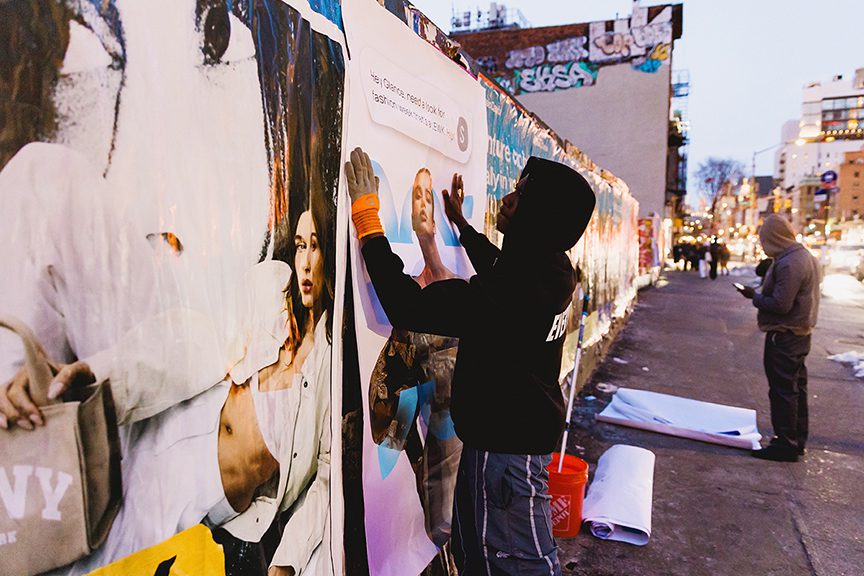
Street-level guerrilla advertising in Austin, including poster campaigns, stencil work, and ambient installations, works best in the East Austin and South Congress corridors where foot traffic is dense and the audience is culturally engaged. The university area around UT Austin, centered on the Drag (Guadalupe Street) and the surrounding campus blocks, offers a concentrated student audience that responds to street-level creative in a cost-efficient environment.
Austin’s warm weather makes chalk and stencil programs particularly effective because the dry pavement conditions and high foot traffic during outdoor activities create high exposure for sidewalk-level creative. Campaigns that use pavement stencils along high-traffic routes during SXSW or Austin City Limits Music Festival reach the specific event audiences in the moments when they are moving through the city between venues.
Documentation photography in Austin benefits from the city’s visual character: the murals, the vintage neon signs, the historic buildings, and the distinctive Austin light all create backdrops that make brand documentation photographs more visually interesting than equivalent documentation from more generic urban environments. A brand installation photographed against an East Austin mural wall looks different and better than the same installation photographed against a generic commercial building. Location selection in Austin should explicitly account for the photographic context that each location provides.
Format
Best Austin Locations
Best Season
Key Consideration
Poster campaigns
East 6th, South Congress, UT Drag
Year-round
UV-resistant materials recommended
Wall murals
East Austin, SoCo, SXSW zone
Year-round
Commission with local artists for best reception
Chalk / stencil
SXSW corridors, ACL festival area
March, October
Event timing critical
Experiential
SXSW, Rainey, East 6th
March, April
Press-focused concept required for SXSW
Highway billboards
I-35, Mopac, US-183
Year-round
Book early; SXSW window sells out months ahead
Austin City Limits Music Festival: The Fall Moment
Austin City Limits Music Festival in October is the second major annual media concentration moment in Austin after SXSW. ACL brings over 450,000 attendees to Zilker Park over two weekends, creating an enormous temporary concentration of music fans, media, and content creators in the festival zone and the surrounding neighborhoods.
Brand activations during ACL face similar strategic requirements to SXSW: the competition for attention is intense, and brands that simply show up are lost in the noise. Brands that create genuine experiences or genuinely interesting creative at street level in the corridors around Zilker Park and South Congress during ACL weekend have access to a concentrated audience that is in an experience-seeking and social-sharing mindset.
The logistics of ACL brand activations require lead time and coordination with Austin’s festival permit and event management network. The city’s experience with managing SXSW and ACL means the permitting and coordination requirements are well-established, but they need to be started well in advance of the event.
Building an Austin Outdoor Advertising Strategy
An effective Austin outdoor advertising strategy combines at minimum two of the three primary outdoor formats: large-format wall presence (murals or billboard), street-level presence (guerrilla campaigns in East Austin and South Congress), and event-timed activations (SXSW or ACL). The combination creates brand visibility across the outdoor environment that a single format cannot achieve.
Digital amplification of Austin outdoor campaigns is particularly important for brands whose target consumers extend beyond the Austin market. The city’s documentation culture means that campaign photography from well-executed Austin outdoor work generates social sharing to audiences in other cities, which extends the geographic reach of a local investment. Brands running Austin outdoor campaigns should plan the social content and earned media strategy for that documentation alongside the physical campaign, not as an afterthought.
How to Evaluate an Advertising Agency Before Signing
The evaluation process that consistently produces good agency decisions involves fewer criteria than most brands apply but deeper investigation on each one. Here is a proven framework.
Start with portfolio specificity. Ask to see work from clients in your specific category, not from the agency’s most impressive or most varied portfolio. An agency that has done excellent work in consumer packaged goods may have significantly less relevant experience in technology or entertainment. The strategic thinking, the creative conventions, and the audience dynamics differ enough across categories that category-specific experience genuinely predicts performance in ways that general excellence does not.
Then conduct real reference checks. Ask for three references from clients with similar budgets and similar campaign types to yours. Call all three, not just the one the agency volunteers. Ask specifically: did the agency deliver what they promised in the pitch? How did they handle complications in the field or in the creative process? Would you hire them again without hesitation? A strong, consistent set of positive answers to these questions is the most reliable predictor of a good agency relationship.
Examine execution infrastructure for any agency doing physical-world work. Ask specifically who will be on the ground managing installations, whether they use their own crews or subcontractors, how they handle field complications, and what their quality control process looks like. Agencies with genuine operational infrastructure answer these questions with specificity and confidence. Agencies that subcontract loosely will be vague or will redirect to capabilities they are more confident discussing.
Clarify the account management structure before signing. Ask to meet the person who will be managing your account day to day, not just the senior leadership who presented in the pitch. Many agencies pitch with their most impressive and senior people and service with junior account coordinators. Knowing who you will actually work with, and having the opportunity to assess that person before you sign, protects you from one of the most common sources of agency relationship disappointment.
Read the contract carefully, particularly the termination provisions and the production markup structure. Reputable agencies have straightforward termination clauses, typically 30 to 90-day notice periods, and transparent production billing. Agencies with complex lock-in provisions, punitive termination fees, or unclear production markup practices are telling you something about how they expect the relationship to function when it is not going well.
What Guerrilla Marketing Brings That Other Channels Do Not
Guerrilla marketing occupies a specific role in the advertising channel mix that no other format replicates. Understanding that role is essential for deciding whether to include it in a campaign and for evaluating which agencies are genuinely equipped to deliver it.
The unique value of guerrilla marketing is its ability to create genuine physical brand encounters in the environments where consumers live, rather than reaching consumers in the media environments they consume. When someone encounters a well-executed brand installation in their neighborhood, the experience is categorically different from seeing a digital ad: it is unexpected, it is in a context the consumer already trusts and values, and it generates a level of attention and memory encoding that passive media cannot replicate.
The social media amplification of physical brand moments has added a second layer of value to guerrilla marketing that did not exist in the format’s early years. A brand installation in Wicker Park or Silver Lake or Williamsburg that is genuinely interesting will be photographed and shared by the neighborhood’s active content creator community, reaching audiences in other cities and demographics that are not physically present at the execution. This amplification makes the effective reach of a well-executed guerrilla campaign far larger than the physical foot traffic at the installation location would suggest.
Earned media is the third layer of guerrilla marketing value. Campaigns with genuine news value, whether because the creative is exceptionally strong, the location is culturally significant, the timing aligns with a relevant moment, or the execution breaks new creative ground, generate press coverage that extends the campaign’s reach to readers who never encountered the physical execution. This earned media is free in the sense that it requires no additional media spend, but it requires the initial investment in quality creative and professional documentation to produce the press-worthy visual evidence that editors require.
For agencies that claim guerrilla capabilities, the relevant question is whether their guerrilla practice is genuinely built to deliver all three layers of value, physical presence, social amplification, and earned media, or whether they are delivering only the first layer, physical placement, without the documentation and press strategy infrastructure that makes the broader value accessible. Many agencies that offer guerrilla as a service deliver physical placements but leave the amplification and earned media value on the table because they have not built the practice around those outcomes.
Austin’s Creative Economy and Brand Advertising
Austin’s creative economy, spanning music, film, technology, and the entrepreneurial startup community that has clustered in the city over the past decade, creates a consumer base that is more receptive to creative and unconventional brand advertising than the general US consumer population. This is not unique to Austin, but it is particularly pronounced here because the city has attracted creative professionals from across the country who bring high standards for what constitutes genuinely interesting brand communication.
Brands that demonstrate genuine understanding of Austin’s creative culture, whether through creative partnerships with Austin artists and musicians, through authentic engagement with the SXSW and ACL music festival communities, or through brand storytelling that references Austin’s specific cultural identity rather than treating it as a generic Sun Belt city, consistently outperform brands that treat Austin as just another market to cover. The authenticity bar in Austin is high and the audience for genuine versus performative brand engagement is sophisticated enough to distinguish between the two.
The city’s growing technology community, particularly the post-2020 influx of tech companies and employees relocating from California, has created a second consumer segment that is distinctly different from Austin’s original creative and music culture audience. The tech transplant in South Austin or the Domain neighborhood is consuming media, making purchasing decisions, and responding to advertising in ways that are more similar to Silicon Valley consumer patterns than to traditional Austin culture. Campaigns that need to reach both segments, the original Austin creative community and the tech transplant community, need to navigate this duality thoughtfully rather than treating the Austin market as a single unified audience.
Film and television production has increased significantly in Austin over the past several years, bringing an additional community of entertainment industry professionals and the associated media attention to the city. Major productions using Austin locations generate press coverage that highlights specific Austin neighborhoods and venues, creating awareness of specific parts of the city that can be leveraged by brands running campaigns in those locations.
Measurement and Accountability in Advertising Agency Relationships
One of the most important conversations to have with any advertising agency before signing is the measurement conversation. How will the campaign’s success be measured? What are the specific metrics that will be reported, at what frequency, and in what format? What happens when the campaign underperforms against those metrics? What level of creative and strategic iteration is included in the scope and what triggers additional fees?
Clear, upfront agreement on measurement and accountability protects both parties in an agency relationship. The client gets explicit commitments about what will be measured and what the agency’s response will be to performance data. The agency gets protection against being evaluated on metrics that were not part of the original scope or that are outside the agency’s ability to control. Brands and agencies that fail to have this conversation upfront consistently find themselves in conflict about performance when the campaign is already running, which is the worst time to establish expectations.
For guerrilla campaigns specifically, the measurement conversation is particularly important because the format does not produce the kind of attributable digital performance data that paid search or paid social does. The relevant metrics for guerrilla campaigns are photo documentation of coverage, earned media placements generated by the campaign, social sharing and organic documentation by consumers in the field, and brand search lift during and after the campaign period. Brands that agree on these metrics upfront will evaluate the campaign fairly. Brands that agree on guerrilla as a format and then try to evaluate it against digital performance metrics will be disappointed, not because the campaign failed, but because they are applying the wrong measurement framework.
Long-Term Agency Relationships vs Project-Based Engagements
Brands choose between retainer-based agency relationships and project-based engagements for different reasons, and both models have genuine advantages depending on the brand’s situation. Understanding the dynamics of each model helps brands choose the right structure for their specific circumstances.
Retainer relationships provide consistency, deeper brand knowledge, and priority access to the agency’s resources. An agency that works with a brand for two or three years on retainer develops understanding of the brand’s audience, its competitive position, its creative preferences, and its operational requirements that a project-based agency cannot develop in the context of a single campaign. This accumulated knowledge makes each campaign in a long-term relationship more effective than the first, because the agency is not rebuilding understanding from scratch each time.
Project-based engagements provide flexibility and the ability to select the best agency for each specific campaign type. A brand that runs both brand awareness campaigns and performance marketing campaigns may benefit from using a creative boutique for the awareness work and a digital performance agency for the conversion work, engaging each on a project basis rather than asking a single agency to do both well. Project-based engagements also allow brands to test agency relationships before committing to a retainer, which protects against the cost of discovering that an agency’s execution does not match its pitch after a long-term relationship has been established.
For guerrilla marketing specifically, project-based engagements are the most common model because brands often want guerrilla for specific campaign moments, launches, seasonal activations, or event-timed campaigns, rather than as an ongoing monthly service. Guerrilla specialists like AGM work on project bases as well as retainer relationships, and the project model allows brands to access specialist guerrilla capability without the overhead of an ongoing retainer when guerrilla is not a continuous need.
Frequently Asked Questions
What is the best time of year for outdoor advertising in Austin?
Austin’s outdoor advertising is genuinely year-round friendly due to the mild climate and abundant sunshine. The SXSW window in March and the ACL window in October are the peak media-concentration moments. Spring (April-May) and fall (September-October) are the strongest general pedestrian traffic seasons. Summer heat from July through August reduces midday foot traffic but evening activity remains strong.
What neighborhoods are best for guerrilla advertising in Austin?
East Austin (the East Sixth Street corridor), South Congress, and the UT Austin Drag are the three strongest guerrilla advertising neighborhoods. East Austin offers the best combination of foot traffic, creative-class audience, and social documentation behavior. South Congress serves the lifestyle consumer and tourist audience. The Drag reaches the student population efficiently.
Should I advertise during SXSW?
If your brand is targeting the technology, entertainment, or media professional audience, SXSW is one of the best opportunities in the US calendar. The concentration of press and content creators means earned media potential is extraordinarily high for genuinely interesting activations. If your brand is targeting the general Austin consumer, SXSW timing is less important and you should focus on t …
How does AGM approach outdoor advertising campaigns in Austin?
We combine location scouting specific to Austin’s neighborhood geography with production specifications appropriate for the Texas climate and the chosen format. We manage documentation photography that captures Austin’s distinctive visual environment and coordinate with local press and content creators for earned media outreach on campaigns with genuine news value.
What makes Austin outdoor advertising different from other Texas markets?
Austin’s combination of SXSW media concentration, unique neighborhood cultures in East Austin and South Congress, strong mural and street art tradition, and year-round outdoor activity make it an outdoor advertising market with more national media use per dollar than Dallas or Houston. Austin’s tech-heavy consumer also documents and shares campaign content at higher rates than the broader Texas market.