Size of a Movie Poster: Dimensions, Formats, and What They Mean for Marketing
The standard movie poster is 27 x 40 inches. But that is one format in a range of theatrical and entertainment poster sizes, each designed for a specific display environment.
The size of a movie poster depends on the format. The standard theatrical one-sheet is 27 x 40 inches. Bus stop formats are 40 x 60 inches. Half-sheets are 22 x 28 inches in a horizontal orientation. Each format exists for a specific display environment and a specific marketing function. Understanding the full range of movie poster sizes — and the practical implications of each — is useful for anyone in entertainment marketing, concert promotion, or brand campaigns that use poster distribution.
The one-sheet’s 27 x 40 inch dimensions emerged from the practical constraints of theater lobby display hardware. Standard lobby display cases were built to accommodate this specific size, and the size has been maintained through decades of equipment replacement because changing the standard would require replacing display infrastructure across thousands of theaters simultaneously. The format is efficient for shipping: one-sheets are typically shipped rolled in tubes, and the 27-inch width allows multiple posters per tube while keeping tube diameter practical for bulk shipment.
The 2:3 aspect ratio of the one-sheet is also the standard aspect ratio of portrait-orientation film photography and the default vertical crop for most digital design software. This makes the one-sheet format particularly easy to work with in design workflows that also produce digital assets: the same composition can translate from the one-sheet to a vertical mobile ad with minimal redesign, because the aspect ratios are compatible.
The 40 x 60 Bus Stop Format
The 40 x 60 inch bus stop poster is used in transit advertising infrastructure: bus shelters, train station corridors, and similar outdoor transit environments. It is proportionally identical to the one-sheet — the same 2:3 vertical format at 1.5 times the size. A design produced for the one-sheet can be printed at 40 x 60 with no composition changes. The larger format increases visual impact in environments where the viewer approaches at close range and where the poster needs to compete with other nearby advertising displays.
Movie Poster Sizes in Concert and Event Marketing
Concert promoters use the same standard sizes as the theatrical industry, with some variation based on the specific display environments they target. The one-sheet at 27 x 40 inches is standard for concert posters displayed in venues, record shops, and music retail environments that have display hardware built around the theatrical standard. The 18 x 24 inch format is common for independent promoters because it is a more economical print size while still being large enough to be visible and read clearly from typical pedestrian distances.
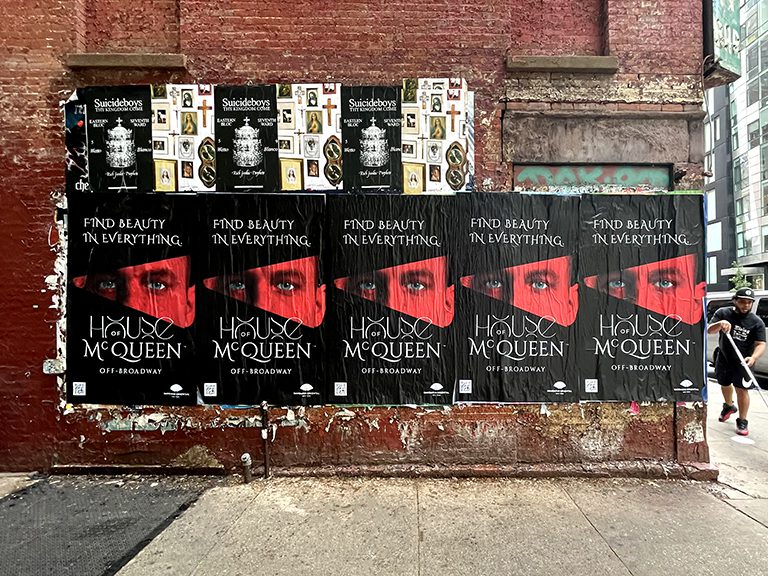
For outdoor poster campaigns in urban environments — the kind of street-level distribution that characterizes grassroots concert promotion — the 24 x 36 inch format is the most practical. It is large enough to be seen from across a street, small enough to be placed on a wide range of surfaces without requiring significant space, and prints efficiently on standard large-format printers without the specialty equipment required for larger formats.
Practical note for concert promoters: When designing a concert poster, build the composition to work at 24 x 36 inches first. The design can then be scaled up to 27 x 40 (one-sheet) or 40 x 60 (transit) with minimal adjustment. Building up from the smaller format produces more flexible design assets than building down from a large format, where details added at large scale often become illegible at the smaller print sizes used in some placement environments.
Resolution and File Preparation for Poster Printing
Poster files for professional printing should be prepared at 300 DPI (dots per inch) at the full output size. A one-sheet at 27 x 40 inches at 300 DPI requires a file approximately 8,100 x 12,000 pixels. For large-format outdoor prints at 40 x 60 inches or larger, 150 DPI is typically sufficient because the viewing distance is greater and the human eye cannot resolve the difference between 150 and 300 DPI when viewing a poster from more than three feet away.
Color mode for print files should be CMYK, not RGB. Most design software defaults to RGB for screen display. Files submitted to print vendors in RGB will be converted to CMYK by the printer, and that conversion can shift colors significantly — particularly in saturated reds, deep blues, and certain greens that are within the RGB color gamut but outside the CMYK gamut. Set the document to CMYK from the start of the design process to avoid unexpected color shifts at print.
Bleed area is required by most commercial printers. A standard bleed is 0.125 inches (1/8 inch) on all sides, meaning the printable area with bleed for a 27 x 40 inch one-sheet is 27.25 x 40.25 inches. Any design element that extends to the edge of the final trimmed size — a full-bleed background, a border, or a background color — must extend into the bleed area to ensure no white edge appears after trimming.
Poster Materials and Finish Options
Movie and entertainment posters are most commonly printed on 80 to 100 lb coated paper stock. The coated surface produces sharper detail, more accurate color reproduction, and a more professional appearance than uncoated paper, which absorbs ink and produces slightly muted, softer colors. Glossy finish on coated stock produces the most vivid colors and the most impact in well-lit indoor environments like theater lobbies. Matte or satin finish produces less glare and is more practical in environments with strong overhead lighting or where the poster will be viewed from multiple angles.
For outdoor placements where the poster will be exposed to weather, moisture-resistant or waterproof vinyl is the appropriate material. Vinyl posters maintain their adhesion and legibility in rain and humidity that would destroy a paper poster in hours. A vinyl print for outdoor placement costs more per unit than a paper print but is the only practical format for unprotected outdoor surfaces in most climates.
Choosing the Right Poster Size for Your Campaign
The right poster size for a campaign is determined by where the poster will be displayed, who will be viewing it, and at what distance. Indoor environments with controlled lighting and close viewing distances — theater lobbies, music venues, record stores — are appropriate for the one-sheet and smaller formats. Outdoor environments with variable lighting and longer viewing distances require larger formats: bus stop, transit, or full outdoor billboard.
Budget also plays a role in poster size selection. Printing cost scales with size: a 40 x 60 print costs approximately 2.5 times as much as a 24 x 36 print in unit cost, and that difference multiplies across larger print runs. For campaigns with limited budgets, a larger number of smaller posters placed in the right locations consistently outperforms a smaller number of large posters placed more broadly. Concentration of the right size in the right locations matters more than format size alone.
Practical guidance: For most concert and event poster campaigns in urban environments, the 24 x 36 inch format is the most practical choice. It is large enough to be visible from typical pedestrian distances, small enough to be placed on a wide range of surfaces, prints efficiently at standard commercial rates, and ships and stores conveniently. Reserve the one-sheet format for venue lobby displays and retail environments that have standard display hardware.
Poster Size for Tour and Tour Merchandise
Tour posters are a distinct category from event marketing posters. A tour poster designed for display at the show — displayed in the venue lobby or sold as merchandise — is typically printed at 18 x 24 inches or 11 x 17 inches. These are the standard sizes for the collector poster market that has developed around live music, and they are sized for framing and home display rather than for outdoor street placement.
The promotional poster for the same tour — placed in record shops, on street boards, and in the venue neighborhood in the weeks before the show — is typically a 24 x 36 or 27 x 40 format, visible from a distance and readable from across a street. The two types of posters serve different functions and require different design approaches even when they use the same visual identity: the promotional poster must communicate all key information at a glance from a distance, while the collectible tour poster can include more detailed design elements that reward close viewing.
How Movie Studios Use Poster Campaigns
Major studio releases typically produce multiple poster versions for a single film: a teaser poster for the initial announcement, a character set with individual character one-sheets for franchise films with ensemble casts, a final theatrical one-sheet for the primary promotional period, and specialty formats for IMAX, Dolby, and other premium screening experiences. The marketing materials for a wide-release studio film can include dozens of poster variations across all formats and markets.
The rollout of poster materials is timed to align with the promotional calendar. A teaser poster appears months before the release date, designed to create awareness without revealing significant plot details. The final theatrical one-sheet appears in the four to eight weeks before release, with the full cast, key credits, and the release date. Character posters for franchise films deploy across the four to six weeks before release, building awareness around the specific characters with the largest audience investment.
For independent films without major studio distribution infrastructure, the poster campaign operates differently. Independent releases typically produce a single one-sheet plus a smaller run of 24 x 36 or 18 x 24 posters for grassroots placement in relevant neighborhoods, coffee shops, record stores, and cultural spaces aligned with the film’s subject matter or aesthetic. The placement is more targeted and more personal than a studio rollout, often involving the filmmakers themselves in the placement process — which also generates documentation content for the film’s social channels.
Poster Campaign Production: From Design to Placement
Understanding movie and entertainment poster dimensions is useful in isolation, but it becomes operationally valuable when connected to the full production workflow: from design to print to placement. Each stage of that workflow has its own requirements, lead times, and potential failure points. A poster campaign that is designed without understanding print requirements produces files that need revision before printing. A print run that is ordered without understanding the placement timeline produces posters that arrive too late to matter. Understanding the full workflow prevents avoidable delays at each stage.
The design stage should begin with the final poster dimensions confirmed, including bleed area. A poster designed at exactly 24 x 36 inches without bleed will have visible white edges after trimming unless the print file includes the required bleed area. Standard bleed is 0.125 inches on all sides, making the print file for a 24 x 36 inch poster 24.25 x 36.25 inches. Any background color, image, or design element that extends to the edge of the poster must extend to the edge of the bleed area to ensure complete coverage after trimming. Elements that should not be trimmed — text, logos, key image elements — should be kept within a safe zone of at least 0.25 inches inside the trim edge.
The print stage requires files in CMYK color mode at 300 DPI for indoor prints and 150 DPI for large-format outdoor prints. Digital design files are typically created in RGB color mode, which covers a wider color range than CMYK. When an RGB file is converted to CMYK for print, colors that fall outside the CMYK gamut shift — typically becoming less saturated. Saturated reds, deep blues, and certain greens are particularly susceptible to gamut-shift during RGB-to-CMYK conversion. Designing in CMYK from the start eliminates this problem by keeping all colors within the printable gamut throughout the design process.
Print vendors for entertainment poster campaigns fall into two categories: specialty theatrical printers serving studio and major promoter accounts with archival-quality output, and commercial large-format printers serving the broader entertainment marketing market. Specialty theatrical printers produce the highest quality output at higher cost per unit, typically with minimum order quantities that make them impractical for small campaign print runs. Commercial large-format printers produce campaign-quality output at lower cost per unit with faster turnaround and lower minimum orders. Most concert and entertainment marketing campaigns use commercial vendors.
Placement Strategy for Entertainment Poster Campaigns
The physical placement of entertainment posters determines whether the campaign’s visual investment reaches the right audience in the right environments. A well-designed poster placed in the wrong locations is wasted. A moderately designed poster placed precisely in the locations where the target audience concentrates will outperform a beautifully designed poster scattered broadly across a market.
Placement targeting for entertainment poster campaigns follows the same logic as any other street-level marketing: identify where the target audience is physically present in concentrated numbers and place materials at those locations at the highest possible density. For music and concert posters, that means the neighborhoods where the relevant music community lives and shops, the record stores and music retail environments where those consumers browse, the bars and venues where they go to see comparable shows, and the transit corridors they use between home and the shows they attend.
Placement density vs. coverage: A common mistake in concert and entertainment poster campaigns is spreading posters too thin across a wide geographic area in pursuit of broad coverage. A single poster on every other block in a borough reaches a huge number of people with low frequency. The same number of posters concentrated in the three neighborhoods where the target audience lives reaches fewer total locations but creates the repeated exposures that build genuine awareness and purchase intent. Dense placement in targeted neighborhoods almost always outperforms thin coverage across a broad area for the same number of posters and the same placement budget.
Placement logistics for a poster campaign in a major urban market require advance planning of the route, confirmed placement agreements with property owners or venue managers for interior placements, and a systematic documentation approach that records every placement location. The documentation serves two purposes: it proves the campaign ran as planned for client reporting, and it produces social content — placement photos at recognizable locations — that extends the campaign’s reach through social media channels.
Poster Sizes for Different Campaign Objectives
Matching poster size to campaign objective and display environment is a practical decision that significantly affects both campaign cost and campaign effectiveness. Using a format that is too small for the environment produces posters that are overlooked. Using a format that is larger than the display environment requires creates logistical complications and waste. The right format for each application follows from understanding where the poster will be displayed and what reading distance the consumer will have.
For lobby and indoor display in theatrical and venue environments, the 27 x 40 one-sheet is the standard because it fits the display hardware that was built for that format. For street-level outdoor campaigns in urban environments, the 24 x 36 format is the practical standard because it prints efficiently, ships conveniently, and is large enough to be visible from typical pedestrian distances without requiring the specialty equipment needed for larger formats. For transit advertising environments — bus shelters, subway platforms, and similar locations — the 40 x 60 format is the standard because it was designed specifically for those environments’ specific viewing distances and hardware specifications.
The financial case for working within standard sizes is compelling beyond just display hardware compatibility. Standard sizes print at standard rates on standard equipment, with standard paper stocks available from standard vendors. Custom sizes require custom setup, often require custom equipment or custom paper sizes, and typically carry premium pricing per unit that is not justified by any functional benefit. Unless a campaign has a specific reason that requires a non-standard format, work within the established standards and capture the cost and convenience advantages they provide.
Frequently Asked Questions
What is the standard movie poster size?
The standard movie poster size is the one-sheet at 27 x 40 inches. This format is designed to fit standard theatrical lobby display cases and has been the primary movie poster format for decades. It produces a vertical poster with a 2:3 aspect ratio that reads well at typical theater lobby viewing distances.
What size is a bus stop movie poster?
A bus stop movie poster is typically 40 x 60 inches, the same 2:3 vertical aspect ratio as the standard one-sheet but 1.5 times the size. This format is designed for outdoor transit advertising environments — bus shelters, train stations, and similar spaces — where a larger format is necessary to maintain visual impact at the viewing distances typical of those locations.
What resolution should a movie poster be for printing?
Movie poster files for professional printing should be prepared at 300 DPI at the full output size. For the standard 27 x 40 inch one-sheet, that means approximately 8,100 x 12,000 pixels. For large-format outdoor prints, 150 DPI is generally sufficient. Files must be prepared in CMYK color mode and include a minimum 0.125 inch bleed on all sides.
What size are concert tour posters?
Concert tour posters most commonly use the 24 x 36 inch format for general outdoor placement, the 27 x 40 inch one-sheet format for venue and retail display, and the 18 x 24 inch format for independent or lower-budget productions. The one-sheet 27 x 40 inch format is the standard for display in venues, record stores, and other environments that use theatrical display hardware.
Are movie poster sizes the same internationally?
No. The US standard is the 27 x 40 inch one-sheet. The UK uses a Quad Crown format at 30 x 40 inches, which is a horizontal orientation rather than vertical. European formats vary by country, with 70 x 100 cm being a common alternative to the US one-sheet. International campaigns must account for these format differences when producing materials for distribution across multiple countries.
A half-sheet movie poster is 22 x 28 inches in a horizontal (environment) orientation. It was historically used in theater lobbies for secondary display positions and in retail environments where the vertical one-sheet format did not fit available display space. Half-sheets are less common in contemporary theatrical marketing than they were in the mid-twentieth century but are still produced for specialty releases and collector audiences.