Mobile Pop Up Shops | American Guerrilla Marketing
Mobile pop-up shops take the brand retail experience to consumers wherever they are. Here is how to build a traveling shop strategy that creates real customer relationships and drives real revenue.
Mobile pop-up shops are one of the most versatile tools in the direct-to-consumer brand’s marketing toolkit. They combine the commercial immediacy of retail with the consumer engagement depth of experiential marketing, creating a format that builds brand relationships and drives revenue simultaneously. A consumer who discovers your brand at a mobile pop-up shop, tries the product, makes a purchase, and talks to someone who genuinely believes in what they are selling has had an experience that no digital channel can replicate.
At American Guerrilla Marketing, we design and execute mobile pop-up shop programs for brands across multiple categories and at every stage of growth. This guide covers how mobile pop-up shops work, how to build a traveling retail strategy, and what it takes to execute programs that produce both commercial results and lasting consumer relationships.
The fundamental value proposition of a mobile pop-up shop is the combination of discovery, trial, and immediate purchase in a single consumer encounter. Unlike e-commerce, where the consumer must already know they want to buy and must trust the brand enough to enter payment information without having experienced the product, a mobile pop-up shop allows the consumer to experience the product first and purchase second, with a knowledgeable brand representative present to guide the decision.
This trial-to-purchase sequence dramatically reduces the conversion friction that DTC brands face online. A consumer who discovers a brand through an Instagram ad faces multiple barriers to first purchase: skepticism about product quality, uncertainty about sizing or fit, reluctance to enter payment information to an unfamiliar brand, and the inertia of having to actively initiate a transaction. A consumer who picks up a product at a mobile pop-up shop, examines it, tries a sample if applicable, and decides to buy it in the moment faces none of these barriers. The trial has already overcome the skepticism. The brand representative has built enough trust that the transaction feels safe. The purchase happens immediately.
Mobile pop-up shops also create customer relationships that have measurably higher lifetime value than customers acquired through digital channels alone. The in-person discovery experience creates a stronger initial brand connection than a digital ad encounter, and customers who made their first purchase in a face-to-face environment tend to be more loyal and more likely to refer friends than those who made their first purchase online.
Formats for Mobile Pop-Up Shops
Mobile pop-up shops take several different formats depending on the brand, the product category, and the operational context. Understanding the format options helps brands choose the approach that fits their brand identity and operational requirements.
Vehicle-Based Mobile Shops
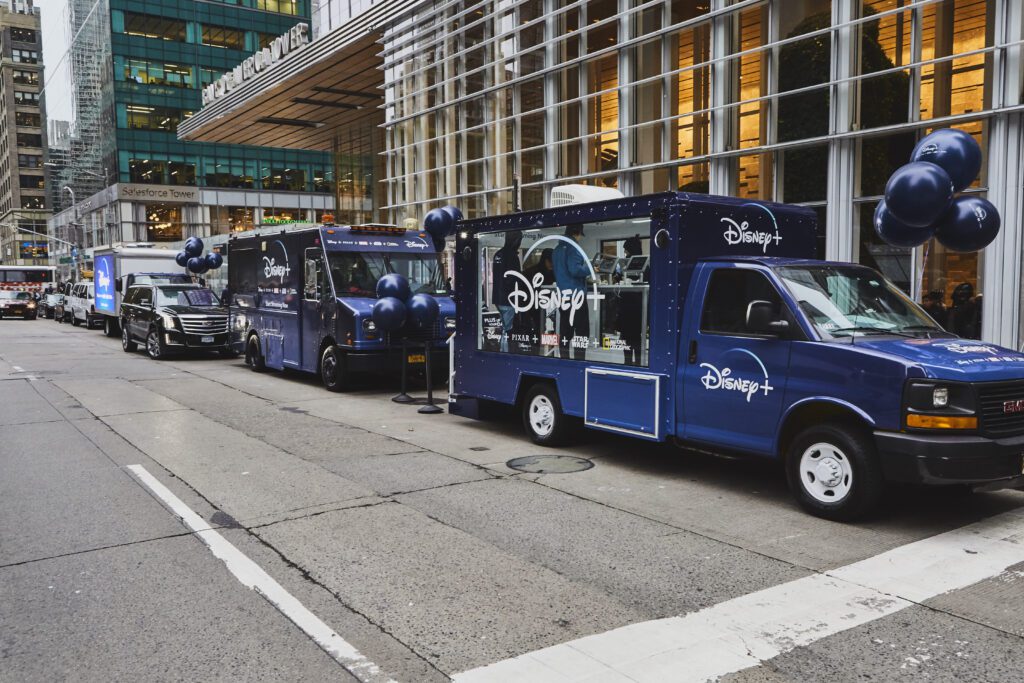
The most recognizable mobile pop-up shop format uses a branded vehicle as the retail environment. Step vans and box trucks allow for interior display and shopping space. Custom trailers create more immersive retail environments. Sprinter vans serve as product storage and operational bases for exterior shopping setups. The vehicle-based format is most appropriate for programs that cover multiple cities and need a self-contained, consistently configured retail environment at every stop.
Portable Shop Systems
For brands that need to activate at markets and events where a large vehicle is not practical, a portable shop system uses a smaller vehicle for logistics support combined with a portable retail setup of branded display tables, canopy systems, and display fixtures that can be assembled and disassembled quickly at each location. This format is more flexible than a vehicle-based shop and can access a wider range of venues, but it requires more setup time and produces a less immersive brand environment.
Market Stall Formats
For brands targeting the farmers market, craft market, and specialty food market environment, a market stall format is the natural approach. This is a portable shop system sized and designed for the specific constraints of market environments: standard 10×10 or 10×20 vendor spaces, quick setup within market load-in windows, and display design optimized for the market consumer context.
The format should serve the experience, not the other way around. We have seen brands invest in elaborate vehicle builds for programs that would have been better served by a well-designed portable shop system. Ask what the consumer experience requires before choosing the format that delivers it.
Building a Traveling Retail Strategy
A mobile pop-up shop program is not just a series of stops; it is a traveling retail strategy that should be built around clear commercial objectives, a well-defined target consumer, and a location and event strategy that concentrates those consumers.
Setting Revenue Objectives
Unlike sampling activations, mobile pop-up shop programs have direct revenue implications that can be tracked and measured against investment. Setting clear revenue objectives, by market, by stop, and by program total, allows brands to evaluate the program’s commercial performance and make adjustments to locations, products, pricing, or staffing that improve results over the program’s duration.
Revenue objectives need to be realistic relative to the location type, the product category, and the program duration. A market stall at a Saturday farmers market in a premium neighborhood might reasonably sell $800 to $3,000 in product. A branded vehicle at a multi-day festival might generate $5,000 to $20,000 in direct sales. Setting objectives without reference to realistic benchmarks for the location type produces targets that are either unmotivating because they are too easy or demoralizing because they are unreachable.
Location and Market Strategy
Location strategy for mobile pop-up shops needs to balance commercial quality (will consumers at this location buy, not just browse?) with consumer profile alignment (are the consumers at this location the brand’s target buyer?) and operational viability (can the program actually run effectively at this location?).
The highest-performing locations for mobile pop-up shops are typically those where consumers are already in a purchasing mindset and where the brand’s product category has strong natural relevance. A specialty food brand at a premium farmers market is operating in exactly the right context for its category. A streetwear brand at a neighborhood music market is operating in the right cultural context for its community. When the brand’s identity and the location’s identity are genuinely compatible, conversion rates improve significantly.
Inventory and Product Strategy
Product selection for a mobile pop-up shop should not be the brand’s complete catalog. A curated selection of the most relevant, accessible, and compelling products performs better than a comprehensive display. Consumers at a mobile shop are making decisions quickly in a social environment; a focused selection makes that decision easier and reduces the paralysis that too many choices can create.
The hero product, or products, that should drive trial and conversion should be positioned most prominently in the display. Supporting products that complement the hero should be available but should not compete for primary visual attention. Clearance or secondary products, if included at all, should be clearly separated from the core collection to avoid brand perception issues that arise from mixing premium products with discounted ones in the same display context.
Mobile Pop-Up Shop Format
Best Market Types
Typical Setup Time
Sales Per Day Range
Vehicle-based retail
Events, neighborhood retail districts
30-90 minutes
$1,000 – $8,000
Portable shop system
Markets, community events, fairs
45-120 minutes
$500 – $5,000
Market stall format
Farmers markets, craft markets
30-60 minutes
$400 – $3,000
Custom experiential retail trailer
Premium events, brand flagship moments
2-4 hours
$3,000 – $25,000
Staffing Mobile Pop-Up Shops
The staff for a mobile pop-up shop need skills that span brand representation and retail sales. They need to engage consumers warmly and genuinely, demonstrate and explain products knowledgeably, guide purchase decisions without pressure, handle transactions efficiently, and maintain the energy and professionalism of the shop environment across an entire activation day.
Retail experience is valuable but not always available in brand ambassador pools. AGM selects staff for mobile pop-up shop programs based on a combination of brand alignment, consumer engagement natural ability, and either retail experience or strong aptitude for the sales component. Pre-activation training covers product knowledge, key consumer messages, sales technique, transaction handling, and inventory management protocols specific to the program.
Measuring Mobile Pop-Up Shop Performance
Mobile pop-up shops generate the most direct measurement data of any activation format because they involve actual commercial transactions. Key performance metrics include total revenue per activation day, units sold per category and SKU, conversion rate from consumer engagement to purchase, average transaction value, and consumer contact data captured through opt-ins or purchase records.
Over the course of a multi-stop program, these metrics allow brands to identify which location types, which days of the week, which price points, and which product combinations drive the best commercial performance. This data is immediately actionable: a product that is being tried frequently but not purchased is a pricing or communication problem. A location that generates high traffic but low conversion is likely a consumer profile mismatch. Real-time awareness of these patterns allows field managers to make adjustments that improve performance mid-program.
Mobile Pop-Up Shops as a Long-Term Brand Strategy
Brands that commit to ongoing mobile pop-up shop programs across multiple seasons build competitive advantages that are genuinely difficult for competitors to replicate. The customer database accumulated through direct purchase relationships grows over time into a high-quality CRM asset. The community presence built through consistent market and event participation creates cultural credibility that advertising cannot buy. The operational infrastructure, the vehicle, the staff relationships, the event access, improves with each program cycle as investment in long-term assets rather than per-campaign costs.
The most successful mobile pop-up shop brands we have worked with at AGM treat the program as a core channel in their marketing mix rather than a periodic campaign. They budget for it annually, refine it based on each season’s performance data, and build the operational systems that allow it to improve continuously. Over three to five years, these brands develop a direct-consumer sales and relationship channel that rivals or outperforms their e-commerce channel in customer quality metrics, even if it represents a smaller share of total revenue.
Operating Mobile Pop-Up Shops Across Multiple Markets
Running mobile pop-up shops across multiple markets simultaneously or in quick succession requires operational systems that maintain program quality and brand consistency without centralizing all decision-making in a way that makes the program unresponsive to local market conditions. The tension between standardization and local adaptation is one of the fundamental operational challenges of multi-market mobile retail programs.
Standardization is necessary for brand consistency: the same display standards, the same product selection (with appropriate local adjustments), the same staff training and brand representation, and the same documentation and reporting protocols across all markets. Local adaptation is necessary for effectiveness: location selection, event calendar integration, and consumer engagement approach should reflect the specific characteristics of each market rather than applying a template without regard for local conditions.
AGM manages this balance in multi-market mobile pop-up shop programs through a combination of standardized brand and operational protocols applied by trained field managers who have genuine market knowledge in their respective cities. The brand standards travel with the program; the tactical execution adapts to each market.
Consumer Psychology in Mobile Pop-Up Shop Environments
Mobile pop-up shops create specific consumer psychological conditions that differ from both fixed retail and e-commerce environments in ways that brands can use strategically.
The scarcity and temporality of a mobile pop-up shop creates purchase urgency that fixed retail does not. A consumer at a mobile pop-up shop knows the opportunity to buy from the brand in this location and on this day will not be available tomorrow. This temporal scarcity reduces the procrastination that kills e-commerce conversion and increases the probability of an immediate purchase decision. Brands can reinforce this effect through communication at the shop (this is a limited stop, this product is available today) without being manipulative, simply by being clear about the mobile and temporary nature of the shop.
The social proof of other consumers engaging with the mobile shop also functions differently than in fixed retail. A small group of people gathered around a mobile shop in a park or market creates visible social engagement that attracts additional consumer attention in a way that a store with normal foot traffic does not. The mobile shop’s unusualness makes consumer gathering more visible and more socially compelling. Staff who understand this can amplify the effect by creating moments of visible consumer engagement and enthusiasm that draw additional passersby into the shop environment.
The trust created by a face-to-face interaction with a knowledgeable brand representative is consistently higher than the trust created by digital communication alone. Consumers who have met and talked with a brand representative, who have looked them in the eye and asked questions and received genuine answers, carry that trust into their subsequent interactions with the brand. E-commerce repurchase rates for mobile pop-up shop customers are typically higher than for customers acquired through digital channels alone, reflecting this trust differential.
Building Your Brand’s Mobile Pop-Up Shop Presence Year Over Year
The compounding value of consistent mobile pop-up shop presence in specific markets and at specific events becomes visible over the course of multiple seasons. In the first season, the brand is establishing itself: learning which locations work, building event relationships, developing the operational systems that allow the program to run smoothly. In the second season, the brand is executing more efficiently on the learning from the first: better location selection, stronger event relationships, more refined product and pricing strategy, improved staff quality through retention of the best performers from the previous season.
By the third season and beyond, the brand has built something that cannot be replicated by a competitor entering the same market for the first time: genuine community presence, consumer familiarity, event organizer partnerships, and the kind of brand loyalty that comes from multiple direct consumer encounters over time. This compounded presence is the most durable competitive advantage that mobile pop-up shop investment can produce.
Mobile Pop-Up Shops and Retail Partnership Development
For brands pursuing retail distribution alongside their direct sales channels, mobile pop-up shop programs serve a secondary strategic purpose: demonstrating consumer demand to retail buyers. A brand that can show a Target or Whole Foods buyer that its mobile pop-up shop consistently sells ,000 to ,000 in product per day at their target retail locations has a powerful piece of evidence that the product will sell off a retail shelf with brand support.
Many of the brands AGM has supported with mobile pop-up shop programs have used the program’s sales data as part of retail buyer presentations. The combination of direct sales performance data, consumer feedback collected at the shop, and documentation showing consumer engagement quality gives retail buyers a confidence-building picture of market demand that few other marketing formats can provide. Mobile pop-up shop data is particularly compelling because it represents actual purchase behavior rather than survey data or digital engagement metrics.
For brands already in retail, mobile pop-up shop programs in markets where key retail accounts are located create visible consumer demand around those accounts. A buyer at a regional grocery chain who sees a brand’s mobile pop-up shop consistently drawing a crowd at local markets in their region is a buyer who is more confident in the brand’s ability to drive sell-through in their stores. This kind of market-level brand visibility, created through consistent mobile pop-up shop presence, is one of the most effective forms of retail relationship building available to emerging brands.
How to Start Your Mobile Pop-Up Shop Program
Starting a mobile pop-up shop program begins with three decisions: what format makes sense for your brand and product, which markets you want to prioritize, and whether you are going to rent, buy, or build your shop infrastructure. These decisions are interconnected and should be made together rather than sequentially.
For most brands running their first mobile pop-up shop program, renting a configured vehicle or building a portable shop system is the right starting point. The operational learning from a first season of mobile pop-up shops is substantial, and that learning should inform the more significant investment decisions like vehicle purchase or custom build that come later. Starting with a more modest approach allows the brand to develop its program strategy, its location knowledge, and its staff quality before committing major capital to vehicle infrastructure.
Work with an experienced agency partner for the first program. The operational complexity of running a mobile pop-up shop program, especially across multiple markets, is significant, and the learning curve for a brand running the format for the first time is steep. An experienced partner reduces that learning curve dramatically by bringing established market knowledge, staff relationships, event access, and operational systems that a first-time program would otherwise need to develop from scratch.
AGM works with brands launching their first mobile pop-up shop programs as well as brands with established programs who want to scale or improve their existing operations. Contact us with your program objectives and we will tell you honestly what the right approach looks like for your specific situation.
Pricing Strategy for Mobile Pop-Up Shops
Pricing at a mobile pop-up shop requires a different approach than standard retail or e-commerce pricing. Consumers at mobile pop-up shops are making discretionary, impulse-influenced purchases in a social environment. The decision context is more similar to a farmers market or a specialty retail experience than to a planned grocery run or an e-commerce research-and-purchase cycle.
Prices at mobile pop-up shops should be simple, clearly posted, and consistent with the brand’s retail pricing where applicable. Significant discounting at the mobile shop relative to retail pricing can create problems with retail partner relationships and can also undermine the brand’s premium positioning. Small, event-specific promotions (a discount on multi-unit purchases, a free sample with a minimum purchase) work better than broad price reductions.
For brands without existing retail distribution, mobile pop-up shop pricing should be set based on the brand’s intended long-term retail price point rather than on current cost structure alone. Pricing too low at the mobile shop creates consumer expectations that become difficult to correct when retail distribution launches at higher prices. Price to the long-term position, not just to what the first season of production costs suggest.
Frequently Asked Questions
What are mobile pop-up shops?
Mobile pop-up shops are traveling retail environments that use branded vehicles or portable shop setups to sell products directly to consumers at markets, events, and neighborhoods across multiple locations and markets. They bring the retail experience to the consumer rather than requiring the consumer to visit a fixed store.
How are mobile pop-up shops different from stationary pop-up retail?
Stationary pop-up retail occupies a fixed location for the duration of its run, requiring consumer discovery and visitation. Mobile pop-up shops move to multiple locations and markets, reaching consumers in their own neighborhoods and at events they already attend rather than depending on attracting foot traffic to a single location.
What industries use mobile pop-up shops?
Food and beverage, fashion and apparel, beauty and personal care, consumer goods, artisan and craft products, and wellness brands all use mobile pop-up shops effectively. The format works best for brands with products that benefit from in-person discovery and that have target consumers who are concentrated in specific geographic areas or event communities.
How do you choose locations for mobile pop-up shops?
Locations are chosen based on the concentration of the target consumer, the consumer’s mindset and receptiveness at that location, the physical and operational viability of running the shop at that location, and the cultural fit between the brand and the location’s identity. Farmers markets, specialty food markets, cultural events, neighborhood weekend markets, and fitness events are common high-performing location types for most brand categories.
What does AGM provide for mobile pop-up shop programs?
AGM provides end-to-end management of mobile pop-up shop programs including vehicle strategy, route and location planning, staff recruitment and sales training, event access and vendor applications, field management, inventory logistics support, documentation, and post-campaign reporting including sales data analysis.