American Guerrilla Marketing — Field Notes
South Bank is one of London’s most remarkable pedestrian environments for street-level marketing. The stretch of the Thames riverbank between Westminster Bridge and London Bridge encompasses some of the UK’s highest-traffic cultural institutions, including the Tate Modern, the Southbank Centre, the National Theatre, the BFI, and Borough Market, all within walking distance of each other along a riverfront promenade that draws tens of millions of visitors annually.
The result is a pedestrian environment with several characteristics that make it unusually valuable for guerrilla marketing. First, sheer volume: the South Bank’s foot traffic rivals London’s busiest retail streets while delivering an audience that is actively engaged with its environment rather than in rapid transit mode. Second, audience composition: the mix of international tourists, London residents on leisure visits, creative and cultural professionals, and students creates a demographically diverse but culturally engaged audience that is more receptive to well-crafted brand messaging than most other London pedestrian markets. Third, the area’s cultural context creates strong associations for brands that position themselves near its institutions and activities.
American Guerrilla Marketing plans and executes guerrilla marketing campaigns in South Bank and other London markets through our established UK field partner network. We bring the campaign strategy, creative direction, and operational standards from New York, with local execution managed by field teams who know the South Bank’s specific environment, permitting requirements, and audience patterns. This guide covers the opportunity and how we approach it.
South Bank’s Audience: Who Is There and When
Understanding the South Bank audience requires distinguishing between its different temporal compositions. On weekday mornings, the area is primarily populated by commuters and professionals, including the significant concentration of creative and media companies in the offices of the Coin Street neighborhood and the surrounding Southwark area. This professional audience is brand-literate and commercially active.
By midday and through the afternoon, the mix shifts toward leisure visitors, tourists, and people taking breaks from the nearby London Bridge business district. This audience is in an experiential mindset, engaging with the environment for enjoyment rather than transit, which increases receptivity to brand encounters.
Weekend audiences are the most diverse and highest in raw volume, with the Thames riverside walkway seeing some of London’s highest pedestrian densities during summer afternoons. The tourist proportion of this audience is significant, including large numbers of international visitors from Europe, North America, and Asia who photograph and share their South Bank experiences extensively on social media.
Street-Level Marketing Formats for South Bank
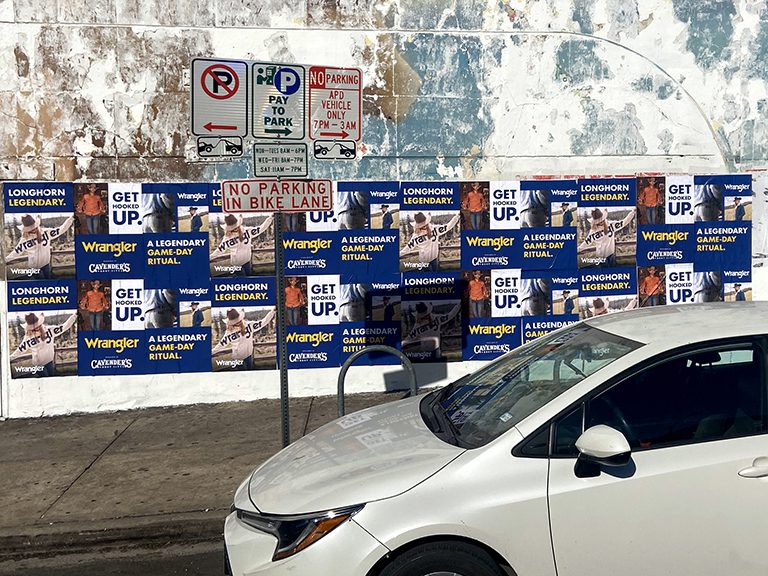
Poster campaigns on prominent surfaces in the South Bank area reach the continuous flow of pedestrians along the riverfront and on the approach streets from Waterloo and London Bridge stations. Key surfaces include the walls of the undercroft skateboarding area beneath the Southbank Centre (a historic posting location with strong cultural associations), permitted surfaces on the approach streets from Waterloo Station, and the walls of commercial properties along the Stamford Street and Borough Market corridors.
The South Bank’s visual culture is influenced by its position adjacent to major arts institutions. Poster campaigns that reflect a level of creative quality consistent with the visual environment of the Tate Modern and Southbank Centre perform better than generic promotional formats. The audience’s cultural engagement means they notice and respond to creative quality in ways that audiences in purely commercial environments may not.
Street team activations at key pedestrian concentration points create direct human brand contact with the South Bank’s highest-density audience moments. The areas in front of the Tate Modern at peak visitor hours, the riverside walkway near the Millennium Bridge on summer weekends, and the Borough Market pedestrian zones on market days are the highest-concentration points for specific audience types within the South Bank area.
Experiential pop-up activations work well in South Bank’s abundant open public space. The area’s broad riverside promenade, the Tate Modern forecourt, and the open spaces of the Southbank Centre can accommodate temporary brand installations that would not fit in London’s denser retail neighborhoods. These installations become photography destinations and social sharing moments for the tourists and leisure visitors who constitute a significant portion of the South Bank’s audience.
South Bank and Nearby Areas: Extended Campaign Geography
The South Bank is most effective as the anchor of a broader south London or London-wide campaign that uses the riverfront’s high traffic as the primary brand awareness engine while extending reach into adjacent neighborhoods with different but complementary audience profiles.
Bermondsey and Borough immediately east of London Bridge offer a creative and food industry audience concentration that complements the South Bank’s more general cultural audience. Borough Market and the surrounding streets draw a food and lifestyle-focused consumer audience that is highly aligned with premium consumer brand campaigns.
Waterloo and Lambeth immediately south of the South Bank contain significant residential and transport infrastructure. Campaigns on the approach routes from Waterloo Station reach the daily commuter and leisure transit audience in addition to the South Bank’s leisure visitor population.
London Bridge and Southwark to the east have significant creative industry, hospitality, and retail concentrations that expand the campaign’s reach into the professional audience segments of London’s south bank more broadly.
Coordinating South Bank Campaigns with London-Wide Programs
Brands that want significant London market presence often coordinate South Bank campaigns with placements in other key London areas: Shoreditch and Hackney for the east London creative and youth audience, London Soho for the media and entertainment industry audience, Camden for the alternative and youth culture audience, and Notting Hill for the affluent west London lifestyle audience. A campaign structured across multiple London neighborhoods with a South Bank anchor can achieve the kind of market saturation that creates the omnipresence effect of appearing everywhere the target consumer is likely to be during a defined campaign period.
Plan Your South Bank Campaign with AGM
American Guerrilla Marketing coordinates guerrilla marketing campaigns in South Bank and across London through our UK field partner network. We plan campaigns from New York and manage execution through experienced London-based field teams who operate to our standards.
Contact us at [email protected] or call (646) 776-2770 to discuss your South Bank campaign.
How AGM Scopes and Plans This Type of Campaign
Every campaign AGM builds starts with the same foundational questions: Who is the audience, where are they, what do they respond to, and what does success look like after the campaign closes? These questions sound simple but their answers drive every tactical decision that follows. The audience geography shapes the route. The audience behavior shapes the format. The definition of success shapes the measurement framework. Campaigns that skip these foundational questions and jump to tactical selection produce activity without direction.
For campaigns in this category, the planning conversation typically covers four areas. First, audience concentration: where is the target audience physically present, at what density, and for how long at each location? This determines whether a campaign should focus on neighborhood saturation, event-environment activation, surrounding venue presence, or some combination of these approaches. Second, format selection: which specific formats, given the audience geography and behavior, will generate the most qualified brand exposures? Third, creative requirements: what design standards does this specific audience context require, and what creative approaches have worked in similar contexts? Fourth, measurement: what specific data will be captured during the campaign, and how will that data connect to the business objectives that motivated the investment?
The answers to these questions shape a campaign plan that is specific to the brand, the audience, and the objectives rather than adapted from a generic template. AGM does not run the same campaign for every client. We build campaigns from the actual conditions of each specific brief, which is why clients who have worked with generic street marketing vendors before often see substantially different results when they bring the same format to AGM with the same geographic targets.
Common Mistakes and How to Avoid Them
The most persistent mistakes in this campaign category fall into predictable patterns that AGM has encountered and documented across hundreds of programs. Understanding these patterns helps brands avoid the errors that consistently undermine campaign performance regardless of how much budget is invested behind them.
The first pattern is over-spreading with insufficient volume. Campaigns that try to cover too much geographic area with too few poster units, ambassadors, or activation events create a diffuse presence that generates single exposures per audience member rather than the repetition that builds genuine recall. The audience needs to encounter the campaign multiple times to form a durable brand impression. Concentration builds recall; diffusion builds nothing.
The second pattern is mismatched creative. Campaign creative designed for one context or audience often fails badly when transplanted to a different one. A creative approach that works for a mass consumer brand may feel incongruent for a B2B brand at a trade show. A visual style developed for a digital advertising context may read as corporate and out of place in a street art-influenced neighborhood. Creative should be briefed and developed specifically for the context and audience of each campaign rather than adapted from existing assets that were designed for different conditions.
The third pattern is inadequate lead time. The planning and production requirements for physical campaign components, combined with the multi-week minimum requirements for pre-show marketing sequences and ambassador recruitment, mean that campaigns assembled in the final two to three weeks before a launch consistently compromise on quality, scope, or both. The brands that build the strongest campaigns begin planning six to ten weeks before the campaign’s first activation date, giving every component adequate development time.
The fourth pattern is incomplete measurement. Campaigns that do not define their measurement framework before launch often find that the available data after the campaign does not answer the questions that matter for the next campaign investment decision. Building the measurement framework before launch ensures that the right data is captured in the right way during the campaign and that the resulting report connects to business outcomes rather than just activity metrics.
Why Brands Return to AGM for This Campaign Type
The brands that work with AGM on campaigns in this category typically return because the operational discipline we bring to physical campaign execution is rare in the marketing services market. Most brands have had the experience of engaging a street marketing or ambassador agency that delivers activity reports without field accountability, produces campaigns that underperform against the brief without a credible explanation of why, or creates coordination problems between campaign components that were managed by different vendors without integration.
AGM manages campaign components as an integrated program rather than as a collection of separate vendor relationships. When the pre-show email campaign, the ambassador program, and the surrounding city poster campaign are all planned from the same brief and coordinated by the same team, the components reinforce each other rather than creating conflicting messages, overlapping logistics, or gaps in audience coverage. The integration is the value beyond the individual component capabilities, and it is the reason clients who have managed these programs piecemeal through multiple vendors typically see better results when they consolidate the program through a single integrated agency.
Contact AGM at [email protected] or by phone at (646) 776-2770 to discuss your campaign requirements. The planning conversation is where most of the real work begins, and we are prepared to have it.
How AGM Scopes and Plans This Type of Campaign
Every campaign AGM builds starts with the same foundational questions: Who is the audience, where are they, what do they respond to, and what does success look like after the campaign closes? These questions sound simple but their answers drive every tactical decision that follows. The audience geography shapes the route. The audience behavior shapes the format. The definition of success shapes the measurement framework. Campaigns that skip these foundational questions and jump to tactical selection produce activity without direction.
For campaigns in this category, the planning conversation typically covers four areas. First, audience concentration: where is the target audience physically present, at what density, and for how long at each location? This determines whether a campaign should focus on neighborhood saturation, event-environment activation, surrounding venue presence, or some combination of these approaches. Second, format selection: which specific formats, given the audience geography and behavior, will generate the most qualified brand exposures? Third, creative requirements: what design standards does this specific audience context require, and what creative approaches have worked in similar contexts? Fourth, measurement: what specific data will be captured during the campaign, and how will that data connect to the business objectives that motivated the investment?
The answers to these questions shape a campaign plan that is specific to the brand, the audience, and the objectives rather than adapted from a generic template. AGM does not run the same campaign for every client. We build campaigns from the actual conditions of each specific brief, which is why clients who have worked with generic street marketing vendors before often see substantially different results when they bring the same format to AGM with the same geographic targets.
Common Mistakes and How to Avoid Them
The most persistent mistakes in this campaign category fall into predictable patterns that AGM has encountered and documented across hundreds of programs. Understanding these patterns helps brands avoid the errors that consistently undermine campaign performance regardless of how much budget is invested behind them.
The first pattern is over-spreading with insufficient volume. Campaigns that try to cover too much geographic area with too few poster units, ambassadors, or activation events create a diffuse presence that generates single exposures per audience member rather than the repetition that builds genuine recall. The audience needs to encounter the campaign multiple times to form a durable brand impression. Concentration builds recall; diffusion builds nothing.
The second pattern is mismatched creative. Campaign creative designed for one context or audience often fails badly when transplanted to a different one. A creative approach that works for a mass consumer brand may feel incongruent for a B2B brand at a trade show. A visual style developed for a digital advertising context may read as corporate and out of place in a street art-influenced neighborhood. Creative should be briefed and developed specifically for the context and audience of each campaign rather than adapted from existing assets that were designed for different conditions.
The third pattern is inadequate lead time. The planning and production requirements for physical campaign components, combined with the multi-week minimum requirements for pre-show marketing sequences and ambassador recruitment, mean that campaigns assembled in the final two to three weeks before a launch consistently compromise on quality, scope, or both. The brands that build the strongest campaigns begin planning six to ten weeks before the campaign’s first activation date, giving every component adequate development time.
The fourth pattern is incomplete measurement. Campaigns that do not define their measurement framework before launch often find that the available data after the campaign does not answer the questions that matter for the next campaign investment decision. Building the measurement framework before launch ensures that the right data is captured in the right way during the campaign and that the resulting report connects to business outcomes rather than just activity metrics.
Why Brands Return to AGM for This Campaign Type
The brands that work with AGM on campaigns in this category typically return because the operational discipline we bring to physical campaign execution is rare in the marketing services market. Most brands have had the experience of engaging a street marketing or ambassador agency that delivers activity reports without field accountability, produces campaigns that underperform against the brief without a credible explanation of why, or creates coordination problems between campaign components that were managed by different vendors without integration.
AGM manages campaign components as an integrated program rather than as a collection of separate vendor relationships. When the pre-show email campaign, the ambassador program, and the surrounding city poster campaign are all planned from the same brief and coordinated by the same team, the components reinforce each other rather than creating conflicting messages, overlapping logistics, or gaps in audience coverage. The integration is the value beyond the individual component capabilities, and it is the reason clients who have managed these programs piecemeal through multiple vendors typically see better results when they consolidate the program through a single integrated agency.
Contact AGM at [email protected] or by phone at (646) 776-2770 to discuss your campaign requirements. The planning conversation is where most of the real work begins, and we are prepared to have it.
Ready to Run a South Bank Guerrilla Marketing Campaign?
AGM builds London campaigns with the operational discipline and local market knowledge needed to perform in one of the world’s most sophisticated street-level advertising environments.
Contact Our Team
Get a Campaign Quote
Capabilities Deck
Email: [email protected] | Phone: (646) 776-2770
Frequently Asked Questions About Guerrilla Marketing in South Bank
Why is South Bank a strong location for guerrilla marketing?
South Bank combines extremely high foot traffic with a culturally engaged audience mix of tourists, residents, and creative professionals. The concentration of major cultural institutions creates a context where brands with strong creative execution can achieve significant visibility and social reach.
What guerrilla marketing formats work best in South Bank?
Poster campaigns on prominent riverside surfaces, street team activations at pedestrian concentration points near major institutions, experiential pop-ups in the area’s open public spaces, and ambassador programs targeting the Thames embankment’s peak foot traffic windows.
Can AGM run guerrilla marketing campaigns in South Bank?
Yes. AGM plans and coordinates South Bank campaigns through UK-based field partner networks. Campaign strategy and creative direction come from our New York headquarters with local execution managed by experienced London field teams.
What time of year is best for South Bank guerrilla marketing?
Summer months from May through September when riverside pedestrian traffic peaks, and the Christmas market period in November and December. Major cultural events at Tate Modern and the Southbank Centre create predictable audience concentration that campaigns can align to throughout the year.
How does guerrilla marketing in South Bank generate social reach?
South Bank’s status as one of London’s most photographed public areas means brand installations and prominent poster campaigns generate organic social content from the visitors who document and share their experiences, including international tourists who extend campaign reach globally.
Related: Wheatpasting Campaigns | Guerrilla Marketing Services | Brand Ambassador Agency | Guerrilla Marketing London
Frequently Asked Questions