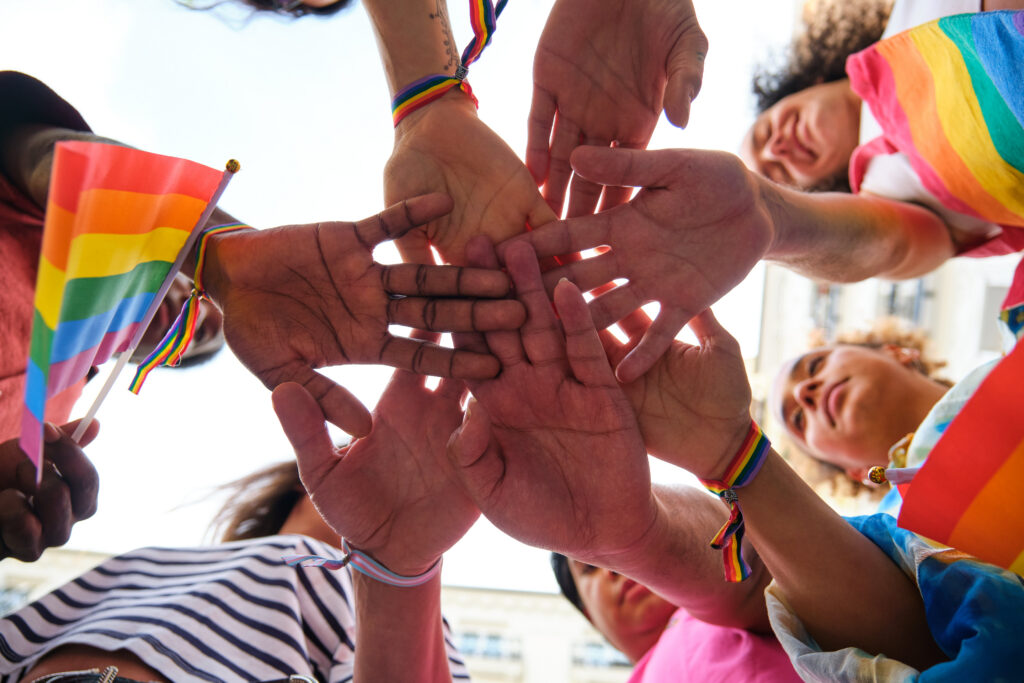
Pride street teams are where a campaign stops being advertising and becomes an actual relationship. Every other element of a pride campaign, the wheatpasted posters in the neighborhood, the LED truck driving through the parade, the sidewalk stencils on the approach to the festival, those are all one-way communications. A street team is a conversation. It is one human being representing a brand connecting with another human being in a community that takes authenticity very seriously.
At American Guerrilla Marketing, out of Industry City in Brooklyn, our team has built pride street teams for campaigns across the country. We know the difference between a street team that earns genuine community warmth and one that generates community skepticism. The difference is not just in training. It starts with who you recruit.
This article covers everything about building effective pride street teams: recruitment, training, deployment strategy, and how to integrate them into the broader campaign for maximum impact.
What Pride Street Teams Actually Do
Pride street teams are brand ambassador crews deployed in the field at Pride events and in LGBTQ+ communities. Their core activities include:
Material distribution: Branded giveaways, promotional materials, product samples, event flyers, and other items that create tangible brand touchpoints. The physical handoff of something useful or desirable creates a more memorable brand encounter than any passive impression.
Product sampling: For consumer product brands, direct sampling at Pride creates trial in a high-positive-emotion context. An ambassador who hands someone a product sample at Pride while making genuine human connection is creating a brand memory that will influence purchase behavior long after the event ends.
Opt-in collection: Many pride campaigns include a data collection goal. Street teams are among the most effective opt-in collection mechanisms because the personal interaction creates a context in which people are more willing to share contact information than they would be with a digital prompt.
Brand conversation: The most valuable interactions go beyond handoffs to genuine conversations about the brand, its products, and its community support. These conversations create deeper brand relationships than any number of passive exposures.
Social documentation: Pride events are social media environments. Street teams can generate content for the brand’s own channels and create the kind of genuine moments that attendees photograph and share organically, extending the campaign’s social reach.
Recruiting Pride Street Teams That Belong
The most important decision in building a pride street team is the recruitment criteria. For Pride events specifically, cultural authenticity is not optional. The LGBTQ+ community will identify performative or inappropriate ambassadors immediately, and those interactions damage the brand more than no presence at all would.
Our recruitment process for pride street teams starts with a clear principle: we prefer to hire LGBTQ+ community members for these roles. People who are themselves part of the community they are engaging bring inherent credibility, cultural fluency, and genuine enthusiasm that non-community staff cannot fully replicate through training alone.
When we supplement LGBTQ+ community members with allied staff, we apply rigorous screening to ensure genuine allyship rather than surface agreement. We look for candidates with documented community involvement, demonstrated cultural knowledge, and personal relationships within LGBTQ+ communities. We do not accept ambassadors who cannot speak authentically about why the brand’s community support matters to them personally.
We also bring specific intentionality to the diversity within our pride street teams. The LGBTQ+ community includes people of every race, ethnicity, gender expression, and background. A team that reflects this diversity creates more authentic peer-to-peer interactions across the full spectrum of community members the team will encounter.
Training Pride Street Teams
Once recruited, our pride street teams go through complete training that covers several areas beyond standard promotional briefing:
Brand knowledge and LGBTQ+ support history: Team members need accurate, specific information about what the brand actually does in support of the LGBTQ+ community. Charitable partnerships. Employee policies. Year-round representation in brand communications. Community investment history. Community members ask these questions, and ambassadors who can answer them specifically and honestly earn trust that scripted ambassadors cannot.
Community cultural context: Pride has historical roots that team members should understand. Key moments in LGBTQ+ rights history, the significance of specific Pride events, current community issues, and the diversity of identities within the LGBTQ+ umbrella are all part of the cultural briefing. This context shapes how ambassadors approach interactions and helps them navigate the conversations that come up naturally in Pride environments.
Communication approach: We train against promotional scripts and toward genuine conversation frameworks. The goal is for ambassadors to approach people as fellow humans who might find the product or brand interesting, not as targets for a pitch. This shift in orientation creates completely different interaction dynamics.
Operational logistics: Event layout, team positioning, shift timing, reporting protocols, material handling, and safety procedures are all covered in the operational briefing. An ambassador who is uncertain about any of these elements cannot be fully present in their brand interactions.
Deployment Strategies at Pride Events
How we deploy pride street teams depends on the specific event structure and campaign goals. Common deployment models include:
Roving corridor teams: Teams move through the highest-traffic pedestrian corridors within the event footprint, approaching groups and individuals for direct interaction. This model maximizes encounter frequency with the broadest audience cross-section.
Fixed sampling stations: Teams positioned at agreed-upon festival locations where traffic naturally concentrates. Stations allow for higher interaction dwell time and are effective for more complex sampling programs or situations where the product requires explanation or demonstration.
Neighborhood roving: Teams operating in LGBTQ+ neighborhoods surrounding the festival, engaging community members who are gathering in bars, restaurants, and public spaces in advance of or following the main event. This expands the campaign’s geographic reach beyond the official festival footprint.
Venue seeding: Teams entering LGBTQ+ bars, venues, and gathering spots during Pride Week to engage community members in social settings outside the formal festival. This is particularly effective for brands that want to integrate into the social environment of Pride Week rather than operating only at the official events.
Integrating Street Teams with Other Campaign Elements
Pride street teams generate their strongest results when integrated with the broader campaign system. Wheatpasting in the surrounding neighborhood in the weeks before the event builds visual brand familiarity so that the brand is recognizable when street teams approach people. LED trucks driving through the crowd create mass awareness and visual excitement that street teams can then capture through closer-range interactions. Sidewalk stencils near street team positions create conversation starters that ambassadors can reference when approaching people who have just noticed the ground-level installations.
The multi-format campaign creates a surround-sound brand experience where street team interactions happen in a context already saturated with brand presence. This context amplifies the individual interaction, making the street team encounter part of a larger brand experience rather than an isolated promotional moment.
Performance and Quality Management
Our team leaders are active quality managers throughout every pride street team deployment. They monitor ambassador interactions, address performance issues in real time, coordinate logistics replenishment, and maintain team energy and morale throughout long event-day shifts.
Shift reports from team leaders capture key metrics at regular intervals: distribution counts, opt-ins collected, notable interactions, any issues or unusual situations. These real-time reports keep the client informed throughout the activation and provide the raw data for post-campaign reporting.
For multi-day Pride events, we run daily debriefs with team leaders to identify what is working and what needs adjustment. Day two and three performances are consistently better than day one for this reason: we apply learnings from each day to improve the subsequent day’s approach.
What do pride street teams do at LGBTQ+ events?
Pride street teams are brand ambassador crews deployed at Pride events and in LGBTQ+ neighborhoods to create direct, personal brand touchpoints with community members. They distribute branded materials, execute product sampling, collect opt-ins, engage in genuine brand conversations, and create the human layer of a campaign that passive advertising cannot provide.
How is staffing a pride street team different from other event staffing?
Pride street team staffing requires genuine cultural competency in LGBTQ+ communities. Our team prioritizes candidates who are themselves LGBTQ+ community members or genuine allies with deep community knowledge. Generic promotional staff deployed at Pride without this background create inauthentic interactions that the community immediately recognizes and often responds to negatively.
How big should a pride street team be?
Team size scales with event size and campaign goals. A focused regional Pride activation may need four to eight street team members. A major urban Pride with large distribution goals may require 20 to 40 or more. We size teams based on distribution volume targets, event footprint, and the specific tactics being executed.
What training do pride street team members receive?
Our pride street team training covers brand knowledge and LGBTQ+ support history, product information where applicable, cultural context and community nuances, communication approach for authentic interaction, opt-in collection protocols, event logistics, and safety and shift management protocols. Training is tailored to each client and each specific event.
Where do pride street teams operate within a festival footprint?
We map event footprints in advance and identify the highest-traffic pedestrian corridors, gathering points, and areas where the team’s engagement goals are best served. For parade events, teams often work along the viewing areas. For festival events, teams work the main thoroughfares and any high-concentration areas near stages, food courts, or entry points.
Can pride street teams work at events outside of the main Pride calendar?
Yes. We deploy pride street teams at LGBTQ+ community events throughout the year, not just at official Pride events. This includes film festivals, community organization fundraisers, sports tournaments, cultural events, and social gatherings in LGBTQ+ venues and neighborhoods. Year-round street team presence supports sustained community relationships rather than annual-only visibility.
How do we measure pride street team performance?
Our teams track all activities in real time, with team leaders logging distribution counts, opt-ins collected, meaningful interactions, and any notable moments throughout shifts. These field reports compile into a post-campaign performance summary. We also track social amplification from any organic sharing of street team interactions by attendees.
Campaign Architect – American Guerrilla Marketing
Frequently Asked Questions
What do pride street teams do at LGBTQ+ events?
Pride street teams are brand ambassador crews deployed at Pride events and in LGBTQ+ neighborhoods to create direct, personal brand touchpoints with community members. They distribute branded materials, execute product sampling, collect opt-ins, engage in genuine brand conversations, and create the human layer of a campaign that passive advertising cannot provide.
How is staffing a pride street team different from other event staffing?
Pride street team staffing requires genuine cultural competency in LGBTQ+ communities. Our team prioritizes candidates who are themselves LGBTQ+ community members or genuine allies with deep community knowledge. Generic promotional staff deployed at Pride without this background create inauthentic interactions that the community immediately recognizes and often responds to negatively.
How big should a pride street team be?
Team size scales with event size and campaign goals. A focused regional Pride activation may need four to eight street team members. A major urban Pride with large distribution goals may require 20 to 40 or more. We size teams based on distribution volume targets, event footprint, and the specific tactics being executed.
What training do pride street team members receive?
Our pride street team training covers brand knowledge and LGBTQ+ support history, product information where applicable, cultural context and community nuances, communication approach for authentic interaction, opt-in collection protocols, event logistics, and safety and shift management protocols. Training is tailored to each client and each specific event.
Where do pride street teams operate within a festival footprint?
We map event footprints in advance and identify the highest-traffic pedestrian corridors, gathering points, and areas where the team’s engagement goals are best served. For parade events, teams often work along the viewing areas. For festival events, teams work the main thoroughfares and any high-concentration areas near stages, food courts, or entry points.
Can pride street teams work at events outside of the main Pride calendar?
Yes. We deploy pride street teams at LGBTQ+ community events throughout the year, not just at official Pride events. This includes film festivals, community organization fundraisers, sports tournaments, cultural events, and social gatherings in LGBTQ+ venues and neighborhoods. Year-round street team presence supports sustained community relationships rather than annual-only visibility.
How do we measure pride street team performance?
Our teams track all activities in real time, with team leaders logging distribution counts, opt-ins collected, meaningful interactions, and any notable moments throughout shifts. These field reports compile into a post-campaign performance summary. We also track social amplification from any organic sharing of street team interactions by attendees.
How early should a brand start planning?
For most campaigns, the smart move is to start planning at least two to four weeks before the launch window so production, routing, staffing, and reporting are all lined up.
What makes one market perform better than another?
Market fit depends on audience density, neighborhood behavior, route efficiency, and whether the creative belongs in that setting. The busiest city is not always the best city.
Can AGM bundle this with other services?
Yes. AGM often combines this work with supporting formats so the campaign has stronger repetition and cleaner reporting across the whole run.
How does AGM quote pages like this?
We quote from official rate cards where they apply, then scope the remaining production, staffing, and routing details to the actual job.