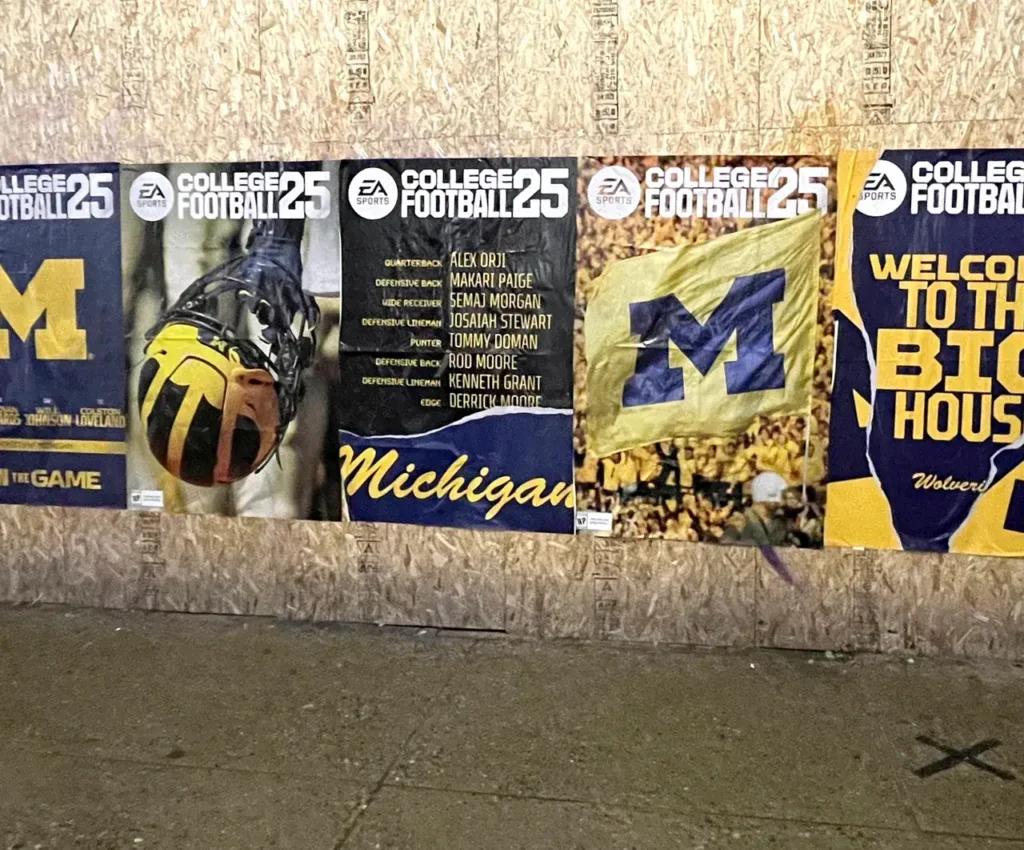
The University of Michigan is one of the premier guerrilla marketing targets in the Midwest — and arguably one of the best student marketing opportunities in the country. With 47,000+ enrolled students, a nationally recruited student body drawn from all 50 states, a nationally ranked business school, and Michigan Stadium (The Big House, 107,000-seat capacity), UMich concentrates exceptional demographic diversity and spending power in a compact, walkable Ann Arbor environment.
The Ann Arbor commercial districts surrounding UMich — State Street, South University Avenue, and the Main Street downtown corridor — are dense, pedestrian-first environments where street-level advertising generates impressions that digital formats consistently fail to match. Students walk these corridors multiple times daily between classes, housing, and social destinations. A wheat paste poster on the State Street construction hoarding is seen by 3,000+ students every weekday morning.
Our team executes student marketing campaigns in Ann Arbor across the full tactical mix — from wheat paste and sidewalk stencils to brand ambassador deployments and digital geofencing that extends physical campaign reach into the digital touchpoints where UMich students spend their screen time. This guide covers the geography, the tactics, the timing, and the creative approach that makes guerrilla marketing work at the University of Michigan.
State Street: The Academic-Commercial Spine of UMich
State Street is the central commercial artery of the UMich campus market — running from South University Avenue north through the academic core, flanked by bookstores, clothing retailers, restaurants, and bars that serve the student population. Every UMich student walks this corridor multiple times weekly during the academic year.
Wheat paste campaigns on State Street target the construction hoardings at active development sites — the University of Michigan’s ongoing campus development generates construction activity that provides consistent hoarding surface on and around State Street across academic years. Posters installed on State Street construction hoarding see 4,000–7,000 daily impressions from the morning and afternoon academic foot traffic.
Sidewalk stencils at the State Street-Liberty Street intersection and the State Street-North University intersection — the two highest-volume pedestrian crossings on the corridor — generate consistent brand visibility with a 45-day active lifespan before significant weather degradation. The pedestrian crossing approach is one of the most valuable stencil positions in any college market: students pause at these crossings multiple times daily, providing repeated exposure to the same message with attention that is briefly available during the crossing wait.
South University Avenue: Student Life at Peak Energy
South University Avenue between East University and Washtenaw is the heart of UMich’s student social life — bars, restaurants, and social venues that draw the majority of on-campus socializing Thursday through Saturday nights. Street-level campaigns on South University reach students in a social, leisure mindset where brand discovery and word-of-mouth are most active.
Brand ambassador activations on South University during Thursday through Saturday evenings reach students who are actively exploring, open to sampling, and in social environments where brand conversations spread rapidly. A four-person team on South University on a Thursday evening can engage 600–900 students over a four-hour window with direct product or brand interactions.
South University’s bar corridor is also a strong target for projection campaigns during football weekends — the commercial facades facing South University generate building-scale visibility to the thousands of students and alumni moving through the corridor before and after Michigan games.
The Big House Effect: Football Saturdays as a Guerrilla Opportunity
Michigan Stadium’s 107,000-seat capacity makes Michigan football home games extraordinary guerrilla marketing opportunities. The State Street corridor, South University Avenue, and the Main Street zone fill with a combined crowd of students, alumni, and visitors that dwarfs regular academic day traffic — generating 6–10x the normal daily impression count for campaigns active during football weekend deployments.
Football Saturday guerrilla campaigns at UMich require specific timing strategy. Pre-game (3 hours before kickoff) is peak foot traffic on State Street as fans move from parking lots and downtown to the stadium. Post-game is the highest-energy social window — immediately following the game, students and alumni flood South University Avenue and Main Street bars regardless of the outcome. Mobile billboard trucks operating the Michigan Stadium perimeter loop on game day generate mass exposure to the full game-day crowd — including the tailgate areas around Ferry Field and the golf course.
LED mobile billboard campaigns on Michigan game days are among the highest-impression campaigns we execute in any market — the concentration of 100,000+ people in a compact commercial zone creates mobile billboard impression counts that would take weeks to achieve in the same Ann Arbor market on a normal academic week.
Main Street Ann Arbor: Reaching the Full Market
Ann Arbor’s Main Street commercial district serves a broader demographic than the campus-adjacent corridors — the mix of UMich faculty and staff, Ann Arbor professionals, and out-of-town visitors creates a cross-demographic pedestrian zone that extends campaign reach beyond the pure student audience. Main Street between William and Liberty is the primary zone, with the Kerrytown market district to the north offering additional foot traffic from the local professional and family demographic.
Main Street campaign placements work best for brands targeting both the UMich student segment and the broader Ann Arbor professional demographic simultaneously — extending campus campaign reach into the adult professional market without requiring separate market investments.
Digital Amplification: Geofencing the UMich Campus
Physical guerrilla campaigns at UMich generate maximum impact when amplified by geofenced digital advertising that follows students from the street into their mobile devices. A student who sees our wheat paste on State Street Monday morning and encounters a geofenced Instagram ad on Monday evening has experienced the brand twice in two different contexts within 12 hours — doubling the brand recall impact of the physical campaign alone.
Our UMich geofencing strategy uses physical campaign locations to seed mobile audience pools — placing tracking pixels in QR codes on campaign materials and using device-level geofencing within 400-meter radii of active campaign locations. The resulting audience pool is retargeted with digital ads that reinforce the physical campaign messaging across the student’s primary social platforms through the campaign duration.
Move-In Weekend and Fall Semester Launch
UMich move-in weekend in late August is the single highest-value window for brand introduction in the Ann Arbor market. Approximately 7,000 first-year students are arriving, orienting to their new environment, and forming their first brand relationships at Michigan. Every business, restaurant, and brand they encounter during move-in weekend becomes part of their Ann Arbor mental map — a relationship that can persist for four years.
Our move-in weekend campaigns deploy wheat paste and stencils 5–7 days before students arrive to ensure full installation and maximum freshness when the student body arrives. Street team activations run during the move-in weekend itself — typically the final weekend of August — at the State Street commercial zone and the South University Avenue corridor where first-year students are walking for the first time as UMich students.
Ann Arbor’s Year-Round Marketing Calendar
The University of Michigan’s academic calendar creates specific high-value campaign windows beyond the major fall and football windows. Winter semester launch in early January is a strong secondary window — students are returning after a winter break during which many have been away from Ann Arbor, meaning the campus commercial corridors feel fresh and newly discovered. Brands that deploy winter semester campaigns capture returning students who are forming their second-semester habits.
Spring semester (March–April) is an underexploited window in Ann Arbor. As Michigan weather improves and students spend more time outdoors on State Street, South University, and the Main Street downtown, foot traffic in the commercial corridors increases substantially from the mid-winter baseline. Spring campaigns targeting the end-of-year social energy — graduation preparation, spring events, end-of-year parties — reach a student population that is particularly receptive to experiential and entertainment brand messaging.
The Ann Arbor Art Fair in July — one of the largest outdoor art fairs in the country, drawing 500,000+ visitors over four days — creates an extraordinary summer campaign window for brands targeting the broader Ann Arbor and Michigan market. The Art Fair’s combination of local residents, Michigan university alumni, and tourists from across the region generates impression counts that exceed even football Saturday traffic on the downtown State Street and Main Street corridors. Our Art Fair campaign packages are planned specifically around the Art Fair’s zone boundaries and the pedestrian flow patterns that the four-day event creates.
Brand Launch Strategy at University of Michigan
The University of Michigan’s nationally recruited student body and strong alumni network make it one of the most powerful brand launch platforms in the Midwest. Products and services that successfully penetrate the UMich student market benefit from a distribution network that spans all 50 states — UMich graduates return to every major US market carrying their Michigan brand loyalties with them. A brand that becomes the “Michigan brand” for a specific product category earns a national distribution advantage that no amount of paid media can replicate.
Our UMich brand launch campaigns are structured around this alumni network value: create strong initial awareness among current students through physical guerrilla campaigns, amplify through social media organic content that reaches alumni networks, and track the geographic distribution of brand searches and social mentions to identify the alumni markets where the Michigan launch creates the strongest secondary brand awareness. This analytics approach treats the UMich campaign as a national brand launch vehicle, not just a local student market activation.
Choosing a University of Michigan Guerrilla Marketing Partner
The right partner for University of Michigan guerrilla marketing campaigns has specific Ann Arbor location knowledge — State Street corridor placement positions, South University Avenue activation timing relative to bar hours, Michigan Stadium approach routes for football Saturday campaigns, and the specific Ann Arbor municipal requirements for commercial installations in the commercial districts adjacent to campus. An agency without this Ann Arbor-specific knowledge will plan campaigns based on generic college town assumptions that consistently underperform compared to campaigns built on demonstrated Michigan market expertise.
Questions to evaluate Michigan market expertise: Can the agency identify the highest-impression wheat paste positions on State Street relative to the morning academic foot traffic window? Do they know the Ann Arbor permit requirements for sidewalk stencil campaigns in the downtown commercial zone? Have they executed campaign activations during Michigan football Saturdays and documented the specific traffic patterns and optimal positioning for that unique environment? Our Michigan team has executed UMich campaigns with this level of market specificity — contact us at (646) 776-2770 to discuss your Ann Arbor campaign planning.
Brand Ambassador Programs at University of Michigan: What Works
Brand ambassador programs at the University of Michigan succeed when they are staffed by UMich students rather than generic promotions staff without campus context. The authenticity difference between a UMich student brand ambassador — who can speak knowledgeably about campus life, reference specific UMich cultural touchpoints, and navigate the social dynamics of the campus community as an insider — and a non-student promotions staff member is immediately apparent to the students being engaged. UMich students are academically sharp and socially sophisticated; they recognize and respond to authenticity, and they consistently engage more deeply with brand ambassadors who are part of their own community.
Our UMich ambassador programs recruit from the university’s student population through campus job boards, social media, and network referrals that reach the student segments most relevant to each campaign’s target demographic. A fintech brand targeting Ross School of Business students recruits ambassadors from Ross; a music streaming brand targeting the University’s arts and music programs recruits from SMTD and the School of Art and Design. This targeted ambassador recruitment ensures that the student-to-student brand conversations are contextually credible rather than demographically mismatched.
Ambassador training for UMich campaigns covers the brand’s core value proposition, the specific campus cultural context that makes the brand relevant to UMich students, and the engagement scripts that generate natural conversation rather than scripted pitches. The goal is for ambassador interactions to feel like peer recommendations rather than marketing — which requires training that goes well beyond product feature descriptions into the genuine lifestyle and identity connections that make the brand relevant to the specific student demographic being engaged.
Measuring UMich Campaign Results: Beyond Impression Counts
University of Michigan guerrilla campaigns are measured across multiple metrics that capture the full impact of campus market presence. Standard impression counts (based on Ann Arbor pedestrian traffic data for specific corridors) provide the baseline reach estimate. Organic social documentation volume — posts and stories from UMich students who document campaign elements without brand prompting — captures the earned media value beyond direct impressions. Brand search volume uplift in the Ann Arbor market during active campaign periods provides a quantitative indicator of awareness impact. And direct response metrics (QR code scans, promo code uses, app downloads, landing page visits attributed to the campaign period) capture conversion activity where the campaign’s CTA is a specific trackable action.
For brands with existing UMich student customer bases, we also analyze purchase behavior data during and after campus campaign periods — comparing purchase frequency, basket size, and new customer acquisition rates during active campaign periods to baseline periods to isolate the campaign’s measurable sales impact. This post-campaign ROI analysis is particularly valuable for consumer brands with strong digital purchase tracking, where the connection between campus awareness campaigns and downstream purchase behavior can be traced through persistent customer identifiers across the campaign window.
UMich Guerrilla Marketing: The Long-Term Brand Investment
The University of Michigan is not just a campus marketing target — it is a national brand launch platform. UMich’s reputation as one of the country’s most selective public universities, its nationally recruited student body drawn from every state, and its powerful alumni network concentrated in major markets from New York to San Francisco to Chicago make a successful UMich campaign the seed of a national brand relationship rather than just a local market awareness exercise.
The brands that invest in consistent, multi-year UMich guerrilla marketing presence build cumulative brand equity with UMich students that follows those students into their professional careers across the country. The student who encounters your brand as a sophomore on State Street, uses your product as a junior, and recommends it to their social network carries that brand relationship to their first job in New York, their second job in Chicago, and their subsequent career in every major market where UMich alumni concentrate. This alumni network diffusion is the hidden premium value of university market investment that standard impression-count metrics do not capture.
Our multi-year UMich campaign programs are designed specifically to build this cumulative brand equity — establishing consistent brand presence across the key UMich commercial corridors and campus-adjacent neighborhoods with creative that evolves over time to remain relevant to each successive incoming class while building recognition with the continuing students who see the brand campaign grow and deepen across their years at Michigan. Contact our team at (646) 776-2770 to discuss your University of Michigan marketing strategy.
Michigan Market Costs: What to Budget for UMich Campaigns
University of Michigan guerrilla marketing campaigns in Ann Arbor are more affordable than equivalent college-market campaigns in New York, Boston, or Los Angeles while delivering equivalent or superior demographic quality due to UMich’s nationally recruited student body and the strong social amplification culture of the Ann Arbor campus market. Wheat paste campaigns on State Street run approximately $40–$65 per placement including print and installation. A 25-placement State Street and South University wheat paste campaign with premium print materials and GPS documentation runs $2,500–$3,500. Multi-format campaigns adding street team activations and sidewalk stencils to the wheat paste base layer typically run $5,000–$8,000 for a full-week execution covering UMich’s primary commercial corridors.
Football Saturday campaigns carry a premium due to the extraordinary demand for mobile billboard and street team availability in Ann Arbor on game days — vehicles and staff are booked by multiple clients competing for the same high-value game-day windows. We recommend booking football Saturday activation at least 6–8 weeks in advance to secure availability and preferred positioning. Non-football period campaigns can typically be planned on 3–4 week timelines with standard lead times for print production and location scouting. Contact us at (646) 776-2770 to begin planning your UMich campaign.
Year-Round Ann Arbor Market Presence: Beyond the Academic Calendar
The University of Michigan’s influence on Ann Arbor’s consumer market extends beyond the academic year. The city’s 120,000+ permanent residents — including UMich faculty, research staff, hospital employees, and the young professional population that Ann Arbor’s tech sector has grown significantly — make Ann Arbor a year-round market opportunity that brands should not abandon after the May graduation weekend. Summer Ann Arbor campaigns reach the city’s permanent professional resident base without the competition from academic-year campaign saturation that peaks from September through April.
The Ann Arbor Art Fair in July — drawing 500,000+ attendees over four days — is the summer’s signature high-traffic event and among the largest annual outdoor events in Michigan. Art Fair campaigns in the Main Street and State Street zones during the four-day July event reach a cross-section of Michigan consumers from across the state that no other single Ann Arbor event provides, extending the brand’s Michigan market reach well beyond the UMich student population into the broader state consumer market that visits Ann Arbor specifically for the Art Fair experience. Contact us at (646) 776-2770 to plan your year-round Ann Arbor campaign strategy.
Frequently Asked Questions
What is guerrilla marketing at the University of Michigan?
Guerrilla marketing at the University of Michigan refers to street-level campaigns targeting UMich’s 47,000+ students in and around the Ann Arbor campus — wheat paste poster campaigns, sidewalk stencils, brand ambassador activations, and street team deployments in the State Street, South University, and Main Street corridors.
Where are the best activation spots near University of Michigan?
The highest-impact activation zones near UMich are State Street between William and North University, South University Avenue between East University and Forest, Main Street in downtown Ann Arbor, and the Liberty-Washington pedestrian zone connecting central campus to the hospital complex.
Do brands need permission to market near UMich campus?
Activations on public property — Ann Arbor public sidewalks and pedestrian zones — do not require university permission. Our campaigns deploy in the off-campus commercial districts that border the UMich campus, where no university permission is required.
When is the best time to run a guerrilla campaign at University of Michigan?
Move-in weekend in late August is the single highest-impact window for brand introduction. Fall semester (September–October), Homecoming weekend, and football Saturdays are peak windows. Winter semester start in January is a strong secondary window.
How does Football Saturday affect guerrilla marketing at UMich?
Michigan Stadium holds 107,000 spectators, making Michigan football home games the largest recurring foot traffic event in the state. State Street and South University Avenue fill with students, alumni, and visitors on game days — creating extraordinary brand exposure for campaigns timed to Michigan football Saturdays.
What is the student demographic at University of Michigan?
University of Michigan students are typically high-achieving, upper-middle-class, and professionally ambitious — drawn from all 50 states. The Ross School of Business, Law School, and engineering programs attract students with strong digital product adoption tendencies and significant discretionary spending power.
Does American Guerrilla Marketing run campaigns at University of Michigan?
Yes. Our team deploys student marketing campaigns in Ann Arbor including the State Street corridor, South University Avenue, Main Street, and Michigan Stadium approaches on football Saturdays. We handle planning, location scouting, execution, GPS documentation, and post-campaign reporting. Contact us at (646) 776-2770.