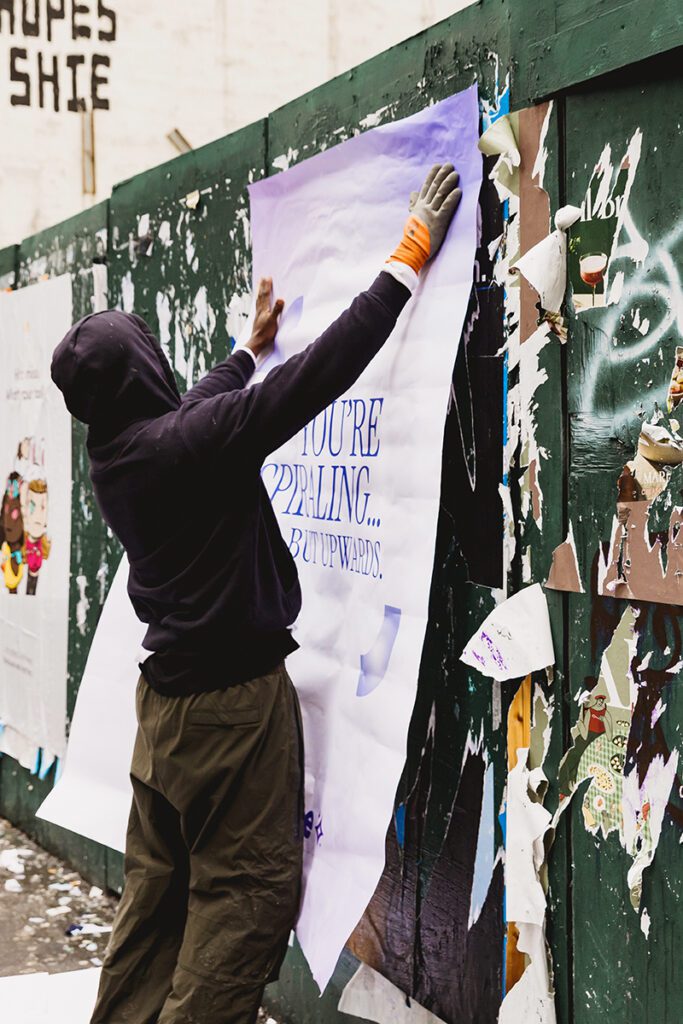
What Is Wheatpasting in London: The Complete Brand Guide
Wheatpasting has been part of London’s visual market for decades. Before digital screens lined every underground corridor, before social media algorithms decided what millions of commuters saw each morning, the city’s walls carried the news — film releases, concert tours, political campaigns, countercultural movements. That tradition is still alive, and it’s working harder than ever for brands that know how to use it.
If you’re approaching this from the US, the UK terminology is slightly different. You’ll hear “flyposting” used interchangeably with wheatpasting in London. The mechanism is the same: large-format paper posters applied with a water-based adhesive paste to walls, hoardings, and approved surfaces. The result is bold, physical, and impossible to scroll past. In a city of nearly nine million people covering 607 square miles, a well-placed wheatpaste campaign can stop pedestrian traffic in its tracks.
This guide breaks down how wheatpasting actually works in London — the mechanics, the neighborhoods, the regulations, the formats, and the reasons brands from film companies to fashion labels keep coming back to it. If you want to know whether this format fits your campaign, you’ll have a clear picture by the end of this page.
Wheatpasting gets its name from the paste used to adhere posters to surfaces. The traditional recipe is simple — wheat starch, water, sometimes a splash of vinegar or commercial additive to improve adhesion and slow breakdown. In practice, modern campaigns sometimes use pre-mixed commercial wallpaper paste or PVA-based adhesives, but the principle is identical. Paste goes on the wall, poster goes on the paste, more paste goes over the poster to seal and weatherproof it.
The result clings to surfaces in ways that tape and staples can’t achieve at large scale. A well-applied wheatpaste poster on a brick or wood-hoarding surface will stay intact through London’s rain, wind, and general urban abuse for weeks — sometimes months. The technique scales efficiently too. A two-person crew can post thirty to forty locations in a single overnight shift across East London.
Format and Size Options
London campaigns typically run at several standard sizes depending on the wall space and visual goal:
A1 (594mm x 841mm): Single-sheet posters, good for dense placement and repetition
A0 (841mm x 1189mm): The workhorse format — noticeable, printable, affordable at volume
Double Crown (508mm x 762mm): A classic UK format that fits standard hoarding panels
Quad Crown (1016mm x 762mm): Large horizontal format, highly visible on hoardings
Custom large-format: Multiple sheets tiled together for wall murals or oversized imagery
Paper weight matters. Campaigns running in autumn or winter in London should specify heavier stock — 120gsm minimum, 150gsm preferred — to handle moisture without degrading mid-campaign.
Why London Is Particularly Well-Suited to This Format
London is a walking city. Not in the American sense where people walk through parking lots between cars and shops — in the genuine sense where millions of residents and tourists move through streets on foot every single day. Shoreditch’s Brick Lane sees foot traffic patterns that rival shopping centres. The South Bank along the Thames draws pedestrians from Waterloo to Tower Bridge consistently throughout the week. Camden High Street on a Saturday is shoulder-to-shoulder from noon to closing.
That foot traffic is what gives wheatpasting its value in London. The poster doesn’t just catch someone scrolling through their phone — it’s there when they look up, when they round a corner, when they stop at a crossing. Physical presence in a walking city carries weight that digital placements in a car-centric market simply don’t.
London has more than 40 major West End theaters, attracts over 20 million tourists annually, and has five boroughs — Tower Hamlets, Hackney, Southwark, Lambeth, and Camden — that are consistently ranked among Europe’s most culturally active urban neighborhoods.
The Street Art Culture That Creates Space for Campaigns
East London in particular has developed a street art ecosystem that makes legitimate surface access more available than in most major cities. Shoreditch has some of the highest concentration of formally approved street art surfaces in Europe — walls commissioned, managed, and regularly refreshed by property owners who understand the marketing and community value of that content. That ecosystem creates real opportunities for brand campaigns, because the infrastructure (approved surfaces, local postering crews, established permission relationships) already exists.
This is different from spray-painting or stencil work. Wheatpaste campaigns in this context are paper posters on approved walls. The production is professional, the placement is coordinated, and the campaigns are planned in advance — not guerrilla in the reckless sense, but guerrilla in the sense of working at street level with a specific audience in mind.
Who Uses Wheatpasting in London
The short answer: any brand that wants to reach a specific London demographic through physical presence rather than paid digital reach. In practice, the most active categories in London right now are:
Film and Entertainment
Film studios — from major Hollywood distributors to independent UK film companies — have used London wheatpasting for decades. The Leicester Square premiere tradition brings global attention to the city, and street-level campaigns in the weeks before a premiere amplify that visibility at ground level. The BFI film culture, London’s numerous independent cinemas (Picturehouse, Curzon, Everyman), and the strength of British film criticism make London a market where physical buzz genuinely moves box office numbers.
West End Theater
Productions along Shaftesbury Avenue, St Martin’s Lane, and Drury Lane compete intensely for audience awareness. Theater marketing in London uses a layered approach — tube card advertising, press reviews, social media, and street campaigns that push posters into the neighborhoods where target audiences live and socialize. Shoreditch, Soho, and Covent Garden are prime theater marketing zones for shows targeting arts-engaged audiences aged 25-50.
Music
Album releases, tour announcements, and single drops use wheatpasting to create street-level anticipation. London’s music scenes are hyperlocal — what works in Dalston doesn’t necessarily land the same way in Brixton — and wheatpasting lets labels and artists target with neighborhood precision.
Fashion and Streetwear
Fashion brands in particular understand that their demographic doesn’t just shop online — they move through specific London neighborhoods in predictable patterns. A streetwear brand dropping a new collection will run wheatpaste campaigns in Carnaby Street, Brick Lane, and Portobello Road because that’s where their customer already is, on foot, looking at what’s around them.
Understanding the Regulatory market in London
Flyposting — unauthorized posting on public infrastructure like lamp posts, bus shelters, and council-owned walls — is regulated under the London Local Authorities Act and can result in fines against the poster placer and, in some cases, the commissioning brand. Responsible wheatpaste campaigns in London do not use unauthorized public surfaces. They use private walls with documented landowner permission.
The practical difference between a botched campaign and a professional one is the surface list. Any credible operator in London maintains relationships with property owners who allow postering for a fee or as part of ongoing arrangements. Those surfaces are defensible. They give the campaign legitimacy and longevity — because posters on owned walls don’t get torn down by enforcement teams on Monday morning.
This is important for US brands to understand. The UK takes flyposting enforcement more seriously than many American cities. Working with a professional operator who knows the London market eliminates that risk entirely.
The Physical Difference: How London Walls Compare to New York
If you’ve worked in New York street campaigns, London will feel familiar in some ways and different in others. New York scaffolding provides easy mass-coverage opportunities that London doesn’t have in the same density. London compensates with hoardings around construction sites — London is perpetually under construction somewhere — and the concentration of approved street art surfaces in East London boroughs.
The brick and render surfaces common throughout London hold paste differently than the plywood hoardings of New York construction sites. Brick is more porous, which means paste soaks in and holds well. Render is smoother but still accepts adhesion cleanly. The result is that London poster placements often hold up better over time than equivalent New York placements, which is useful when you’re paying for two to four weeks of visibility.
Planning a London Wheatpaste Campaign: The Basics
A well-structured London wheatpaste campaign has five core components:
Surface list: Pre-approved walls by neighborhood, with dimensions and ownership documented
Print production: UK-based print runs are usually faster and cheaper for London campaigns than shipping from the US
Posting crew: Local operators with neighborhood knowledge and existing surface relationships
Documentation: GPS-verified photo reports for every placement, delivered within 24 hours of posting
Duration management: Agreement on how long placements stay up and what happens when they’re covered by subsequent campaigns
Timeline from brief to launch is typically two to three weeks for a straightforward single-borough campaign. Multi-borough campaigns covering four or more London neighborhoods need three to five weeks to coordinate surface lists, print logistics, and crew scheduling.
“The brands that get the most out of London wheatpasting are the ones who treat it like any other media buy — defined objectives, defined geography, proof of placement. The format delivers, but only if the planning is solid.”
What Makes a London Wheatpaste Campaign Work
The difference between a campaign that creates genuine street presence and one that disappears into the visual noise of a major city comes down to three things: placement density, design clarity, and neighborhood fit.
Placement density means hitting a neighborhood hard enough that residents notice. One or two posters in Shoreditch means nothing. Twenty-five posters within a ten-minute walk of Boxpark on Bethnal Green Road means something. The threshold for campaign visibility varies by neighborhood, but the principle is consistent — you need enough placements to feel like a presence, not just a poster.
Design clarity at street scale is different from what works on a phone screen. High contrast, large type, a single clear message. Designs built for Instagram look mediocre on a six-foot wall. The best wheatpaste artwork in London treats the wall as the primary medium, not an afterthought.
Neighborhood fit means understanding that Brixton audiences respond differently than Mayfair audiences. Shoreditch is not Camden. The image and copy that lands in a creative district full of 25-35-year-old tech and media workers won’t necessarily work in a residential south London neighborhood with different demographics and values. Knowing your placement neighborhood as well as you know your audience is what separates effective campaigns from expensive wallpaper.
Why This Query Usually Leads to Commercial Research
Even though the phrase starts with “what is,” the search intent is usually more advanced than a dictionary definition. Most people typing this want a plain-English explanation plus the commercial basics: where London poster campaigns run, whether they are legal, how they are priced, and what kinds of brands use them. Competitor pages that surface for this topic mix educational framing with service-page signals, which is a good clue about what the search results expects.
That means the article should answer the core definition quickly, then move into the operational questions that matter to a buyer. Searchers often compare wheatpasting with flyposting terminology, want to understand the difference between approved private walls and unauthorized public surfaces, and look for evidence that the format still works in a screen-heavy city. They also expect examples. London-specific neighborhoods, entertainment use cases, and realistic campaign budgets help the page feel grounded instead of generic.
The common title pattern here is “what is” plus a practical payoff: guide, costs, legal rules, or how it works. Common H2s revolve around what the format is, where it works in London, legal considerations, poster sizes, campaign costs, and who uses it. By aligning to that structure, the page serves both informational searchers and high-intent brand teams who are moving from curiosity toward booking.
How Our London Operators Work
People ask us what a wheatpaste posting night actually looks like. Here’s the honest version: AGM’s crews run two or three operators per team. They start between 3am and 5am, which is the window where foot traffic is low enough to work efficiently but daylight is close enough that documentation photos are clean. We’ve placed campaigns in Shoreditch, Brixton, Camden, and along the South Bank using this exact model, and the 3am-5am window is non-negotiable — it protects our crews, gives us clean surfaces to work with, and means the posters are fresh when commuters start moving at 7am.
Paste is mixed to a specific ratio: roughly one part wheat starch to eight parts cold water, heated until it thickens, then cooled to working temperature. We adjust consistency depending on surface porosity. Brick in Hackney drinks paste fast — we mix slightly thicker than we would for the smoother render surfaces common in parts of Southwark. The paste goes on the wall first with a wide brush, the poster is applied, then a top coat seals it. A poster applied this way on a protected surface out of direct rain will last six to eight weeks in London conditions.
Each AGM London crew posts 30 to 45 locations per overnight shift. A3 location GPS coordinates and timestamped photos are logged throughout the night and compiled into a proof-of-posting report delivered to the client by 10am the same morning.
Crew coordination matters more than most clients expect. Our operators are assigned specific zones — one team might cover EC1 and EC2 (Shoreditch and Old Street corridor), another covers SE1 (Southwark and Borough), another handles N1 (Angel and Islington). That zone discipline means no duplicated effort and no missed locations. We’ve run campaigns where the client’s brief required 60 locations across six boroughs overnight, which means three simultaneous crews working in parallel. That kind of coordination only works if your operator network is already established, not assembled on the fly.
Campaign Timeline for a London Wheatpaste Run
Clients from the US often underestimate how long London campaigns take to set up properly. Here’s what a realistic timeline looks like from brief to posting night:
Week One: Brief, Surface List, Print Brief
We need your campaign brief, brand assets, and target neighborhoods before we can do anything useful. Within 48 hours of receipt we’ll send back a proposed surface list — walls by borough, dimensions, ownership status, and recommended format per location. Print brief goes to our UK print partner simultaneously. For A0-format posters (841mm x 1189mm) on a run of 200 sheets, the print turnaround is typically three to four working days from final artwork approval.
Week Two: Print Production and Logistics
Printing runs, posters are delivered to our London storage point, crews are briefed on specific locations. Any permit documentation for sites that require it is confirmed during this phase. Some surface owners in Shoreditch and Brixton require 72-hour advance notice before posting — that confirmation happens here.
Week Three: Posting and Documentation
The overnight run. Typically a Sunday-to-Monday or Wednesday-to-Thursday posting night depending on what’s happening in the target neighborhoods. Documentation is compiled and delivered the same morning. We do a daytime walkthrough 24 hours later to confirm all placements are intact.
From what we’ve seen in the field, the campaigns that hit hardest are the ones that land on a Tuesday or Wednesday morning — before the weekend clutter and after the Monday refresh. Theater and film clients especially benefit from that mid-week posting window.
London’s Best Wheatpaste Surfaces by Zone
Not every wall in London is equal. After years of running campaigns across the city, here’s how we think about zones:
East London (EC1, EC2, E1, E2, E8)
The highest concentration of approved surfaces in the city. Brick Lane alone has more than a dozen regularly refreshed walls between Bethnal Green Road and Buxton Street. Shoreditch High Street near Boxpark gives us multiple hoarding opportunities that face high foot traffic from the early morning market crowds through to the late-night restaurant and bar circuit. Dalston’s Kingsland Road has render-surface walls on the Ridley Road end that hold paste exceptionally well.
South London (SE1, SE5, SE15, SW2)
Brixton’s Coldharbour Lane and Atlantic Road corridors are reliable. The covered market area on Pope’s Road draws steady foot traffic seven days a week. Peckham’s Rye Lane and the area around Bussey Building (Copeland Road) has developed into a strong creative-district surface cluster. Borough Market perimeter hoardings are harder to access but deliver exceptional visibility given the tourist and foodie foot traffic.
North London (N1, NW1, NW6)
Camden’s Chalk Farm Road approaching the market is solid for music and entertainment campaigns. Angel has good hoarding coverage around the Upper Street / Islington Green junction. Kentish Town Road has a stretch of approved brick surfaces that hold well through the autumn and winter seasons.
West End (W1, WC2, WC1)
Seven Dials in Covent Garden, the streets immediately south of Shaftesbury Avenue, and the laneways off Carnaby Street in Soho are the key targets for theater and entertainment campaigns. Surface access is tighter here and costs more per location — expect £200-£400 per approved wall per two-week period — but the audience density justifies it for high-value entertainment launches.
Frequently Asked Questions
What is wheatpasting in London?
Wheatpasting is the practice of applying large-format paper posters to walls using a paste mixture, typically wheat starch-based. In London it’s used by brands, film studios, theater productions, and artists to create high-visibility street presence. The technique is also called flyposting in the UK, particularly in media and regulatory contexts.
Is wheatpasting legal in London?
Wheatpasting on private property with landowner permission is entirely legal in London. Unauthorized flyposting on public structures — lamp posts, council walls, bus shelters — is regulated under the London Local Authorities Act and can result in fines. Professional campaigns use pre-approved private walls with documented permission, which eliminates legal risk entirely.
How much does a wheatpaste campaign cost in London?
Costs vary based on scale, neighborhood, format, and duration. Entry-level campaigns in one London neighborhood start around £1,500-£3,000 for printing, placement, and documentation. Multi-borough campaigns covering four or more neighborhoods with large-format printing typically run £8,000-£25,000+. Contact us for a specific quote based on your brief.
What neighborhoods are best for wheatpasting in London?
Shoreditch, Brixton, Camden, Dalston, Peckham, Hackney Wick, and Brick Lane have the highest concentration of approved surfaces and culturally engaged foot traffic. The West End — Soho, Covent Garden, the theater district along Shaftesbury Avenue — works particularly well for entertainment and theater campaigns targeting arts-engaged audiences.
How do I book a wheatpaste campaign in London from the US?
American Guerrilla Marketing coordinates London wheatpaste campaigns through our UK operator network. We handle the surface list, print logistics, crew coordination, and GPS photo documentation. Contact us at [email protected] or (646) 776-2770 for a campaign quote and timeline.