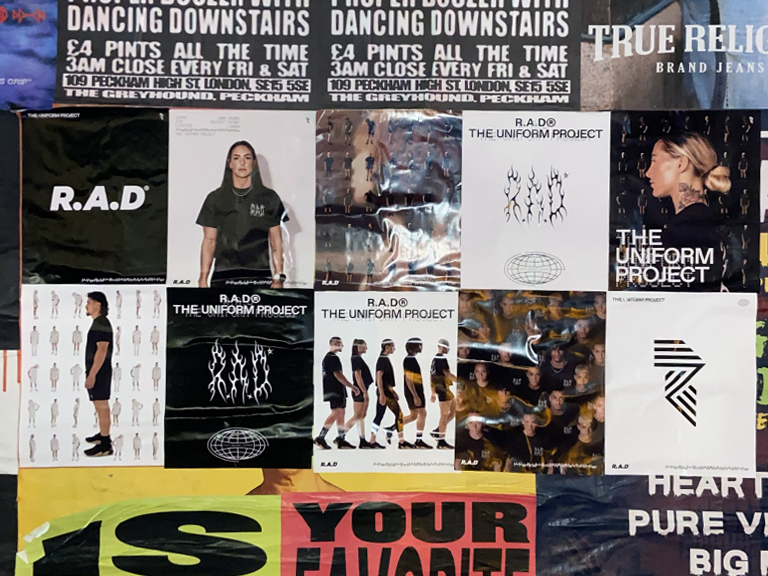
Independent film companies in London operate in a permanent tension between the need to create genuine marketing presence and the reality of budgets that would barely cover a single week of tube advertising. A limited-release British indie — three or four London venues, a BFI-backed production, a director whose previous film played Sundance and Tribeca but hasn’t crossed into mainstream awareness — needs to be visible to its audience without the resources to be visible to everyone.
Wheatpasting is one of the tools that works at this scale. Not because it’s cheap — a properly done campaign with real surface access, quality printing, and GPS documentation isn’t free — but because it can be targeted precisely enough that a relatively modest budget creates concentrated visibility in exactly the neighborhoods where the target audience is. A £2,500 campaign that puts fifty well-placed A0 posters around Dalston, Hackney, and the South Bank can do more for an indie film’s opening weekend than £10,000 of broadly targeted digital advertising that reaches a million people with no particular connection to independent cinema.
This guide is about how independent film companies — whether UK-based or US-based with UK distribution — approach London wheatpaste campaigns on real-world indie budgets. The economics, the neighborhood selection, the timing relative to reviews and venue programming, and how street campaigns fit into the specific ecosystem of independent film marketing in London.
The Indie Film Audience in London
London’s independent cinema audience is a specific and knowable demographic. They’re concentrated in specific neighborhoods. They have specific habits — reading Time Out’s film section, following BFI-selected programming, listening to recommendations from specific podcast and social media sources. They use Letterboxd. They make deliberate choices about what to see and at which venue.
This specificity is what makes wheatpasting effective for indie films in a way that mass-media advertising cannot match. You don’t need to reach everyone. You need to reach the people who are likely to see an independent British film at the Hackney Picturehouse on a Tuesday evening. Those people live in Dalston, Hackney, Shoreditch, and the surrounding east London neighborhoods. They walk past walls. They respond to good design. They’ll photograph and share an interesting poster if the design rewards it.
The BFI Film Fund supported approximately 70 new UK film productions in 2024, with average budgets of £1.5-£4 million. UK independent distributors handle roughly 200-250 independent film releases per year in the London market. The average marketing budget for a BFI-supported film is significantly lower than its production budget — making cost-efficient street campaigns a practical choice rather than a luxury add-on.
Venue-Specific Marketing
For limited-release indie films, the specific venues where the film is playing matter as much as the neighborhoods. The Ritzy in Brixton, the Rio in Dalston, the Hackney Picturehouse, the ICA on The Mall, the Barbican Cinema, the Curzon Soho, the BFI Southbank — each of these venues has its own audience relationship. Postering near the specific venue creates a combination of brand awareness and booking instruction that broader neighborhood campaigns don’t achieve as efficiently.
A poster within a five-minute walk of the Ritzy that includes the venue name and a QR code to the booking page is doing two jobs at once: building awareness of the film and reducing the friction between awareness and ticket purchase. For an indie with a limited release pattern, that friction reduction has direct commercial value.
Budget Allocation for Indie Film Campaigns
Working with a £2,000-£4,000 budget (the realistic range for most independent releases with marketing support), here’s how to allocate effectively:
| Component |
Budget at £2,500 |
Budget at £4,000 |
| UK print production (150 A0 sheets, 150gsm) |
£350-£450 |
£450-£600 |
| Surface access (two neighborhoods) |
£400-£600 |
£600-£900 |
| Crew (one posting night, two-person team) |
£400-£600 |
£800-£1,200 (two nights) |
| Campaign management and GPS documentation |
£300-£500 |
£400-£600 |
| Contingency |
£200-£300 |
£300-£400 |
The most consequential budget decision at the lower end is choosing depth over breadth. Two neighborhoods with 20-25 placements each will outperform five neighborhoods with 8-10 placements each. Density within a neighborhood is what creates the impression of a campaign that has arrived, rather than isolated posters that look like they happened by accident.
“The indie films that use street campaigns most effectively are the ones that accept they can’t be everywhere and commit fully to being somewhere. One neighborhood done properly beats five neighborhoods done passably.”
The Timing Relationship With Reviews
Indie film marketing in London is fundamentally review-dependent. The conversion of street awareness into ticket sales requires the credibility that reviews provide. A film that opens to three stars in The Guardian and two enthusiastic reviews from specialist film critics has the critical infrastructure to convert curious passers-by into ticket buyers. A film that hasn’t been reviewed yet is asking people to take a risk on the basis of a poster alone, which is a much harder ask.
The optimal timing for indie film wheatpasting maps to this review dynamics:
- Two to three weeks before opening: First posting round. Goal is awareness — getting the title and image into the visual environment of the target neighborhoods before the film opens.
- One week before opening (around press screening): Some campaigns choose a second posting round here, particularly if early word from press screenings is positive. This is tactical and depends on budget and confidence in reception.
- Opening weekend: If reviews are strong and the first week of box office is encouraging, a refresh or extension of placements can support a campaign building momentum. This is the best use of any remaining contingency budget.
Design for Indie Film Street Campaigns
Independent film key art is often designed by accomplished graphic designers working with a director’s visual vision. The results can be striking in a print or digital context and disappointing at street scale — because the design has been optimized for the viewing conditions of a magazine, a website, or a cinema foyer display board, not for a wall seen from a moving pavement.
Common indie film design issues for street campaigns:
- Typography too small or too light — festival selection text and small-print credits that read fine at A4 become illegible at A0
- Color palettes that work in print but disappear on brick or render surfaces — pale cream on white-render walls, dark navy on dirty brick
- Compositions that rely on fine detail or texture that doesn’t survive the grain of paper-on-surface at viewing distance
The adaptation for street doesn’t require redesigning the key art — it requires a specific street version that strips back to the essential elements: the image, the title, the venue name or URL. A specialist who has prepared print files for London street use can advise on what survives the transition from proof to wall.
Working With UK Independent Distributors
UK independent distributors — companies like Curzon Artificial Eye, Thunderbird Releasing, Vertigo Films, and Dogwoof — often have established relationships with London postering operators. If you’re producing a film that will be distributed through one of these companies, it’s worth asking whether street campaign coordination is part of their marketing package or whether the production is responsible for sourcing and managing it separately.
For US-based production companies with UK distribution through an independent distributor, the split of marketing responsibility varies by deal structure. Some distribution agreements include UK marketing spend as a distributor contribution; others leave it entirely to the production or split it pro rata. Understanding this clearly before the UK marketing plan is assembled prevents the last-minute scramble that produces the least effective campaigns.
How Indie Film Teams Stretch Small Budgets in London
Search results around indie film street promotion consistently lean toward practical planning, not theory. Producers want to know how to create visible buzz without paying for a full citywide out-of-home buy. In London, that usually means concentrating posters around independent cinemas, film festival venues, universities, nightlife clusters, and neighborhoods where culture audiences already walk. A compact poster run in Shoreditch, Soho, Hackney, or Brixton can create more conversation for an indie release than a thinly spread plan that tries to touch every borough.
The strongest indie film campaigns also rank around timing. If the release is tied to a premiere, review embargo, festival appearance, or one-week cinema run, the posters need to appear close enough to the event that people still remember the title when tickets go live. That is why indie film marketers often choose a seven to ten day poster window, dense placement near cinemas and bars, and clean creative built around the title, release date, and one arresting image. Searchers looking for this topic are usually trying to connect street activity to an actual release calendar.
For that reason, this page now speaks more directly to the real decision points: where indie audiences move in London, how much density matters, how to coordinate posters with trailers and social, and why proof of posting matters when every pound is being watched. The winning angle is not just “street posters look cool.” It is “street posters help a low-budget film look bigger than its media spend” when they are placed in the right London pockets and launched at the right moment.
Frequently Asked Questions
Why Independent Film Benefits Disproportionately from Wheatpasting
Major studio releases can buy their way to cultural saturation in London with above-the-line media buys — tube cards blanket the underground network, billboards cover the Westway, digital screens run on the South Bank and Oxford Street. Independent film companies don’t have those budgets, and most don’t need them. What independent film needs is precise, credible street presence in the neighborhoods where the actual target audience lives and spends time.
Wheatpasting delivers that precision in a way that traditional media buying cannot. A £3,000 wheatpaste campaign in Peckham, Dalston, and Bloomsbury reaches more of the genuine arthouse cinema-going audience than a £30,000 bus panel buy spread across the entire London network. That efficiency is why independent film distributors are among the format’s most consistent users in London.
Independent films (under £2m budget) released in the UK account for approximately 30% of all theatrical releases but only 8-12% of total box office. The gap between release volume and box office share reflects the marketing challenge — street campaigns in precisely targeted neighborhoods are one of the most cost-effective ways to close it.
Where Independent Film Audiences Are in London
The Peckhamplex in SE15 is the most price-accessible cinema in inner London. Its audience skews younger, more diverse, and more culturally adventurous than the West End multiplex crowd. Walls on Rye Lane and the streets feeding into the Bussey Building (Copeland Road) are increasingly part of standard independent film campaign plans because of the quality of the audience they reach.
The Rio Cinema on Kingsland High Street in Dalston is another anchor. The Rio programs a mix of contemporary independent releases, repertory screenings, and community events. Its audience is the core independent film demographic in east London — arts professionals, creative workers, students from the nearby Goldsmiths and UAL campuses by tube. We’ve placed campaigns on Kingsland High Street and the Broadway Market area (E8) specifically targeting this audience, and the correlation with Rio opening-weekend performance has been consistent.
BFI and Curzon Audiences
The BFI Southbank and Curzon cinemas (Bloomsbury, Soho, Mayfair) draw the most film-literate audiences in London. These venues program the films that set critical discourse, generate awards buzz, and establish the reputation that drives word-of-mouth. A campaign in the streets around these venues — South Bank riverside path, Russell Square, Bloomsbury Way — reaches the audience most likely to recommend a film to their social and professional network.
How AGM Approaches Indie Film Campaigns
Our approach to independent film campaigns is different from studio releases in two key ways: the neighborhood strategy is tighter, and the creative execution is more important. Independent film audiences in London are sophisticated about advertising. A generic, poorly designed poster on an inappropriate wall will not just underperform — it will generate a negative signal about the film’s quality and ambition.
We work with indie film clients at the creative brief stage to ensure the poster design is appropriate for wall-scale application. The constraints are the same as for any wheatpaste campaign — legibility at distance, high contrast, minimal information hierarchy — but the aesthetic expectations of an arthouse audience are higher than for genre releases. A great poster is table stakes.
For a typical independent UK film release, our recommended campaign covers: Dalston/Hackney (E8, N16), Peckham (SE15), Brixton (SW2/SW9), Bloomsbury/Fitzrovia (WC1, W1T), and the South Bank (SE1). That five-zone campaign hits the five highest-concentration independent film audience neighborhoods in London with a total of 30 to 50 placements. Total campaign cost: approximately £2,800 to £4,500 depending on format and print spec.
We’ve placed for independent film releases ahead of BFI London Film Festival screenings, and the approach is consistent: tight geography, high-quality print, well-chosen surfaces in the right neighborhoods. The BFI audience doesn’t need to see a campaign everywhere — they need to see it in the places they already trust as markers of cultural quality.
The BFI London Film Festival as a Campaign Opportunity
The BFI London Film Festival, held each October across venues from the BFI Southbank to the Hackney Picturehouse, is one of the most important windows for independent film wheatpaste campaigns in London. The festival concentrates the UK’s film critical establishment, international buyers, arts press, and a highly engaged film-going public in a two-week period that generates disproportionate media attention relative to its size.
Films premiering at BFI LFF that want to build London street presence around their premiere should post in the week before the festival opens. That timing puts fresh posters on walls just as the arts press is ramping up festival coverage and the most engaged film audiences are starting to build their viewing schedules. A well-placed campaign in Hackney (near the Hackney Picturehouse), Southwark (near the BFI Southbank), and Bloomsbury creates a geographic ring around the festival’s main venues.
We’ve placed campaigns for BFI LFF premieres and recommend the same three-zone approach consistently: the South Bank riverside (SE1), Dalston/Hackney (E8/N16), and Bloomsbury (WC1). Those three zones cover the festival’s three main audience clusters — the BFI Southbank regulars, the east London arts workers who frequent the Hackney Picturehouse, and the Bloomsbury academic and critical establishment centered on UCL and the British Museum district.
Post-Festival UK Distribution Campaign
Films that generate strong BFI LFF buzz often go into UK theatrical distribution in the weeks immediately following the festival. A post-LFF distribution campaign benefits from the awareness the festival has already built — people who read about the film in festival coverage are primed to respond to street presence in the cinemas that will be screening it. We coordinate with UK distributors on post-LFF campaign timing to ensure street presence arrives at the moment when festival-generated awareness is highest and the box office window is opening.
From what we’ve seen in the field, independent films that invest in a two-phase campaign strategy — festival premiere positioning followed by a distribution launch campaign — consistently generate more sustained London box office runs than single-phase campaigns. The first phase builds name recognition; the second phase converts it to ticket sales.
Can indie film companies afford wheatpaste campaigns in London?
Yes. Entry-level focused campaigns in one or two London neighborhoods start at £1,500-£3,500. This is within range for most independent UK film releases with BFI Film Fund support or independent distribution deals. The key is tight neighborhood focus rather than trying to cover the whole city. A £2,500 campaign concentrated in Dalston and Hackney can create genuine street presence for a limited-release indie.
Which London neighborhoods are most cost-effective for indie film campaigns?
Shoreditch, Dalston, Peckham, and South Bank (near the BFI) offer the best combination of lower surface access costs and high concentration of the indie film-going demographic. These neighborhoods deliver better value for indie film campaigns than the more expensive West End zones. Campaigns should also include the immediate vicinity of the specific venues showing the film — Ritzy Brixton, Rio Dalston, Hackney Picturehouse, BFI Southbank.
What is the minimum poster run for an indie film wheatpaste campaign?
A minimum viable print run for a focused single-neighborhood campaign is around 100 A0 sheets. This provides enough stock for 25-35 placements with contingency for damaged or rejected sheets. Below 100 sheets, per-unit print cost rises enough to make the economics less favorable. For a two-neighborhood campaign, budget 150-200 sheets to maintain adequate density in both zones.
How do indie films use wheatpaste alongside BFI and critical support?
BFI-supported films often open with strong critical support from specialist film press. Wheatpaste campaigns work best as a physical amplifier for that critical momentum — reaching the cinema-going audience who reads those reviews in the neighborhoods where they live, building the sense of a film that has arrived in the city. The street presence reinforces the critical consensus and gives audiences a visual memory point that makes the review experience more concrete.
Should an indie film campaign post near specific cinema venues?
Yes, for limited-release films specifically. Concentrated postering within walking distance of the specific venues showing the film is often more effective than broad neighborhood coverage. Placements near the Ritzy in Brixton, the Rio in Dalston, or the Hackney Picturehouse put both the awareness message and the location information in front of the right people simultaneously. Including the venue name on the poster is more useful than a general URL for audiences who need both information and decision support.