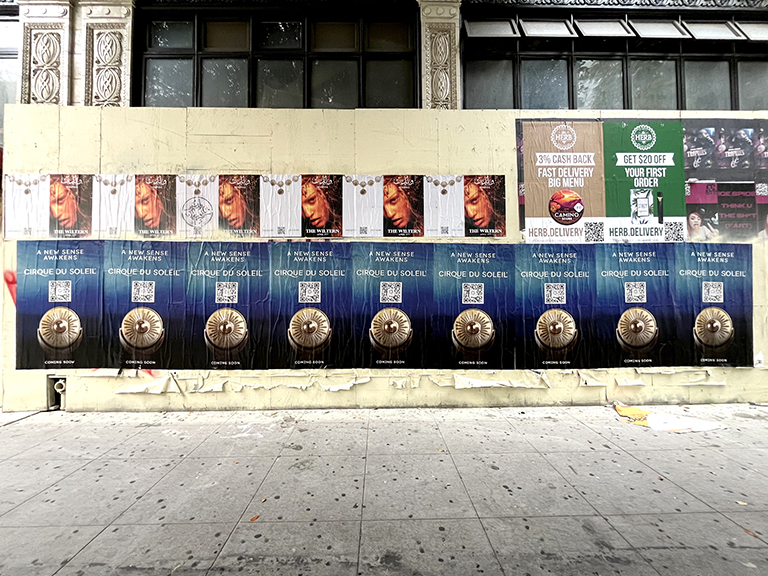
Street marketing works when it earns attention rather than demanding it. The best street-level campaigns create a moment of genuine surprise — something the pedestrian didn’t expect to find on their commute, their walk to lunch, their Saturday afternoon in the neighborhood. That moment of genuine engagement is worth more than a thousand algorithmic impressions from a consumer who’s trained themselves to scroll past ads without registering them.
The challenge is that street marketing encompasses a huge range of tactics, from simple flyer distribution to sophisticated multi-format campaigns that layer murals, stencils, mobile displays, and experiential events across an entire city. Not every tactic works for every brand, objective, or market. Understanding which tools serve which purposes is the difference between a campaign that builds lasting brand presence and one that burns budget without building anything measurable.
This guide covers 15 street marketing tactics with strategic context for each — when to use them, what they cost, and how they perform in practice. We deploy every format on this list in 50+ U.S. markets, so the guidance here is operational, not theoretical.
The Fundamentals: Why Street Marketing Works
Street marketing operates in a media environment where the consumer hasn’t opted in to receive brand communication. That’s simultaneously the format’s challenge and its greatest advantage. Opt-in audiences receive messages they’ve already agreed to hear; street marketing reaches consumers in an unguarded state, in the places and moments that are genuinely theirs rather than brands’ by contract.
Earned Attention vs. Purchased Attention
Traditional advertising purchases attention: you pay for the placement, and the consumer sees it as part of consuming other content. Street marketing earns attention: it creates something worth noticing in a space the consumer thought was beyond brand communication. Earning that attention requires creativity, cultural relevance, and execution quality that passive media placements don’t demand. The payoff is an engagement quality that purchased attention rarely produces.
Physical Presence and Cultural Embedding
Street marketing creates physical brand presence in the environments where consumers actually live. A mural in a neighborhood doesn’t just reach the people who walk by it — it becomes part of the neighborhood’s visual identity, associated with the place and the culture rather than with an advertising slot. This association-by-location is one of the most powerful brand-building mechanisms available in any media format.
Organic Social Amplification
Well-executed street marketing generates user-created content at a rate that no purchased media format can match. A striking mural, a creative street installation, an unexpected experiential activation — these become social posts, TikToks, and Instagram stories that carry brand messages to audiences far beyond the physical location. The earned media multiplier on strong street marketing execution can dwarf the paid campaign’s direct reach.
Tactic 1: Wheatpasting and Wheatpasting
Wheatpasting is the foundation of street marketing’s visual vocabulary. Large-format paper posters applied with paste to permitted surfaces create dense visual saturation in urban neighborhoods at a cost per impression that traditional OOH rarely matches. Our wheatpasting campaigns deploy on curated permitted wall networks that deliver predictable reach in the specific neighborhoods that matter to each client.
Best for: album drops, film releases, fashion launches, event promotion, product launches requiring rapid urban saturation. Minimum viable market: NYC, LA, Chicago, Miami, Austin. Cost range: $5,000–$25,000 per market.
Tactic 2: Brand Murals
Painted wall murals are street marketing’s highest-impact, longest-duration format. A well-executed brand mural in the right neighborhood generates social sharing, press coverage, and foot traffic documentation over months or years. The production investment is higher than poster campaigns, but the cultural return — and the long-tail earned media — often exceeds the initial cost by multiples. Entertainment brands, fashion companies, and tech platforms use murals as flagship activations in markets where cultural credibility is a prerequisite for consumer adoption.
Best for: flagship brand presence, launch moments requiring cultural credibility, multi-city brand tours. Cost range: $15,000–$75,000+ per market depending on wall size and city tier.
Tactic 3: Sidewalk Stencils
Chalk-based sidewalk stencils create ground-level brand impressions in the literal path of foot traffic. Water-soluble stencil paint produces temporary messaging that generates strong awareness without permanent surface impact. Stencil campaigns work particularly well as directional tools — pointing pedestrians toward a nearby activation, pop-up, or retail location — and as ambient awareness layers in neighborhoods where wall space is limited or expensive.
Best for: event directionals, product launch ambient campaigns, neighborhood saturation in concert with other tactics. Cost range: $3,000–$10,000 per market for a 2–3 day deployment.
Tactic 4: Street Team Deployment
Professional street team deployments create the most direct consumer engagement available in street marketing. Trained brand ambassadors in the right locations with the right message generate face-to-face brand interactions that convert to awareness, trial, and downstream purchase intent at rates passive formats can’t match. Street teams work best when the interaction itself has value — a sample, a demonstration, an experience — rather than simply a flyer handout.
Best for: product sampling, experiential launches, event activation support, market entry awareness. Cost range: $3,000–$10,000 per market per day for a professional 4–8 person team.
Tactic 5: LED Billboard Trucks
LED billboard trucks bring high-brightness digital displays to any location, following audience concentrations rather than waiting for them to come to a fixed location. The format is particularly valuable for launch events, sports days, and festival deployments where the target audience is concentrated at a specific location on a specific date. Route-based deployments through high-traffic corridors create multi-neighborhood awareness from a single asset.
Best for: launch events, sports activations, festival campaigns, markets where static OOH inventory is unavailable. Cost range: $2,000–$6,000 per day depending on market and route complexity.
Tactic 6: Mobile Billboards
Mobile billboard trucks carrying large-format printed displays offer an alternative to LED trucks at lower cost with different creative possibilities. Printed displays can carry more complex visual content than LED at cost; LED displays allow content changes and can show video. Both formats share the core mobile advantage: reaching audience concentrations wherever they form rather than waiting at a fixed location.
Best for: broad market coverage at cost efficiency, multi-day campaigns, markets where LED availability is limited. Cost range: $1,500–$4,000 per day.
Tactic 7: Brand Ambassador Programs
Long-term brand ambassador programs extend street marketing’s reach beyond campaign activations into ongoing consumer touchpoints. Ambassadors embedded in relevant community events, venues, and lifestyle contexts create sustained brand presence without the campaign-by-campaign activation cost. Ambassador programs work best for brands with genuine community alignment — the ambassador relationship requires authentic connection that rented attention can’t replicate.
Best for: DTC brands building community presence, lifestyle brands targeting specific subcultures, market entry programs requiring sustained visibility. Cost range: varies by program scope; typically $5,000–$20,000/month for a coordinated multi-ambassador program.
Tactic 8: Projection Advertising
High-lumen projectors deployed at night transform building facades, water features, and large surfaces into dramatic brand displays. Projection advertising generates immediate social sharing and press attention — the visual spectacle of a brand image covering an entire building is inherently newsworthy. The format is constrained to nighttime and appropriate surface conditions, but within those parameters it delivers some of the highest earned media returns available in the street marketing toolkit.
Best for: launch events, award shows, fashion weeks, cultural moments requiring dramatic visual statements. Cost range: $5,000–$20,000 per activation depending on projection scale and duration.
Tactic 9: Sticker Advertising Campaigns
Branded sticker campaigns operate differently from other street tactics because distribution happens through people rather than surfaces. Stickers handed out by street teams, seeded through retail partners, or included in product packaging become carried by consumers into their own environments — on laptops, water bottles, skateboards, and phone cases. A well-designed sticker generates brand impressions long after the campaign ends, in locations the campaign never planned to reach.
Best for: youth-oriented lifestyle brands, product launches targeting creative communities, brands seeking organic peer-to-peer distribution. Cost range: $1,000–$5,000 for print plus $3,000–$10,000 for professional distribution.
Tactic 10: Guerrilla Sampling
Product sampling deployed through street teams at high-density locations creates trial moments with consumers who wouldn’t otherwise encounter your product. Sampling campaigns work best when the product speaks for itself — food and beverage, beauty, personal care, tech accessories — and when the sampling context matches the brand’s intended use occasion. A kombucha brand sampling outside a yoga studio is efficient targeting; the same brand sampling outside a sports bar is wasted budget.
Best for: food and beverage launches, beauty and personal care launches, CPG brands entering new markets. Cost range: product cost plus $3,000–$8,000 per market for professional sampling deployment.
Tactic 11: Pop-Up Retail and Brand Installations
Temporary pop-up retail and brand installations create immersive brand experiences in unexpected locations. A pop-up that appears for 2–3 days in a neighborhood generates urgency — the FOMO of a limited-time, location-specific experience — that permanent retail can’t replicate. Pop-ups also generate social content from every consumer who visits and shares, extending the campaign’s reach organically.
Best for: DTC product launches, limited-edition releases, brand experiences that require consumer immersion. Cost range: $10,000–$50,000+ depending on installation complexity and duration.
Tactic 12: Street Art Partnerships and Artist Collaborations
Brands that partner with established street artists — commissioning limited-edition work, supporting artist projects, co-creating campaign materials — gain cultural credibility that direct advertising can’t manufacture. The artist’s existing audience and reputation attach to the brand through the collaboration. This approach works best when the brand-artist relationship has genuine alignment rather than feeling like a commercial annexation of an artist’s credibility.
Best for: youth-oriented brands, culture-forward launches, brands rebuilding credibility after perception challenges. Cost range: highly variable based on artist stature.
Tactic 13: Event Ambush Marketing
Ambush marketing — activating near a major event without being an official sponsor — captures concentrated audience attention at a fraction of official sponsorship costs. This requires careful navigation of trademark and proximity regulations that vary by event and venue. When executed correctly, a brand presence in the blocks surrounding a major concert, sporting event, or festival reaches an audience that the official sponsors paid tens of thousands of dollars to access.
Best for: challenger brands entering sports and entertainment marketing, brands targeting event-specific demographics. Cost range: $5,000–$20,000 for a street-level event ambush activation.
Tactic 14: Experiential Marketing Events
Full experiential marketing events — interactive installations, brand experience pop-ups, consumer engagement activations — represent the highest-investment, highest-engagement format in street marketing. Where passive tactics create impressions, experiential creates memories. The format demands creative execution, logistical precision, and enough of a “wow” factor to earn the social content that amplifies the investment beyond its physical footprint.
Best for: major brand launches, annual brand moments, campaigns where consumer engagement and social content generation are primary objectives. Cost range: $25,000–$200,000+ depending on complexity.
Tactic 15: Multi-Format Integrated Campaigns
The most powerful street marketing campaigns layer multiple tactics from the list above into a coordinated multi-format presence across a neighborhood or city. A launch campaign might combine wheatpasting for broad visual coverage, a street team for direct engagement, an LED truck for launch day impact, and a mural as the permanent anchor of the campaign’s visual identity. The layered approach creates genuine omnipresence — the sense that the brand has taken over a city — that no single tactic can achieve alone.
Our guerrilla marketing services are built around this integrated model. We plan the tactic mix, coordinate production schedules across formats, manage permitting for each element, and deliver consolidated documentation that shows the full campaign footprint in a single report. For brands serious about street presence, this integrated approach consistently outperforms single-tactic campaigns at comparable budget levels.
Frequently Asked Questions About Street Marketing Tactics
What is street marketing?
Street marketing is a form of out-of-home advertising that brings brand messaging directly to consumers in public spaces through non-traditional formats — murals, posters, stencils, street teams, mobile displays, and experiential events. Unlike traditional OOH, street marketing emphasizes direct consumer engagement, cultural relevance, and earned media generation alongside impression delivery.
What are the most effective street marketing tactics?
The most consistently effective street marketing tactics include wheatpasting for visual saturation, brand murals for cultural credibility, street teams for direct engagement, sidewalk stencils for foot traffic direction, LED billboard trucks for mobile reach, and experiential activations for high-engagement brand moments. Effectiveness depends heavily on campaign objectives and the specific neighborhood and demographic being targeted.
How much does street marketing cost?
Street marketing costs range widely by tactic and market. Single-tactic campaigns in a single city can start at $5,000–$10,000. Full multi-tactic campaigns across multiple markets run $25,000–$150,000+. The format’s cost efficiency relative to traditional OOH makes it attractive for brands that need high impact with targeted budgets.
Is street marketing legal?
Street marketing is legal when executed within established legal frameworks — permitted surfaces, compliant materials, licensed placements, and approved activation zones. Unauthorized placements on public property create legal liability for brands. Professional agencies build compliance into every campaign format and market, protecting brands from enforcement actions and brand reputation risk.
What industries use street marketing most effectively?
Entertainment (film, music, streaming), fashion and apparel, food and beverage, tech startups, cannabis, beauty, and consumer electronics brands use street marketing most effectively. Any brand targeting urban consumers aged 18–40 with discretionary income has strong alignment with street marketing’s typical reach profile and cultural resonance.
How does American Guerrilla Marketing execute street campaigns?
We plan and execute multi-tactic street marketing campaigns in 50+ U.S. markets. Our process includes strategic tactic selection, site scouting, permitting, production coordination, street team deployment, and GPS-documented delivery confirmation. Every campaign closes with a full photo and video documentation package. Call us at (646) 776-2770 or visit our Industry City, Brooklyn office to discuss your campaign.
What is street marketing tactics guide?
American Guerrilla Marketing provides street marketing tactics guide services across 50+ U.S. markets. Every campaign is planned, scouted, executed, and GPS-documented by our field teams. We work with regional brands and Fortune 500 companies on campaigns that require real street-level execution and documented proof of performance.
How does AGM approach tactics guide?
Our process starts with a market consultation to understand your goals, target audience, and budget. We then scout locations, handle any required permissions or permits, coordinate production and installation with our local crews, and provide a full GPS-tagged photo report after the campaign runs.
What markets does American Guerrilla Marketing cover for tactics guide?
We operate in 50+ U.S. markets including New York, Los Angeles, Chicago, Miami, Houston, Atlanta, Seattle, Denver, Boston, and dozens of secondary markets. Contact us to confirm availability and pricing for your specific market.
How much does a tactics guide campaign cost?
Campaign pricing depends on market, format, quantity, and duration. We work with budgets ranging from targeted single-market runs to national rollouts across multiple cities. Use our RFP Builder or contact us directly for a custom quote based on your specific campaign requirements.
How do I get started with tactics guide through AGM?
The fastest way to get started is to submit your campaign details through our RFP Builder at americanguerrillamarketing.com, or contact us directly at [email protected] or (646) 776-2770. Our team typically responds within one business day with availability and initial pricing.