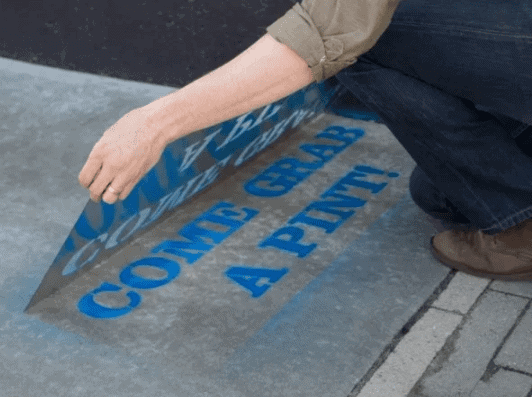
Street and sidewalk decals are one of the most effective event advertising formats available when placed correctly, high foot traffic, zero barrier to view, and 100% unavoidable by anyone walking through the zone. We’ve used sidewalk and street decals to support concert launches, product activations, festival promotions, and brand takeovers across dozens of cities, and when the placement strategy is sound, they consistently outperform posters and flyers for on-the-ground event awareness. This guide covers every format, the real costs, what works and what doesn’t, and the legal space you need to understand before deploying.
Why Sidewalk Decals Work for Event Advertising
Event advertising has one primary challenge: reaching people in the physical geography near the event before they commit to staying home. Street and sidewalk decals solve that problem by inserting your message directly into the pedestrian experience of the neighborhood where your event will happen. A person walking down Bedford Avenue in Williamsburg or past the entrance to Prospect Park will see a sidewalk decal at foot-eye-level before they even look up at a poster on the wall above it.
The placement geometry is what makes this format effective. Pedestrians look down. Anyone working through a busy sidewalk, especially someone checking their phone, spends significant time with eyes at ground level. A well-designed decal placed at a pedestrian chokepoint like an intersection, a subway exit, or a venue entrance commands viewing time that eye-level media doesn’t always get.
Sidewalk decals also have the benefit of longevity relative to other street-level formats. In low-rainfall conditions with appropriate materials, a quality vinyl decal holds for two to four weeks. A paper flyer placed at the same location survives a single rainstorm. For multi-week event promotion campaigns, that durability difference is significant.
Types of Street and Sidewalk Decals for Event Advertising
Removable Vinyl Decals
High-quality removable vinyl is the industry standard for permitted sidewalk advertising. The material adheres firmly enough to withstand foot traffic and weather but removes cleanly without surface damage when the campaign ends. We source materials specifically tested for urban concrete and asphalt surfaces, cheaper vinyl products leave adhesive residue or tear on removal, which creates liability issues and ruins the relationship with property or venue owners for future campaigns.
Vinyl decals are UV-printed in full CMYK color, hold up through multiple rain events, and can be produced in sizes from small directional arrows (12 inches) to large floor graphics covering several square feet. For high-impact event promotion, we typically run larger-format pieces (24 to 36 inches) at key pedestrian chokepoints rather than distributing small stickers across a wide geography.
Chalk and Water-Soluble Stencils
Chalk-based and water-soluble paint stencils are fully temporary, they disappear with rain or normal pedestrian abrasion within 24 to 72 hours. This makes them appropriate for high-frequency event scenarios where you want brand presence immediately before and during the event window and don’t need or want longer-term persistence.
We’ve used chalk stencils on the sidewalks outside university venues, music halls, and convention center entrances where the audience we need to reach is physically present in the 48 hours before an event. After we’ve stenciled 200 to 400 positions around a venue zone, the walk from subway or parking to the venue becomes a branded experience before the audience even reaches the door.
Chalk stencils are also more broadly permissible than permanent adhesives in most jurisdictions. Because they’re genuinely temporary and leave no surface damage, enforcement action is rare in cities that tolerate them. That said, legal compliance varies significantly by municipality, always confirm local regulations before deploying.
Custom Directional Decals
Directional decals, arrows, route markers, and navigation-style graphics, serve a functional as well as promotional purpose for events in complex urban settings. For a festival spread across multiple city blocks, or a brand activation in a convention center or park where wayfinding is a real attendee challenge, directional floor graphics reduce confusion and improve the attendee experience while reinforcing brand presence at every decision point.
We’ve used directional decal systems for large events in Bryant Park (New York), Millennium Park (Chicago), and the Gaslamp District (San Diego). The combination of event wayfinding and branded visual identity creates something that feels like sponsor integration rather than advertising, audiences engage with it rather than tuning it out.
Street Decals (Roadway Applications)
Street decals, placed in crosswalks, on roadway surfaces, or at intersection entry points, offer high visibility to both vehicle and pedestrian audiences. These require different material specifications than sidewalk decals: anti-slip coating, higher adhesion for asphalt (which expands and contracts more than concrete), and materials that meet local roadway safety standards.
In most cities, crosswalk and roadway decals require municipal permits and are subject to more formal approval processes than sidewalk applications. The incremental permitting effort is worth it for the right event, a branded crosswalk at a major intersection near a venue can generate significant media attention and social sharing in addition to its direct advertising function.
Best Locations for Event Sidewalk Decals
Subway Exits and Transit Nodes
Transit exits are the single highest-value placement location for urban event advertising. Every person walking out of a subway entrance is on foot, looking where they’re stepping, and within the pedestrian environment where your event exists. In New York, we’ve placed sidewalk decals at the exits of stations on the L, 1, and A/C/E lines that serve major event venues, Union Square, Atlantic Terminal, and Penn Station are particularly high-value nodes for large-scale events.
The key technical consideration for subway exits: the foot traffic volume is extreme. Material selection matters more here than anywhere else. We use commercial-grade vinyl with a heavy slip-resistant laminate that holds up through thousands of footfalls per day without lifting, tearing, or becoming a slip hazard.
Venue Entrance Zones
The immediate approach to a venue, the last 200 feet of sidewalk before the entrance, is prime decal territory. This is where the target audience is definitionally present, moving at pedestrian pace, and fully in the mental context of the event they’re attending or considering. Decals here can carry messaging that presupposes attendance (“Welcome to [event]”) rather than traditional advertising copy.
High-Pedestrian Retail Corridors
For events serving a specific neighborhood or demographic, the main retail corridor through that community is typically the highest-reach placement zone available. We’ve placed event decals on Bedford Avenue in Williamsburg for music events, on Abbot Kinney Boulevard in Venice for brand activations, on Michigan Avenue in Chicago for major cultural events. The audience walking these corridors is exactly the audience most events are trying to reach, and they’re moving at pedestrian speeds that allow meaningful impression dwell time.
University Campuses
For events targeting students and the 18-to-24 demographic, campus walkways are the most efficient placement environment available. We’ve deployed sidewalk stencil and decal campaigns across the campuses of NYU, USC, UT Austin, and dozens of other universities, typically placing 200 to 400 impressions across the highest-pedestrian-traffic walkways and plaza areas on campus in the days leading up to an event. The concentration of target demographic in a bounded geographic space makes campus placements extremely efficient.
Festival Grounds and Event Perimeters
For multi-day festivals, placing decals on the approach routes from parking areas, transit stops, and hotels to the festival entrance creates a branded corridor experience that builds anticipation before attendees arrive and reinforces brand memory after they leave. We’ve executed this approach at music festivals, food and beverage events, and outdoor markets in cities including Austin (South by Southwest approaches), Nashville (Music Row area), and New Orleans (Festival grounds near the Fair Grounds Race Course).
The Legal Landscape: What’s Permitted and What Isn’t
The legal status of sidewalk decals varies substantially by city and by material type. Getting this wrong creates fines, forced early removal, and potential venue relationship damage. Here’s what we’ve learned across 500+ campaigns in markets nationwide.
Chalk and water-soluble stencils are tolerated in most US cities because they’re genuinely temporary and cause no surface damage. Enforcement action against chalk advertising is rare in New York, Los Angeles, Chicago, Austin, and most major urban markets. Some cities have explicit policies; many simply don’t enforce ordinances against genuinely temporary, washable applications. We always confirm the local posture before deploying at scale.
Adhesive vinyl decals require more care. On private property, a venue parking lot, a branded retail exterior, a festival ground owned by a private entity, adhesive decals are generally permissible with property owner consent. On public sidewalks, the legal situation varies: some cities prohibit adhesive advertising outright, others require permits, and some treat it as a civil rather than criminal matter with fines as the enforcement mechanism.
Roadway and crosswalk applications require municipal permits in virtually all US cities. The application process ranges from a simple written request to a formal permit with traffic control requirements. For high-visibility crosswalk decals at major intersections near event venues, the permitting effort is worth it, these generate media coverage and social sharing at rates that justify the administrative investment.
AGM works through local legal parameters in each market before deploying. We do not drop clients into compliance problems. If a specific placement isn’t viable legally, we identify the closest legal alternative that achieves the same campaign objective.
How to Design Effective Event Sidewalk Decals
Contrast and Legibility at Ground Angle
Sidewalk decals are read from above and at an angle, a fundamentally different viewing geometry than a poster or billboard. Design for this. High-contrast color combinations, white on dark, yellow on black, red on white, read clearly from a natural walking distance. Low-contrast designs that look elegant in a design mockup become illegible at foot level in real-world conditions. We preview all decal creative at simulated ground-level viewing angles before going to production.
Fewer Words, Larger Type
A pedestrian has 1 to 3 seconds of reading time on a sidewalk decal. The copy has to work within that window. Event name, date, and a single-word call to action (the venue name or a URL if short) is the maximum viable information load. Anything more is not being read. We’ve seen clients attempt to put four-line taglines on 18-inch decals, the result is unreadable. One message. Large type. High contrast.
QR Codes for Event Detail
A QR code on a sidewalk decal bridges the gap between the limited copy space and the full event information the audience needs. We’ve measured QR scan rates on sidewalk decals in high-foot-traffic zones at 2 to 5% of passing pedestrians, low in absolute percentage terms but significant at scale when you’re placing 200 to 400 units across a neighborhood. The people who scan are high-intent prospects.
Include Dates and Key Event Info
The decal must answer the most immediate question: when? Campaigns that omit the date force the audience to seek out additional information, which most won’t do. Date in large, clear typography is non-negotiable for event advertising.
Case Examples of Effective Event Sidewalk Decal Campaigns
Music Festival Approach Routes
We’ve placed sidewalk and street decals on the pedestrian approach routes to major music festivals, positioning branded graphics at every decision point between the nearest transit stops and the festival entrance. For a festival serving 20,000 daily attendees walking a 10-minute route from the subway, a properly placed decal campaign creates 200,000 to 300,000 branded impressions over a three-day event weekend without any ongoing staffing cost.
Concert Venue Promotion in Brooklyn
For a venue launch campaign in Brooklyn, we deployed 300 sidewalk decals and chalk stencils across a 10-block radius centered on the venue, focusing placements on the Bedford Avenue L train exit (one of Brooklyn’s highest-pedestrian-volume transit nodes), the sidewalks along North 6th and North 7th Streets, and the McCarren Park entrance approaches. The campaign ran for two weeks ahead of the venue’s opening and contributed to a sold-out first weekend, the client attributed a meaningful share of ticket traffic to the street-level campaign.
Food and Beverage Event in the Gaslamp District
For a food and beverage festival in San Diego’s Gaslamp Quarter, we used directional decals on the sidewalks from the Convention Center trolley stop to the festival entrance, combined with event-branded graphics at the main intersection chokepoints on Fifth Avenue. The directional system reduced attendee wayfinding confusion and created branded touchpoints along the entire approach route.
Costs for Sidewalk Decal Event Advertising
Production and installation costs for sidewalk decal campaigns depend on material type, quantity, geography, and application complexity. Vinyl decals for a single-city event campaign, production plus placement of 50 to 100 units across a targeted neighborhood zone, typically run in the range that makes them competitive with other event marketing formats on a cost-per-impression basis.
Chalk stencil campaigns have lower material costs but require crew time for stenciling, which is labor-intensive at scale. For a 200-unit chalk stencil deployment across a university campus or neighborhood, plan for a crew of 2 to 4 people over 6 to 8 hours depending on placement density and walking distances.
For current AGM pricing on sidewalk decal and stencil programs for your event, contact us at americanguerrillamarketing.com/contact. Pricing varies by market, scale, and material type, we provide campaign-specific quotes rather than generic rate cards.
Frequently Asked Questions About Sidewalk Decals for Events
How long do sidewalk decals last?
Vinyl adhesive decals hold 2 to 4 weeks in dry conditions with appropriate material selection. In high-rainfall or high-foot-traffic zones, plan for 1 to 2 weeks of effective life. Chalk stencils typically last 24 to 72 hours depending on rainfall and pedestrian traffic volume. We match material to duration requirements for each campaign.
Are sidewalk decals legal?
Legality varies by city and by material type. Chalk and water-soluble stencils are tolerated in most US cities as genuinely temporary, no-damage applications. Adhesive vinyl on public sidewalks requires permits in some cities and is prohibited on public property in others. Roadway applications require permits virtually everywhere. AGM works through local compliance in each market before deploying, we won’t put clients in a compliance problem.
What size should a sidewalk decal be for maximum visibility?
For a standalone event-promotion decal, 24 to 36 inches across is the minimum for meaningful visual impact at pedestrian viewing distances. Larger pieces, 3 to 5 feet, work well in open plaza areas and broad sidewalks. At busy transit exits where pedestrians are compressed, even smaller pieces at high frequency create cumulative impact.
Can sidewalk decals be used in all weather?
Vinyl decals survive rain once properly applied, but application should happen in dry conditions to ensure adhesion. Chalk stencils wash off in rain, plan the deployment window accordingly, and don’t apply if rain is forecast within 24 hours of the target event date. For multi-week outdoor campaigns, vinyl is the appropriate material regardless of weather expectations.
What QR scan rate can I expect from sidewalk decals?
In high-foot-traffic urban zones, we’ve measured QR scan rates of 2 to 5% of passing pedestrians. For a placement at a subway exit with 5,000 to 10,000 daily pedestrians, that’s 100 to 500 scans per day, meaningful lead volume for an event-registration call to action.
Does AGM handle permits for sidewalk decal campaigns?
Yes. For markets where adhesive decals or roadway applications require permits, AGM manages the permitting process. This is standard practice in cities like New York, Los Angeles, and Chicago. Contact us at americanguerrillamarketing.com/contact to discuss your event’s geography and timeline.
Frequently Asked Questions
How Street and Sidewalk Decals Can Help Advertise Your Event: A Tactical Guide generates better results when placement, timing, creative, and local execution all work together. These questions cover the details brands usually need before launch, during rollout, and while evaluating performance.
When do street and sidewalk decals work best for event promotion?
They work best in the final days before an event and in the immediate area where attendees already walk, queue, or gather.
What message should go on an event decal?
Keep it tight: event name, date, location, and one action such as scan for tickets or follow arrows to the venue. Too much text hurts readability.
Are sidewalk decals good for directional wayfinding?
Yes. They are especially useful for guiding people from transit stops, parking areas, or busy nearby corridors toward the venue entrance.
How far from the venue should event decals be placed?
Start where likely attendees first enter the area and continue closer to the venue so the message builds step by step rather than appearing only at the last second.
Do event decal campaigns require permits?
Often they do, especially in dense urban markets or on public property. Permit and surface rules should be checked before production starts.
What surface conditions matter for decal placement?
The surface needs to be clean, dry enough for adhesion, and safe for foot traffic. Rough texture, moisture, and dirt can reduce durability.
How long do event decals usually last?
That depends on material, weather, traffic, and surface type, but many event campaigns are built for short-term use around a specific date or weekend.
Can sidewalk decals support other event marketing formats?
Yes. They pair well with posters, street teams, mobile media, and social promotion because they reinforce the event message right at ground level.
How should results be measured for an event decal campaign?
Track scans, ticket sales by area, foot traffic flow, and day-of attendance patterns when possible. Simple directional campaigns can also be judged by crowd movement and arrival efficiency.
What is the biggest mistake with event decals?
Placing them where the audience moves too fast or never looks down. Good placement matters more than adding more decals.
Related Pages and Articles