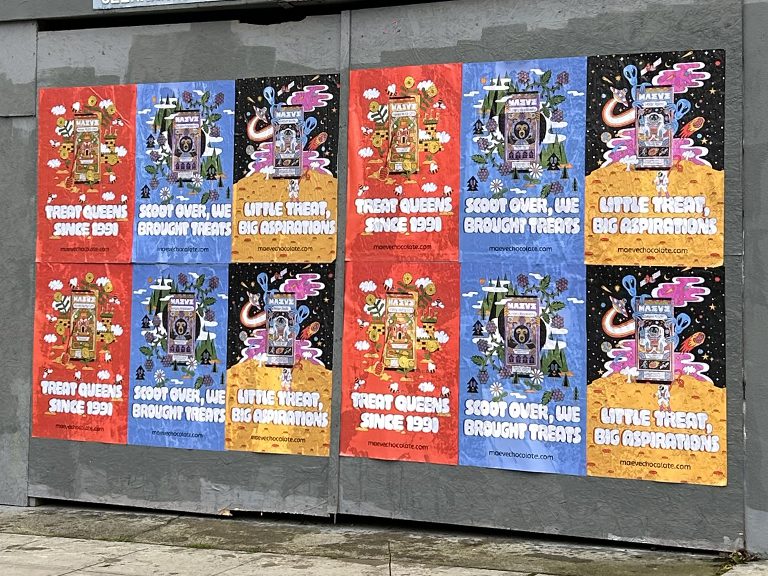
Standard poster dimensions in the United States are measured in inches. The main formats are 11×17, 18×24, 22×28, 24×36, 27×40, and 36×48. Each dimension reflects a specific industry standard that developed over decades of commercial printing, display hardware production, and real-world campaign use.
We run poster campaigns across the country every week. We work in New York, Los Angeles, Chicago, Miami, and dozens of other cities. We deal in dimensions daily. This guide gives you the exact numbers and the context behind each standard, so you can make the right call for your print order.
Note that the 18×24 and 36×48 share the same 3:4 aspect ratio. This means an 18×24 design scales perfectly to 36×48 without any crop or distortion. Similarly, the 24×36 and 40×60 share the same 2:3 ratio. Knowing these proportional relationships helps you design for multiple sizes from a single master file.
The Dimensions That Matter Most: 18×24 and 24×36
These two formats account for the vast majority of standard poster production in the United States. Understanding them in depth is more valuable than memorizing the full list.
18 x 24 Inches
Width: 18 inches (1.5 feet) Height: 24 inches (2 feet) Area: 432 square inches Aspect ratio: 3:4 (portrait) Resolution at 150 DPI: 2,700 x 3,600 pixels Resolution at 300 DPI: 5,400 x 7,200 pixels Standard frame sizes available: Yes, widely at retail stores Fits standard print equipment: Yes, all large-format vendors
This is the standard. The 18×24 has the most print shop support, the widest frame availability, and the most design templates built around it. For any indoor campaign in a venue, window, or lobbied space, this is the dimension to use.
24 x 36 Inches
Width: 24 inches (2 feet) Height: 36 inches (3 feet) Area: 864 square inches (double the 18×24) Aspect ratio: 2:3 (portrait) Resolution at 150 DPI: 3,600 x 5,400 pixels Resolution at 300 DPI: 7,200 x 10,800 pixels Standard frame sizes available: Yes, at art supply and framing stores Fits standard print equipment: Yes, all large-format vendors
The 24×36 is the outdoor standard. At twice the area of the 18×24, it reads from significantly greater distances and commands more visual attention in busy environments. For outdoor campaigns in dense urban markets, that’s where we start the size conversation.
Proportional Scaling Between Sizes
The 18×24 and 36×48 share the same 3:4 aspect ratio. The 24×36 and 40×60 share the same 2:3 ratio. This means: design your master at 24×36, and it scales perfectly to 40×60 for bus shelter ads. Design your master at 18×24, and it scales cleanly to 36×48 for trade show panels. These proportional relationships are powerful for multi-format campaigns.
Aspect Ratios: Why They Matter for Poster Design
Aspect ratio is the relationship between width and height. It determines how a design fills the canvas and whether artwork from one size translates cleanly to another.
Size
Aspect Ratio
Description
11 x 17
1:1.55
Slightly narrower than 3:4 standard
18 x 24
3:4
Classic portrait ratio
22 x 28
11:14
Close to but not identical to 3:4
24 x 36
2:3
Standard portrait, same as 35mm film
27 x 40
27:40
Unique ratio, no direct equivalent
36 x 48
3:4
Same ratio as 18×24, double the size
When the aspect ratio changes between sizes, the design does not scale proportionally. A 24×36 design (2:3 ratio) cropped to fit a 22×28 frame (11:14 ratio) will lose content from the top or bottom. Always design at the target aspect ratio and verify before scaling to different formats.
Standard Dimensions in Inches for Poster Boards
Poster boards (the physical board material, more than prints) have their own standard dimensions:
Paper poster board: 22 x 28 inches (most common at retail)
Foam core board (retail): 20 x 30 inches
Foam core board (commercial): 24 x 36 inches, 30 x 40 inches
Tri-fold display board: 36 x 48 inches unfolded
Coroplast (corrugated plastic): 18 x 24 or 24 x 36 inches for cut-size; 48 x 96 inches full sheet
These board dimensions are separate from print dimensions. A print ordered at 24×36 inches gets mounted on a 24×36 foam core board. The board dimension should match or slightly exceed the print dimension. Mounting a 24×36 print on a 20×30 foam core board requires trimming the print, which usually wastes material and effort.
Dimension Precision: Bleed and Safe Zones
Standard dimensions in inches refer to the finished, trimmed size of the poster. In production, your file needs to be slightly larger than the finished dimensions to account for bleed and trimming.
Here are the actual file dimensions you should set up for each standard poster size:
Finished Size
File Size (with 0.125″ bleed)
11 x 17 in
11.25 x 17.25 in
18 x 24 in
18.25 x 24.25 in
22 x 28 in
22.25 x 28.25 in
24 x 36 in
24.25 x 36.25 in
27 x 40 in
27.25 x 40.25 in
36 x 48 in
36.25 x 48.25 in
Always add bleed before you start designing. It is much harder to add bleed after the fact than to work within the extended canvas from the beginning.
File Setup Rule: The 3-Layer Approach
Set up your poster file with three reference zones: (1) The bleed area: the full file dimensions including bleed. (2) The trim line: the exact finished poster dimensions. (3) The safe zone: 0.25 inches inside the trim on all sides. All critical design content must stay inside the safe zone. Background graphics and colors should extend to the full bleed edge.
Metric Equivalents of Standard U.S. Poster Dimensions
For international clients or printers, here are the metric equivalents of standard U.S. poster dimensions:
U.S. Dimension (inches)
Millimeters
Centimeters
11 x 17
279 x 432
27.9 x 43.2
18 x 24
457 x 610
45.7 x 61.0
22 x 28
559 x 711
55.9 x 71.1
24 x 36
610 x 914
61.0 x 91.4
27 x 40
686 x 1016
68.6 x 101.6
36 x 48
914 x 1219
91.4 x 121.9
Industry-Specific Standard Poster Dimensions
Different industries gravitate toward different standard dimensions. Knowing your industry’s norms saves time and aligns your posters with the display hardware already in place.
Music and Entertainment
Concert promoters and venue operators default to 18×24 for indoor shows and 24×36 for outdoor festivals. The 27×40 movie one-sheet dimension pops up at music-adjacent venues and theaters that share promotional real estate with film distributors. Album launch campaigns in city markets typically run 24×36 for street placements and 18×24 for venue lobby installations. If you’re promoting a show at a club with pre-existing display rails and frames, confirm the frame size before printing. Most mid-size music venues use 18×24 frames in their lobbies and back bars.
Film and Media
The 27×40 one-sheet is the industry standard for theatrical release posters. It fits the standardized display hardware used by movie theaters across the United States. If you’re doing any campaign that touches theater distribution, you’ll need to match this dimension exactly. Some smaller theaters accept 24×36 in custom frames, but assume 27×40 unless you’ve confirmed otherwise with the venue.
Retail and Consumer Goods
Retail in-store display systems are built around 22×28 and 18×24. Floor stand systems from major retail fixture suppliers are almost universally sized for one of these two formats. Pharmacy chains, grocery stores, and big-box retailers all use 22×28 as their primary in-store promotional poster dimension. If your retail campaign needs to fit into existing fixtures, confirm which format those fixtures accept before you print.
Political and Civic Campaigns
Political campaigns use 11×17 for grassroots community postings and 18×24 for higher-visibility placements. Lawn signs run at different dimensions entirely (typically 18×12 or 24×18). For community bulletin boards, schools, and neighborhood centers, 11×17 is the standard because it fits the space constraints of those environments. For outdoor placements in higher-traffic zones, 18×24 is the minimum to maintain readability.
Trade Shows and Corporate Events
Trade show poster panels and corporate event displays commonly use 24×36 as a step-and-repeat background element or 36×48 for booth back-wall signage. Tabletop displays typically use 11×17 or 18×24 in portrait or environment. Large inline or island booth displays move to 36×48 and beyond. The key is that trade show poster dimensions interact with the booth hardware, so confirm hardware specs before you finalize your print dimensions.
What Changes as You Move Between Standard Dimensions
Each jump up the dimension ladder changes more than just the size. It changes how the poster functions in its environment.
Going from 11×17 to 18×24 roughly doubles the area. The 18×24 carries more visual weight and reads better in a room with multiple competing elements. But the jump in cost is proportional to the area increase, and the increase in shelf impact is meaningful for any indoor campaign with competition on the same wall.
Going from 18×24 to 24×36 again doubles the area. The 24×36 crosses a threshold: it moves from being a poster you read up close to one that communicates from across a room or across a sidewalk. That’s the functional difference between the two formats. Use 18×24 for intimate or controlled environments. Use 24×36 when you’re working in open, competitive visual environments where distance is a factor.
Going from 24×36 to 36×48 is less of a functional leap and more of a scale leap. Both formats communicate effectively from a distance. The 36×48 simply commands more wall space, more visual attention, and more presence. It’s the right move when you have the wall space, the budget, and a campaign that warrants the presence. It’s overkill for campaigns in compact environments where a 24×36 would do the same job at a lower cost per placement.
The practical lesson: don’t automatically choose the biggest format you can afford. Choose the format that fits the environment and the viewing behavior of your target audience. A 24×36 placed intelligently in a neighborhood with slow, curious foot traffic outperforms a 36×48 in a high-speed transit corridor where people are moving too fast to read the larger format anyway.
What are the standard poster dimensions in inches?
The standard poster dimensions in the U.S. are: 11×17 (small), 18×24 (standard), 22×28 (retail), 24×36 (large), 27×40 (movie one-sheet), and 36×48 (wide format). The two most widely used are 18×24 and 24×36.
What are the exact dimensions of an 18×24 poster?
An 18×24 poster is exactly 18 inches wide by 24 inches tall. The aspect ratio is 3:4. At 150 DPI, the file size is 2,700 by 3,600 pixels. Production files should be set up at 18.25 by 24.25 inches to include the 0.125-inch bleed.
What are the exact dimensions of a 24×36 poster?
A 24×36 poster is exactly 24 inches wide by 36 inches tall. The aspect ratio is 2:3. At 150 DPI, the file is 3,600 by 5,400 pixels. Production files should be 24.25 by 36.25 inches to include bleed.
Do standard poster dimensions include the frame?
No. Standard dimensions refer to the print or paper size only. Frame sizes refer to the inner opening or the outer frame dimensions. A frame listed as 18×24 has an inner opening of 18×24 to accept a standard-size print. Always confirm the inner print opening when purchasing frames.
What is the aspect ratio of a standard 24×36 poster?
The 24×36 poster has a 2:3 aspect ratio. This is the same ratio used in 35mm film photography. It is also identical to the 40×60 bus shelter advertising format, which means 24×36 designs scale to transit advertising without distortion.
Can I use the same design file for 18×24 and 36×48 posters?
Yes, if you set up your file correctly. The 18×24 and 36×48 share the same 3:4 aspect ratio. A file designed at 36×48 can be scaled down to 18×24 without any cropping or distortion. Design at the larger size and output at both dimensions from the same file.
How do I set up bleed for standard poster dimensions?
Add 0.125 inches of bleed on all four sides of your finished poster dimensions. For an 18×24 poster, your file canvas should be 18.25 by 24.25 inches. For a 24×36 poster, use 24.25 by 36.25 inches. Set this up in your design software before you start laying out the poster.
What is the best poster dimension for a street campaign in a dense urban market?
For outdoor street campaigns in cities like New York, Chicago, or Los Angeles, 24×36 is the baseline. Dense urban environments have high visual noise, fast-moving pedestrians, and lots of competing content. A 24×36 poster reads clearly from the sidewalk. In areas with slower foot traffic and closer viewing distances, 18×24 works well too. The key variable is how far away your viewer is when they first encounter the poster.
Can I use a non-standard dimension for my poster?
Yes. Most commercial print shops can produce custom dimensions. But custom sizes don’t benefit from standard frame availability, standard display hardware, or standard paper yield rates. They often cost more per unit because they cut inefficiently from standard paper rolls. Unless there’s a specific reason to go custom, standard dimensions save money and reduce friction at every stage.
How do I know if my design will print clearly at a large dimension?
Divide the pixel dimensions of your design file by the physical print dimensions to get DPI. For a 24×36 poster, you need at least 150 DPI, which means your design file should be a minimum of 3,600 x 5,400 pixels. If your file is smaller than that, the print will likely look soft or blurry at full scale. Request a physical proof print before approving a large run if you have any doubts about your source file resolution.
Are standard poster dimensions the same in Europe?
No. Europe uses the ISO A-series paper sizes, which are based on a different mathematical system. The closest European equivalent to the U.S. 18×24 is A2 (420x594mm). The closest to 24×36 is A1 (594x841mm). U.S. and European dimensions do not align precisely, so files need adjustment when crossing markets.
Frequently Asked Questions
What are the standard poster dimensions in inches?
The standard poster dimensions in the U.S. are: 11×17 (small), 18×24 (standard), 22×28 (retail), 24×36 (large), 27×40 (movie one-sheet), and 36×48 (wide format). The two most widely used are 18×24 and 24×36.
What are the exact dimensions of an 18×24 poster?
An 18×24 poster is exactly 18 inches wide by 24 inches tall. The aspect ratio is 3:4. At 150 DPI, the file size is 2,700 by 3,600 pixels. Production files should be set up at 18.25 by 24.25 inches to include the 0.125-inch bleed.
What are the exact dimensions of a 24×36 poster?
A 24×36 poster is exactly 24 inches wide by 36 inches tall. The aspect ratio is 2:3. At 150 DPI, the file is 3,600 by 5,400 pixels. Production files should be 24.25 by 36.25 inches to include bleed.
Do standard poster dimensions include the frame?
No. Standard dimensions refer to the print or paper size only. Frame sizes refer to the inner opening or the outer frame dimensions. A frame listed as 18×24 has an inner opening of 18×24 to accept a standard-size print. Always confirm the inner print opening when purchasing frames.
What is the aspect ratio of a standard 24×36 poster?
The 24×36 poster has a 2:3 aspect ratio. This is the same ratio used in 35mm film photography. It is also identical to the 40×60 bus shelter advertising format, which means 24×36 designs scale to transit advertising without distortion.
Can I use the same design file for 18×24 and 36×48 posters?
Yes, if you set up your file correctly. The 18×24 and 36×48 share the same 3:4 aspect ratio. A file designed at 36×48 can be scaled down to 18×24 without any cropping or distortion. Design at the larger size and output at both dimensions from the same file.
How do I set up bleed for standard poster dimensions?
Add 0.125 inches of bleed on all four sides of your finished poster dimensions. For an 18×24 poster, your file canvas should be 18.25 by 24.25 inches. For a 24×36 poster, use 24.25 by 36.25 inches. Set this up in your design software before you start laying out the poster.