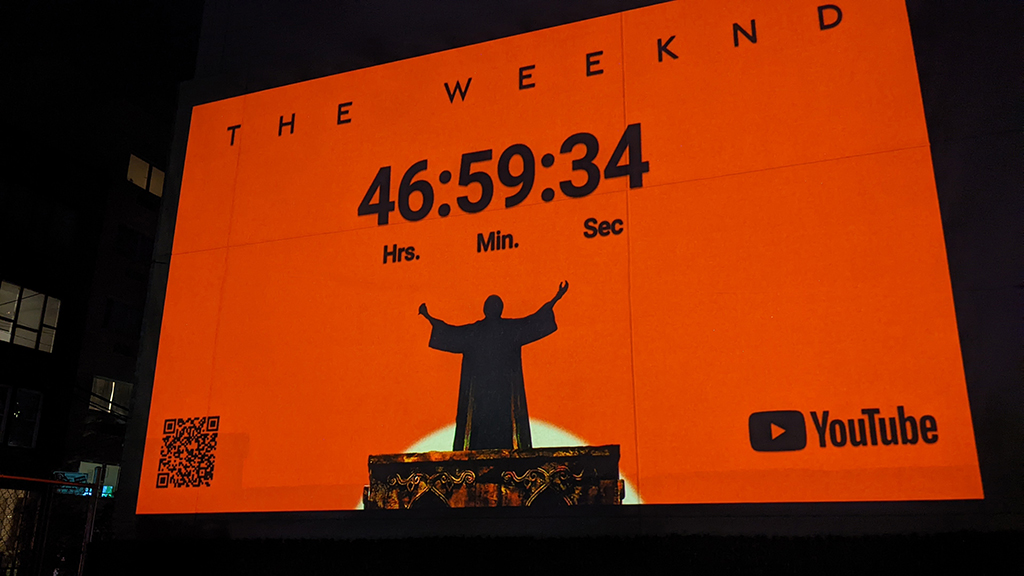
If you want to understand why a projection campaign in Tepito carries a different weight than one in Polanco or Santa Fe, start with the name. El Barrio Bravo — the brave neighborhood — is not a marketing slogan that some city planner invented. It is what Tepito calls itself, has always called itself, and will keep calling itself long after any brand campaign has come and gone. That identity is earned through the neighborhood’s history, its boxing champions, its street market culture, its muralists, and the intense pride its residents take in being from there. Any brand that wants to project in Tepito is projecting into that identity, and it either fits or it doesn’t.
For the brands that do fit, Tepito offers something that the more expensive districts of CDMX simply cannot replicate: street-level authenticity at scale. The Mercado de Tepito is one of the largest informal markets in the world. The neighborhood’s density means building walls are everywhere and blank facades are plentiful. The evening and overnight economy means activity never fully stops. And the neighborhood’s content culture — residents documenting barrio life in real time — means a campaign that lands well in Tepito doesn’t stay in Tepito. It travels.
AGM has worked with challenger brands, cultural properties, music artists, sportswear companies, and consumer goods brands that specifically sought Tepito projections for the cultural credibility those campaigns generate. This post is our honest account of the neighborhood, what projection campaigns there look and feel like, and what brands need to understand before they show up.
Tepito’s Identity: How the Barrio Bravo Got Its Name
Tepito occupies a specific geography in the northeastern corner of Mexico City’s urban core — bounded by Eje 1 Norte (Peralvillo) to the north and east, and merging with the edges of Centro Historico to the south and west. It is densely residential and densely commercial simultaneously, with apartment buildings stacked above market stalls and vecindades (residential courtyards from the colonial era) sitting alongside warehouse-scale informal retail structures.
The neighborhood’s fame rests on several pillars. The street market is the most visible — the Mercado de Tepito is not a single building with a fixed address but rather a distributed informal economy that spreads across hundreds of city blocks, with the density of goods and vendors shifting street by street. Electronics, clothing, accessories, food, imported goods, and a thousand other categories are available in the market, and it draws buyers from across CDMX and the wider metropolitan area daily. On Saturdays, the market expands to its maximum footprint and the street crowds become extraordinary.
The Mercado de Tepito spreads across hundreds of city blocks and is considered one of the largest informal commercial markets in the world, drawing buyers from across Mexico City and the metropolitan area seven days a week.
Boxing is the other pillar of Tepito’s identity. The neighborhood produced Ruben Olivares, who many Mexican boxing historians consider the greatest bantamweight of all time, with 23 world title fights and a fighting style that was purely Tepito — aggressive, fearless, always moving forward. Salvador Sanchez, the WBC featherweight champion who died tragically young in 1982, was also shaped by the Tepito boxing tradition. The connection to the broader national boxing culture, including the tradition that runs through Canelo Alvarez’s relationship with the Mexican boxing identity that Tepito represents, gives the neighborhood a pride of athletic identity that cuts across age groups. Walk into a barbershop or a market stall in Tepito and you will find boxing photos on the wall.
The Market Grid: Avenida Toltecas and the Street Economy
Avenida Toltecas is one of the main market arteries in Tepito, and understanding it gives you a sense of how the neighborhood’s street economy is organized. The market doesn’t occupy a single named street — it fills every available surface, including the sidewalks, the gaps between buildings, the covered passages between vecindades, and the impromptu vendor setups that appear and disappear on a daily basis. Toltecas is one of the key corridors because it connects multiple market blocks and runs through a dense section of the neighborhood’s commercial core.
The building facades along these market corridors are where projection surfaces become most strategically valuable. A wall facing a market corridor in Tepito isn’t just a wall — it’s a surface that hundreds or thousands of buyers walk past every day, often slowly because of the crowd density. A projected image on that wall sits in the visual field of a buyer who may stop, look at a vendor’s goods, look up at a neighboring building, and look back — which means the projection gets multiple glances rather than a single passing impression.
Boundary at Eje 1 Norte: Tepito and Centro Historico
The northern boundary of Centro Historico runs along Eje 1 Norte, the major viaduct that also marks the southern edge of the Peralvillo area and defines Tepito’s relationship to the historic center. This boundary is not just administrative — it marks a real shift in the built environment and the street character. On the Centro Historico side, you have colonial architecture, tourist activity, and the visual language of the city’s official heritage. On the Tepito side, you have the raw urban fabric of a working-class neighborhood that has never been gentrified and has no particular ambition to be.
Campaigns that use both sides of this border can create interesting visual continuity, but most Tepito projections work entirely within the neighborhood’s geography rather than borrowing the Centro Historico’s visual legitimacy. Tepito doesn’t need Centro Historico’s credibility. It has its own.
Mural Culture and the Visual Tradition
Tepito has a significant mural and street art tradition that covers building facades throughout the neighborhood. These murals range from community memorial portraits to politically charged imagery to abstract work, and they have trained Tepito residents to look at building walls as a legitimate canvas for visual expression. When a projection appears on a Tepito facade, it lands in a neighborhood that already has a framework for reading building walls as cultural statements.
This matters for campaign design. A projection in Tepito that is purely commercial — a logo, a product, a promotional message — may be technically visible but culturally inert. The mural tradition sets a high bar for what a building wall should say. Campaigns that incorporate visual language drawn from the neighborhood’s own aesthetic history, that reference boxing, market culture, barrio identity, or the visual codes of Mexican street art, are in conversation with that tradition. They earn their place on the wall rather than simply occupying it.
“In Tepito, the wall is already speaking. You’re not putting your message into a blank space — you’re adding your voice to a conversation that started decades before you arrived.”
Our team has seen brands make both mistakes: arriving with corporate creative designed for a Polanco audience and wondering why it generates no traction, and arriving with culturally overproduced “authentic barrio” imagery that reads as condescension to people who actually live there. The middle path is what works — a campaign that knows what it is, respects the neighborhood’s visual tradition, and communicates a clear message without pretending to be something it isn’t.
The Building Stock: What Makes Tepito a Strong Projection Environment
Tepito’s physical built environment is a product of its history as a dense working-class residential neighborhood. The housing stock is predominantly mid-century apartment buildings and older vecindadas, with thick concrete and masonry exterior walls that provide excellent projection surfaces. Unlike the glass curtain walls of Santa Fe or the ornate Porfirian facades of Roma Norte, Tepito’s building exteriors are plain. Flat stucco, painted concrete, and bare masonry are the dominant surface textures.
The height scale also works in projections’ favor. Most residential buildings in Tepito are three to six stories, which means projection surfaces are at street scale rather than tower scale. A projector positioned across a street can cover an entire building facade with a large, bright image without needing the extreme lumen output required for tower projections in Santa Fe. This makes Tepito projections visually intimate in a way that tower projections cannot be — the image is big enough to command attention but close enough to feel like it’s speaking directly to the street.
Tepito’s dense grid of mid-century residential buildings provides some of the largest blank exterior wall surfaces in CDMX’s urban core — flat, matte, and at street scale rather than tower scale.
Party Walls and Side Facades
The most prized projection surfaces in Tepito are the party walls — the exterior sides of buildings that face an adjacent vacant lot, a parking area, or a secondary street with no building attached on one side. These walls are typically completely blank (no windows, no architectural detail) and often span the full height of the building. A four-story party wall in Tepito gives a projector approximately 12 to 15 meters of vertical throw at full building width, which creates a canvas comparable in scale to many standard billboards but with the raw visual authenticity of the neighborhood itself.
Secondary streets running perpendicular to the main market corridors are the best locations for these surfaces. They’re set back enough from the heaviest foot traffic to allow a projector placement with clean sight lines, but they’re still within the neighborhood’s active geography and easily visible from the market corridors nearby.
The Night Economy: Tepito After Dark
One of the facts about Tepito that surprises people outside the neighborhood is the extent to which it operates around the clock. The market corridors in the most active parts of the neighborhood remain lit and populated well into the night. This is not a district that rolls up at sunset — it is an urban commercial environment that generates activity at all hours, driven by the scale and informality of its commercial economy.
For projection campaigns, the night economy means that the evening hours are not the end of the active viewing window but rather a continuation of it. Foot traffic composition shifts after 9 PM — the daytime buyer crowd gives way to younger residents, socializing groups, and the nighttime commercial activity specific to certain market corridors — but the streets are not empty, and a projection that runs until midnight in Tepito is reaching a real audience throughout that window.
Weekend nights in particular draw significant crowds around the neighborhood’s social spaces. The combination of market activity, street food vendors, and the social gravity of a densely populated neighborhood means that weekend evenings in Tepito can produce higher foot traffic volumes in specific corridors than some daytime hours in less active neighborhoods.
Saturday Market Crowds: The Peak Projection Window
The single highest-volume foot traffic event in Tepito’s weekly cycle is the Saturday market expansion. On Saturdays, the Mercado de Tepito reaches its maximum geographic footprint, with vendors filling additional blocks that are less active during the week. Buyers who can’t come during weekday hours arrive in large numbers, and the streets become genuinely packed in the core market area.
Saturday morning and afternoon in Tepito is one of the highest pedestrian density environments in all of Mexico City. The crowd characteristics are broad — families doing weekly shopping, young people browsing electronics and streetwear vendors, food buyers stocking up for the weekend, and the general commercial activity of one of Latin America’s great market cultures. For consumer brands targeting a broad working-class and middle-class Mexican audience, a Saturday projection in Tepito reaches that demographic at maximum concentration.
The practical implication for projection setup is that Saturday campaigns require earlier positioning of equipment. The streets fill up early, and finding a clean projector placement after the market crowds have assembled is significantly harder than setting up during Friday evening. AGM’s team typically scouts Saturday locations the day before and positions equipment during the early morning hours.
Grassroots and Challenger Brands: Why Tepito Works for Them
The brand categories that consistently find Tepito projections most valuable are challenger brands, culturally rooted consumer brands, and any brand that benefits from street-level authenticity. The logic is simple: advertising in Polanco or Santa Fe signals wealth and establishment. Advertising in Tepito signals something different — a willingness to show up where the culture is real rather than where the money is concentrated.
Sportswear brands with a street culture orientation have used Tepito projections to establish credibility with a Mexican working-class audience that global advertising campaigns don’t reach. Regional music artists — banda, corridos, regional Mexican genres with deep roots in working-class culture — use Tepito projections to announce releases and tours to a core audience that follows them for reasons beyond algorithm-served content. Consumer goods brands launching products in the Mexican market find that a Tepito campaign establishes authenticity before the brand enters mainstream retail.
| Brand Type |
What Tepito Delivers |
Best Campaign Moment |
| Challenger sportswear |
Street culture credibility |
Saturday market crowds |
| Regional music (banda, corridos) |
Core audience announcement |
Friday evening, pre-weekend |
| Consumer packaged goods |
Working-class market penetration |
Weekday market hours |
| Mexican cultural properties |
Barrio audience, community resonance |
Weekend evening |
| Political and civic campaigns |
Urban core voter reach |
Weekday evening |
| Local and regional brands |
Authentic CDMX market entry |
Saturday morning |
What Tepito projections cannot do is make a brand feel like something it isn’t. The neighborhood has a finely calibrated cultural antenna, and campaigns that are trying to borrow street credibility without earning it through genuine product or cultural relevance tend to fall flat. The audience is sophisticated about authenticity in a way that is harder to deceive than the audience in a neighborhood where commercial advertising is more normalized as the dominant visual language.
Social Media Amplification: How Tepito Campaigns Travel
One of the most consistently underappreciated aspects of a Tepito projection campaign is its organic amplification potential. The neighborhood has a strong content creation culture — residents document barrio life, market activity, street art, and neighborhood events at a rate that produces significant social media output relative to the neighborhood’s geographic footprint. A projection that lands well in Tepito gets photographed and shared by multiple people independently, each adding their own commentary and cultural framing.
This amplification works differently from what happens in Polanco or Condesa, where projection content tends to be shared within relatively affluent, internationally connected social networks. Tepito content circulates through Mexican working-class social networks, regional networks, and the diaspora communities that maintain strong cultural ties to CDMX neighborhoods. A brand that shows up authentically in Tepito gets introduced to social networks that are very difficult to reach through conventional advertising.
The visual quality of the projection matters enormously for this amplification. A sharp, high-lumen, high-resolution image on a well-chosen Tepito wall photographs beautifully at night. The rawness of the building surface, the neighborhood context, and the scale of the projection all contribute to images that look genuinely dramatic when shared online. Our team invests in equipment calibration specifically to ensure that Tepito campaigns produce shareable visual quality alongside their street-level impact.
Tepito’s Boxing Legacy and Campaign Creative
It would be a missed opportunity not to address how the boxing legacy shapes creative strategy for Tepito projections. The connection between Tepito and Mexican boxing isn’t a historical footnote — it is an active, present source of neighborhood pride that campaigns can reference honestly and powerfully.
Brands in sportswear, fitness, nutrition, and sports media have an obvious entry point. But the boxing connection extends beyond the literal sport into the broader cultural vocabulary of Tepito: toughness, perseverance, community loyalty, pride in working-class origins. These are themes that resonate with the neighborhood’s identity whether or not the specific brand has anything to do with athletics.
The connection to Ruben Olivares specifically — who was born and raised in the neighborhood and whose fighting style embodied everything Tepito considers itself to be — is a cultural touchstone that campaigns can approach with respect and intelligence. Olivares won world championships not through technical precision but through an unstoppable forward pressure and refusal to back down. That’s a story that translates across brand contexts when it’s handled with genuine respect rather than appropriation.
Working Within the Neighborhood: How AGM Operates in Tepito
Our team’s approach to Tepito campaigns begins with the understanding that we are guests in a neighborhood with its own established social order. We work through local relationships built over time, ensuring that our presence in the barrio is welcomed rather than simply imposed. This isn’t just good ethics — it is practical campaign management. A projection campaign that the neighborhood actively embraces generates more word-of-mouth, more documentation, and more organic amplification than one that appears and disappears without local context.
Our operators in Tepito know the neighborhood at the block level. They know which walls are appropriate, which times of night work best for different corridor locations, and how to position equipment in ways that don’t disrupt the market activity that defines the neighborhood’s daily rhythm. That local knowledge is not something that can be parachuted in from a planning office — it comes from sustained presence and genuine relationships.
Tepito’s 24-hour commercial activity and strong organic content culture means a well-placed projection campaign reaches a real audience across multiple viewing windows and generates organic social media documentation at rates that exceed most other CDMX neighborhoods.
Tepito in a Broader CDMX Campaign Strategy
Very few brands use Tepito as their only CDMX projection location. More commonly, it anchors one end of a multi-neighborhood strategy where different districts serve different audience purposes. Tepito handles the working-class and street-culture segment. Roma Norte or Condesa handles the creative and professional segment. Santa Fe handles the corporate segment. Polanco handles the luxury and executive segment.
What Tepito contributes to a multi-district strategy is not just additional reach — it is a distinct form of cultural legitimacy that other districts cannot provide. A brand that shows up in Polanco and Santa Fe only is a rich-neighborhood brand. A brand that shows up in Polanco and Tepito is a brand that spans Mexico City’s social geography. That span communicates something about the brand’s actual relationship to Mexican culture that targeted advertising cannot manufacture.
The brands that understand this most clearly tend to be global brands with deep Mexican market experience — companies that have been in Mexico long enough to know that the country’s cultural gravity does not center on the luxury districts. It centers on places like Tepito, where the culture that most Mexicans actually identify with is most alive.
Frequently Asked Questions
Why do brands use guerrilla projections in Tepito instead of traditional advertising?
Traditional outdoor advertising in Tepito — billboards, bus shelters, static displays — doesn’t carry the same cultural weight as something that appears directly on a neighborhood wall. Tepito’s identity is built on authenticity and grassroots culture. A projection campaign that uses the neighborhood’s own building facades as canvas communicates a brand’s willingness to show up in the barrio on its own terms, which is exactly the credibility signal that working-class and street-culture audiences respond to.
What is the Mercado de Tepito and why does it matter for projections?
The Mercado de Tepito is one of the largest informal street markets in the world, spreading across hundreds of city blocks in the neighborhood with vendors selling electronics, clothing, food, accessories, and practically everything else. It draws buyers from across Mexico City and the metropolitan area, creating daily foot traffic volumes that rival formal retail centers. Projection surfaces facing the market corridors reach that buyer population during the market’s active hours, which extend well into the evening.
How does Tepito’s boxing culture affect the identity of the neighborhood?
Boxing is deeply embedded in Tepito’s self-image. The neighborhood produced legendary fighters including Ruben Olivares and Salvador Sanchez, and it has a strong connection to the national boxing tradition that extends through generations of residents. Brands that can connect their campaign message to strength, competition, perseverance, or the working-class athleticism that boxing represents in Tepito find a much stronger reception than brands that arrive with no cultural reference point.
Does a projection campaign in Tepito generate organic social media content?
Tepito has a very active street-level content culture. Residents document neighborhood life, market activity, mural art, and street events continuously, and a high-quality projection on a major Tepito wall will be photographed and shared widely. The neighborhood’s social media presence is disproportionately large relative to its geographic size because its cultural identity — El Barrio Bravo — is a story people want to tell. A projection that fits that story gets amplified.
What building surfaces in Tepito work best for guerrilla projections?
The dense mid-century and early-20th century apartment buildings in Tepito feature large flat concrete exterior walls with minimal architectural ornament, which are among the best projection surfaces in CDMX. Party walls between buildings, the blank sides of residential blocks facing secondary streets, and the exterior walls of warehouse-style commercial structures along the market corridors all receive projections with excellent contrast. The neighborhood’s existing mural tradition means that residents are already accustomed to seeing building facades used as visual canvases.