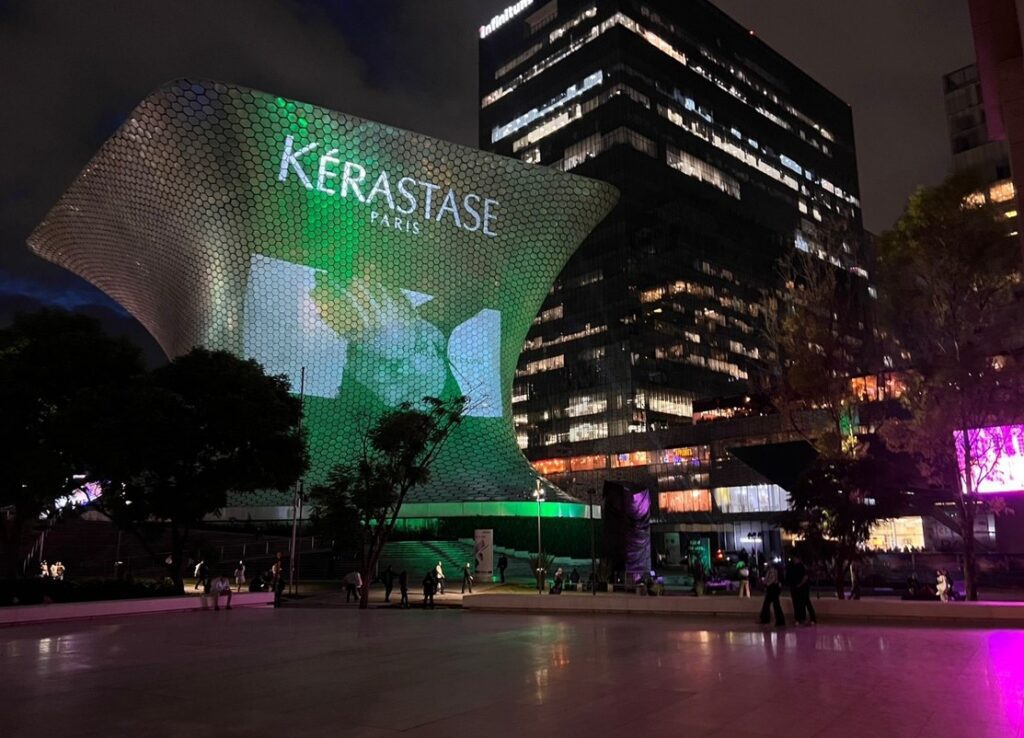
When a fashion brand wants to make a statement in Mexico City, putting up a billboard on the Periferico is not the move. The city’s fashion audience, the people who actually drive brand desirability and cultural momentum in CDMX, does not respond to that channel. They respond to things they discover on foot, things their community photographs and shares, things that appear on buildings they already care about in the colonias they actually move through. Guerrilla projections built for fashion brands operate at precisely this level: they are discovered, not served.
Mexico City is no longer a secondary fashion market. The city now hosts Mercedes-Benz Fashion Week, attracts international press and buyers, and has produced designers including Carla Fernandez, Pineda Covalin, Armando Takeda, and Yakampot who have earned serious international attention. Gucci, Louis Vuitton, Hermes, Cartier, Dior, and Valentino all operate flagships on Presidente Masaryk in Polanco. Mexico Fashion Week runs across two main neighborhoods. The Zona Maco art fair draws an international collector class that overlaps substantially with luxury fashion buyers. The infrastructure of a genuine global fashion market is already here.
What AGM does in this environment is position projection campaigns where they create not just awareness but cultural meaning. A lookbook projected on the baroque facade of a Centro Historico church says something different than the same imagery on a concrete wall in Roma Norte. Understanding which surface makes which brand statement is the work.
Mexico City as a Fashion Market: The Context Brands Need to Understand
The Mexican fashion industry is built on a specific cultural layering that international brands sometimes miss on first approach. At the top sits global luxury, concentrated in Polanco’s Masaryk corridor where the international maisons operate flagship retail alongside each other in a format that closely mirrors the luxury corridors of Paris, Milan, and New York. This segment of the market is established, competitive, and increasingly sophisticated.
Directly below luxury runs a substantial contemporary international and local designer tier. Roma Norte and Condesa are the geographic center of this market, home to concept stores, independent boutiques, and the creative professionals who work in fashion, advertising, film, and design. Mexican designers working in this space have built international profiles by drawing on indigenous textile traditions, craft techniques, and visual languages that are genuinely distinct from European fashion systems.
Carla Fernandez works with indigenous artisan communities across Mexico to produce fashion that is explicitly rooted in pre-colonial and colonial Mexican craft traditions. Pineda Covalin applies Mexican artistic imagery, including Frida Kahlo references and traditional embroidery patterns, to luxury accessories. Armando Takeda and Yakampot work in contemporary Mexican fashion with global distribution. These designers have created an argument, visible internationally, that Mexico City produces fashion that is not just a local version of trends originating elsewhere.
For international brands entering or expanding in Mexico City, this context matters. The audience is educated about fashion globally and locally. They are not simply aspiring toward European taste; they have a sophisticated Mexican aesthetic framework that they bring to evaluating brands. A projection campaign that demonstrates cultural fluency in CDMX will land differently with this audience than generic international brand imagery dropped onto any available wall.
Mexico City is home to over 25 million people in its metropolitan area, making it the largest Spanish-speaking city on earth and one of the top 10 largest urban areas globally. The fashion consuming population of this city, at any income bracket, is enormous.
Masaryk and the Polanco Luxury Corridor
Presidente Masaryk Avenue is Mexico City’s primary luxury retail address. Running through the heart of Polanco, the street carries flagship stores for essentially every major European luxury house operating in Mexico. The proximity of Gucci, Louis Vuitton, Hermes, Cartier, Dior, and Valentino to each other creates a concentrated luxury corridor that draws CDMX’s highest-income consumers, international visitors staying in the nearby luxury hotels, and fashion industry professionals as a matter of course.
The buildings along and immediately around Masaryk are primarily mid-century commercial structures and some newer mixed-use buildings, generally four to eight stories with facades in cream, white, and stone colors. These are not the architectural monuments of Centro. They are restrained, elegant, and relatively simple. For luxury fashion projection campaigns, this restraint is actually a positive. Projected lookbook imagery or brand visual campaigns need a facade that does not compete with the content. The clean commercial facades of Polanco’s Masaryk corridor let the brand image lead.
Projection campaigns on Masaryk reach exactly the right audience for luxury market entry: the people walking the street are already in the mindset of luxury consumption. They are there because they are interested in the boutiques. Running a projection that places a brand’s visual identity within that environment, on a building adjacent to established luxury addresses, creates an implicit association between the brand and its neighbors on the block. That kind of positioning signal is difficult to manufacture through any other outdoor media format.
The Streets Behind Masaryk
The streets immediately surrounding Masaryk in Polanco, including Horacio, Julio Verne, Edgar Allan Poe, and the side streets connecting them, carry the secondary retail layer of the luxury corridor: restaurants where fashion industry lunches happen, concept stores, design studios, and a dense residential population of Polanco’s wealthy residents. Building facades on these streets are often better projection surfaces than Masaryk’s commercial strip itself, with wider and taller residential facades providing more canvas area while maintaining the Polanco audience association.
Surface Matching: Which Architecture Fits Which Fashion Brand
The relationship between architectural surface and fashion brand positioning is not abstract. Specific surface qualities communicate specific brand values, and the wrong surface choice creates dissonance rather than alignment.
Polanco Mid-Century Commercial: Luxury and International Prestige
The smooth cream and white facades of Polanco’s 1940s through 1960s commercial buildings project luxury fashion with clarity and elegance. The neutral tones do not color-shift projected imagery. The scale is appropriate for fashion campaign formats: tall enough to display a figure at near-life scale, wide enough for horizontal campaign compositions. The Masaryk corridor audience reads content on these surfaces through a luxury consumption frame from the moment they approach.
Roma Norte Porfirian Buildings: Cultural Identity and Contemporary Positioning
Roma Norte’s Porfirian-era residential and commercial buildings, built primarily from the 1880s through 1910s during the presidency of Porfirio Diaz, are the most photographed building type in CDMX after the Zocalo. Their ornamental stone facades, wrought iron balconies, and Parisian architectural influences have become the visual signature of Mexico City’s creative identity. Projecting fashion content on these surfaces places a brand within the cultural infrastructure of CDMX’s design community.
Contemporary international brands, streetwear labels, and any brand trying to position within Mexico City’s creative community rather than just its luxury economy should be looking at Roma Norte’s Porfirian facades as their primary projection surface. The audience that frequents Roma Norte is the CDMX creative class, and the buildings are the visual identity of that community.
Roma Norte Brutalist Concrete: Streetwear and Edge Positioning
The eastern edge of Roma Norte, particularly around Eje 1 Norte and the blocks transitioning toward Doctores, carries a different building stock from the ornamental Porfirian core. Mid-century and later concrete construction, some of it in the exposed concrete brutalist style, provides angular, raw surfaces that read in a completely different register. These walls are what streetwear brands and contemporary brands wanting an urban, unpolished aesthetic should be targeting. The contrast between a fashion-forward projection and a raw concrete wall is itself a statement.
Centro Historico Colonial and Baroque: Heritage and Artisan Positioning
For fashion brands with a connection to craft, heritage, or cultural depth, projecting on Centro’s colonial baroque facades is the most direct visual argument available in Mexico City. The stone, the history, and the architectural grandeur place brand imagery within a context of permanence and cultural significance. Mexican designers working in indigenous craft traditions, international brands with artisan production stories, and heritage luxury brands with multi-century histories all find that Centro’s architectural backdrop amplifies their positioning in a way that modern surfaces cannot.
The Ciudadela artisan market near Centro, the Mercado de Artesanos de la Ciudadela, draws a different audience from the Masaryk luxury corridor. This audience is interested in Mexican craft and design, both domestic buyers looking for quality artisan goods and international visitors seeking authentic Mexican design. Projecting heritage fashion content near this zone creates audience-message alignment at a very specific level.
Santa Fe Glass Towers: Contemporary Luxury
The Santa Fe business district in western Mexico City has a building stock dominated by glass-curtain office towers, several of which have been designed by internationally recognized architects. As noted in the Centro Historico context, glass towers generally reflect rather than absorb projected light, making them poor direct projection surfaces. However, the concrete and stone ground-level and mid-rise structures adjacent to the towers provide projection surfaces within an environment whose visual identity is defined by the towers themselves. A ground-level projection on a concrete structure with a glass skyscraper as backdrop creates a specific visual context: contemporary, corporate, international. This environment fits luxury contemporary brands and global fashion houses wanting to signal modern Mexico City sophistication rather than historic cultural roots.
The surface you project on is the first sentence of your campaign. A lookbook on Bellas Artes marble reads as cultural institution. The same content on a Roma Norte Porfirian facade reads as local creative prestige. On a Polanco mid-century commercial building it reads as luxury retail. The imagery is secondary to the context.
How Fashion Projections Create Cultural Alignment
The fundamental question for any fashion brand using guerrilla projections is not “where can we find a wall” but “which cultural identity do we want to borrow from.” Architecture in Mexico City carries intense cultural associations that decades of photography, media coverage, and lived experience have encoded into the city’s collective visual memory.
When you project a fashion campaign on the baroque facade of a colonial church in Centro, you are not just using a large flat surface. You are inserting your brand into a visual tradition that includes Diego Rivera murals, Nobel Prize-winning literature set in these streets, and 500 years of human life concentrated in one of the densest urban environments on earth. Whether that association serves your brand depends on what you sell and who you want to become in the Mexican market.
When you project in Roma Norte, you are inserting your brand into the contemporary creative identity of Mexico City, the same visual landscape that appears in the social media feeds of the city’s most influential designers, artists, architects, and media figures. The buildings are the background of the creative class’s daily visual experience. Placing your campaign there is a claim about where your brand belongs in that world.
Mexico City’s Instagram and TikTok fashion community is among the most active in Latin America, with fashion-tagged content from CDMX reaching audiences across Mexico, the United States, Spain, and the rest of Latin America. A single compelling projection image shared by the right account can reach hundreds of thousands of people who were never present at the activation.
The Instagram and TikTok Content Moment
Every fashion projection campaign in Mexico City is also a content production event, whether the brand plans for it or not. The CDMX fashion audience shoots constantly. People walking past an interesting projection will stop, photograph it from multiple angles, post it immediately, and tag both their location and any visible brand elements. The social media trail from a well-executed projection campaign in Roma Norte or Polanco typically begins within minutes of the projection starting and continues for days as images circulate through the fashion community’s networks.
This social amplification dynamic changes how AGM thinks about projection placement for fashion brands specifically. For most projection campaigns, the primary audience is the people physically present at the location. For fashion campaigns in CDMX, the primary audience is often the digital audience that receives the content created by the people physically present. This does not mean the in-person audience is irrelevant. It means the projection placement needs to work both as a physical space for people to gather and photograph, and as a visually coherent image that travels well when compressed into a phone-shot photograph or a 15-second TikTok clip.
Projection surfaces that produce clean, high-contrast imagery with strong architectural context photograph better than technically superior surfaces in visually neutral environments. A projection on an unremarkable concrete wall at 90% technical quality produces a less shareable image than a projection on a Porfirian stone facade at 80% technical quality, because the architectural context in the photograph adds value that the technical quality cannot compensate for.
Fashion Week and Industry Event Windows
Mexico City’s fashion calendar provides specific high-value windows when the industry is physically concentrated in the city and when fashion-media attention is at its annual peak.
Mercedes-Benz Fashion Week Mexico City has established CDMX as a recognized international fashion week destination. During Fashion Week, the city’s fashion audience is in an heightened state of brand attention. Designers are showing, press is covering, buyers are meeting, and the social media volume around fashion content spikes dramatically. A projection campaign timed to Fashion Week runs in front of an audience that is professionally and personally oriented toward noticing and evaluating fashion brand activity.
Zona Maco, the international contemporary art fair held annually in CDMX, draws a collector and buyer audience from across the Americas and Europe that represents one of the highest-income, most internationally connected demographics to physically visit Mexico City. Luxury fashion brands and fashion-adjacent design brands find that the Zona Maco audience period, typically in February, is one of their best windows for projection campaigns in Polanco and Roma Norte because the international audience concentration is unusually high.
Vogue Mexico events and the broader Mexican celebrity culture built around Televisa and Netflix Mexico productions create ongoing amplification windows throughout the year. Mexican celebrities with millions of social media followers photographing a fashion projection and posting it to their audience can generate reach that dwarfs the physical audience of any neighborhood activation. AGM’s network in CDMX includes awareness of when high-profile events are drawing celebrity and influencer concentrations to specific neighborhoods, which helps us time projection activations for maximum organic amplification potential.
Market Entry Projections: How International Brands Announce Themselves
When an international fashion brand enters Mexico City for the first time, or expands its presence significantly, there is a window of a few months during which the announcement either lands with cultural weight or gets absorbed into background noise. Guerrilla projections are a primary tool for ensuring it lands with weight.
A global luxury house opening on Masaryk can announce its arrival through a projection campaign that runs simultaneously in Polanco and Roma Norte on the same night. The Polanco activation reaches the luxury retail audience directly. The Roma Norte activation reaches the creative class whose endorsement signals cultural legitimacy to the broader Mexican market. The two together create a city-wide conversation that a press release or social media post cannot generate on its own.
The images from both activations circulate together. Fashion media covering the market entry can write about the projections as the story rather than just the store opening, giving the campaign editorial coverage that advertising cannot buy. The two-colonia strategy also signals that the brand understands Mexico City’s geographic complexity, which is itself a form of cultural intelligence that the fashion-forward CDMX audience notices.
Perisur and the Southern Fashion Retail Environment
The Perisur shopping center in the southern part of Mexico City, near the Pedregal residential area and Universidad UNAM zone, represents a different tier of the fashion retail environment. Perisur anchors the fashion market for Mexico City’s southern colonias, serving a residential population that skews educated and upper-middle class but is geographically removed from the Polanco and Roma Norte concentration.
Brands looking to reach the Perisur audience with projection campaigns need to look at the building stock surrounding the shopping center and in the adjacent residential colonias of Pedregal de San Angel, Coyoacan, and the streets running toward the UNAM campus. These areas carry a distinctive mid-century Mexican modernist architecture, including the famous Pedregal residential homes built on lava field terrain, and the iconic UNAM campus buildings including the Biblioteca Central with its Juan O’Gorman mosaic facade.
For fashion campaigns specifically, the UNAM campus and surrounding Coyoacan area deliver a student and academic audience that skews toward accessible fashion rather than luxury. Brands that want to reach Mexico City’s 22 to 32 year old fashion consumers without the tourist and expat overlay of Roma Norte will find the Coyoacan and Ciudad Universitaria zone a complementary environment to northern colonia campaigns.
Single-Night vs. Multi-Night Campaign Strategy for Fashion
One of the most consistent strategic questions AGM gets from fashion brands is whether to concentrate activation on a single dramatic night or spread across multiple nights. The answer depends on what the campaign needs to accomplish.
Single-night projections create scarcity. When the event happens only once, the people who photograph it hold exclusive content. Fashion audiences in particular respond to exclusivity at the content level: a projection that runs for one night becomes a moment, something that was there and is now gone. The sharing behavior this creates is immediate and intense because the audience knows the documentation window is closing. If a brand’s objective is social media virality and the creation of a cultural moment, a single-night high-quality activation in the right location delivers that better than a week-long lower-impact run.
Multi-night campaigns build cumulative awareness. More people encounter the campaign over multiple nights. Those who missed the first night catch it on subsequent nights. Brand recall accumulates across the target audience rather than peaking once. Press coverage that builds over several nights can compound, with outlets that did not cover night one seeing the campaign on night two or three and writing about it. For market entry campaigns or brand awareness objectives where the goal is ensuring that a large portion of the target audience registers the brand’s presence in Mexico City, multi-night runs deliver more consistent coverage.
| Campaign Type |
Strategy |
Why |
Best For |
| Social media virality |
Single-night or two nights |
Scarcity drives sharing urgency |
Product drops, limited editions, cultural moments |
| Market entry |
Multi-night, multi-colonia |
Broad awareness build across target demographic |
New brand launches, major store openings |
| Fashion Week activation |
2-3 nights during Fashion Week week |
Concentrated industry audience window |
Press amplification, industry positioning |
| Seasonal campaign |
Single night per colonia, 2-3 colonias |
Audience coverage without repetition |
Spring/Fall collection launches |
| Celebrity-adjacent |
Single night timed to event |
Concentrates social media audience |
Film premieres, award shows, major CDMX events |
The Difference in What Gets Shared From Polanco vs. Roma Norte
The social media character of content coming out of Polanco and Roma Norte is genuinely different, and it matters for fashion brands thinking about which colonia’s projection audience they want to activate.
Polanco content on Mexican Instagram and TikTok tends to read as aspirational luxury. Photographs from Masaryk and the surrounding streets appear in feeds alongside high-end restaurant content, luxury car posts, and travel content from international destinations. The visual language of Polanco content is polished, high-production, and positioned within an aspirational consumer framework. Fashion content shared from Polanco sits within this context and is read through that frame.
Roma Norte content reads as culturally credible and creative-community adjacent. Photographs from Roma Norte appear in feeds alongside gallery opening images, independent restaurant content, local designer showcase posts, and street photography. The visual language of Roma Norte content is artful rather than simply aspirational. Fashion content shared from Roma Norte reads as culturally endorsed rather than just commercially placed.
Which one a brand wants depends on what social proof structure they are building. A luxury house entering Mexico wants the Polanco association first, then the Roma Norte validation second to signal cultural seriousness beyond retail. A contemporary brand or local designer wants the Roma Norte association to establish creative credibility before worrying about the luxury corridor endorsement.
Mexican Celebrity Culture and Fashion Projection Amplification
Mexico City’s entertainment industry, centered on Televisa’s studios in Chapultepec and the growing Netflix Mexico production ecosystem, generates a celebrity culture with enormous domestic social media reach. Mexican actors, presenters, musicians, and influencers with primary CDMX audiences have follower counts in the millions and an outsized influence on fashion and consumption trends across the country.
When these individuals photograph a fashion projection campaign and post it to their audiences, the reach mathematics change dramatically. A projection activation that reaches 5,000 physical pedestrians in an evening can reach 500,000 social media users overnight if three to five well-followed Mexican celebrities happen to photograph it. AGM’s approach to high-value fashion campaigns in Mexico City includes awareness of event schedules, celebrity movements, and social media timing that maximizes the probability of this kind of organic amplification.
This is not about arranging paid celebrity posts. It is about running the campaign where and when the right people are already present and already active on social media. Fashion Week activations, Zona Maco week activations, and campaigns timed to film premiere events at the Cineteca Nacional in Coyoacan or at the Auditorio Nacional in Polanco all benefit from higher concentration of celebrities and influencers in the surrounding streets.
Frequently Asked Questions
Why do fashion brands use guerrilla projections in Mexico City specifically?
Mexico City’s fashion market has reached a scale and sophistication that demands culturally serious brand statements. International luxury brands entering Mexico need to do more than open a store on Masaryk; they need to demonstrate cultural fluency. Guerrilla projections on architecturally significant buildings in the right colonias signal that a brand understands Mexico City as a city rather than just a retail geography. The visual content of a projection also travels: the images get photographed and shared across CDMX’s large and active Instagram and TikTok fashion audience, extending the campaign well beyond the original audience present at the activation.
What is the difference between a Polanco projection and a Roma Norte projection for fashion?
A Polanco projection on or near Presidente Masaryk positions a brand within the luxury retail corridor where Gucci, Louis Vuitton, Hermes, and Dior have flagship stores. The audience association is wealth, international prestige, and premium positioning. A Roma Norte projection on a mid-century or Porfirian building positions the brand within the creative and cultural identity of CDMX’s arts and design community. These are fundamentally different positioning statements even if the visual content is identical. Which one is right depends entirely on where the brand wants to sit in the Mexican fashion market.
Which Mexico City neighborhoods have the best projection surfaces for fashion campaigns?
For luxury fashion: Polanco’s mid-century commercial buildings on and around Masaryk offer clean cream and white facades with good light absorption adjacent to the luxury retail corridor. For contemporary and streetwear: Roma Norte’s Porfirian residential and commercial buildings provide ornamental stone facades with strong architectural identity. For heritage and artisan positioning: Centro Historico’s colonial baroque buildings place brand imagery within 500 years of Mexican craft and cultural history. For brutalist contemporary: the concrete buildings of Roma Norte’s eastern blocks near Eje 1 Norte offer raw, angular surfaces that read as edgy and urban.
How does Mexico City’s fashion calendar create windows for projection campaigns?
Mercedes-Benz Fashion Week Mexico City concentrates the fashion industry audience in CDMX during its run, creating a period when fashion press, buyers, influencers, and brand representatives are all actively moving through the city. The Zona Maco art fair draws an international collector and luxury buyer audience that overlaps heavily with fashion. Vogue Mexico events and Mexican celebrity-adjacent fashion moments create social media amplification windows. Timing projection campaigns to these calendar events means the people photographing and sharing campaign imagery are exactly the fashion-focused individuals whose content carries maximum reach in the target market.
Should fashion brands run single-night or multi-night projection campaigns in Mexico City?
Single-night campaigns create urgency and scarcity. When a projection runs only once, the people who photograph it know they have something exclusive, and they share it immediately. Multi-night campaigns build accumulative awareness: more people encounter the campaign, brand recall increases across the target audience, and press coverage compounds over multiple nights rather than peaking once. For social media virality, single or two-night activations tend to perform better because exclusivity drives sharing behavior. For broad awareness of a market entry or major launch, multi-night runs across multiple colonias deliver more consistent audience coverage.