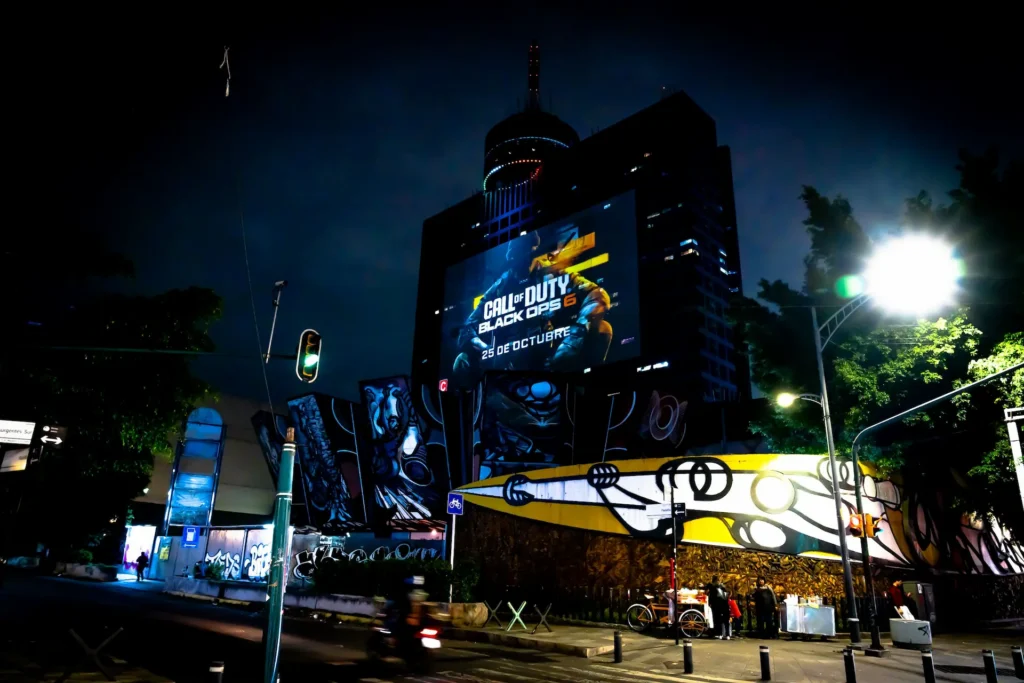
Doctores doesn’t appear on most brand marketing maps of Mexico City. When agencies and clients think about CDMX projection campaigns, they typically start with Polanco (premium), Roma Norte (creative), or Reforma (high traffic) and stop there. Doctores sits south of Centro Historico in a dense urban fabric of mid-century apartment blocks, taqueria-lined streets, boxing gyms, and lucha libre history — and it is, as a consequence, one of the most underused projection markets in the city.
That gap is an opportunity. The colonia is home to the Arena Mexico, the cathedral of Mexican lucha libre wrestling and one of the most-attended arenas in the world by cumulative ticket sales. Tuesday and Friday nights around Calle Doctor Lavista produce foot traffic concentrations that rival any event district in the city. The neighborhood’s connection to Mexican sports culture — lucha libre and boxing both — gives it a cultural identity that brands in sports, entertainment, consumer goods, and regional culture can tap with genuine resonance. And the building stock is exactly what guerrilla projections need: large, flat, matte concrete walls at street scale, in a visual environment where a dramatic projected image stands out rather than competing with polished retail facades and luxury signage.
AGM has run campaigns in Doctores and considers it one of the most strategically valuable underused districts in CDMX. This post covers the geography, the Arena Mexico effect, the Mercado de Jamaica connection, the building environment, and why certain brand categories specifically benefit from anchoring their CDMX campaign here.
Doctores: Geography and Identity
The colonia Doctores occupies a roughly rectangular area south of Centro Historico, bounded roughly by Eje Central Lazaro Cardenas to the west and Avenida Cuauhtemoc to the east, with Centro Historico’s southern edge to the north and the colonias Obrera and Algarín to the south. The street names within Doctores are famously all named after doctors and medical figures — Doctor Lavista, Doctor Liceaga, Doctor Vertiz, Doctor Lucio, Doctor Andrade, Doctor Erazo — which gives the neighborhood a distinctive and memorable address character.
The colonia is among the most densely populated in Mexico City’s central delegation of Cuauhtémoc. The housing stock is primarily mid-century concrete apartment buildings, older two- and three-story residences, and the occasional vecindad. Commercial activity runs along the main arteries and secondary streets, with small businesses, street food vendors, taquerías, hardware stores, clothing stalls, and the general commercial texture of a working-class urban colonia.
Doctores is one of Mexico City’s most densely populated central colonias, with a built environment of mid-century apartment blocks that provide large, matte concrete exterior walls — among the best projection surfaces in the urban core.
What distinguishes Doctores from adjacent colonias like Obrera, Algarín, or Tránsito is precisely the presence of the Arena Mexico. The arena is not a facility that sits at the edge of the neighborhood — it is embedded in the street grid at Doctor Lavista, and its gravitational pull on Tuesday and Friday nights transforms the surrounding blocks from quiet residential streets into a pre-event and post-event fan corridor.
The Arena Mexico: Why It Defines the District
The Arena Mexico is CMLL’s (Consejo Mundial de Lucha Libre) home arena, and CMLL is the oldest professional wrestling promotion in the world, founded in 1933. The Arena Mexico itself, opened in 1956, has been the primary venue for the highest-profile lucha libre events in Mexico for seven decades. By total tickets sold across its history, it is genuinely one of the most visited sports and entertainment venues in the world — a fact that surprises people outside the lucha libre world but is well understood by anyone familiar with Mexican sports culture.
Lucha libre is not a niche subculture in Mexico. It is one of the country’s most loved and broadly attended cultural exports, with a weekly television presence, a global fanbase, and deep roots in Mexican family culture. Going to the lucha libre at the Arena Mexico is something that crosses generations — grandparents bring grandchildren, couples go on dates, groups of friends make regular Tuesday night trips. The fan base is broad in both age and income, with tickets available at popular prices that make it accessible to working-class families in a way that many entertainment options in Mexico City are not.
The arena’s regular schedule is Tuesday and Friday nights, with additional shows for special events and anniversary programs. Standard event nights draw significant crowds to the surrounding streets, particularly the blocks immediately around the arena on Doctor Lavista and the connecting streets. The pre-event window — roughly 6:00 PM to 8:00 PM for an 8:30 PM event — and the post-event period are both high foot traffic moments with a specific audience character: sports fans in an energized, social mood, many of them wearing the masks and T-shirts of their favorite wrestlers.
“The Arena Mexico fan on event night is one of the most photogenic and most social media-active audiences in Mexico City. They’re already in costume, already celebrating, already photographing everything around them. A projection campaign near the arena on a Tuesday or Friday night reaches people in the exact state you want to reach them.”
The Blocks Around Doctor Lavista
The specific streets that see the highest Arena Mexico event traffic are the blocks of Doctor Lavista immediately flanking the arena, and the connecting streets running perpendicular to it — particularly the blocks toward Eje Central to the west and toward Doctor Lucio to the south. Taqueria and food vendor activity concentrates in these corridors before and after events, which means the foot traffic is not just the transit of fans moving from metro to arena — it is a slower-moving crowd that stops to eat, buys merchandise from sidewalk vendors, and socializes before and after the show.
The building facades on these blocks are an excellent projection canvas. Most are four- to six-story residential or mixed-use structures with substantial flat concrete exterior walls. The street widths are standard CDMX urban-core dimensions — narrow enough that a projector across the street delivers a large, sharp image without needing extreme lumen output, but wide enough to provide clean sight lines for foot traffic.
The Lucha Libre Cultural Connection: What It Means for Campaigns
Lucha libre is one of Mexico’s most beloved cultural exports and carries a specific set of cultural associations that are valuable for brand campaigns. The sport connects to Mexican values of family, community, spectacle, theatrical drama, and the celebration of athleticism through a distinctly Mexican lens. Lucha libre heroes — rudos (heels) and técnicos (faces) — are cultural archetypes that Mexican audiences have grown up with across multiple generations.
For brands that can credibly connect to this cultural vocabulary, the Arena Mexico neighborhood offers something no other CDMX district provides: genuine, unmediated access to the sports culture audience at the moment when they are most engaged with it. A sports brand, an entertainment property, a food and beverage company that sponsors lucha libre, or even a regional brand that simply wants to signal its Mexican cultural identity — all of these have a natural home in the projection corridor around the Arena Mexico.
The key word is “credibly.” Lucha libre fans are sophisticated about commercial relationships with their sport. A campaign that uses lucha imagery in a superficial or culturally disconnected way will register as inauthentic to an audience that has spent a lifetime with the real thing. Campaigns that are either genuinely part of the lucha libre ecosystem (official sponsors, licensed imagery) or that approach the culture with evident respect and knowledge work well. Generic brand campaigns that happen to be near the arena on a Tuesday night get foot traffic but not cultural traction.
The Arena Mexico hosts regular events on Tuesday and Friday nights, generating concentrated foot traffic in the surrounding Doctor Lavista corridor from an audience that spans multiple generations and is deeply engaged with one of Mexico’s most culturally significant sports traditions.
Boxing Gyms and the Athletic Tradition
Doctores has a boxing tradition that runs parallel to its lucha libre identity. The colonia has historically been home to boxing gymnasias and training facilities, and the sport is woven into the neighborhood’s physical and cultural fabric alongside lucha libre. Several of CDMX’s working-class colonias in the central and eastern city have this double identity — lucha libre for the spectacle and family entertainment, boxing for the discipline and the fighters-come-from-here pride.
For brands in sportswear, nutrition, fitness, and athletics, this double identity makes Doctores an unusually rich projection environment. The audience that comes for lucha events overlaps partially with the audience that follows boxing and trains in neighborhood gymnasias, and together they represent a working-class Mexican sports culture that is underserved by most national and international advertising campaigns. Showing up in Doctores with a campaign that respects that culture is worth more than the equivalent media investment in a district where sports culture is more passive and consumption-oriented.
The Mercado de Jamaica: An Adjacent Audience Layer
Just east of Doctores, the Mercado de Jamaica is Latin America’s largest flower market — a wholesale and retail operation that draws flower buyers, florists, event planners, and retail shoppers from across Mexico City and the metropolitan area. The market operates primarily during the day and early morning, with the highest activity in the pre-dawn and morning hours when wholesale buyers come for the freshest stock.
The Mercado de Jamaica’s proximity to Doctores creates a daytime audience layer that is entirely separate from the Arena Mexico’s nighttime event crowd. Jamaica buyers move through the streets between the market and the transportation routes connecting to the rest of the city, and those movement corridors pass through or near the Doctor Lavista area. A projection campaign designed for the morning or daytime window can reach the Jamaica buyer audience on the same surfaces that later receive the Arena Mexico event crowd.
This daytime/nighttime flexibility is one of the practical advantages of Doctores as a projection market. Unlike Santa Fe (a weekday-centric district) or Xochimilco (a weekend-centric one), Doctores has viable audience windows at multiple times of day and week — morning flower market buyers, daytime neighborhood resident and commercial traffic, and Tuesday/Friday event-night sports fans. A multi-day Doctores campaign can optimize for different audiences across those windows.
Eje Central Lazaro Cardenas: The Western Traffic Anchor
The western boundary of Doctores runs along Eje Central Lazaro Cardenas, one of Mexico City’s most important north-south arterials. Eje Central carries enormous daily traffic volumes — both vehicle and pedestrian — as a central spine of the city’s commercial and transit infrastructure. Metro stations along Eje Central bring thousands of daily transit users through the western edge of Doctores, and the commercial activity along the arterial adds to the general foot traffic volume.
Buildings on the Doctores side of Eje Central face this arterial traffic directly. During rush hours, the combination of slow vehicle traffic, pedestrians at metro station entrances, and the general commercial bustle of Eje Central creates significant dwell time for projections on these east-facing facades. Evening projections on Eje Central-facing buildings in Doctores reach both the commuter stream returning from the city center and the pre-event Arena Mexico crowd beginning to arrive in the neighborhood.
The Avenida Cuauhtemoc Eastern Boundary
On the eastern side, Avenida Cuauhtemoc provides a significant traffic arterial that connects Doctores to the broader south-central city. The metro corridor along Cuauhtemoc brings additional transit users through this edge of the neighborhood. Buildings facing Cuauhtemoc from Doctores are in a different audience environment from the interior colonia streets — more transit-oriented, faster-moving traffic — but they benefit from the sustained daily volume of one of the city’s primary north-south corridors.
Brand Categories That Work in Doctores
The audience profile of Doctores determines which brands are well-served by projections here. The primary audience is working-class and lower-middle-class Mexico City residents, with a strong sports culture overlay provided by the Arena Mexico events. The secondary audience, through the Jamaica market connection, includes small business owners and retail operators from across the city.
| Brand Category |
Doctores Advantage |
Best Timing |
| Sports brands and athleisure |
Lucha libre and boxing culture alignment |
Tuesday/Friday event nights |
| Regional music (banda, corridos, grupero) |
Working-class CDMX core audience |
Weekend evening |
| Beer and beverages |
Pre- and post-event crowd, social occasion context |
Event nights |
| Consumer packaged goods |
Dense working-class residential population |
Weekday daytime |
| Lucha libre and wrestling content |
Direct fan base access |
Event nights, any time |
| Local and challenger brands |
Urban core credibility |
Weekend evening |
| Flower, plant, and home goods |
Jamaica market buyer proximity |
Weekday morning/daytime |
Brands in beer, soft drinks, and beverages find Doctores particularly effective because the Arena Mexico event context creates an ideal pre-consumption moment. Fans arriving for a lucha show are thinking about food and drinks. A projection for a beer brand or a snack brand within a block of the arena on event night is reaching people in the exact mindset for that product category.
The Mural Tradition and Visual Environment
Doctores shares with Tepito a tradition of mural art on building facades that reflects the neighborhood’s cultural priorities. The walls of Doctores carry portraits of lucha libre legends, boxing champions, neighborhood figures, and general street art that reflects the visual energy of a dense urban working-class colonia. A projection campaign that arrives in Doctores is entering a visual conversation already in progress, and the bar for what earns attention on a Doctores wall is set by that tradition.
The mid-century apartment buildings provide the specific surface type that works best for guerrilla projections: large, flat, relatively smooth concrete exterior walls with no architectural ornament to break up the projection surface. Party walls between building plots are particularly good — some blocks in Doctores have four- to six-story blank concrete side walls facing streets or vacant lots that are as clean a projection canvas as exists anywhere in the urban core of CDMX.
How Doctores Fits a Broader CDMX Urban Core Strategy
Doctores sits in what AGM thinks of as the urban core working-class belt of central CDMX — a geography that includes Tepito to the north, Doctores in the center, and the Obrera and Algarín colonias to the south. These neighborhoods collectively represent Mexico City’s most densely populated, most culturally rooted, least-gentrified urban core, and they constitute a projection geography that very few brands have meaningfully invested in.
A campaign that uses this geography — a Tepito placement paired with a Doctores placement, or a Doctores placement combined with a Centro Historico evening projection — can claim a presence in the authentic heart of Mexico City that no campaign concentrated in Polanco or Condesa can replicate. For brands that are trying to communicate a genuine relationship with Mexican urban culture rather than a polished aspirational positioning, the urban core working-class belt is where that story lives.
The specific value of adding Doctores rather than running another placement in the same category of neighborhood is the Arena Mexico effect. No other working-class colonia in central CDMX has a reliable twice-weekly event that creates a predictable, passionate crowd of thousands. That predictability allows brands to plan projection campaigns around specific event dates, making Doctores one of the most strategically plannable locations in the entire CDMX projection geography.
No other working-class colonia in Mexico City’s urban core produces a twice-weekly event crowd comparable to the Arena Mexico on Tuesday and Friday nights, giving Doctores a campaign planning predictability that most neighborhood projection markets cannot offer.
Frequently Asked Questions
What is the Arena Mexico and why does it matter for projection campaigns in Doctores?
The Arena Mexico is the home arena of CMLL (Consejo Mundial de Lucha Libre) and is considered the cathedral of Mexican lucha libre wrestling. By tickets sold over its history, it is one of the most visited arenas in the world. Events run on Tuesday and Friday nights, and the streets around Calle Doctor Lavista fill with fans before and after every show. A projection on a building near the Arena Mexico on an event night reaches thousands of passionate sports fans in a high-energy, visually receptive state.
How do brands use Arena Mexico event nights for guerrilla projection campaigns?
Brands targeting sports fans, working-class consumers, and the Mexican wrestling audience typically run projections on the buildings around Calle Doctor Lavista and the surrounding streets on Tuesday and Friday evenings, timed to coincide with fan arrival (roughly one to two hours before the event) and fan departure (immediately after the show ends). The foot traffic concentration in a three-block radius around the Arena Mexico on event nights is extraordinary, and the fan base’s high social media activity means campaign content gets photographed and shared extensively.
What is the connection between Doctores and the lucha libre tradition?
Doctores has been the home colonia of the Arena Mexico for decades, and many of the wrestlers who have competed at the arena have trained, lived, or maintained their roots in the neighborhood. The area has boxing gyms, wrestling academias, and a general sports culture that runs deep into the community’s identity. Residents identify with the athletic tradition of the neighborhood in a way that makes culturally connected brand campaigns land more authentically here than generic advertising.
What role does the Mercado de Jamaica play in Doctores projection strategy?
The Mercado de Jamaica, Latin America’s largest flower market, is located near Doctores and draws buyers from across Mexico City daily from early morning onward. Its proximity creates a secondary audience window for Doctores projections that is separate from the Arena Mexico event night crowd — a working-class commercial buyer population that moves through the neighborhood during daytime and morning hours. Brands targeting both commercial buyers and entertainment audiences can use Doctores as a platform for reaching both within the same campaign geography.
How does Eje Central Lazaro Cardenas affect projection campaigns on the western edge of Doctores?
Eje Central Lazaro Cardenas is one of the busiest arterials in Mexico City, carrying extremely high vehicle and pedestrian traffic along the western edge of Doctores. Buildings facing Eje Central from the Doctores side receive exposure from the massive daily traffic volume on this arterial. Evening projections on buildings facing Eje Central can reach commuters and transit users at the end of the workday when dwell time is relatively high due to traffic slowdowns and pedestrian congestion at metro entrances.