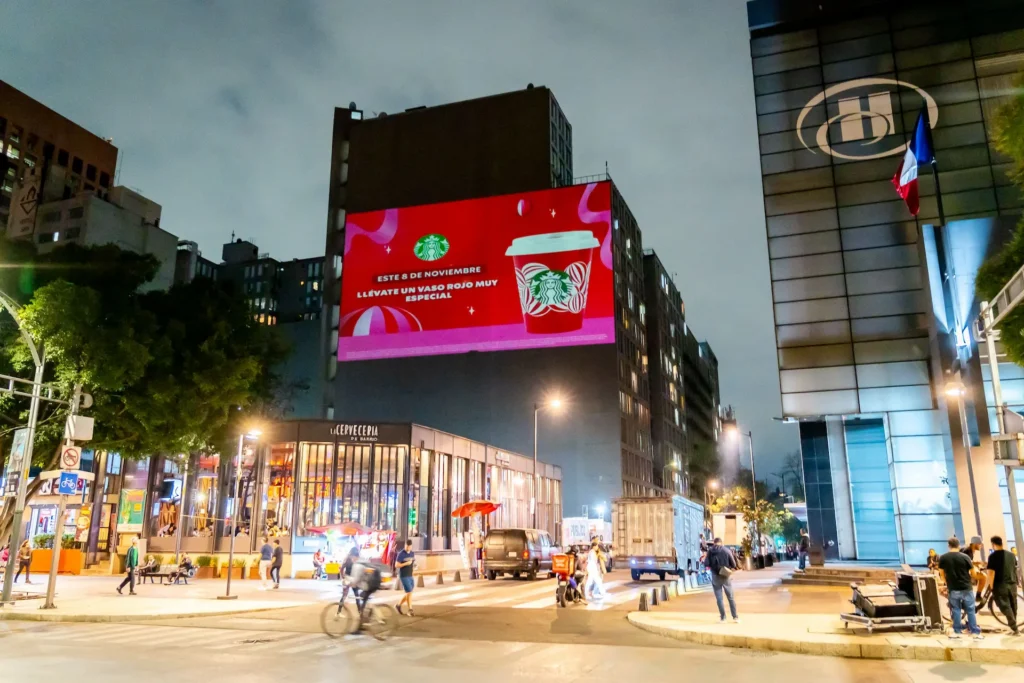
Mexico is one of the top five cinema markets in the world by attendance. Not by ticket revenue — by actual human bodies in seats, watching films. The per-capita cinema attendance rate in Mexico consistently ranks among the highest globally, and Mexico City is the engine of that national habit. Both Cinemex and Cinepolis — the two largest cinema chains in Latin America — are headquartered here. The city has a density of cinema screens per square kilometer that rivals any market in North America. And the culture of going to the movies in CDMX is embedded across economic classes and demographic segments in a way that is not true of most cities of comparable size.
For a film promotion, this market profile creates an opportunity that guerrilla projection campaigns are particularly well positioned to serve. CDMX has the cinema-going audience, the relevant press, the distributor offices, and the social media infrastructure to make a strong opening weekend. What it often lacks — what street-level campaigns provide — is the sense that a film’s arrival is a cultural event rather than just another title in the multiplex lineup.
Our team at AGM has worked on film promotion campaigns in Mexico City ranging from Hollywood studio wide releases to independent Mexican productions to art-house festival films seeking a theatrical run. The strategic logic differs across these categories, but the fundamental opportunity is the same: in a city where going to the cinema is a deeply rooted habit, a campaign that makes a film feel unmissable can move the opening weekend needle significantly. This piece covers how film promotion projections work in CDMX, where they should go, and what makes them connect to box office performance.
Mexico City’s Theatrical Market: The Scale of the Opportunity
To understand why film promotion projections matter in Mexico City, you first need to grasp the scale of the theatrical market. Mexico City’s metro area has hundreds of cinema screens across dozens of multiplexes. The major circuits — Cinemex, Cinepolis, Cinepolis VIP, Cineteca Nacional — operate everywhere from the premium Polanco shopping centers to the commercial corridors of Iztapalapa and Ecatepec in the eastern suburbs.
Cinemex has its corporate offices in CDMX and operates screens in virtually every major commercial development in the city. Cinepolis, headquartered in Morelia but operating its national strategy through its Mexico City commercial office, is the hemisphere’s largest cinema chain and uses CDMX as its marketing laboratory for new formats and campaigns. Both companies’ marketing decisions affect theater counts and placement of films across the country — a film that launches well in Mexico City gets better positioning in Guadalajara, Monterrey, and every other Mexican market.
All major Hollywood studios — Universal, Warner Bros., Disney, Sony, and Paramount Pictures all maintain Mexico City distribution offices. These offices coordinate the Mexican theatrical release strategy for every major release, including the marketing and promotional campaigns. When studios’ Mexico City teams decide to use guerrilla projections as part of a film’s street-level marketing, they are doing so with the explicit goal of driving opening weekend performance in the country’s largest market.
Mexico has one of the highest cinema attendance rates per capita in the world. Cinemex and Cinepolis — the two largest cinema chains in Latin America — are both headquartered in Mexico City, which concentrates theatrical decision-making and marketing activity in the same city where AGM operates its CDMX projection network.
The Cinema Corridor: Reforma, Polanco, and the WTC
The geographic concentration of Mexico City’s premium cinema screens creates a natural target zone for film promotion projections. The corridor running from Paseo de la Reforma through Polanco to the World Trade Center complex along Insurgentes Sur is where the city’s highest-attended, highest-grossing screens cluster — and it is also some of the best projection real estate in CDMX.
Cinemex WTC sits at the World Trade Center complex on Insurgentes Sur, surrounded by the WTC towers and the Pepsi Center arena. The tower facades visible from Insurgentes — one of the city’s main north-south arterials — provide large, high-visibility projection surfaces. A film promotion projection on the WTC towers the night before opening weekend is seen by the Insurgentes commuter and leisure traffic as well as by audiences arriving for the WTC cinemas themselves.
Cinemex Antara operates within the Antara Polanco shopping and entertainment complex in northern Polanco, in one of the city’s most affluent commercial zones. The building structures of Antara have exterior surfaces facing the internal plaza and the surrounding streets. A projection on the Antara complex reaches the shopping and dining crowd of northern Polanco — a demographic with high cinema attendance rates and high per-capita entertainment spending.
Cinema Lido, on Reforma itself, is one of the city’s classic art-house screens — smaller than the multiplexes but with a culturally engaged audience that over-indexes on film coverage, social media sharing, and the kind of word-of-mouth that drives independent film performance. A projection near Cinema Lido targets exactly the audience whose opinion of a film spreads through the social networks that influence wider attendance.
Cineteca Nacional: The Art-House Anchor
The Cineteca Nacional, in Coyoacan, is Mexico City’s national cinematheque and one of the cultural institutions with the highest standing among the city’s film community. Its exterior — a large, modern complex with open plazas — is visible from the adjacent Xoco neighborhood and the Insurgentes Sur corridor. A projection campaign near the Cineteca for an art-house or independent film connects the release directly to Mexico City’s film culture establishment, which is the primary audience for that category of film and whose opinion carries significant weight in the press and social media ecosystem.
Mexican Film Culture and the Projection Medium
Mexico has produced some of the most globally celebrated films of the past 30 years. Alfonso Cuaron’s Roma — shot in black and white in the Colonia Roma neighborhood — won the Academy Award for Best Picture and Best Foreign Language Film and put Mexico City itself on the map as a cinematic subject. Y Tu Mama Tambien, Pan’s Labyrinth, Amores Perros, and The Revenant (partially shot in Mexico) all established a global reputation for Mexican-origin or Mexico-produced cinema that still resonates with international audiences and festival programmers.
This cultural context matters for film promotion projections in CDMX. The city has a population that takes cinema seriously — not just as entertainment but as art and cultural production. Large-scale projection of film imagery has been used in Mexico City for cultural events and film festivals for decades. When a film promotion projection uses a significant building surface well, it taps into a tradition of large-scale public art and film culture that residents recognize and respect.
For Mexican-produced films specifically, a guerrilla projection in the neighborhoods where the film was shot creates a particular resonance. A film shot in Roma Norte, projected onto a Roma Norte building, is received as belonging to the neighborhood — a homecoming rather than a marketing intrusion. This effect generates the kind of organic neighborhood pride and social sharing that no amount of paid digital advertising can manufacture.
When a film projection goes up on the actual street where a scene was filmed, it stops being an advertisement and starts being a landmark. Residents share it not as a brand impression but as a piece of neighborhood history. That is the distinction between an ad that happens to be on a building and a campaign that earns its place on a building.
Neighborhood Targeting by Film Genre
Different film genres draw different demographic audiences, and those audiences concentrate in different Mexico City neighborhoods. Precise neighborhood targeting for film promotion projections allows the campaign to put imagery in front of people who are already likely to see that kind of film, rather than broadcasting to the entire city indiscriminately.
| Film Genre |
Primary Neighborhoods |
Key Demographics |
Best Projection Surfaces |
| Animated family |
Del Valle, Narvarte, Coyoacan, Insurgentes Sur corridor |
Families with children, ages 4-12 |
Commercial facades along family-traffic streets |
| Adult thriller / horror |
Roma Norte, Condesa, Polanco |
25-40, urban adults, cinema-engaged |
Art Deco facades, corner buildings, near venues |
| Romantic drama |
Condesa, Santa Fe, Polanco, Roma Norte |
25-45, couples, date-night demographic |
Restaurant districts, shopping corridor facades |
| Action / blockbuster |
Centro, Insurgentes corridor, broad east-west distribution |
15-35, cross-class, high volume |
Large commercial facades, Reforma towers |
| Art house / independent |
Roma Norte, Condesa, near Cineteca Nacional |
Film-engaged, 25-50, press/media adjacent |
Cineteca exterior, Roma Norte facades |
| Mexican-produced films |
Film’s own shooting locations, Centro, neighborhood-specific |
Varies by story, cultural pride across classes |
Filming locations, neighborhood icons |
This targeting logic applies both to the projection placement and to any complementary wheatpasting campaign that runs in the same period. A family animated film campaign that places wheatpasting in Del Valle and Narvarte during the week before opening weekend is already in front of the families that will attend before the projection campaign activates.
The Premiere Night Projection Strategy
Film premieres in Mexico City are significant events — they attract press, talent, social media coverage, and the entertainment industry community that decides how a film gets covered and positioned in the market. A strong premiere night in CDMX can set the tone for a film’s entire theatrical run in Latin America.
The premiere night projection strategy extends the premiere’s visual production into the public realm. While the red carpet and premiere event itself happen inside the venue, a projection on the building’s exterior — or on adjacent building surfaces visible from the street — brings the film’s visual identity to the people who couldn’t get an invitation. The building becomes part of the premiere production rather than just its container.
The mechanics work as follows: the projection activates at the same time as the premiere event, typically beginning 60-90 minutes before the start time when the red carpet is most active and press photography is at its peak. The projection content — key art, character imagery, title treatment — is visible in the background of photographs taken outside the venue. Those photographs run in entertainment press coverage alongside red carpet photos, which means the projection appears in media that reaches the full market without requiring a separate media buy.
After the official premiere event concludes and the invited audience disperses into the surrounding neighborhood, the projection continues running. The post-premiere crowd — people from the event spilling into nearby restaurants and bars — encounters the projection as part of the evening’s visual environment. Their social media posts carry the projection imagery into the feeds of their followers: entertainment journalists, film industry contacts, and the culturally engaged broader public that the film is ultimately trying to reach.
A premiere night projection visible in the background of red carpet press photographs generates media impressions in entertainment coverage without requiring a separate paid media placement. The projection appears in dozens of editorial photographs published across the press cycle that follows a major premiere.
Building the Opening Weekend Conversation
The opening weekend is where theatrical films win or lose their market position. A film that opens strongly gets better scheduling — more showtimes, more screens, longer runs — in subsequent weeks. A film that opens weakly gets pulled quickly, regardless of critical reception. For film distribution teams in Mexico City, managing the opening weekend perception is as important as managing the actual box office.
Guerrilla projections contribute to opening weekend performance through the conversation they generate in the week leading up to release. A projection that appears in Roma Norte or Condesa three to five nights before opening creates a discovery moment for people who may have seen the trailer online but didn’t register the opening date. The physical encounter with the film’s imagery at building scale, in their own neighborhood, creates a concrete reminder and a social moment.
The social media flywheel around pre-opening projections follows a reliable pattern. Someone photographs the projection on a Tuesday night and posts it. Their followers — many of whom are in the same neighborhood social circle — see it and recognize the film. Some post about it themselves. The film enters the week’s ambient social conversation in a way that passive digital advertising rarely achieves. By Friday opening night, the social media environment in the target demographic has already been primed by multiple days of organic projection-related content.
The measurement challenge is real — it is difficult to isolate the projection’s contribution to opening weekend performance from the effects of trailers, press coverage, and other marketing activities. But distribution teams who have run campaigns with and without guerrilla projection components consistently report that the projection campaigns produce measurable increases in pre-opening social media volume, which correlates with higher opening weekend attendance.
The FICM and FICUNAM Festival Windows
Mexico City’s film festival calendar creates secondary projection campaign windows that are valuable for specific types of films. The two most significant festivals are the FICM (Festival Internacional de Cine de Morelia), which runs in October and focuses on Mexican and Latin American productions, and FICUNAM (Festival Internacional de Cine UNAM), which runs in February-March and has a strong art-house and international focus based at the National Autonomous University of Mexico campus in southern CDMX.
The FICM generates substantial Mexico City press attention even though its main events are in Morelia, Michoacan — the festival’s Mexico City premiere events and press screenings attract CDMX entertainment journalists and industry contacts who then write about the films for national audiences. A guerrilla projection in CDMX during FICM week for a film that is premiering at the festival creates an urban presence in the media capital that the festival itself cannot provide from Morelia.
FICUNAM, operating on the UNAM campus and in affiliated venues across southern CDMX, reaches a highly film-literate, academically connected audience that represents some of Mexico City’s most influential cultural gatekeepers. An art-house or international film projection near the UNAM campus or the Cineteca Nacional during FICUNAM creates exactly the right cultural association for films that want to be positioned as serious cinema rather than commercial entertainment.
Hollywood Studios and the Mexico City Distribution Ecosystem
All six major Hollywood studios — Universal, Warner Bros., Disney, Sony Pictures, Paramount, and Lionsgate — maintain Mexico City distribution offices that coordinate theatrical releases across the Mexican market. These offices work closely with Cinemex and Cinepolis on screen allocation, and they run their own marketing campaigns alongside the chains’ in-theater advertising.
Studio distribution teams in CDMX have been increasingly receptive to guerrilla projection as a complement to their standard outdoor advertising buys. The logic is straightforward: a standard outdoor billboard on Reforma is one of hundreds of billboards visible along the corridor. A guerrilla projection on a specific building, at a specific moment, with specific audience targeting, creates a different quality of impression. It does not replace the billboard buy — it adds a dimension of street-level impact that the billboard format does not deliver.
The content produced for studio theatrical campaigns — key art, character portraits, title treatments, taglines — is already designed at a professional level and translates well to projection format with appropriate adaptation. Studios that have invested in high-quality key art (which all major studios do) essentially have their projection assets already created; the work is adapting them to the building surface and the nighttime visual environment.
Mexican-Produced Films: Specific Campaign Considerations
Films produced by Mexican production companies, or international co-productions with significant Mexican creative involvement, have projection campaign opportunities that Hollywood wide releases don’t. The most powerful of these is location-specific placement — putting the campaign in the exact physical locations where the film was made.
Mexico City has served as a film location for internationally celebrated productions for decades. The streets of Roma Norte, Condesa, Centro Historico, Tepito, Xochimilco, and dozens of other neighborhoods have been the physical backdrop for films that have won international awards and reached global audiences. When a film shot in Roma Norte is projected onto a Roma Norte building, the projection creates an immediate, emotional connection for neighborhood residents who recognize both the film imagery and the building it is cast on.
This connection generates the kind of organic social sharing that neighborhood pride activates — people tagging the street corner, tagging the film, describing the connection to followers who may be scattered across the world but maintain a relationship to that specific Mexico City neighborhood. The diaspora dimension is significant: Mexicans living in the United States, in Canada, in Spain, and elsewhere follow CDMX’s cultural life on social media, and content from their home neighborhoods generates high engagement regardless of geographic distance.
Timing Projections to Mexico City Cinema-Going Habits
Cinema attendance in Mexico City peaks on Thursday evenings (when many distributors hold preview screenings for the following day’s wide release), Friday evenings, Saturday afternoons and evenings, and Sunday matinees. The week before opening weekend is the critical pre-awareness window; the Wednesday-Thursday before opening is when the final push needs to land.
AGM structures film promotion projection timelines to map to this calendar:
- 10-14 days before opening: First projection activation — announcement and intrigue. The film’s key visual without the opening date, letting the image work as a conversation starter.
- 7 days before opening: Second activation adding the opening date and tagline. This is the projection that makes the release concrete for people who have already been primed by the first placement.
- Premiere night (typically Wednesday or Thursday): Premiere night projection as described above — on the premiere venue and adjacent surfaces.
- Opening weekend nights (Friday-Sunday): Optional third activation near the highest-attended cinemas in the target demographic zone, running during peak cinema arrival hours (6pm-10pm).
This four-touch sequence turns a single projection activation into a campaign arc — one that builds recognition and momentum across the pre-opening window rather than delivering a single impression that may not convert on its own.
Integrating Projections with Wheatpasting for Film Campaigns
Film promotion campaigns benefit particularly from the wheatpasting and projection combination because the two formats operate at different times of day and reach audiences in different modes. Wheatpasting works during daylight hours and reaches the walking-around, shopping, eating-out audience. Projections work at night and reach the going-out, socializing, cinema-attending audience. A film campaign that has both running simultaneously in the same neighborhoods is in front of its target demographic almost continuously across their waking hours.
In Roma Norte, the combination is visually reinforced when the wheatpasting and projection use the same key art. A person who sees a film poster wheatpasted on a Roma Norte wall while getting coffee in the morning, and then sees the same imagery projected at building scale when they walk past in the evening, has received two high-quality brand impressions in the same day with no media buy overlap. The same creative assets doing twice the work — in completely different formats, at completely different scales, at completely different times of day — is a significant efficiency for film promotion budgets.
The Social Media Flywheel for Film Projections
Film fans in Mexico City are among the most socially engaged entertainment audiences in Latin America. The CDMX cinema community — critics, fans, industry workers, casual audiences — is active on social media in ways that directly affect how a film enters the market conversation. A projection that appears in Roma Norte, Condesa, or Centro and is photographed and shared by film-engaged social media users can reach the entertainment press, influence aggregate audience awareness, and seed word-of-mouth in the networks that most affect opening weekend decisions.
The flywheel works in multiple directions. Fan photographs of the projection get shared with friends, generating direct awareness. Entertainment journalists who encounter the projection include it in coverage of the release, generating press amplification. The film’s own social media team reposts fan photographs of the projection, generating official brand acknowledgment of the organic content. And the comments and conversations generated around the projection posts create engagement signals that social platforms use to push the content further.
The key variable in this flywheel is the quality of the projection itself. A technically poor projection — dim, poorly mapped, using low-resolution assets — does not generate strong social photography. A technically excellent projection on a visually interesting surface, well-designed and running at maximum output, creates a photograph worth taking. AGM prioritizes technical quality in its projection campaigns precisely because the photographs are part of the campaign’s deliverable, not just a secondary benefit.
Frequently Asked Questions
Why is Mexico City one of the most important theatrical markets for guerrilla film promotion?
Mexico has one of the highest cinema attendance rates per capita in the world. Both Cinemex and Cinepolis — the two largest cinema chains in Latin America — are headquartered in Mexico City, and CDMX has among the highest concentration of cinema screens in the hemisphere. Hollywood studios, independent distributors, and Mexican film production companies all use Mexico City as the primary launch market for theatrical releases in Latin America.
Where should film promotion projections be placed in Mexico City?
The cinema corridor along Paseo de la Reforma and in Polanco is the prime geography for theatrical release projections — buildings near Cinemex WTC, Cinemex Antara, and Cinema Lido capture audiences walking to and from major cinemas. For broader awareness, Roma Norte and Condesa target cinephile demographics; for animated family films, Del Valle and Narvarte target family neighborhoods; for wide-release commercial films, Centro Historico provides maximum reach.
How does a premiere night projection campaign work in Mexico City?
A premiere night projection activates on the building where the premiere event is held and on adjacent surfaces visible from the red carpet and the street. The projection extends the visual production of the premiere into the public realm — people on the street who didn’t receive invitations to the event see the film’s imagery at scale, and photographs of the projection circulate alongside premiere red carpet content on social media.
How do film festival windows in Mexico City affect projection campaign planning?
The FICM (Festival Internacional de Cine de Morelia) runs in October and generates significant press attention for Mexican-produced and Latin American films. FICUNAM (Festival Internacional de Cine UNAM) runs in February-March with a strong art-house focus. Both festivals create secondary promotion windows where projection campaigns in CDMX can capture press and festival-audience attention before or during a theatrical release.
Which Mexico City neighborhoods target animated film audiences vs. adult thriller audiences?
Animated family films perform best with projections in Del Valle, Narvarte, Coyoacan, and family-oriented corridors along Insurgentes Sur — neighborhoods where families with children concentrate. Adult thriller, horror, and drama campaigns target Roma Norte, Condesa, and Polanco, where younger adults without children represent the primary cinema-going demographic.