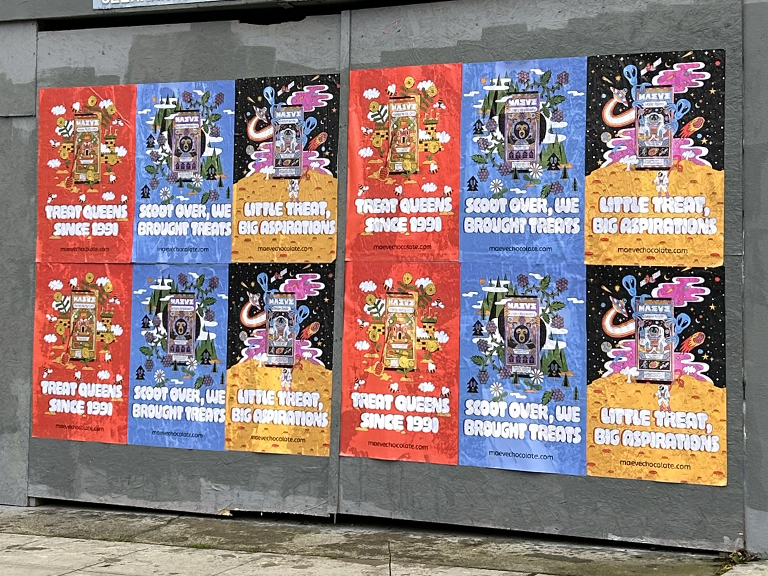
# Posting Strategy Showdown: Nailing the Best Wheatpaste Marketing Move for Your Brand (2026)
**Focus keyword:** wheatpaste marketing strategy for brands
**Search intent:** Brand managers and marketing directors looking to match their specific campaign goal to the right wheatpaste method, practical decision guidance, not format advocacy.
—
Wheatpaste marketing isn’t one tactic. It’s a family of methods with meaningfully different cost structures, reach profiles, and campaign fits. The brands that get poor results from the format almost always chose the wrong method for their goal, not the wrong format. We’ve run wheatpaste campaigns across more than 500 activations for brands in entertainment, fashion, food and beverage, DTC consumer goods, and tech. The decision framework below is what we actually use when a new client comes to us.
—
## What Are the Main Wheatpaste Marketing Methods?
The format splits into four primary execution strategies. Each is optimized for a different campaign goal, budget level, and measurement approach. Understanding the distinctions, and matching them to your specific situation, is where campaign ROI gets determined, before a single poster gets printed.
—
## Method 1: Time and Space, When and Why It Dominates
### What Time and Space Wheatpaste Means in Practice
“Time and space” is the campaign structure built for moment-specific impact: maximum locations, simultaneous installation, concentrated market presence within a 48–72 hour window. We’re talking 150–500+ poster locations across a defined market, installed while the creative is fresh and the timing is intentional.
We use this structure most often for entertainment clients, streaming platform launches, album drops, film and TV premieres. The reason is simple: entertainment marketing is time-indexed. A television series premiering on a specific date doesn’t benefit from a gradual awareness build. It needs the target market to feel like the campaign is everywhere in the 10 days before.
In a campaign we ran for an entertainment client across Lower Manhattan and Brooklyn, a 220-location simultaneous installation on a Friday overnight generated documented social mentions starting by Saturday morning, organic photography from pedestrians encountering the campaign before any paid promotion was activated. That momentum is specific to the time-and-space structure.
### When Time and Space Is the Wrong Choice
This method creates a peak, not a sustain. If your brand needs ongoing market presence rather than a single concentrated moment, this structure wastes the frequency advantage of the format. It’s also a harder structure to optimize, with 200+ simultaneous locations, you can’t easily isolate which placements performed and which didn’t.
—
## How the Refresh Method Maximizes Budget Impact
### What Refresh Cycle Wheatpaste Looks Like
The refresh cycle maintains fresh poster presence at a consistent set of locations over 4–16 weeks. As posters degrade, get covered, or pass their visual prime, crews replace them. The brand stays present in its key corridors throughout the campaign window.
We built this structure for brands that operate in a specific geographic market and need sustained top-of-mind presence: restaurants, fitness studios, bars, retail locations, and service businesses with a physical address. After running a 12-week refresh campaign for a hospitality client across Glenwood South in Raleigh and the surrounding corridors, the brand saw sustained foot traffic lift throughout the campaign period rather than the steep drop-off typical of one-time installations.
### The Logistics That Make Refresh Work
Most agencies that offer “refresh campaigns” are actually selling a one-time install with optimistic terminology. A real refresh cycle requires:
– Printed inventory reserve (10–20% over initial quantity to enable replacement runs)
– Crew monitoring of installed locations with documented condition assessments
– Replacement scheduling triggered by condition threshold, not arbitrary calendar dates
– Updated documentation with each replacement run
We operate refresh campaigns with these systems in place. For clients who need to show sustained campaign presence to internal stakeholders, this operational infrastructure is what makes the proof-of-performance possible.
—
## By-the-Poster Campaigns: Precision Over Coverage
### What By-the-Poster Campaigns Deliver
By-the-poster execution places 20–75 posters in very specific locations chosen for one of two reasons: confirmed audience presence at that location, or proximity to a specific event or venue.
We use this structure for two client scenarios. First: event-specific campaigns where we need posters on the pedestrian routes to a venue in the 5–7 days before an event. We’ve placed posters on the walking routes from the Houston Street subway station to venues in the Lower East Side, from the Crenshaw stations in Los Angeles toward SoFi Stadium, and from the Convention Center in Nashville toward Bridgestone Arena, all within 48-hour windows before major events.
Second: precision demographic targeting for niche brands that need a specific audience type, not broad market coverage. A B2B software company recruiting engineering talent placed 40 posters near coworking spaces, university campuses, and coffee shops in the SoMa and Mission Districts of San Francisco. The campaign generated 380 unique QR scans in two weeks, from exactly the audience the brand needed to reach.
### The Testing Value of Starting Small
For brands running their first wheatpaste campaign, a tightly scoped test can still be smart. If you want a smaller or custom setup, contact AGM for pricing. For a standard 24×36 wheat paste run, 100 posters are $4,500 and 200 posters are $5,500. That gives the brand real performance data before it commits to a broader market rollout.
—
## How Wheatpaste Compares to Other Outdoor Advertising Strategies
### The Core Advantage Over Billboards
Billboards reach vehicular audiences. The average dwell time for a billboard impression is 2–4 seconds. The format works for one-idea messages that can be absorbed at highway speed: brand name, phone number, simple visual.
Wheatpaste reaches pedestrians. Dwell time at a pedestrian location, a walk-signal point, a bus stop, a narrow corridor, runs 10–45 seconds. That’s the difference between a logo impression and a complete message, between a passive impression and a QR scan, between an ad being seen and an ad being photographed.
For brands targeting urban consumers in the 18–40 demographic, the pedestrian environment isn’t just preferable. It’s where the audience actually makes decisions, socializes, and forms the cultural associations that influence purchase behavior.
### What Wheatpaste Offers That Digital OOH Cannot
Digital out-of-home (DOOH) is the fastest-growing outdoor format. It’s measurable, dynamic, programmatically bought, and operationally clean. We’re not arguing against it.
What DOOH cannot produce is perceived cultural authenticity. A digital LED screen looks exactly like what it is: paid advertising inventory. A well-executed wheatpaste campaign in the right neighborhood looks like it belongs there. That distinction drives the organic documentation, photography, social posts, word-of-mouth, that multiplies the campaign’s effective reach without additional spend.
Brands running both DOOH and wheatpaste in the same market consistently report that the wheatpaste component generates disproportionately more organic social content. The formats aren’t competing. DOOH handles programmatic reach; wheatpaste handles cultural penetration.
### Transit Advertising: Complement, Not Competitor
Transit advertising and wheatpaste reach the same urban audience through different moments in the same commute. Transit captures the in-vehicle impression at the bus stop or in the subway car; wheatpaste captures the same person walking through the neighborhood around those transit touchpoints.
When we run campaigns for clients who have both transit buys and wheatpaste, the combined format consistently outperforms either channel alone. The audience encounters the brand multiple times through different format contexts, a frequency and diversity of impression that neither format achieves independently.
—
## Maximizing Creative Impact and Audience Targeting
### The Creative Freedom Wheatpaste Provides
No outdoor format offers creative flexibility comparable to wheatpaste. Billboard formats are governed by spec sheets and approval processes. Wheatpaste can run:
– Custom dimensions from 18″×24″ to multi-sheet 48″×144″ installations
– Irregular formats with shaped edges, overlapping panels, and surface-reactive compositions
– Sequential installations where multiple posters across a block create a single large image
– Location-reactive creative that incorporates the environment into the design itself
That flexibility is part of why wheatpaste campaigns generate organic social documentation at rates that other outdoor formats can’t match. The design has room to be interesting enough to photograph.
### How Strategic Location and Demographic Targeting Work Together
Location selection is where strategy translates to performance. We don’t select locations by surface availability alone. We select based on:
**Pedestrian count at relevant hours**, a corridor that peaks at 7am may miss an entertainment brand’s 6pm–midnight audience entirely
**Demographic composition of surrounding blocks**, neighborhood demographics, nearby businesses, and transit access patterns all inform audience composition
**Enforcement history**, a wall may be available but in a corridor where posters get removed within 48 hours. Our crew relationships and market knowledge identify these patterns before investment is committed
**Competition density**, a heavily posted corridor may reduce impact regardless of location quality. Fresh territory in an adjacent block often outperforms the prime wall that’s been posted over 12 times in the past month
### Using QR Codes to Enhance Measurement and ROI
Every wheatpaste campaign we run uses QR codes with location-specific UTM parameters. This structure enables:
– Location-level performance comparison (which specific blocks and corridors drive the most scans)
– Creative variation testing (different QR code placement positions, different instruction copy)
– Time-based performance analysis (scan patterns by day and hour reveal audience timing)
– Cross-channel attribution (when wheatpaste QR traffic is tagged correctly, it feeds properly into digital attribution models)
Brands that track wheatpaste campaigns with this level of rigor build a compound advantage: each campaign generates data that makes the next one more effective.
—
## Legal and Ethical Considerations for Wheatpaste Marketing
### Permitted vs. Unpermitted: What Brands Need to Know
The legal environment for wheatpaste varies by city, by corridor, and by surface. At the permissible end: property-owner authorization provides full legal clarity and enables full campaign documentation. Several cities also operate legal posting zones managed by third parties, permitted by the municipality, with consistent availability and pricing.
At the other end: unpermitted placement in tolerance zones carries legal risk that varies by enforcement environment. Fine ranges in major markets run from $75 to $2,000+ per location depending on jurisdiction. We brief clients on the specific enforcement environment in their target markets before any campaign commitment.
### How Professional Agencies Work through Regulations Responsibly
The difference between operators with real market relationships and agencies printing and hoping is local crew knowledge. We know which corridors in Williamsburg see aggressive enforcement and which don’t. We know which property owners in Chicago’s West Loop corridor have posted authorization agreements. We know the complaint-response timeline in Wynwood vs. Downtown Miami.
That knowledge doesn’t appear in any media kit. It accumulates through years of operating in specific markets, and it’s a primary determinant of campaign durability.
—
## ROI Data and Real-World Campaign Benchmarks
### What Measurable Outcomes Look Like
Brands that track wheatpaste campaigns with QR codes and social monitoring consistently report:
**QR engagement:** In high-foot-traffic pedestrian environments with well-designed QR integration, scan rates typically run 0.5%–2.5% of estimated daily pedestrian flow for the location. A corner location with 5,000 daily pedestrians and a well-placed, high-contrast QR code generates 25–125 scans per day.
**Organic social documentation:** In neighborhoods with documented photography cultures (Williamsburg, Wynwood, Melrose/Fairfax, Arts District LA, Wicker Park), professional campaigns generate measurable organic social content within the first week.
**Foot traffic lift:** Hospitality and retail clients running refresh campaigns in direct proximity to their locations consistently report foot traffic lift attributable to the campaign period, though specific lift percentages vary significantly by market, location quality, and campaign execution quality.
### Campaign Case Examples from Our Portfolio
In New York, a 200-location Williamsburg and LES blitz for a streaming client generated 2,400+ unique QR scans in 72 hours and 28% foot traffic increase to a nearby flagship retail partner during the campaign window.
In Austin, a corridor campaign along East 6th Street and South Congress for a CPG brand ahead of SXSW generated consistent organic documentation, brand photography surfacing across Instagram and TikTok from attendees who encountered the campaign without any paid social activation.
—
## The Brand-to-Method Matching Guide
| Brand Type | Best Method | Why |
|————|————|—–|
| Entertainment / streaming | Time + space blitz | Date-specific, needs simultaneous market saturation |
| Restaurant / hospitality | Refresh cycle | Needs sustained local presence, geographic service area |
| Fashion / streetwear | Dedicated corridor | Frequency within taste-audience concentration |
| DTC product launch | Blitz + by-the-poster | Launch moment + precision testing |
| Event / festival | By-the-poster | Venue-proximate, time-bound |
| Tech / recruiting | Corridor + by-the-poster | Specific professional audience concentration |
| Retail chain | Refresh cycle | Always-on awareness in competitive local markets |
| B2B brand | By-the-poster | Small audience, precision over reach |
—
## FAQ: Wheatpaste Marketing Strategy
**Q: Which wheatpaste method is best for a product launch?**
For most product launches with a specific go-live date, the time-and-space blitz delivers the concentrated market moment you need. Add by-the-poster precision placement at high-value ancillary locations (venues, transit hubs, retail adjacencies) for supplemental precision. Contact us to plan: americanguerrillamarketing.com/contact.
**Q: How much does a wheatpaste campaign cost?**
Pricing depends on market, method, location count, poster size, and campaign duration. Contact AGM for current rates by market and campaign type: americanguerrillamarketing.com/contact.
**Q: What’s the minimum campaign size for professional execution?**
We execute campaigns starting at small by-the-poster runs and scaling to 500+ location blitzes. The appropriate starting point depends on your goal, market, and available creative. Talk to us about your specific situation.
**Q: How does AGM document campaign installations?**
Every campaign includes GPS-tagged photography for each installation location, with time stamps verifiable in EXIF data. Post-campaign reporting includes a map overlay of all locations, poster count by location, and a condition assessment at the 1-week mark for campaigns including monitoring.
**Q: Can wheatpaste run alongside paid digital?**
Yes, and the combination consistently outperforms either channel independently. Wheatpaste with QR codes that feed into retargeting audiences creates a physical-to-digital conversion loop. Social content generated organically by the physical campaign reduces paid social costs for the same awareness outcomes.
**Q: How long do wheatpaste posters typically last?**
On good surfaces in markets we know well, professional paste application produces posters that hold 2–6 weeks depending on weather, surface conditions, and enforcement environment. Campaigns requiring specific duration guarantees should include monitoring and replacement provisions in the scope.
**Q: Does wheatpaste work in secondary markets outside major cities?**
Yes, but the method often shifts. Secondary markets with lower pedestrian density typically respond better to corridor concentration than broad blitzes. We’ve run effective campaigns in mid-size markets including Raleigh, Nashville, Pittsburgh, Indianapolis, and New Orleans, all with city-specific placement strategy. Contact us for market-specific guidance.
—
## Start Planning Your Wheatpaste Campaign
American Guerrilla Marketing operates in 50+ markets with permanent crew infrastructure, permitted location access, and GPS-tagged documentation standards built into every campaign scope.
**Get in touch:** americanguerrillamarketing.com/contact
**Campaign overview:** americanguerrillamarketing.com/wheatpasting-poster-campaigns/
Frequently Asked Questions
Posting Strategy Showdown Nailing The Best Marketing Move For Your Brand generates better results when placement, timing, creative, and local execution all work together. These questions cover the details brands usually need before launch, during rollout, and while evaluating performance.
What should a brand decide before choosing a posting tactic?
Decide whether the goal is awareness, attendance, traffic, launches, or cultural presence. The best tactic depends on the actual job the campaign needs to do.
Do all brands need the same posting density?
No. Event and entertainment campaigns often need heavier short-term density, while service brands may perform fine with a more focused support layer.
How do I know if posters fit my brand?
They fit when your audience moves through public space in meaningful numbers and your message can be understood quickly.
What is the difference between coverage and dominance?
Coverage means appearing in many places. Dominance means showing up repeatedly in the places that matter most. Dominance is often more persuasive.
Should premium brands avoid street posting?
Not if the creative and placement are disciplined. Premium positioning can work well on the street when execution feels intentional rather than sloppy.
What is a good first market for a posting test?
Choose a city where you already have demand, a relevant event, or clear audience concentration. Testing in a random market usually teaches less.
How quickly can posting campaigns go live?
They can move quickly once creative, print, and route decisions are locked, but rushing without planning usually creates messy execution.
Can posting support retail or pop-up traffic?
Yes. It works especially well when the route leads naturally toward a store, launch site, or event destination.
What should I ask an operator before hiring them?
Ask how they select routes, document installs, handle replacements, and adapt for each market. Those answers reveal whether they are strategic or just operational.
What is the biggest reason a posting campaign underperforms?
Weak alignment between message and place. Even good creative struggles when it shows up in the wrong streets.
Related Pages and Articles