American Guerrilla Marketing
Nationwide serivce
Media planning, media buying, billboard advertising, & guerrilla marketing
ISO metric formats, London wall inventory, and field intelligence for running a wheatpaste campaign that actually holds across Shoreditch, Brixton, Camden, and beyond.
London’s street poster market runs on ISO metric formats — the same A-series standards used across Europe, with B-series and UK-specific sheet formats filling the premium and large-format tiers. Every London print house stocks A1 and A0 as standard substrates. B1 and 4-Sheet production requires either a larger-format digital house or a sheetfed press with extended substrate capacity. If your campaign artwork was built to US specs — 24×36, 27×40, or 40×60 — you will need to reformat before sending files to a London printer.
This guide covers every standard wheatpaste poster size used in London campaigns — from A4 density-run supplements to 6-Sheet building-face takeovers. It includes field notes on how each format performs across specific London districts, impression estimates for key wall positions, and the practical file setup information you need before your campaign goes to print.
American Guerrilla Marketing field operators have walked Brick Lane, Shoreditch High Street, Coldharbour Lane, and Chalk Farm Road firsthand. The placement intelligence on this page comes from on-the-ground campaign work — not modeled data or third-party research.
AGM field operators have walked every major London corridor on-the-ground. We know which formats hold on Victorian brick versus rendered surfaces, which sizes read from across Shoreditch High Street, and which surfaces survive wet-weather installation. Call (646) 776-2770 or email [email protected].
The eight formats below are ordered from smallest to largest. London’s wheatpaste market is weighted toward A1 for density runs and B1 or A0 for premium placements. The 4-Sheet and 6-Sheet formats exist at the top end — limited inventory, maximum visual impact, and campaign-defining presence when placed correctly.
| Specification | Details |
|---|---|
| Metric Dimensions | 210 × 297 mm |
| Imperial Dimensions | 8.3 × 11.7 in |
| Pixels @ 300ppi | 2,480 × 3,508 px |
| US Equivalent | 8.5 × 11 in (Letter, close) |
| Print Method | Digital offset, laser, inkjet |
| Typical Run Volume | 100–1,000 sheets |
A4 is the base ISO format — the most widely printed sheet in the UK — but it is rarely the primary format for outdoor wheatpaste campaigns in London. Its role in the street is supplementary: snipe campaigns on poles, construction barriers, interior pub noticeboards, and campus posting. Rarely primary for outdoor wheatpaste in London but widely used as a supplementary format for density runs in tight corridors like Brick Lane’s side streets and Camden’s indoor market spaces.
At street level in London, A4 holds its own in enclosed or semi-enclosed environments — inside a venue, at the base of a wall, in a stairwell, or on an indoor noticeboard where the reading distance is less than two metres. On an open outdoor surface, A4 disappears. The format’s street value is in its ability to cover surface types and spaces that larger formats cannot reach: the narrow alley entrance in Shoreditch, the pub window in Brixton, the student union board near a university campus. Use A4 as the tail end of a campaign that starts with A1 or B1 on the major surfaces and extends into every space where those formats are too large to fit or too expensive to waste.
| Specification | Details |
|---|---|
| Metric Dimensions | 297 × 420 mm |
| Imperial Dimensions | 11.7 × 16.5 in |
| Pixels @ 300ppi | 3,508 × 4,961 px |
| US Equivalent | 11 × 17 in (Tabloid) |
| Print Method | Digital offset, large-format inkjet |
| Typical Run Volume | 100–500 sheets |
A3 is the secondary London street format. Bar and venue interior flyposting, construction fence strips in narrower East London service corridors, and campus posting near UAL, Goldsmiths, and UCL are the natural homes for A3. Good density-run format where A1 volume is cost-prohibitive — when a campaign needs to establish a presence across 30 or 40 locations on a tight budget, A3 can carry that job in the right environment.
The format works at close reading distance — the corridor of a pub, the entrance to a market hall, a stairwell approaching a venue. London has an abundance of these semi-enclosed posting environments: Victorian railway arch spaces in Bermondsey and Hackney, the covered market passages in Brixton, the corridors of established music venues in Camden. In these spaces, A3 is correctly proportioned and reads well. On an open wall with any sightline beyond three metres, A3 starts to lose visual authority. The London street poster market respects A1 and above for outdoor surfaces; A3 is for the spaces where the outdoor market cannot reach.
| Specification | Details |
|---|---|
| Metric Dimensions | 420 × 594 mm |
| Imperial Dimensions | 16.5 × 23.4 in |
| Pixels @ 300ppi | 4,961 × 7,087 px |
| US Equivalent | 16 × 20 in (close) |
| Print Method | Digital offset, large-format inkjet |
| Typical Run Volume | 50–300 sheets |
A2 is the threshold where outdoor wheatpaste in London starts to earn its place on a wall. The format carries enough surface area to deliver a headline, a visual, and a call to action at a distance of three to five metres. Elevated snipe executions and selective wheatpasting in premium London locations run A2 effectively. Common for art exhibitions, gallery openings, and creative industry launches in Shoreditch, Hackney, and South Bank — environments where the audience is close to the wall and the creative needs to be read in detail rather than at distance.
A2 offers placement flexibility that larger formats do not. One person can carry, paste, and place A2 sheets without assistance. The sheet is light enough to handle in wet weather without tearing, and it is small enough to fit on wall sections that A1 cannot reach — the sections between windows on a Victorian terrace, the sides of a hoarding panel, the support columns under a railway arch. In London’s dense and architecturally varied street environment, that flexibility has real value. Two sheets of A2 tiled vertically on the same wall approximate A1 coverage in situations where a single A1 sheet will not stay flat on an uneven surface.
| Specification | Details |
|---|---|
| Metric Dimensions | 594 × 841 mm |
| Imperial Dimensions | 23.4 × 33.1 in |
| Pixels @ 300ppi | 7,087 × 9,933 px |
| US Equivalent | 24 × 36 in (Standard Wheat Paste) |
| Print Method | Digital offset, screen, large-format inkjet |
| Typical Run Volume | 100–3,000+ sheets |
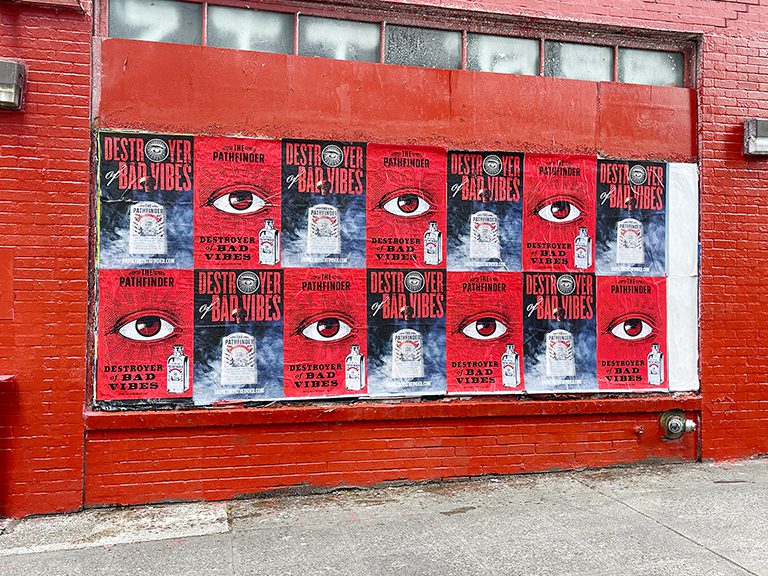
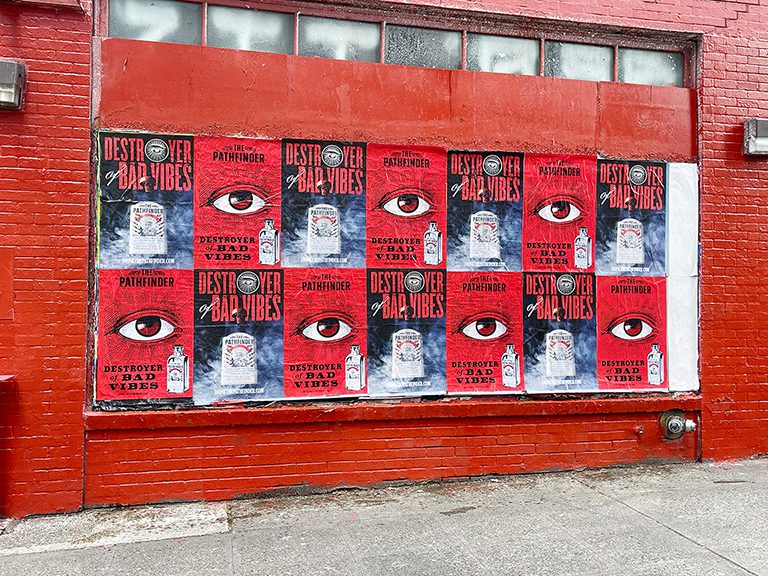
A1 is the default London street poster format. Every London print house runs A1 as its primary substrate. Music industry baseline format — concerts, tours, album releases, club nights, DJ announcements. Works on virtually every surface in the Shoreditch, Brixton, Camden, and Hackney placement inventory. A1 is the format that every London wall is configured to accommodate — the standard surface-to-format relationship that makes London street poster campaigns legible to audiences, printers, and paste operators alike.
The London music and entertainment industry has run on A1 for decades. The walls of Brick Lane, the hoarding runs along Bethnal Green Road, the venue corridors of Coldharbour Lane and Brixton Road — all of these surfaces are sized, conditioned, and expected to carry A1 sheets. That embedded standard means A1 campaigns in London operate with an efficiency that other formats cannot match: faster production, lower unit cost, and a field operator network that knows exactly how to handle, transport, and place the format at scale.
For campaigns entering London for the first time — US brands, international entertainment properties, global retail launches — A1 is where you start. It gives you density, it gives you wall access across all major districts, and it gives you a format that the city’s street poster ecosystem is built to support. Add B1 or A0 on select high-visibility positions to build visual authority on top of the A1 foundation.
| Specification | Details |
|---|---|
| Metric Dimensions | 707 × 1,000 mm |
| Imperial Dimensions | 27.8 × 39.4 in |
| Pixels @ 300ppi | 8,350 × 11,811 px |
| US Equivalent | 27 × 40 in (Movie Poster, close) |
| Print Method | Large-format digital, sheetfed offset |
| Typical Run Volume | 50–500 sheets |
B1 is the premium authority format in London street campaigns. Film launches, major brand activations, entertainment campaigns with strong visual creative — this is where B1 operates. A B1 placed on the same wall as A1 inventory immediately reads as higher-priority. On Brick Lane, a B1 placement commands visual authority above the surrounding A1 inventory — not because audiences consciously measure the difference, but because the format occupies more space and carries more visual weight at the same reading distance.
B1 is the nearest UK match to the US 27×40 movie poster specification — the format used for one-sheet film marketing in American theatres and on US city walls. For campaigns that originate in the US film or entertainment market and need a London execution, B1 is the format that requires the least file adjustment while delivering the equivalent street impact. US artwork built to 27×40 crops to B1 proportions with minimal design adjustment, which makes B1 the practical choice for campaigns managing simultaneous US and UK executions from the same creative assets.
The Shoreditch placement market responds well to B1. The perimeter walls of the Truman Brewery, the south-facing facades along Bethnal Green Road, and the railway-adjacent walls in Hackney Wick are all surfaces where B1 sits at the right scale — large enough to dominate a section of wall, manageable enough that a two-person crew can place 40 to 60 sheets in a single overnight window.
| Specification | Details |
|---|---|
| Metric Dimensions | 841 × 1,189 mm |
| Imperial Dimensions | 33.1 × 46.8 in |
| Pixels @ 300ppi | 9,933 × 14,043 px |
| US Equivalent | 33 × 47 in (close to Large Format) |
| Print Method | Large-format digital, wide-format inkjet |
| Typical Run Volume | 10–100 sheets |
A0 is the large-format statement piece in the London wheatpaste market. Major brand launches, streaming platform campaigns, and fashion house season activations use A0 when they need a format that sits visually above all the A1 inventory around it without requiring the logistics of a 4-Sheet installation. The Truman Brewery perimeter walls and south-facing Bethnal Green Road facades are standard A0 inventory in Shoreditch. In Brixton, the railway-adjacent walls along Coldharbour Lane have the continuous run length that A0 requires.
A0 requires a two-person installation crew. The sheet surface area is large enough that handling in London’s wet and windy conditions becomes a real operational variable. An AGM field crew placing A0 in London will schedule the installation for early morning, use heavier paste mix, and allow more curing time between adjacent sheets than a standard A1 run. The logistics are manageable—but they need to be planned, not improvised.
A0 is the format that retail and entertainment campaigns use when they need to sit above the ambient poster inventory visually. Placed on a long Bethnal Green Road wall alongside a supporting A1 density run, A0 sheets become the anchor points that the campaign radiates outward from. A campaign that runs 20 A0 placements and 500 A1 sheets in the same zone gives audiences two things: scale at the key walls, and density everywhere else. That combination reads as a major London activation.
| Specification | Details |
|---|---|
| Metric Dimensions | 1,016 × 1,524 mm |
| Imperial Dimensions | 40 × 60 in |
| Pixels @ 300ppi | 12,000 × 18,000 px |
| US Equivalent | 40 × 60 in (Large format / transit) |
| Print Method | Industrial large-format digital |
| Typical Run Volume | 5–40 sheets |
The 4-Sheet format is the standard transit-adjacent and construction hoarding format in the UK outdoor advertising market. In London, this means major transport-adjacent surfaces, construction hoardings in the King Street West and London Bridge development corridors, and large-format exterior walls along transit-heavy streets where the pedestrian approach distance allows the format to fully register before someone passes.
4-Sheet is the format you see on the exterior hoarding panels around major London development projects—the Crossrail perimeter installations, the regeneration hoardings in Nine Elms and Stratford, the construction enclosures around major commercial builds in the City. The campaign tenure on these surfaces can extend for months, which makes 4-Sheet construction hoarding inventory some of the longest-dwell placement available in the London market. A campaign that secures 4-Sheet hoarding positions in a high-foot-traffic development corridor is placing into surfaces that will hold for the duration of the construction phase.
Common during UK film premiere windows at Odeon Leicester Square and BFI Southbank perimeter, where the 4-Sheet format at the approach walls creates a contextual connection between the outdoor campaign and the venue. Requires industrial large-format print and a coordinated installation team. Plan the installation as a separate logistics operation from your A1 or B1 run—the crew, the paste mix, and the timing window for 4-Sheet work are different enough that combining them with a standard poster run creates unnecessary complexity in the field.
| Specification | Details |
|---|---|
| Metric Dimensions | 1,200 × 1,800 mm |
| Imperial Dimensions | 47.2 × 70.9 in |
| Pixels @ 300ppi | 14,173 × 21,260 px |
| US Equivalent | 48 × 72 in (Jumbo Wheat Paste, close) |
| Print Method | Wide-format digital, tiled large-format |
| Typical Run Volume | 3–15 sheets |
The 6-Sheet is the highest-impact wheatpaste format in the London street market. Building face takeovers, major transit corridor walls, and Tube exit approach surfaces. Used for national retail launches, major film campaigns, and international brand entries into the London market that need to own a surface—not just post on it. A 6-Sheet placement is readable from 50+ metres in conditions with adequate contrast, which means it functions at a scale that no smaller format can replicate at street level.
Very limited placement inventory exists for 6-Sheet in London. The format requires a blank wall with enough uninterrupted surface area—no architectural breaks, window interruptions, or adjacent structures that would cut the visual field. AGM scouts and holds 6-Sheet inventory in advance for campaigns that can use the format to full effect. The surfaces that qualify are specific: the blank end-terrace walls in East London that face a main thoroughfare, the building-face panels in Canary Wharf’s development corridors, and the high-clearance transit approach walls near Waterloo and Victoria.
Production for 6-Sheet requires wide-format single-sheet or tiled output from an industrial large-format printer. Tiled production—typically four to six panels printed and aligned on the wall—is the standard approach for campaigns that cannot access single-sheet wide-format substrate at this size. The installation window is extended: three people, precise alignment marking before paste, and a waiting period between tile placements to allow initial bonding before adjacent sheets are added. Get this right and the result is a surface presence that changes how a neighborhood reads a campaign. Get it wrong—misaligned tiles, incomplete coverage, lifted edges—and the investment in the format is wasted. AGM’s certified and licensed installation crews have the experience to place 6-Sheet correctly on the first attempt.
All impression estimates apply the OOH industry standard formula: Daily Foot Traffic × Campaign Duration (14 days) × Street-Level Visibility Factor (0.08–0.12). These figures reflect street-level poster format standards, not modeled billboard projections. Actual impressions vary by specific wall position and pedestrian density at the placement address.
| Format | Wall Position | Est. Daily Foot Traffic | 14-Day Campaign Impressions | Best Application |
|---|---|---|---|---|
| A1 | Brick Lane standard wall | 25,000–40,000 | 420,000–672,000 | Music, entertainment, fashion |
| B1 | Shoreditch High Street | 35,000–55,000 | 588,000–924,000 | Brand launches, film, entertainment |
| A0 | Truman Brewery perimeter | 30,000–50,000 | 504,000–840,000 | Major brands, streaming, fashion |
| 4-Sheet | Construction hoarding, London Bridge | 40,000–70,000 | 672,000–1,176,000 | Mass awareness, retail, film |
| 6-Sheet | Building face, transit approach | 50,000–90,000 | 840,000–1,512,000 | Major launches, national campaigns |
London’s wall character varies dramatically by district. Victorian brick in Shoreditch behaves differently from rendered council housing facades in Brixton, which behaves differently from the hoarding panels in Canary Wharf. AGM field operators have worked across all of these environments. The table below reflects placement intelligence from on-the-ground campaign work across London’s primary street poster districts.
| District | Recommended Format | Wall Character | Best Campaign Type |
|---|---|---|---|
| Shoreditch / Brick Lane | A1, B1, A0 | Victorian brick, Truman Brewery perimeter, long horizontal runs | Music, fashion, brand launches, entertainment |
| Brixton | A1, B1, A2 | Mixed Victorian and mid-century, Coldharbour Lane corridor, venue walls | Music, culture, retail, nightlife |
| Camden | A1, A2, B1 | Market corridors, railway-adjacent walls, mixed commercial | Music, street fashion, entertainment, touring acts |
| Soho | A1, A3, B1 | Dense commercial, narrow streetscapes, venue and bar corridors | Film, entertainment, brand activations, nightlife |
| Canary Wharf | 4-Sheet, 6-Sheet, A0 | Development hoarding panels, corporate campus perimeters | Financial services, tech, major retail, corporate |
| South Bank | A1, A0, B1 | BFI Southbank perimeter, cultural venue approaches, riverside walls | Film, arts, streaming, premium brand |
| Hackney / Broadway Market | A1, B1, A2 | Terraced brick, railway arch panels, independent retail frontages | Independent brands, culture, food and beverage, music |
| Westminster | A1, 4-Sheet, B1 | Regulated environment, transit-adjacent hoardings, tourist corridor walls | Major campaigns, film, national retail, government |
American Guerrilla Marketing field operators walked Brick Lane, Shoreditch High Street, Coldharbour Lane, and Chalk Farm Road firsthand — on-the-ground, boots on the ground, with GPS-tagged placement documentation for every surface in our permissioned inventory. Our certified and licensed field teams carry 10 years of nationwide portfolio work across every major US media market and international cities including London. We guarantee installation and provide GPS-tagged proof-of-posting reports. Our case studies span music, streaming, fashion, automotive, and entertainment campaigns — from 200-sheet A1 runs in Brixton to 6-Sheet building-face takeovers in Shoreditch. We’ve placed campaigns across London that competing operators couldn’t execute because we have the on-the-ground operator relationships and placement inventory knowledge that only comes from firsthand field work in this city.
London’s street poster market is layered. There is the legal permissioned inventory — construction hoardings, venue-approved spaces, approved surface programs in designated districts — and there is the broader wall inventory that has operated through established operator relationships for decades. American Guerrilla Marketing works with permissioned inventory and certified operators. We do not guess at tolerances or improvise on access. Our placement inventory is documented, our operators are licensed, and our installations are GPS-tagged with photo verification sent to the client within 24 hours of execution.
The London market also has specific weather variables that affect every format decision above A1. The city receives consistent rainfall year-round, with the wettest months running from October through January. Paste mix, substrate weight, and installation timing all adjust for wet-weather conditions in London. AGM field operators know which paste formulations hold on wet Victorian brick, which formats are most susceptible to early lifting in sustained rain, and how to extend installation tenure through surface preparation. These are not variables you learn from a technical specification sheet — they are variables you learn from placing hundreds of campaigns in the field.
American Guerrilla Marketing field operators can walk your target districts, photograph available wall inventory, and return a placement plan before you commit to a print run. Contact us at [email protected] or call (646) 776-2770 to request a London scout report.
A1 (594×841mm / 23.4×33.1in) is the baseline standard for London street poster campaigns. Every London print house stocks A1 as its primary substrate, the city’s wall inventory is configured around it, and the music and entertainment industries have run on A1 in London for decades. For campaigns that need to step up from A1 in select high-visibility positions, B1 (707×1000mm) is the natural premium upgrade — immediately recognizable as higher priority to anyone who knows the London poster market. Most London campaigns run A1 for density and add B1 or A0 on the key walls.
A1 measures 594×841mm; B1 measures 707×1000mm — about 19% larger in both dimensions. At street level, that difference is immediately visible. B1 placed alongside A1 inventory reads as a higher-investment placement — the campaign that chose the bigger format on the better wall. B1 is also the nearest UK equivalent to the US 27×40 movie poster format, which makes it the natural choice for US entertainment campaigns that need a London execution without rebuilding artwork from scratch. A1 handles volume; B1 handles authority. The two formats work together well in the same campaign.
Yes. London print houses work in metric dimensions — millimetres, not inches. Build your files to the exact millimetre specification of the format you are printing: 594×841mm for A1, 707×1000mm for B1, 841×1189mm for A0, and so on. Set resolution to 300ppi, work in CMYK colour mode, include bleed in the export, and save as high-resolution PDF. US artwork built to 24×36 or 27×40 does not map precisely to A1 or B1 — the proportions are close but not identical. A London printer who receives a file sized to US specifications will either flag it for correction or size it automatically, which may not align with your design intent.
Railway arch walls — the brick arches and adjacent flat surfaces under and beside the railway viaducts running through Brixton, Hackney, London Bridge, and Bermondsey — are standard A1 and B1 territory. The arch structure itself determines available surface height. Most London railway arch walls carry between 2.5 and 4 metres of usable surface height, which accommodates A1 and B1 in portrait orientation and A0 where the clearance is sufficient. The brick surface on Victorian railway arch walls is typically rough and slightly irregular, which means paste adhesion requires more volume and firmer pressing than a smooth plaster or painted panel surface. Bring extra paste mix for arch wall placements.
London’s consistent rainfall and high ambient humidity are the primary field variables for any wheatpaste campaign in the city. Wet surfaces reduce initial paste adhesion — especially on non-porous painted walls where the paste cannot penetrate the substrate and relies entirely on surface bonding. AGM field operators in London adjust paste formulation for wet conditions, schedule installations during dry windows whenever possible, and avoid placing large formats like A0 and 4-Sheet during active rain. Smaller formats — A1 and B1 — are more forgiving in wet conditions because the lighter substrate weight means they bond faster and are less likely to lift at the edges before initial curing. Format choice for a rainy-season London campaign should weight toward A1 for the bulk of placements and reserve large-format installations for confirmed dry windows.
Standard turnaround for A1 and B1 digital print runs in London is three to five business days from approved final files. A0 and larger formats typically require five to seven business days depending on print house capacity. Rush production at 24 to 48 hours is available from London’s East End digital print houses for A1 and A3 but carries an uplift. Installation scheduling in London requires coordination with field operators for surface access — early-morning windows (before 7am) are standard for B1 and above to avoid pedestrian interference and maximise dry paste curing time before morning traffic. Plan for seven to ten business days minimum from final artwork approval to first installation day for a well-coordinated London campaign.
Each guide below is a dedicated reference for the format standards used in that market -- covering every print size from density-run supplements to large-format building-face installations, with impression metrics and district-level field intelligence.