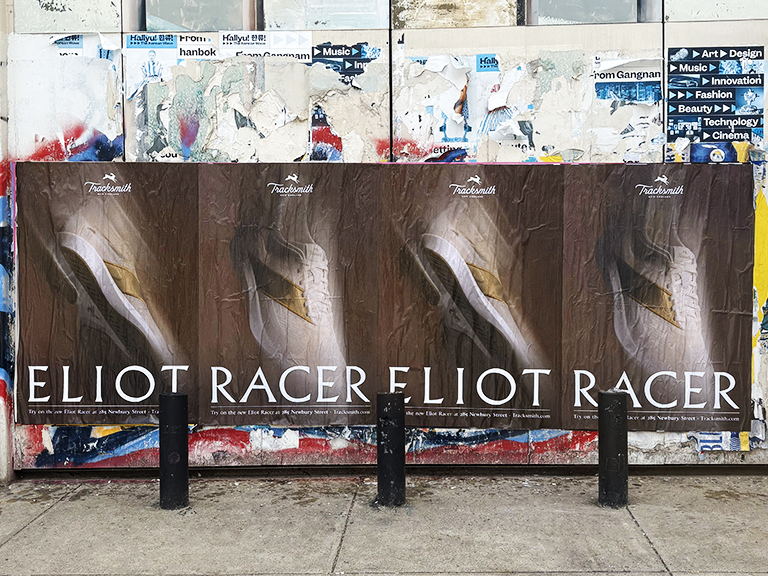
Briefing a wheatpaste campaign in London from a New York office is genuinely doable — but it requires a different briefing approach than you’d use for a domestic campaign. The time zone gap is 5 hours. The paper size system is different. The neighborhoods work differently. The permissioning environment has its own logic. And the operators who do great work in Shoreditch have no frame of reference for “put it somewhere like the Bowery” — that kind of shorthand doesn’t travel.
We’ve coordinated wheatpaste campaigns in London from our New York base for over a decade. We’ve walked Shoreditch with operators, we’ve placed materials on Brick Lane and along the canal in Hackney, and we’ve briefed campaigns that needed to feel London-native without anyone from our team being on the ground during execution. The briefing document is the entire difference between those campaigns working and not working.
This guide covers how to write a brief that travels across the Atlantic — what information it needs to contain, how to frame things so London operators understand exactly what you want, and what the communication flow should look like across the time zone gap. It’s practical, specific, and based on firsthand experience running this exact type of campaign.
Why a Standard US Brief Fails in London
A brief that works for a New York wheatpaste campaign fails in London for predictable reasons. It’s not that London operators are less capable — it’s that the brief is written in a context they don’t share.
Geographic References That Don’t Translate
A brief that says “target areas like SoHo, the Meatpacking District, and Lower East Side” is telling London operators nothing. They know those neighborhoods by reputation, but they don’t know what it means in terms of wall surface types, foot traffic patterns, or demographic character. The equivalent London instruction would be “target Shoreditch, Dalston, and the area around Brick Lane market” — which means nothing to someone in New York who’s never stood on those streets.
The brief needs to name London neighborhoods explicitly, with enough description that operators understand the desired character and demographic, not just the location.
Size Specifications in the Wrong Units
A brief that specifies “24×36 posters” is sending UK operators to a paper size they don’t stock. The equivalent is A1 (594x841mm) — close in size but a different proportion. Operators working from a brief that says “24×36” will either interpret it as A1 (close enough in their minds), try to source non-standard paper, or call you at 2am New York time to ask what you actually want.
The brief needs to specify ISO sizes explicitly. If you want A1, write A1 and give the millimeter dimensions. Don’t assume operators will do the conversion in their head.
Cultural and Visual Context
London’s street visual culture has its own character. The density of poster culture in East London — particularly Shoreditch, Hackney, and Dalston — means your campaign is going up next to a lot of other highly produced visual material. Operators with deep knowledge of those markets know which walls have high visual competition and which have better context for your creative to stand out.
A brief written purely in terms of placement count and neighborhood names doesn’t give operators enough context to make good judgment calls about where within a neighborhood your campaign will work best. The more visual context you provide, the better.
American Guerrilla Marketing field operators who work in London have firsthand knowledge of Shoreditch, Hackney, Brixton, Camden, and Dalston placement environments — including which walls have long-term permissioned access, which zones see the highest foot traffic for specific demographics, and how London’s weather patterns affect paste performance across seasons.
The London Briefing Document: What It Needs to Contain
A brief that works for a London wheatpaste campaign from a New York office needs to be more detailed, not less, than a domestic brief. The distance creates information asymmetry — operators can’t walk back into your office to ask a quick question. The brief has to anticipate those questions and answer them in advance.
Section 1: Campaign Overview
This section should be short — four to six sentences. It answers: What is this campaign for? What is the brand trying to communicate? Who is the target audience? What is the campaign’s tone and feel?
Don’t write this section as a strategy memo. Write it as if you’re explaining the campaign to someone who’s never heard of your brand and needs to make placement decisions on your behalf. Practical, specific, visual.
Example: “This is a launch campaign for a new running shoe targeting 25-35 year old fitness-oriented men and women in East London. The tone is clean, athletic, and slightly understated — not flashy. We want placements that feel like the brand belongs in the neighborhood, not like a corporate takeover. Think walls where the audience would expect to see independent sports or streetwear brands, not where they’d see a global FMCG campaign.”
Section 2: Target Neighborhoods and Zones
List specific London neighborhoods with brief character descriptions. Include a first-choice and second-choice zone for each area, in case first-choice surfaces aren’t available.
| Zone |
Key Streets/Areas |
Demographic |
Notes |
| Shoreditch |
Brick Lane, Bethnal Green Rd, Great Eastern St |
Creative industry, 25-40 |
High competition — premium walls only |
| Hackney |
Mare Street, Broadway Market, London Fields |
Young professional, arts |
Good for longer-duration placements |
| Dalston |
Kingsland Rd, Ridley Road area |
Youth, music, nightlife |
High footfall evenings/weekends |
| Brixton |
Brixton Rd, Atlantic Road, Market Row |
Diverse, cultural, music |
Strong community character — suit cultural brands |
| Camden |
Camden High St, Chalk Farm Rd |
Youth, tourist, music |
High tourist traffic — good for brand awareness |
Section 3: Placement Specifications
This section gives operators the technical and visual specifications they need to execute correctly. It should cover:
- Poster sizes: Specify in ISO dimensions (e.g., A1 = 594x841mm, A0 = 841x1189mm)
- Quantity: Total poster count and distribution across neighborhoods
- Surface preferences: Brick, plywood hoardings, painted walls — describe preferred surface types
- Height guidelines: Standard eye-level (1.2-1.8m to center of poster) unless you have specific requirements
- Co-placement rules: Can your posters be placed adjacent to competitor brands? Any restrictions?
- Permissioned vs. semi-permissioned surfaces: Specify the required permission level for each placement
Section 4: Visual Reference
Include example photos of placement styles you want. Four to eight reference images work well — a mix of the type of walls, the type of visual context, and the type of street environment you’re targeting. London operators who see visual references understand immediately what you’re going for. Written descriptions alone leave too much to interpretation.
Section 5: Documentation Requirements
Every placement needs GPS-tagged documentation. Specify:
- Photo format (landscape or portrait, or both)
- Required shots per placement: straight-on close, environmental context (shows the wall in its neighborhood context)
- Any specific timing requirements (daylight only, or both day and night shots)
- How photos should be organized and submitted (by neighborhood zone, with location address or landmark)
Section 6: Contacts and Escalation
This is the section most US-written briefs skip entirely. Who does the London operator call if there’s a problem? What is the communication channel — email, WhatsApp, Signal? What is the response time expectation given the time zone difference?
Be specific: “The New York contact for this campaign is [Name] at [contact]. Due to the time zone difference, please send any questions or issues before 10am London time (5am New York) so we can respond before your execution day begins. For urgent issues during execution, text [Number] directly.”
The Time Zone Reality: Making It Work
The 5-hour time zone gap between New York and London is manageable — but it requires intentionality. Here’s how a well-run cross-Atlantic wheatpaste campaign communication flow actually looks.
Pre-Campaign Phase (3-6 Weeks Out)
All major briefing calls should happen early in the New York morning — 8am to 10am EDT puts you at 1pm to 3pm in London, which is prime time for a working conversation. Brief the operators thoroughly on this call, not through email exchanges that stretch across days.
After the call, send a written confirmation of everything discussed. Operators should confirm receipt and raise any questions within 24 hours. This is your window to catch misunderstandings before they become field problems.
Production Phase (2-3 Weeks Out)
Artwork files, print specs, and any site-specific instructions should be finalized and delivered to UK print vendors at least 3 weeks before execution. London print vendors who specialize in outdoor poster work have good turnaround times — typically 5-7 business days for A1 and A0 quantities in the hundreds — but you don’t want to be in a rush.
Track print progress through a simple shared document. You should know the status of print production in London without having to send an email asking for an update.
Execution Week
London execution will start while New York is asleep. A 7am London start is 2am New York. The first check-in from London operators will arrive in your inbox before you wake up. This is actually a feature — it means you get an early-morning status update without having to wait for it.
Set the expectation with operators: send a brief status message at the start and end of each execution day. Just a sentence or two — “Started in Shoreditch, 40 placements completed, no issues” or “Ran into access problem on Brick Lane, moved to Bethnal Green Rd instead, updating count.” That’s enough to keep you informed without creating communication overhead.
For real-time issues that need a decision, establish a clear channel — WhatsApp or Signal work well for cross-Atlantic campaign communication because they’re asynchronous but faster than email.
On a recent London wheatpaste campaign we coordinated from New York, all 320 placements across Shoreditch, Hackney, and Brixton were completed across a two-day execution window. GPS-tagged documentation was compiled and delivered to the New York client within 48 hours of the final placement.
Understanding London’s Placement Environment
If you haven’t spent time in East London, it helps to have a realistic picture of what the placement environment is like. These aren’t abstract markets — they’re specific streets with specific rhythms and specific audiences.
Shoreditch
Shoreditch is dense with creative industry workers, young professionals, and tech-adjacent businesses. Brick Lane and the streets around it have a concentration of permissioned poster walls that have been part of London’s street art and wheatpaste culture for years. The foot traffic is high during the week and very high on weekends. Competition for wall space from other brands and artists is real — this is the most contested placement environment in London.
For brands that want to be seen as culturally relevant in London, Shoreditch placements carry significant weight. For brands that just want volume, there are less competitive zones. Know which you’re going for.
Hackney Wick and Olympic Park Area
This area has grown significantly as a creative and residential neighborhood over the past decade. The canal corridor between Hackney Wick and Victoria Park has permissioned surfaces that hold posters well and have a strong visual context for creative and lifestyle brands. Less competitive than core Shoreditch, with a slightly different demographic profile — more arts and independent creative, less tech industry.
Brixton
Brixton has a distinct cultural character — music, community, South London identity. We’ve placed materials here on campaigns for music-adjacent brands and cultural institutions, and when the creative fits the context, the placement resonates differently than it would elsewhere. Don’t place a financial services campaign in Brixton expecting it to feel native. But for the right brand and the right campaign, Brixton placements are some of the most effective in London.
Weather Considerations
London weather is genuinely different from New York. Rain is frequent, and the combination of moisture and cold can affect paste performance and paper quality. Our operators use paste mixes and paper stocks that are tested for UK conditions. This is firsthand knowledge that comes from spending years on London streets, not just reading about the climate.
If you’re briefing a London campaign for spring or autumn — both wet seasons — specifically request that your operators use weather-appropriate materials. Don’t assume the same spec that works for a New York summer campaign will hold up on a damp Hackney wall in October.
Post-Campaign: Getting Documentation Across the Atlantic
Documentation from a London wheatpaste campaign should arrive in your inbox — organized, GPS-tagged, and with the campaign report — within 5 business days of execution completion. That’s the standard we hold our UK operators to, and it’s what you should require from any certified, licensed operator network you work with.
The documentation package should include:
- GPS-tagged photos for every placement (minimum two shots per placement: close and environmental)
- Placement count by neighborhood zone
- Any deviations from the planned brief with explanations
- Total campaign summary with placement map if possible
That documentation is the deliverable, not just the posters on the wall. It’s what you present internally, what you use in case studies, and what justifies the international campaign investment. Require it explicitly in the brief — don’t assume it will arrive in a useful format without specifying what you need.
Using AGM as Your London Coordination Layer
The reason brands come to us for London campaigns — rather than trying to source UK operators directly — is the coordination layer. You deal with one contact in New York. That contact manages the UK operator relationship, the print production, the scheduling, the documentation, and the reporting. You don’t need to become an expert in the London wheatpaste market overnight.
Over a decade of running guerrilla marketing campaigns across the US and internationally, we’ve built the operator relationships, the briefing systems, and the documentation processes that make cross-Atlantic campaigns reliable. The campaigns we run have a nationwide portfolio of case studies and an international track record that reflects what we’ve actually placed — not projections based on someone else’s market knowledge.
If you want to guarantee consistent results in London without building an in-house UK operations capability, working through a single coordination point is the right structure. Contact AGM for a quote, and we’ll walk you through exactly how a London campaign brief would work for your specific situation.
Frequently Asked Questions
What time zones matter when briefing London from New York?
London is 5 hours ahead of New York (EDT) or 6 hours ahead (EST). This means your morning calls need to happen early — a 9am New York call is 2pm London. Schedule coordination calls before noon New York time to catch London operators during their working day. Execution updates from London will arrive in your inbox before you start your day.
Which London neighborhoods are best for wheatpaste campaigns?
Shoreditch, Hackney, Brixton, Camden, and Dalston are the strongest markets for street-level poster campaigns in London. Each has a distinct demographic profile. Shoreditch skews creative-industry and young professional. Brixton has strong cultural resonance with music and community audiences. Camden is tourist-heavy but also strong for youth culture.
How far in advance do I need to book London placements?
4-6 weeks minimum for quality permissioned placements in high-demand zones like Shoreditch. Popular walls in East London book out quickly, particularly around fashion weeks, music festival season, and major brand launches. If you have a specific wall or zone in mind, the earlier you start the better.
Do I need a separate brief for London versus New York?
Yes. The core campaign message can be the same, but the placement brief needs to be localized. UK operators need directions that reference London geography, not New York. Size specs need to be in ISO, not US dimensions. And the brief should account for London-specific environmental factors like weather and wall surface types.
Can AGM handle London campaigns from New York?
Yes. We coordinate London wheatpaste campaigns from our New York office regularly, working through our certified, licensed UK operator network. You deal with one point of contact, receive GPS-tagged documentation, and don’t need to manage a UK vendor relationship yourself.