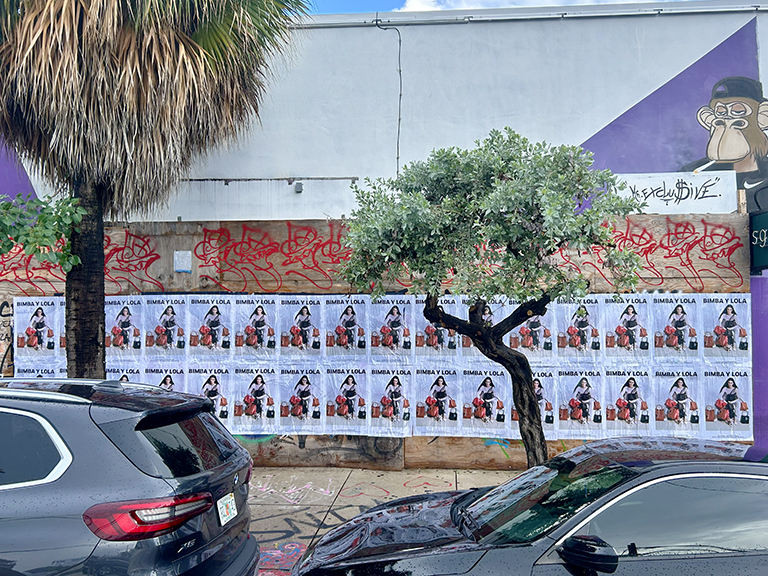
Fashion is one of those industries where the first impression made on a new city isn’t the press release — it’s the street. The people who matter most to a fashion brand’s launch in London or Tokyo or Mexico City — the early adopters, the buyers, the stylists, the photographers who will amplify the brand to the right audiences — they form their opinions before the store opens, before the campaign goes officially live. They form them walking through Shoreditch, cutting through Harajuku, strolling through Roma Norte.
This is why smart fashion brands use wheatpaste campaigns as part of their international market entry strategy. Not instead of digital advertising or PR, but as the physical layer that digital cannot replicate. Wheatpaste communicates something a sponsored Instagram post cannot: that the brand has been there, in that specific neighborhood, claiming space on the streets where the culture actually lives.
We’ve worked with fashion brands on international wheatpaste campaigns across multiple markets. Our American Guerrilla Marketing field operators have placed fashion brand campaigns in Shoreditch and Brick Lane, in Tokyo’s Harajuku and Shibuya corridors, in Paris’s Marais and 11th arrondissement, and in Mexico City’s Roma Norte and Condesa. What we’ve seen, firsthand, is what works and what doesn’t when a fashion brand enters a new city through its streets.
The Street-First Launch Strategy
The traditional international market launch for a fashion brand follows a predictable arc: PR outreach, key opinion leader gifting, press event, official store opening, advertising campaign. Each of these happens in a sequence. Street-level presence, if it happens at all, usually comes late — as part of the advertising campaign rather than as a precursor to it.
Street-first reverses this. In a street-first strategy, wheatpaste goes up before the press event, before the official announcement, sometimes before anyone in the city officially knows the brand is coming. The goal is to create street-level recognition among the early adopters who pay attention to what’s appearing on the walls of their neighborhoods. These are the people who notice a new brand appearing on a corner in Shoreditch and go look it up. These are the people who photograph an arresting poster in Harajuku and post it before the brand’s own social team has put anything live.
Done right, a street-first wheatpaste launch creates earned media before paid media begins. The brand arrives in the city feeling like it belongs there — discovered organically, with a physical presence that precedes the official announcement. That’s a very different brand story than the one that begins with a press release and a paid social push.
The key is restraint in the early placements. Teaser campaigns work best when the imagery is strong and the branding is minimal — enough to intrigue, not enough to fully explain. A striking photograph, a URL, a logo. Nothing that reads like advertising. The full reveal comes later, in the second wave of placements that coincide with the official launch.
Shoreditch and Brick Lane: The London Fashion Entry Point
London’s East End has been the cultural entry point for fashion brands entering the UK market for years. Shoreditch and Brick Lane carry a specific cultural weight that Mayfair or Knightsbridge — despite their retail prestige — don’t have for brand credibility with a younger, fashion-forward demographic.
We’ve walked these streets extensively. The placement inventory in Shoreditch and Brick Lane includes construction hoarding, the sides of mid-century industrial buildings that have been converted to creative offices and galleries, and the low-rise retail strips where independent boutiques and concept stores cluster. These surfaces get seen by exactly the media market that matters for fashion — stylists, photographers, buyers for independent retailers, the people who write about fashion for a living and whose opinion filters down to consumers.
Brick Lane specifically has a Sunday market tradition that brings thousands of people through a concentrated area every week. Wheatpaste placements along the approaches to the market — on the walls of the warehouses that line Bethnal Green Road and the side streets feeding into Brick Lane — see significant foot traffic from exactly the demographics a fashion brand wants to reach first.
Our operators in London are certified and licensed with knowledge of permissioned surfaces in these neighborhoods. We don’t place on surfaces without permission. That matters especially in East London, where the local councils have become more attentive to unauthorized posting and where brands that cut corners on permissioning can generate negative press in exactly the publications they’re trying to impress.
Shoreditch and Brick Lane wheatpaste placements reach an estimated daily foot traffic in excess of 20,000 people on weekday mornings alone, concentrated in the exact demographics — 18-35, creative industry, fashion-aware — that fashion brands need to reach first in a new UK market.
Tokyo’s Harajuku and Shibuya: Cracking the Most Demanding Fashion Market
Tokyo is where fashion brand credibility is hardest to earn and most valuable once you have it. Japanese fashion consumers are among the most knowledgeable and discerning in the world. The culture has its own deep fashion tradition that intersects with international brands in specific ways — brands that try to enter with Western assumptions about what the market wants tend to stumble.
The neighborhoods that matter for fashion brand wheatpaste in Tokyo are Harajuku — specifically the streets around Takeshita-dori and the Omotesando approach — and parts of Shibuya, particularly the areas between Shibuya station and the Cat Street corridor running north toward Harajuku. These are not just high-foot-traffic areas. They are specifically the spaces where Tokyo’s fashion culture is most concentrated and most active.
Surface constraints in Tokyo are more significant than in any other major fashion market. The city is dense, the walls are tightly controlled, and the placements that are available tend to be smaller and more specific than what you’d find in London or Paris. Our operators in Tokyo work with a network of permissioned surfaces — small wall panels, construction barriers, select retail-adjacent spaces — that require advance coordination and can’t be expanded quickly.
This makes Tokyo a market where campaign design matters even more than quantity. A single well-placed, visually arresting A1 or B2-format poster in the right location in Harajuku will be photographed, shared, and discussed more than 50 mediocre placements in less relevant locations. Fashion brands entering Tokyo should plan for fewer, more considered placements rather than high-volume saturation.
We’ve placed for fashion brands in these neighborhoods firsthand. The feedback from the placements — in terms of organic social spread and the conversations we’ve tracked through client monitoring — consistently shows that location specificity beats raw quantity in Tokyo.
Paris: The Marais and 11th Arrondissement for Fashion Credibility
Paris has two distinct fashion street cultures. There’s the official luxury fashion district — Saint-Honoré, Avenue Montaigne, the traditional haute couture belt. And there’s the street fashion culture that lives in the Marais and the 11th arrondissement — the neighborhoods where independent designers, concept stores, and the people who work in fashion actually spend their time when they’re not in ateliers or press days.
For wheatpaste campaigns targeting the fashion community rather than the tourist luxury consumer, the Marais and 11th are where placement matters. The walls along rue de la Roquette and the streets feeding north off Boulevard Voltaire carry a specific visual culture — they’re the walls where gallery opening announcements, music event posters, and fashion brand activations all share space. A well-placed wheatpaste campaign in this environment feels like cultural participation, not advertising.
Paris is also a city where the aesthetics of the poster design matter enormously. French visual culture has high standards for graphic design. Fashion brands entering Paris with cheap-looking creative will get judged for it. The city rewards strong, confident design. If your artwork isn’t at that level, reconsider the market — or reconsider the artwork.
Local print partnerships in Paris allow us to guarantee quality that matches the standard the market demands. Local printers understand the paper weights and ink profiles that produce the richness of color and depth of black that French print culture expects. Shipping prints from the US to Paris almost always produces an output that reads as slightly off to Parisian eyes — subtle, but enough to undermine the brand impression the campaign is supposed to create.
Mexico City: Roma Norte, Condesa, and the Latin American Entry Point
Mexico City has emerged as the primary entry point for fashion brands expanding into Latin America. Roma Norte and Condesa — the neighborhoods that sit adjacent to each other in the western center of the city — have developed a creative and fashion community that rivals any neighborhood in any major North American or European city.
The visual street culture in Roma Norte is vibrant and fast-moving. The walls along Alvaro Obregon — the wide, tree-lined main boulevard of Roma Norte — see consistent poster activity from galleries, music venues, fashion brands, and cultural organizations. This is an active media market for street placement. Brands that appear here are in good company — the neighborhood’s creative residents see the street as part of the cultural fabric.
Condesa, immediately adjacent, is slightly quieter visually but carries its own specific fashion credibility. The neighborhood has a higher concentration of upscale restaurants, boutique hotels, and design-forward retail — the infrastructure that attracts the fashion-adjacent professionals who influence brand perception in the broader Latin American market.
One practical note about Mexico City for fashion brands: the local printing infrastructure is strong and cost-effective. Local print partners can produce large-format work at quality comparable to US or European printers, often at significantly lower cost. For fashion brands running extended campaigns in the Mexican market — multiple waves across a launch window — local production economics make the numbers work better than shipping from New York.
Fashion brands that enter new markets through their streets rather than their press offices build authenticity that money cannot buy later. We’ve seen the difference in how a brand lands when the streets know it before the stores open.
The Role of Teaser and Reveal Campaigns
The two-phase structure — teaser first, full campaign second — is particularly effective for fashion brands because it leverages the industry’s inherent love of mystery and anticipation.
A teaser campaign for a fashion brand wheatpaste launch typically runs one to three weeks before the official launch. It features strong imagery with minimal branding — a product shot without a logo, a striking visual with nothing but a URL, or an abstract image that communicates the brand’s aesthetic without explaining it. The goal is to create curiosity among the people who notice new things appearing in their neighborhoods.
The reveal campaign goes up closer to launch — sometimes simultaneously with the press event or store opening, sometimes a few days before. Full branding, clear messaging, the complete brand proposition. Because the neighborhood has been primed by the teaser, the reveal lands differently. It’s not a cold introduction — it’s the answer to a question that’s already been asked.
GPS-tagged documentation from both phases serves as visual proof of the campaign timeline — boots on the ground evidence that the brand was present in these neighborhoods at these times. For fashion brand case studies and press materials, this documentation tells a compelling story about how the brand entered the market.
What Fashion Brands Get Wrong About International Wheatpaste
The most common mistake is treating wheatpaste as a cost-saving substitute for billboard advertising rather than as a distinct channel with its own specific cultural logic. Fashion brands that approach international wheatpaste by taking their billboard creative and printing it at a smaller size — same design, just pasted instead of posted — miss the point entirely.
Wheatpaste works because it occupies the same visual space as street culture — music posters, gallery openings, neighborhood announcements. When a fashion brand’s wheatpaste creative looks like it was designed for a billboard, it reads as out of place. The visual language is wrong. The scale is wrong. The relationship to the surrounding environment is wrong.
Creative designed for wheatpaste starts from the street. It thinks about how the image will be seen from a sidewalk, how it will sit on an irregular wall surface, how it will look when pedestrians walk past it at a normal walking pace rather than viewing it from a moving vehicle. Fashion brands that brief their creative teams with these constraints — and that understand why wheatpaste demands different thinking than billboard — produce work that actually succeeds on the street.
The second most common mistake is going into a new city without a certified and licensed local operator. International wheatpaste placed without proper permissioning creates legal exposure and reputational risk. In London, Paris, and Tokyo particularly, brands that get caught posting without permission can face fines and negative press in exactly the fashion publications they’re trying to cultivate. Our operators guarantee permissioned placements in every market — that’s not a footnote, it’s a core part of what we deliver.
Frequently Asked Questions
Why do fashion brands use wheatpaste campaigns for international market launches?
Wheatpaste campaigns let fashion brands establish street-level presence before an official retail launch. In fashion markets like London, Tokyo, and Paris, being visible in the right neighborhoods signals cultural relevance to early adopters — the buyers and tastemakers who influence broader adoption. Digital ads reach a screen. Wheatpaste reaches a physical place and communicates that the brand belongs there.
Which international cities are most effective for fashion brand wheatpaste campaigns?
London’s Shoreditch and Brick Lane, Tokyo’s Harajuku and Shibuya, Paris’s Marais and 11th arrondissement, and Mexico City’s Roma Norte are the highest-value markets for fashion brand wheatpaste. Each has a dense concentration of fashion-forward consumers and a street culture that gives poster placements credibility. Secondary markets like Berlin’s Mitte and Barcelona’s Raval are also strong for European expansion.
How early before a fashion launch should a wheatpaste campaign begin?
For a major international market entry, wheatpaste campaigns typically begin two to four weeks before the official launch date. This builds street-level recognition and word-of-mouth before the brand’s official announcements. Teaser campaigns — minimal branding, strong imagery — often go up first, followed by a more explicit campaign closer to launch.
How does wheatpaste compare to traditional out-of-home advertising for fashion launches?
Traditional OOH — billboards, transit advertising — communicates scale and budget. Wheatpaste communicates underground credibility. For fashion brands targeting early adopters and cultural tastemakers, credibility often matters more than scale. The two aren’t mutually exclusive, but wheatpaste should be in the mix for any fashion brand serious about street-level authenticity.
Can American Guerrilla Marketing handle fashion brand wheatpaste campaigns in multiple international cities?
Yes. We’ve coordinated fashion brand wheatpaste campaigns across multiple international cities from a single point of contact. Our operator network covers key fashion markets across Europe, Latin America, and Asia. Contact us for a quote and we’ll outline the scope for your specific launch markets.