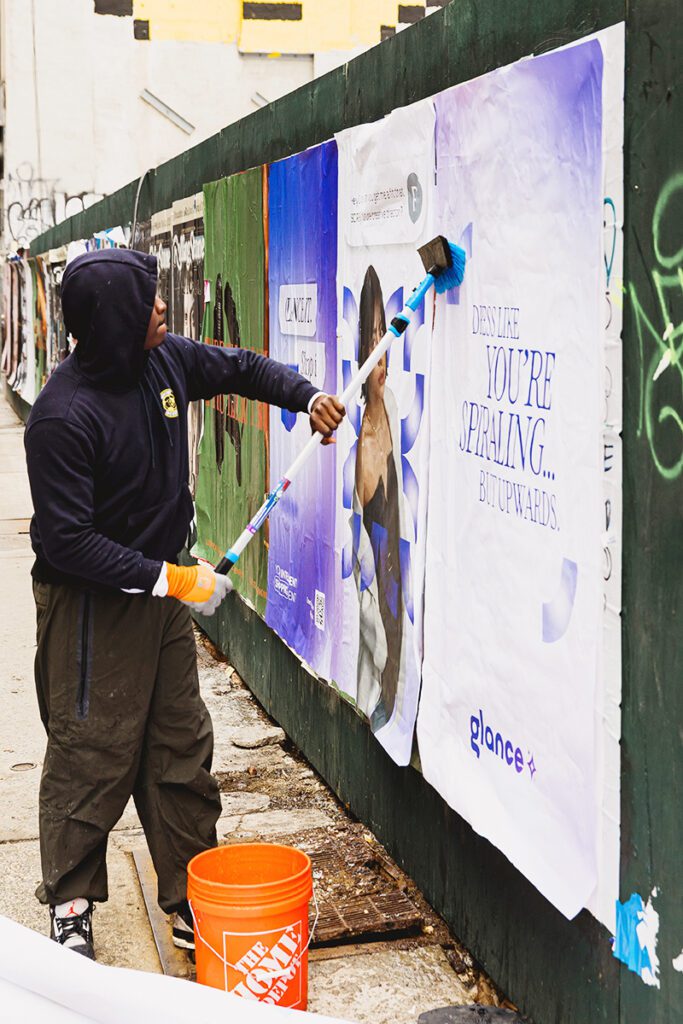
Most international wheatpaste campaign failures are preventable. Not by genius planning or expensive tools — by a systematic pre-production checklist that catches the gaps before they become field problems. The items that sink campaigns aren’t exotic or unpredictable. They’re the same issues that show up repeatedly: artwork in the wrong format, operators who weren’t properly briefed, print materials that didn’t arrive in time, documentation systems that weren’t set up before execution started.
We’ve run international wheatpaste campaigns for over a decade, across markets in North America, Europe, Latin America, and Asia. The pre-production checklist we use isn’t secret knowledge — it’s pattern recognition from firsthand experience watching what goes wrong and working backward to prevent it. This guide is that checklist, with enough context on each item that you understand why it matters, not just what it is.
Work through all 12 items before you authorize print production. This is the line in the sand. Once print runs, you can’t walk back artwork errors or fix a brief that operators haven’t properly read. Before print, almost everything is fixable. After print, your options narrow fast.
Item 1: Artwork Files Are in the Correct Size for Each Market
This is the first item because it’s the most commonly missed and the most expensive to fix late. International markets use ISO A-series paper sizes, not US standard dimensions. A file prepared for a 24×36 US poster needs to be recomposed (not just scaled) for A1 European production. A Tabloid-format file needs A3 adaptation.
What to confirm:
- Each market has a print-ready file in its local standard size
- Files have been recomposed for ISO proportions — not just scaled
- Bleed specifications match local standards (3mm for ISO markets)
- CMYK color mode with embedded profile
- Resolution minimum 150 DPI at final output size
Sign off: “Market-specific print-ready files confirmed — [date]”
Item 2: Operators Are Confirmed and Briefed in Every Market
Every market needs operators — not promises of operators. “We have someone who can handle London” is not the same as “we have a confirmed operator in London who has received and acknowledged the brief.” The difference shows up on execution day.
What to confirm:
- Named operator or operator team confirmed in every market
- Operators are certified and licensed where local regulations require
- Each operator has received, read, and acknowledged the campaign brief
- Any brief questions have been answered before the execution window opens
- Emergency contact information exchanged for each market
Our American Guerrilla Marketing field operators go through a brief review process that requires explicit sign-off before any execution begins. The goal is that every operator goes into the field with zero unresolved questions about what they’re supposed to do. It sounds like a low bar, but it’s remarkable how often campaigns skip this step and pay for it.
Item 3: Print Production Is On Schedule in Every Market
Print production for an international wheatpaste campaign happens in multiple locations — either a central print-and-ship operation or local vendors in each market. Either way, production status needs to be tracked and confirmed before the execution window approaches.
What to confirm:
- Print vendors confirmed and briefed in each market
- Production timelines confirmed against campaign execution date (with buffer)
- Print proofs requested and approved before full production runs
- Delivery address and recipient confirmed for every market
- Tracking numbers or production completion confirmations in hand
The single most common timeline killer in international wheatpaste production is print delays caught too late to fix. Build 5 business days of buffer between print delivery and execution. If print arrives day-of, one delay ends the campaign.
Item 4: Shipping and Customs Clearance Are Accounted For (If Applicable)
If you’re printing centrally and shipping internationally, customs clearance is a real variable. Posters shipping from the US to the UK are subject to customs inspection. Materials shipping to some markets in Latin America can be held at customs for days. This isn’t paranoia — it’s a documented pattern on international campaigns that centralize print production.
What to confirm:
- Shipping method and carrier confirmed with transit time to execution date
- Commercial invoice and customs documentation prepared correctly
- HS codes correctly declared for printed paper goods
- Local delivery arranged from customs clearance point to operator location
- Alternative plan if materials are delayed (local reprint capacity identified)
Item 5: Site Access Is Confirmed for Primary Placement Locations
Permissioned placement means the property owner or manager has authorized the placement. “Permissioned” doesn’t mean someone once placed a poster there without complaint. It means there’s a documented or standing relationship that permits your campaign’s posters.
What to confirm:
- Operators have confirmed site access for at least 80% of planned placements
- Any sites requiring advance payment or formal authorization are confirmed
- Alternative sites are identified for locations with uncertain access
- No planned sites are affected by construction, renovation, or temporary closures
We walked a planned placement zone in Hackney before a campaign and found two of the key walls had been sold to a development project. Three weeks earlier, those placements were in the plan. Without the advance site check, we’d have found out on execution day. The advance check cost 2 hours. The alternative would have cost the campaign.
Item 6: The Campaign Brief Includes Market-Specific Localization
A brief written for one market and sent unchanged to operators in another market isn’t really a brief — it’s a starting point that operators will interpret in their own context. Interpretation is what you don’t want.
What to confirm:
- Brief references local neighborhoods and streets, not just the target city name
- Size specifications are in local standard units (ISO millimeters for European and UK markets)
- Visual reference photos show the type of placement environment appropriate for each market
- Language has been reviewed for cultural context — not just translated, actually reviewed
- Any brand restrictions are stated explicitly and don’t assume knowledge of US market conventions
Item 7: Documentation System Is Set Up and Tested
GPS-tagged documentation is a requirement, not an option. But the documentation system needs to be established and tested before execution starts — not set up the morning of.
What to confirm:
- Operators have GPS enabled and confirmed working on their documentation devices
- Photo naming convention or tagging system is understood and tested
- Submission channel is confirmed (shared drive, email, dedicated app)
- A test photo submission has been made and received by the coordination contact
- Photo standards are clear: required shots per placement, minimum resolution, orientation
| Documentation Item |
Required |
Notes |
| GPS-tagged photos |
Yes — every placement |
Minimum 2 shots: close-up and environmental |
| Timestamp |
Yes |
Device timestamp acceptable if GPS is embedded |
| Location address or landmark |
Yes |
Street address or major landmark reference |
| Neighborhood zone tag |
Yes |
Allows sorting by campaign zone in report |
| Night shots |
Optional |
Required only if campaign targets evening audiences |
Item 8: Weather Forecast Has Been Checked for Execution Days
Wheatpaste doesn’t perform well in heavy rain during application. Paste applied on wet surfaces during active rain won’t cure properly and will peel quickly. This is basic — but it’s regularly ignored in the rush of campaign execution week.
What to confirm:
- 7-day forecast checked for each market during the planned execution window
- Contingency execution dates identified if weather is forecast to be prohibitive
- Operators briefed on weather thresholds (when to pause versus when to continue)
- Paper stock selection accounts for local climate conditions
London and Amsterdam campaigns need more weather attention than Los Angeles campaigns. This is just reality. Build it into the plan.
Item 9: Campaign Timing Is Aligned Across Time Zones
If your campaign has a specific launch moment — a product release date, a broadcast event, an announcement — make sure the execution timing in each market is actually aligned to that moment. “Launch on Tuesday” means different things in New York, London, and Tokyo.
What to confirm:
- Campaign execution dates and times are specified in local time for each market
- Any “simultaneous launch” windows are calculated in UTC and then localized
- Operators in each market know what “go” looks like — who signals it and how
- Early execution by eager operators in early time zones won’t undermine a planned reveal
Item 10: Proof of Posting Documentation Format Is Agreed
Post-campaign, you need proof of posting documentation in a format that’s useful — not just a pile of photos in different folders sent from different operators in different formats over different time periods.
What to confirm:
- Final report format agreed in advance: what it will contain, how it will be organized
- Delivery timeline confirmed: when the completed report will arrive
- Operator documentation obligations confirmed: what they’re responsible for compiling
- Any client-specific reporting requirements have been communicated to operators
Item 11: Legal and Permissioning Status Is Confirmed Per Market
Every market has a different legal context for wheatpaste campaigns. The permissioning requirements that make a campaign compliant in New York are different from those in Berlin or Mexico City. Using certified, licensed operators is the first line of protection — but the brand team should also have confidence that the campaign is operating in the right legal framework in each market.
What to confirm:
- Operators in every market are certified and licensed under local requirements
- All placement surfaces are permissioned — no improvised or unauthorized sites
- Any local permits required for public-facing campaigns have been obtained
- Brand team has been briefed on any market-specific restrictions relevant to the campaign
In Germany, for example, unauthorized poster placement carries enforcement risk that’s considerably more serious than in many US markets. Our operators in Berlin work exclusively on permissioned surfaces with documented authorization. That’s non-negotiable for any campaign we coordinate in the German market.
Item 12: Contingency Plans Exist for Each Market’s Primary Risk
Every market has one or two things that are most likely to go wrong. In London, it’s weather and wall availability. In Mexico City, it’s last-minute site access issues. In Tokyo, it’s documentation approval timing. A contingency plan doesn’t need to be elaborate — it just needs to exist.
What to confirm:
- Primary risk identified for each market
- Contingency response defined: what happens if that risk materializes
- Decision authority clear: who can approve a contingency response mid-campaign
- Alternative sites identified and accessible in each market
- Local reprint capacity available if materials are damaged or delayed
The Complete Pre-Production Timeline
| Weeks Before Execution |
Checklist Milestone |
| 8 weeks |
Markets confirmed, operator outreach begins |
| 6 weeks |
Operators confirmed, brief drafted |
| 5 weeks |
Brief localized and delivered, site access initiated |
| 4 weeks |
Artwork finalized, print-ready files delivered to vendors |
| 3 weeks |
Print proofs approved, production confirmed on schedule |
| 2 weeks |
Materials shipped/confirmed in transit, site access confirmed |
| 1 week |
All 12 checklist items confirmed, documentation system tested |
| Execution day |
Materials confirmed received, operators confirmed ready, weather check done |
This timeline isn’t the only way to structure an international wheatpaste campaign. Some campaigns compress timelines out of necessity and still execute well. But the ones that execute well on compressed timelines are run by people who know from firsthand experience exactly where the risks are and how to mitigate them fast. If you’re running your first international campaign, the 8-week timeline is the right call.
Our nationwide portfolio of completed campaigns across domestic and international markets means we’ve run this checklist more times than we can count. We guarantee a complete pre-production checklist review as part of every international campaign engagement. Contact us to talk through your specific situation and we’ll walk you through exactly what needs to happen before your campaign goes to print.
Frequently Asked Questions
What is the most commonly missed item on an international wheatpaste checklist?
Artwork size conversion. Most brands forget that US paper sizes don’t match ISO A-series dimensions used in the UK, Europe, and Latin America. Files prepared for US printing need to be recomposed, not just scaled, for international markets. This is the single most common source of print production delays on international campaigns.
How early should I start the pre-production checklist for an international campaign?
Start the checklist 8 weeks before your planned execution date. Some items — operator vetting, permit research, site access negotiations — need 6+ weeks of lead time. Starting at 8 weeks gives you buffer for delays without blowing the launch window.
Do I need permits for wheatpaste in every international market?
Not universal permits, but you do need documented permission for every placement surface. Permissioned means the property owner has authorized the placement. In some markets this is formal; in others it’s a long-standing relationship between operators and property owners. Unpermissioned placements create legal exposure and get removed quickly. Our certified, licensed operators only work on permissioned surfaces.
What documentation should operators confirm before the campaign starts?
Operators should confirm: site access is confirmed for at least 80% of planned placement locations, print materials have arrived and been inspected, the brief has been reviewed and any questions answered, the documentation system (GPS-tagged photos) is set up and tested, and emergency contacts are confirmed.
Can this checklist be adapted for domestic-only campaigns?
Yes. Most items on an international wheatpaste checklist are good practice for domestic campaigns too. The main items specific to international campaigns are artwork size conversion, operator vetting in unfamiliar markets, shipping and customs, and time zone coordination. Everything else — brief quality, documentation standards, site vetting — applies regardless of geography.