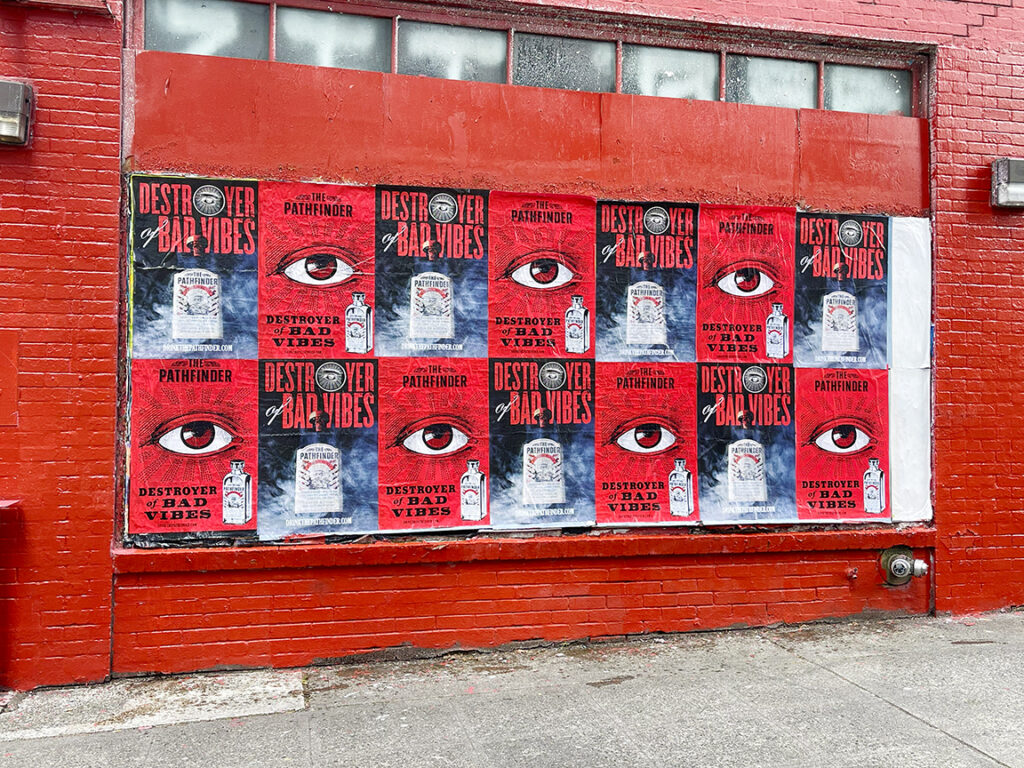
Centro Histórico is where Mexico City began. The Zócalo — the main plaza — is one of the largest public squares in the world. The surrounding blocks hold 1,400+ listed historic buildings, the ruins of the Aztec Templo Mayor, the National Palace, the Metropolitan Cathedral. It’s also, depending on the time of day, one of the most densely populated public spaces on the planet — commuters, tourists from across Mexico and internationally, vendors, office workers, students, and anyone who needs to be at the center of the city for any reason.
For wheatpaste campaigns, that density is the defining fact. Centro Histórico is where you go for scale. Not for precision targeting — the audience here is genuinely diverse across age, income, and lifestyle — but for raw exposure volume that no other zone in Mexico City can match. If the goal is mass awareness, Centro is a critical piece of the campaign architecture.
The Scale of Centro Histórico
The historic center and its immediately surrounding colonias cover an area that sees millions of daily movements. The Zócalo alone is estimated to receive between 50,000 and 200,000 visitors daily depending on the day and whether events are scheduled. The Metro system converges on Centro with multiple major interchange stations — Zócalo, Bellas Artes, Pino Suárez — that move hundreds of thousands of people through the zone every working day.
This is not an audience you can replicate through any other location-based media buy in Mexico City. A single transit advertising package at Bellas Artes station can get you some of that reach, but wheatpaste campaigns in the street fabric of Centro and its surrounding colonias reach people between the stations — on foot, in the street, engaging with the city at human scale.
The greater Centro Histórico zone, including the commercial corridors of Doctores, Guerrero, and Tepito, serves as a daily transit hub for an estimated 3-4 million people. Eje Central Lázaro Cárdenas, the major north-south artery through the historic center, carries some of the heaviest vehicle and pedestrian combined traffic in Latin America.
The Poster Culture of Centro Histórico
Before any campaign planning happens, it helps to understand that Centro Histórico has been a wheatpaste and flyposting environment for generations. Concert announcements, political posters, religious event notices, commercial promotions — layers of printed paper on the walls of Centro is not a recent phenomenon or a countercultural gesture. It’s part of how information has always moved through this part of the city.
That context works both ways. The good news: a campaign poster in Centro Histórico reads as part of a long tradition of urban communication. There’s less tension between the medium and the environment than you might encounter trying the same format in a neighborhood with no street art heritage. The challenge: you’re competing with a very high ambient volume of other printed material. Design that doesn’t cut through the visual noise doesn’t register.
Where Campaigns Actually Run in Centro and Its Surroundings
The core of the UNESCO World Heritage zone — the protected colonial facades within the immediate blocks around the Zócalo — is not where campaigns run. These are the buildings that can’t be posted legally or practically. But Centro Histórico is large, and the operational territory for a campaign extends well beyond those protected facades.
Eje Central Lázaro Cárdenas
The long north-south artery that runs through and past Centro Histórico is one of the most important campaign corridors in the city. It connects Centro to Doctores, Tepito, and Guerrero. The street-level commercial fabric along Eje Central is dense with markets, wholesale businesses, electronics vendors, and food stalls. The wall surfaces here are generally older concrete and brick — excellent for paste adhesion — and the commercial character of the street creates an environment that’s historically receptive to poster campaigns.
Doctores
The colonia directly south of Centro Histórico is one of the most active wheatpaste zones in all of CDMX. Doctores has a strong music culture, particularly for electronic music and underground genres, and its walls have supported flyposting campaigns for concerts, club nights, and album releases for years. The audience skews younger and more working-class than Roma Norte, but for music and entertainment campaigns targeting a broad Mexico City audience, Doctores delivers genuine penetration into demographics that the trendy colonias miss.
Tepito and Guerrero (Northern Adjacent)
North and northeast of Centro, Tepito is a legendary Mexico City market neighborhood with high foot traffic and deep cultural significance. Campaigns here are logistically demanding and require operators with established local presence. The audience is distinctly different from Polanco or Roma Norte — this is Mexico City’s working-class commercial core. For brands that need genuine mass-market reach rather than creative-class aspiration, this zone provides it.
República de Uruguay, Mesones, and the Commercial Corridors
The commercial streets south of the Zócalo — República de Uruguay, Mesones, Correo Mayor — have heavy pedestrian traffic from workers, shoppers, and tourists navigating from the historic core toward the south. These corridors offer wall availability on the faces of commercial buildings and the sides of older structures that have been in commercial use for decades.
Surface Assessment: What Works in Centro
Centro Histórico and Doctores are primarily 19th and early 20th century construction, with rough plaster, exposed brick, and concrete surfaces that are among the best paste adhesion environments in Mexico City. The rough texture grabs paste well, bonds hold longer than on smoother surfaces, and posters resist peeling better in direct sun.
The challenge is the density of existing material. Some surfaces in Centro are essentially permanent palimpsests — years of layered posters and paint creating a rough composite surface that accepts new paste readily but also hosts competing material constantly. Your campaign needs to arrive fresh and be shot for documentation immediately, because the surface competition moves quickly.
In Centro, the walls have memory. Layers of campaigns from the past 50 years are embedded in the plaster. That layering is part of what gives the medium authenticity here — you’re part of a communication tradition that goes back generations.
When Centro Makes Sense as Part of a Campaign
Centro Histórico is not the right primary zone for every campaign. Here’s when it makes sense to include it:
- Mass awareness campaigns: Film releases, streaming platform launches, major concert announcements where you want to reach the broadest possible Mexico City audience regardless of demographic
- Regional Mexican music: Banda, norteño, cumbia, and regional genres have strong audiences in Centro and the adjacent working-class colonias. A Banda release campaign that runs only in Roma Norte is missing its actual fanbase.
- Concert and event promotions for Palacio de los Deportes or Foro Sol: These major venues draw from across the city, including heavily from Centro and Doctores. Campaigns that blanket both the aspirational colonias and the high-density working-class zones get more complete coverage of the actual attendance base.
- Brand campaigns entering the mass market: A brand that wants penetration beyond the creative class needs to show up where the mass market actually exists. Centro is that place.
Protecting Historical Zones While Running Effective Campaigns
Experienced operators in Centro Histórico have internalized the distinction between protected and workable surfaces. The federal and city-level protection zones for historical buildings are not vague — they’re specific, mapped, and well-known to anyone who has operated in this zone for more than a few campaigns.
Colonial facades from the 16th through 18th centuries: no. The corrugated metal hoarding around the archaeological excavation site 50 meters away: yes. The side wall of a 1970s commercial building adjacent to a colonial structure: it depends on the specific designation status and the operator’s relationship with the owner.
This is why “I’ll just do Centro Histórico” is not a complete campaign strategy — it requires an operator who knows the territory at a surface-by-surface level, not just someone who knows where the Zócalo is.
Surface Availability and Wall Character in Centro Histórico
Centro Histórico is operationally unlike any other Mexico City campaign zone. The built environment is dense, historical, and regulated at multiple levels — UNESCO World Heritage designation covers the core zone, and the INAH (Instituto Nacional de Antropología e Historia) has oversight over many of the most prominent structures. That doesn’t mean campaigns can’t run here; it means the approach is fundamentally different from Roma Norte or Condesa.
The workable surfaces in Centro Histórico are concentrated in three distinct types. First: the commercial and residential building stock on the secondary streets off the major pedestrian corridors — streets like Uruguay, Mesones, República de El Salvador, and the blocks of Doctores and Santa María la Ribera that approach the centro boundary. These areas have the rough plaster and concrete surfaces that accept paste well, without the direct regulatory exposure of the UNESCO core.
Second: the commercial corridor on Eje Central Lázaro Cárdenas, which runs north-south through the eastern edge of Centro. This high-traffic avenue has mixed commercial storefronts and older building stock with workable side walls. Our operators in CDMX treat Eje Central as a campaign spine for Centro-adjacent work — it’s not inside the historic core but delivers comparable reach into the Centro audience.
Third: active construction sites and temporary hoardings, which are common throughout Centro Histórico due to ongoing renovation of historic properties. These sites rotate frequently but consistently offer clean, high-visibility surfaces when available.
Centro Histórico and adjacent Doctores receive an estimated 1.5 to 2 million daily visitor and commuter transits combined. Mexico City’s metro area covers 22 million people across 16 alcaldías, and Centro functions as the transit and commercial hub for a significant share of that population daily.
Who You Reach in Centro Histórico
Centro Histórico’s audience is fundamentally different from Roma Norte or Condesa. This is not primarily a creative professional or expat audience. Centro draws working-class and lower-middle-class residents from across the metropolitan area, significant commercial activity (wholesale, retail, services), heavy tourist traffic from both domestic and international visitors, and the daily commuter flows from the metro system.
The audience breakdown matters enormously for campaign planning. Campaigns that work in Centro are ones that speak to broad consumer audiences — regional music acts, mass-market product launches, event promotions with wide demographic appeal, and streaming platforms targeting mass market growth rather than premium positioning. A luxury fashion campaign running Centro Histórico placements alongside Polanco or Condesa is usually a mistake: the audience mismatch will undercut whatever the premium positioning is trying to accomplish.
Where Centro excels is raw reach. The transit flows through Metro Zócalo, Metro Balderas, and Metrobús routes through the area represent daily audience touchpoints that no single colonia in the Roma-Condesa zone can match in sheer volume. For campaigns where the priority is total impressions over demographic precision, Centro Histórico delivers.
Past Campaign Performance in Centro Histórico
One successful pattern we’ve used: lead with Roma Norte and Condesa for early campaign awareness and social media seeding, then extend into Centro Histórico and Doctores for the final week to layer in broader audience reach before a show date or release. This sequencing gets the best of both environments — credibility with the creative audience first, then mass reach in the final push window.
Music campaigns tied to Auditorio Nacional or Palacio de los Deportes dates consistently benefit from Centro presence because those venues draw from across the metro area. The Centro audience is closer geographically and culturally to the broad-market fanbase that fills 65,000-seat shows at Foro Sol.
Coordinating Centro Histórico Campaigns: Operational Notes
Running a wheatpaste campaign in Centro Histórico requires operational knowledge that differs from the Cuauhtémoc western colonia campaigns most operators focus on. The Centro environment has specific characteristics that affect execution planning.
The density of vendors, informal commerce, and pedestrian activity in Centro Histórico means that overnight execution involves navigating a more complex street environment than Roma Norte or Condesa. Some blocks in Centro never fully clear of activity — late-night commerce and informal street markets operate on schedules that vary by block and by day of week. Our operators in CDMX plan Centro execution routes specifically to work with the street activity patterns rather than against them.
Parking and vehicle access in Centro Histórico is more restricted than in the western colonias, which affects how crews move equipment and how quickly they can cover the campaign’s locations. Experienced Centro operators use motorcycle-mounted crew members for tight-street placements and reserve vehicle access for the primary arteries. This operational adaptation increases execution speed in a zone where vehicle access constraints would otherwise create bottlenecks.
The proximity of Centro Histórico to major transit nodes — Metro Zócalo, Metro Bellas Artes, Metrobús stops along Eje Central — creates foot traffic patterns that are useful for campaign planning. Placements on the approach streets to these transit nodes reach commuters and transit users who pass the same locations twice daily. That frequency of exposure from a single placement location is more valuable than a single-exposure placement in a lower-traffic zone of equal area. From our experience running campaigns in Mexico City, Centro’s transit-adjacency is one of its strongest assets when operators know how to use it.
When Centro Histórico Is the Right Campaign Bet
Neighborhood-intent search results usually reward pages that help a reader choose the right area rather than pages that simply praise the area. Centro Histórico has undeniable reach, but it is not automatically the best fit for every brand. It works best for campaigns that benefit from density, repetition, and broad exposure across commuters, vendors, office workers, students, and visitors moving through the historic core.
The tradeoff is execution complexity. Foot traffic stays high, the visual environment is crowded, and some walls cycle creative quickly. That means the operator judgment matters more here. Good planning in Centro is about surface selection, route logic, and making sure the poster reads clearly amid signage, architecture, and competing messages.
- Use Centro when the goal is broad awareness, civic visibility, or tourist-heavy foot traffic.
- Prioritize durable surfaces and timing because turnover and street activity are higher than in many residential colonias.
- Pair Centro with Roma, Juarez, or transit corridors if you need both scale and subculture relevance.
- Make creative legible from distance because the environment is visually dense and fast-moving.
For many buyers, the right answer is not Centro alone but Centro as part of a layered city plan. When it is used that way, the neighborhood can create the scale that makes the rest of the campaign feel bigger.
The bottom line for planners is simple: treat wheatpasting centro historico mexico city as a campaign decision with tradeoffs, not as a generic city talking point. The campaigns that usually perform best in CDMX define the audience, route logic, reporting standard, and creative threshold before the first sheet goes to print.
That is also why the best briefs stay specific about neighborhoods, install timing, and proof of posting. In Mexico City, clarity before execution usually matters more than chasing a bigger poster count after the fact.
Frequently Asked Questions
Can you run a wheatpaste campaign in Mexico City’s Centro Histórico?
Yes. Centro Histórico has a deep tradition of outdoor communication and poster culture. Campaigns run on commercial buildings, hoardings, and preapproved private walls throughout the historic center and its surrounding neighborhoods including Tepito, Doctores, and Guerrero. The zone delivers mass awareness at scale.
What is the audience reach of Centro Histórico for wheatpaste campaigns?
Centro Histórico and its immediate surroundings see an estimated 2-4 million daily visitors — tourists, commuters, workers, and vendors. For mass awareness campaigns, no other zone in Mexico City matches this raw pedestrian volume, though the audience is less demographically targeted than in Roma Norte or Condesa.
Are there restrictions on wheatpasting near historical buildings in Centro Histórico?
Yes. The UNESCO World Heritage core of Centro Histórico includes protected colonial-era facades that cannot legally be pasted. Operators know these boundaries and work around them — posting on commercial hoardings, newer building surfaces, and preapproved private walls rather than on historical facades directly.
Which streets in Centro Histórico are best for wheatpaste campaigns?
Eje Central Lázaro Cárdenas, the commercial corridors around República de Uruguay, the areas around Metro Bellas Artes and Zócalo, and the commercial street fabric of Doctores and Tepito adjacent zones all offer strong placement opportunities with high foot traffic.
How does Centro Histórico compare to Roma Norte for wheatpaste reach?
Centro Histórico reaches a much broader audience by volume but with less demographic precision. Roma Norte delivers a focused creative/professional audience. Centro reaches commuters, tourists, vendors, and the full economic range of Mexico City in one zone. Most campaigns use both for different reasons.