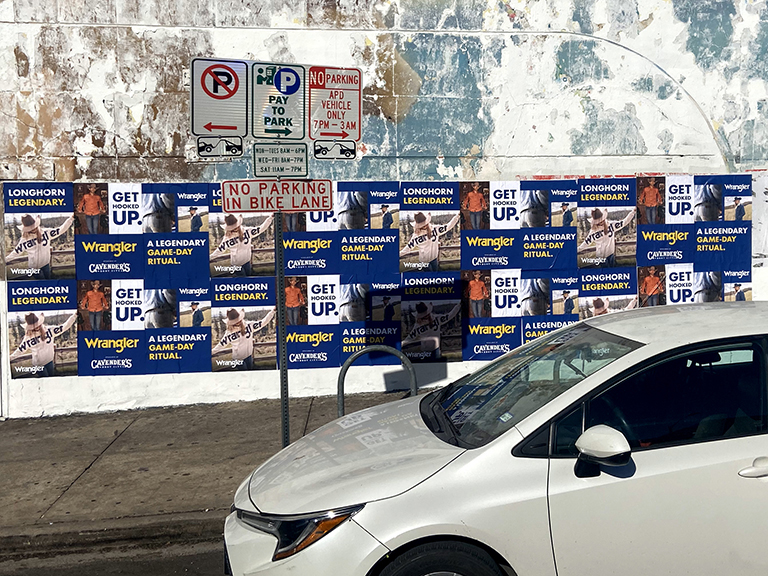
Mexico City’s Metro system moves approximately 4 million people on a typical weekday across 12 lines and 195 stations. When you add the Metrobús BRT network, the Tren Ligero, and the conventional bus system, you’re looking at a transit ecosystem that touches virtually every resident of the metropolitan area every day. The corridors around transit infrastructure are the highest-density pedestrian zones in the city — and for campaigns that need mass reach rather than demographic precision, they’re the most efficient placement territory in Mexico City.
Transit-adjacent wheatpaste campaigns operate differently from colonia-focused campaigns. You’re not targeting a specific demographic profile in a neighborhood they’ve chosen to live in. You’re targeting the entire cross-section of Mexico City in motion — commuters, students, workers, shoppers, and anyone else who moves through the city’s transit network.
For some campaigns, that breadth is exactly what’s needed. For others, the lack of demographic targeting makes transit corridors a supplementary zone rather than the primary campaign territory. This guide covers how to use Mexico City’s transit infrastructure as a campaign context and when it makes sense to do so.
The Metro System as Campaign Context
The Mexico City Metro is one of the most heavily used urban transit systems in the world — ranked consistently in the top 10 by annual ridership. The system’s 12 lines serve the full geographic spread of the metropolitan area, connecting working-class neighborhoods in the far east and south to the financial district, the historic center, and the upscale colonias of the west and north.
Mexico City Metro fast facts for campaign planners: 12 lines, 195 stations, ~4 million daily riders on weekdays, ~1.3 billion annual trips, world’s 9th busiest metro system by ridership. The Insurgentes Metrobús corridor (Line 1) runs 26km from Indios Verdes in the north to el Caminero in the south — the longest BRT corridor in the world at the time of its opening.
High-Value Metro Station Zones for Campaigns
Not all Metro stations are equal for campaign placement. The stations that matter most for wheatpaste strategy are those in or adjacent to the colonias where campaign work runs most effectively:
| Metro Station |
Line(s) |
Adjacent Colonias |
Campaign Value |
| Insurgentes |
L1 |
Roma Norte, Condesa edge |
Very High — central creative zone hub |
| Sevilla |
L1 |
Roma Norte, Juárez |
Very High |
| Chapultepec |
L1 |
Juárez, Polanco approach |
High |
| Balderas |
L1, L3 |
Doctores, Juárez |
High — interchange station, high volume |
| Bellas Artes |
L2, L8 |
Centro Histórico |
Very High — cultural anchor zone |
| Pino Suárez |
L1, L2 |
Centro Histórico |
Very High — major interchange |
| Viveros |
L3 |
Coyoacán edge |
Medium-High — Coyoacán / university zone |
| Coyoacán |
L3 |
Coyoacán |
High — cultural audience access |
The Metrobús Insurgentes Corridor
Avenida Insurgentes is one of the longest urban streets in the world — running approximately 28km from north to south through Mexico City, traversing multiple alcaldías and dozens of colonias. The Metrobús system running along Insurgentes (Line 1) carries over 300,000 passengers daily on this single corridor.
The commercial and residential buildings along Insurgentes create campaign surfaces that sit in front of one of the city’s highest-traffic pedestrian environments. People waiting at Metrobús stops are stationary for 2-10 minutes — prime dwell time for a wall-facing campaign placement. The blocks of Insurgentes that pass through Roma Norte, Condesa, Narvarte, and Coyoacán are particularly valuable for campaigns targeting the specific demographics of those colonias while capturing the broader Insurgentes transit traffic.
Eje Central: The Mass-Market Corridor
Eje Central Lázaro Cárdenas runs north-south through the heart of the city, from Tepito through Centro Histórico, Doctores, and beyond. It’s one of the busiest vehicle and pedestrian corridors in Mexico City and one of the most active wheatpaste campaign zones for mass-market and music campaigns targeting broad urban audiences.
The commercial character of Eje Central — markets, wholesale businesses, electronics vendors, service establishments — and the diverse, working-class audience it serves make it a strong zone for campaigns that need genuine mass reach without the demographic filtering that Roma Norte or Condesa provides. Regional Mexican music campaigns, mass consumer brand launches, and concerts at Centro Histórico adjacent venues all run heavily along Eje Central.
A campaign that runs both Roma Norte (60 locations for the cultural professional audience) and Eje Central / Doctores (60 locations for the mass-market working-class audience) covers more of the real Mexico City spectrum than one that runs 120 locations in Roma Norte alone. Geographic distribution across audience types is the actual reach metric that matters, not raw location count.
Interchange Stations: The High-Volume Nodes
The Mexico City Metro’s major interchange stations — where multiple lines converge — are the highest-pedestrian-density nodes in the transit network. The streets within walking distance of these interchanges see the most concentrated foot traffic in the entire system:
- Balderas (Lines 1 and 3): Between Doctores and Juárez, one of the most active campaign zones in the city. The streets around Balderas see a mix of working-class commuters, Doctores residents, and Juárez workers and visitors.
- Bellas Artes (Lines 2 and 8): The cultural heart of Centro Histórico, adjacent to the Palacio de Bellas Artes, Alameda Central, and the major museums of the historic core. High tourist and cultural visitor traffic mixed with the standard Centro Histórico commuter base.
- Pino Suárez (Lines 1 and 2): Deep in Centro Histórico, with access to the market and commercial zones south of the Zócalo. Very high volume, mass-market audience.
- La Raza (Lines 3 and 5): Northern sector, connecting Tlatelolco and Guerrero zones. High working-class commuter traffic, relevant for mass-market campaigns targeting broader city coverage.
Campaign Formats That Work Near Transit
The transit corridor environment changes what works visually. People moving through transit zones are typically moving faster and looking in more directions than people in a park or café environment. Campaign material near transit needs to be legible at higher speed and greater viewing distance than colonia-interior campaigns.
The design priorities for transit-adjacent wheatpaste in Mexico City:
- Maximum size: 36×48 or 48×72 formats read better at transit-speed viewing distances than standard 24×36
- Extreme contrast: Black on white or bright color on dark backgrounds. At bus stop dwell zones, there’s enough time for a detailed poster. For vehicle-speed viewing, only the highest-contrast elements register.
- Single message: One piece of information — artist name, show date, brand — not multiple elements competing for attention
- No fine detail: The intricate elements that work in a café environment where people stand and read are wasted in a transit setting where people look for 2-3 seconds maximum
Surface Conditions Along CDMX Metro Corridors
The streets immediately surrounding Mexico City metro stations have a specific built environment that creates both opportunities and limitations for wheatpaste campaigns. The station footprints themselves — the below-grade infrastructure and surface-level station buildings — are public infrastructure and off-limits as paste surfaces. The value of metro-adjacent placement is the foot traffic generated by the station, not the station itself.
The buildings within one to two blocks of high-traffic stations have varying surface quality depending on the age and character of the surrounding neighborhood. Metro Insurgentes (Line 1, connecting the Insurgentes corridor through Roma Norte and Condesa) is surrounded by commercial buildings with high foot traffic and a mix of rough and smooth exterior surfaces. The workable walls within two blocks of Insurgentes station on the Roma Norte side are well-mapped by experienced operators — they’re often some of the most competitive locations in the colonia because operators recognize the traffic value.
Metro Hidalgo (Lines 2 and 3, connecting Reforma and Centro) is surrounded by a denser, older commercial zone. The buildings here are predominantly early 20th century construction with rough plaster and brick facades that hold paste well. The foot traffic mix includes commuters, Centro workers, and visitors — a broad cross-section of Mexico City’s 22 million metro area residents.
Metro Chabacano (junction of Lines 2, 8, and 9, located in the Doctores zone) is a major transfer hub. The commercial streets surrounding it serve a working-class and commercial audience that differs substantially from the Roma-Condesa demographic. For mass-market campaigns, Chabacano-adjacent placements deliver reach into demographic segments that colonia-focused campaigns in Cuauhtémoc’s western colonias don’t touch.
Mexico City’s Metro system carries an estimated 4.5 to 5 million passengers per day — one of the highest ridership systems in the Western Hemisphere. Metrobús (Bus Rapid Transit) adds another 900,000+ daily passengers. The combined transit infrastructure generates foot traffic at station areas that no single colonia commercial corridor can match in raw volume.
Who You Reach Along Metro Corridors
Metro-adjacent placements reach a fundamentally different audience profile from colonia-interior wheatpaste campaigns. The colonia approach is about reaching people in their neighborhood environment — the audience that lives, works, or socializes in a specific zone over repeated days. Metro-corridor placements are about reaching people in transit — a one-time pass-through that may include visitors from entirely different parts of the metro area.
For campaigns whose goal is mass awareness across a broad Mexico City audience, metro-adjacent placements make sense as a supplement to colonia campaigns. The two approaches complement each other: colonia placements build frequency with a specific local audience, metro placements extend reach to the broader metro population passing through.
For campaigns targeting a specific demographic, metro corridor targeting needs to match the demographic profile of that corridor’s passenger mix. Line 1 (running east-west through the central city, connecting Observatorio through Centro to Pantitlán) carries a mix of demographics. Line 7 (running north through Polanco and connecting to northern residential zones) skews more affluent. Line 9 (connecting Docotes and the working-class eastern zone) skews working class. Choosing the metro corridor strategically based on the passenger demographic is as important as the placement location itself.
Timing Metro Corridor Campaigns for Traffic Peaks
Metro foot traffic in Mexico City peaks during commute hours — 7am to 9:30am and 6pm to 8:30pm — and weekend midday periods. Wheatpaste campaigns targeting metro-adjacent locations benefit from placement execution that captures these windows. Since execution happens overnight, the timing consideration is about which placements are ready when the morning commute begins.
AGM’s field team typically executes metro-adjacent placements in the first hour of the overnight run — around midnight to 1am — to ensure those locations are fully cured and clean before the 7am commute rush. Construction around station areas is common, which can affect overnight access. Our operators scout metro-adjacent locations in the afternoon before the execution night to flag any access issues.
Weekend execution for metro-corridor campaigns follows a different timing logic. The Metrobús corridors along Insurgentes and Reforma see high weekend leisure traffic from midday through evening. Campaigns targeting weekend foot traffic benefit from Friday night execution — placements are fresh and undisturbed for the Saturday and Sunday traffic peaks.
Past Campaign Performance Along CDMX Metro Routes
From our experience running campaigns in Mexico City with metro-adjacent components, the consistent finding is that placements within one block of high-traffic stations show total impressions that dwarf equivalent placements in colonia interiors — but conversion rates and social pickup are lower. The transit audience is moving quickly and doesn’t dwell with a poster the way a café-goer or park visitor does.
Metrobús as a Campaign Corridor
Mexico City’s Metrobús system — a Bus Rapid Transit network that operates in dedicated lanes on major city boulevards — creates additional transit-adjacent campaign opportunities that complement the Metro station strategy. The Metrobús generates its own distinctive foot traffic pattern: unlike the underground metro, Metrobús stations are at street level, making the approach corridors more visible to street-level poster campaigns.
Línea 1 of the Metrobús runs along Insurgentes Sur and Insurgentes Norte — the major north-south boulevard that connects the city from the southern Pedregal zone through Roma Norte and Condesa to the northern edges of the metropolitan area. The Insurgentes corridor is already one of the most important campaign streets in CDMX for non-metro-adjacent reasons (it connects the key creative colonias). The Metrobús stops add concentrated foot traffic at specific points along the corridor that inform where within the Insurgentes zone placements are most efficient.
Línea 7 of the Metrobús runs along Reforma — the major boulevard connecting Polanco to Centro. Reforma-adjacent placements near Metrobús stops reach the professional and business transit audience that the Reforma corridor naturally concentrates. For campaigns targeting the executive and professional segment, Metrobús stops on Reforma are among the best transit-adjacent placement opportunities in the city.
From our experience running campaigns in Mexico City, the most overlooked Metrobús corridor for campaign work is Línea 4, which runs through the Buenavista transport hub area and connects several northern colonias. This corridor sees heavy commuter traffic from areas not typically covered by creative colonia campaigns, making it useful for campaigns that need reach into the broader urban working population rather than the Cuauhtémoc creative demographic.
When Transit Corridors Beat Lifestyle Neighborhoods
Searchers coming from transit-related queries usually want one thing above all: scale. Metro and bus corridors in Mexico City offer density that few neighborhood-only plans can match, but the tradeoff is that density comes with speed, clutter, and often faster poster churn. A useful page needs to explain both sides clearly.
Transit corridor campaigns are strongest when the goal is visibility at volume. They are less suited to brands that depend heavily on a refined neighborhood halo. That does not make them lower value. It just means the message, design system, and route expectations need to fit the medium and the pace of commuter attention.
- Use transit corridors when broad exposure matters more than tightly curated brand context.
- Expect faster visual turnover and noisier surroundings, so simplify the creative.
- Choose corridors with repeat commuter behavior instead of chasing isolated station names.
- Treat transit routes as one layer of the plan, not the entire city strategy.
The most search-aligned version of this topic helps readers decide when transit should lead the plan and when it should support a more selective colonia mix.
The bottom line for planners is simple: treat mexico city metro corridor wheatpasting as a campaign decision with tradeoffs, not as a generic city talking point. The campaigns that usually perform best in CDMX define the audience, route logic, reporting standard, and creative threshold before the first sheet goes to print.
That is also why the best briefs stay specific about neighborhoods, install timing, and proof of posting. In Mexico City, clarity before execution usually matters more than chasing a bigger poster count after the fact.
Frequently Asked Questions
Can you wheatpaste near Mexico City Metro stations?
Yes. Metro station entrances are typically surrounded by commercial streets and building facades that are suitable campaign surfaces. The station infrastructure itself (Metro CDMX signage, station walls, Metro-owned surfaces) is not appropriate for unauthorized wheatpaste campaigns, but the private and commercial buildings on the streets immediately surrounding each station are some of the highest-traffic campaign locations in the city.
Which Metro lines create the best wheatpaste campaign corridors in Mexico City?
Line 1 (Observatorio to Pantitlán) passes through the core of the city and stops at high-value campaign stations including Insurgentes, Sevilla, Chapultepec, and Balderas. Line 2 passes through Centro Histórico and Doctores. Line 3 connects Tlatelolco to Ciudad Universitaria. For campaigns targeting the creative professional audience, the stations along Línea 1 between Insurgentes and Balderas are the most concentrated.
What is the Metrobús and how does it affect wheatpaste campaign strategy?
The Metrobús is Mexico City’s Bus Rapid Transit system — articulated buses running in dedicated lanes along major corridors including Insurgentes (the world’s longest BRT route at 26km), Eje 1 Poniente, and Eje 4 Sur. Metrobús stations and the surrounding commercial blocks on these corridors carry extremely high foot traffic and are key campaign zones for brands targeting commuter audiences.
How does transit-adjacent wheatpaste differ from colonia-focused campaign work?
Transit-adjacent campaigns target people in motion — commuters, shoppers, and workers moving through high-density corridors rather than spending time in a specific neighborhood. Exposure is high-frequency but lower dwell time than in a café-district colonia. Campaigns that need mass reach prioritize transit corridors; campaigns that need audience quality and engagement prioritize colonia interior placement.
Which transit corridors in Mexico City give the most campaign reach per location?
Eje Central Lázaro Cárdenas (north-south through Centro), Insurgentes (north-south through Cuauhtémoc, Benito Juárez, and Coyoacán), Avenida Chapultepec (east-west), and the blocks around major interchange stations (Balderas, Bellas Artes, Pino Suárez) all offer extremely high daily exposure counts for placed posters.