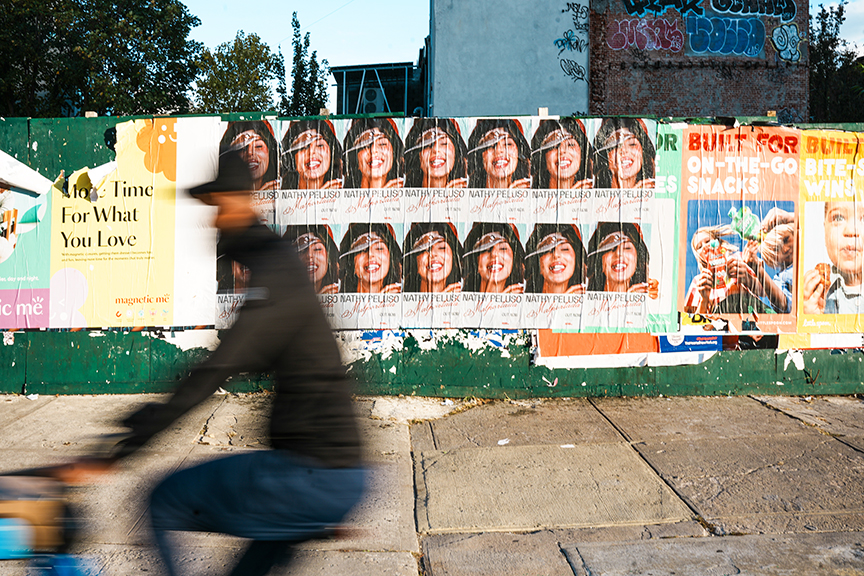
US Brands Wheatpasting in Mexico City: Planning Guide starts with matching the right streets, surfaces, audience, and campaign timing. We’ve placed wheatpaste campaigns in Mexico City for US brands across fashion, entertainment, streaming, and consumer goods — and the process is more straightforward than most US marketing teams expect when they first reach out. AGM’s operators in CDMX handle execution end-to-end; US clients manage the relationship from their own time zone without needing to travel.
The number of US brands running wheatpaste campaigns in Mexico City has grown steadily over the past few years. Music labels with Latin rosters, streaming platforms with Mexican originals, fashion labels entering the Latin American market, tech companies targeting the urban Mexican consumer — these clients have figured out what local advertisers have known for decades: Mexico City’s walls are a legitimate, effective, and relatively affordable channel for reaching the city’s most influential consumers.
Getting it right from the US requires more than finding an operator’s email address online. The gap between running a campaign in Brooklyn and running one in Roma Norte is real — different operators, different operational environment, different cultural register for the medium, different design considerations. This guide is the practical planning resource for US brand teams commissioning Mexico City wheatpaste campaigns for the first time.
Why Mexico City Specifically
US brands that haven’t previously considered Mexico City as a campaign market often ask why CDMX rather than other Latin American cities — Buenos Aires, Bogotá, São Paulo. There are several answers that consistently come up in campaign planning conversations:
Market size: At 22 million metro-area residents, Mexico City is the largest city in North America. The addressable consumer market for most categories is larger than in any other Latin American city.
Cultural influence: What breaks in Mexico City spreads across Mexico and into the broader Spanish-speaking world. CDMX is the cultural production center for Mexico — its music, film, fashion, and media influence extends far beyond the city limits.
Proximity and operational ease for US brands: Mexico City is a direct flight from every major US city. US-to-Mexico campaign management is operationally simpler than US-to-Argentina or US-to-Brazil. Spanish-language campaign materials developed for Mexico can be adapted for other Latin American markets.
Cost advantage relative to US markets: Running a 100-location Roma Norte campaign costs roughly 40-55% of what an equivalent New York campaign costs. For brands with Latin American expansion budgets, Mexico City delivers scale at accessible price points.
Mexico is the US’s largest trading partner and second-largest export market. The US-Mexico border sees an estimated 1 million legal crossings per day. Cultural, commercial, and personal connections between the two countries create a uniquely integrated binational market — brands that operate authentically in Mexico City build relationships that translate across the border in both directions.
The US Brand Mistakes That Derail Mexico City Campaigns
Mistake 1: One-Size Campaign Thinking
The brand manager who says “we want to do Roma Norte” without asking what that means has already half-lost the campaign. Roma Norte is a starting point, not a complete strategy. What’s the specific audience — the artist’s existing fanbase or new audience discovery? What do Roma Norte posters need to complement — is there simultaneous social media activity in Mexico, or is the street campaign carrying the full marketing load in that window?
Good campaign planning for Mexico City from the US starts with the same questions it starts with anywhere: who is the target, what does the campaign need to do for them, and where does that person actually live and move in this specific city?
Mistake 2: English-Only Creative
This is the most obvious mistake and still happens with some regularity. A poster with a tagline that works in English, placed on a Roma Norte wall, is communicating something in the wrong language to the wrong audience. At minimum, any text elements beyond brand name and logo should be in Spanish. Taglines should be written in Spanish by a native speaker, not translated by an AI tool.
The failure mode here isn’t usually incomprehension — most Mexico City residents in Roma Norte have significant English literacy. The failure is cultural: an English tagline reads as a brand that didn’t think the local market was worth the localization effort. That’s the wrong signal for a brand trying to establish authentic local presence.
Mistake 3: Generic Global Creative in a Local Context
Related to the language issue: US brands with global campaign assets frequently use the same creative in Mexico City that they’re running in London and Tokyo. This works if the brand’s positioning is explicitly global and aspirationally international. It doesn’t work for brands that want to feel local, relevant, and culturally connected to Mexico City.
The test: does this creative look like it could have been made for Mexico City specifically, or does it look like it was made somewhere else and placed here? The answer affects how the colonia audience reads the brand.
Mistake 4: Budget-Anchored Operator Selection
US brands shopping for the cheapest Mexico City operator are not getting a good deal — they’re getting exactly what they pay for, which in the lower end of the market often means unmapped wall networks, poor documentation, and campaign execution that doesn’t hold up to scrutiny. The 15% you save by going with a cheaper operator often manifests as 30% of your campaign unverifiable or unexecuted.
Getting the Creative Right for Mexico City
For US brands running campaigns in Mexico City, these are the creative considerations that separate good executions from mediocre ones:
Spanish-language copy: Mandatory for any text element intended to communicate. Brand logos and wordmarks can stay in their original form. Everything else should be in grammatically correct, colloquially appropriate Mexican Spanish.
Local context in the copy: If the campaign is promoting a Mexico City show, say “México” or “CDMX” — not just the venue name, which US audiences know but Mexico City consumers may not. If the campaign is announcing a film release, use the Mexican theatrical opening date and the relevant cinema chain (Cinépolis).
Visual imagery that doesn’t export wrong: Generic US “urban” photography often reads as New York or Los Angeles, not Mexico City. Roma Norte recognizes Roma Norte. Coyoacán recognizes Coyoacán. Imagery that’s deliberately set in Mexico City creates a connection that imported content can’t.
Size and contrast for street reading: These are universal principles but worth restating for US design teams who haven’t created for wheatpaste format before. The poster needs to read at 10 meters on a textured wall surface, in ambient outdoor light, competing with everything else on the street. High contrast and bold typography are not aesthetic choices — they’re functional requirements.
Building the Campaign Brief for a Mexico City Operator
A US brand briefing a Mexico City wheatpaste campaign for the first time should provide:
- Campaign objective: What is this campaign trying to accomplish in Mexico City specifically?
- Target audience description: Who are you trying to reach — genre-specific music fans, professional demographics, broad urban consumers?
- Colonia preferences: Do you have specific neighborhoods in mind, or are you open to the operator’s recommendation based on the audience description?
- Campaign dates: Start date, event date (if applicable), and end date
- Artwork: Print-ready files at correct specifications
- Poster quantity and format: How many posters, what size
- Documentation requirements: GPS-tagged photos, timestamped, organized by colonia, formal report
- Budget range: So the operator can right-size the campaign to the budget
The US Brand Advantage in Mexico City
There’s one thing a US brand has that many local Mexican brands lack for wheatpaste campaigns: the production infrastructure and design sophistication to create campaign material that stands out visually in a competitive environment. US music labels, streaming platforms, and fashion brands often have access to higher-quality photography, more developed brand systems, and better print specifications than smaller local advertisers.
That production quality advantage, deployed in Mexico City with a culturally informed local operator, creates campaigns that perform above the market average. The combination of US creative quality and local operator knowledge is more effective than either alone.
How US Brands Structure CDMX Campaign Budgets
US brands planning Mexico City wheatpaste campaigns typically approach the budget with one of two frameworks, and which framework they use affects how efficiently they can allocate spend.
The first framework is cost-comparison: “what’s the equivalent of X in New York or LA?” In this framework, a brand that would spend $5,000 on a street campaign in Brooklyn translates that directly to a Mexico City budget expectation. The problem with this approach is that it overestimates what’s needed. Mexico City print and labor costs run at 40 to 60% of equivalent US campaign costs, so a $5,000 US campaign expectation will over-buy in CDMX. The result is sometimes good — more placements, wider colonia coverage — but often it means budget that could go toward better wall locations or multi-city extension goes toward campaign elements that don’t add proportional value.
The second framework is objective-based: “what do we need to achieve, and what’s the minimum spend to achieve it?” This approach is more efficient. A US brand entering CDMX for the first time that wants to establish awareness in Roma Norte and Condesa among the 25-42 creative professional demographic can accomplish that goal with $1,800 to $2,800 USD for a mid-scale campaign. That’s a smaller absolute number than many US market campaigns, but it buys the right reach in the right zone.
From our experience running campaigns in Mexico City for US brands, the most common budget mistake is under-investing in documentation and over-investing in poster quantity. More posters in locations that don’t matter adds cost without adding reach. Solid documentation that verifies exactly where the campaign ran and lets the US-side marketing team present results internally is worth paying for separately from raw placement count.
US brands working with AGM on CDMX campaigns pay in USD and receive reports in English. The on-the-ground execution runs in Spanish between our operators and their crews, property owners, and local contacts. US brands don’t need to have Spanish-language capacity to run effective CDMX campaigns — the bilingual interface is what full-service coordination provides.
Documentation Standards for US Brand Campaigns in CDMX
US brands have specific documentation needs that differ from local Mexican brand clients. The primary difference is that US-side marketing teams often need to present CDMX campaign results to leadership or clients who have no familiarity with Mexico City geography. A photo report that makes sense to someone who knows Roma Norte may not communicate anything useful to a VP of Marketing in New York who can’t place Álvaro Obregón on a map.
AGM’s documentation format for US brand clients includes a geographic summary that provides context: colonia name with a brief description (“Roma Norte — Mexico City’s primary creative professional neighborhood, comparable to Brooklyn’s Williamsburg or LA’s Silver Lake”), street names with cross-street references, and a map overlay showing all placement locations plotted on Google Maps or a comparable reference. This context allows US-side stakeholders to understand the campaign’s geographic logic without visiting Mexico City.
Photo sets for US brand clients are compiled into a single organized folder with consistent naming conventions: [Colonia]-[Street]-[PlacementNumber].jpg. Each photo is labeled with the GPS coordinates in the filename or in an accompanying spreadsheet. The package includes both the full-resolution originals and a compressed preview set suitable for email or presentation attachment.
Executive summary paragraphs at the top of the documentation report cover the campaign in terms that translate to any marketing audience: total locations executed, colonias covered, estimated daily impressions (based on foot traffic data for the specific location types), campaign window dates, and any notable observations. This summary is written by AGM in New York, not by the Mexico City operator, specifically to ensure it addresses the information needs of a US business audience rather than reflecting operator priorities.
Cultural Adaptation: What US Brands Get Wrong in CDMX Creative
The most common mistake US brands make when running their first Mexico City wheatpaste campaign isn’t operational — it’s creative. Campaigns designed for a US audience and translated directly to CDMX without adaptation consistently underperform campaigns that were briefed with the Mexican street audience in mind from the start.
The specific failure modes we see most often: English-language copy or mixed English-Spanish copy that signals the brand isn’t really speaking to the local audience, imagery that references US cultural contexts that don’t translate (sports teams, US geography, American pop culture references), and design that prioritizes Instagram-grid aesthetics over street-level readability.
A Roma Norte wall is not an Instagram story. The poster will be seen from 10 to 30 meters away, in varying light conditions, for 2 to 5 seconds as the pedestrian walks past. What reads well at that distance and in those conditions is not the same as what looks good in a digital mockup. High contrast between background and type. Legible at 20 meters without squinting. A single visual idea, not a crowded composition with multiple messages competing for attention.
US brands that localize their creative — even minimally, with Spanish-language text and culturally appropriate imagery — see measurably better social media pickup in CDMX than brands that run their global English-language creative unchanged. The Roma Norte and Condesa audience is sophisticated enough to recognize when a brand has made the effort to speak to them directly, and they respond accordingly.
AGM provides creative review for US brand CDMX campaigns on request — we’ll assess whether a design is likely to perform in the CDMX street context and flag any cultural or legibility issues before print production commits the budget. This review adds a few days to the pre-production timeline but consistently prevents the more expensive mistake of printing and placing creative that doesn’t land.
What US Brand Teams Should Lock Before the Campaign Goes to Print
The strongest ranking pages for cross-border campaign queries usually remove uncertainty for the buyer. US teams want to know what changes in Mexico City, what does not, and where preventable mistakes happen. In practice, the biggest misses are rarely technical. They come from assuming a US neighborhood logic, US review speed, or US compliance language will carry over unchanged into CDMX.
A useful Mexico City brief for a US brand includes local audience assumptions, image usage approvals for Spanish-language variants, realistic turnaround expectations, and a clear internal signoff path. If your legal or procurement team needs landlord-authorized language, documentation samples, or an operator scope before payment, that should be established before printing. Waiting until install week is what creates rushed decisions and diluted placement.
- Approve Spanish copy, bilingual copy, or image-led creative before production starts.
- Define whether the campaign goal is awareness, market entry, event support, or retailer lift.
- Choose neighborhoods based on audience behavior, not on the streets your team already recognizes from travel.
- Ask for a reporting package your US team can forward internally without extra explanation.
US brands usually perform best in Mexico City when they treat street media as a local market entry tool rather than as a copy-paste extension of a US launch. That shift changes the creative tone, the neighborhoods you buy, and the way success gets reported back to headquarters.
The bottom line for planners is simple: treat us brands wheatpasting mexico city as a campaign decision with tradeoffs, not as a generic city talking point. The campaigns that usually perform best in CDMX define the audience, route logic, reporting standard, and creative threshold before the first sheet goes to print.
That is also why the best briefs stay specific about neighborhoods, install timing, and proof of posting. In Mexico City, clarity before execution usually matters more than chasing a bigger poster count after the fact.
Frequently Asked Questions
Why do US brands use wheatpaste campaigns to enter the Mexico City market?
Wheatpaste campaigns give US brands physical presence in Mexico City’s most culturally influential neighborhoods at a fraction of the cost of traditional OOH media buys. The medium is culturally fluent in CDMX — street campaigns are how communication has worked in the city for generations. For a US brand announcing its arrival, being visible on Roma Norte walls sends a message that no digital ad campaign can replicate.
Which US brand categories are most active in Mexico City wheatpaste campaigns?
Music labels and distributors (especially those handling Latin music), streaming platforms (Netflix, Spotify, Apple), fashion brands entering the Mexican market, tech companies targeting the urban Mexican consumer, film distributors releasing in Mexico, and consumer brands with Latin America expansion strategies are the primary US client categories.
What are the biggest mistakes US brands make when running Mexico City wheatpaste campaigns?
The most common mistakes: treating Mexico City as a single market without understanding colonia differences, using US-only creative without Spanish-language adaptation, assuming the same campaign structure that works in New York will work in CDMX, hiring operators based on lowest price without verifying their wall network and documentation quality, and not building enough lead time.
How should US brands adapt their creative for Mexico City wheatpaste campaigns?
At minimum: Spanish-language copy for any text elements beyond brand name/logo, culturally appropriate imagery that doesn’t read as obviously transplanted US content, and Mexican market-specific details if relevant. Higher-effort adaptation includes Mexico City-specific photography and messaging that acknowledges the local cultural context.
Does a US brand need a Mexican business entity to run a wheatpaste campaign in Mexico City?
No. Wheatpaste campaigns in Mexico City are managed through service agreements with local operators. US brands pay operators directly (often in USD for operators with international client experience), and the operator handles all local logistics including printing, labor, and execution. No Mexican business registration or local legal entity is required.