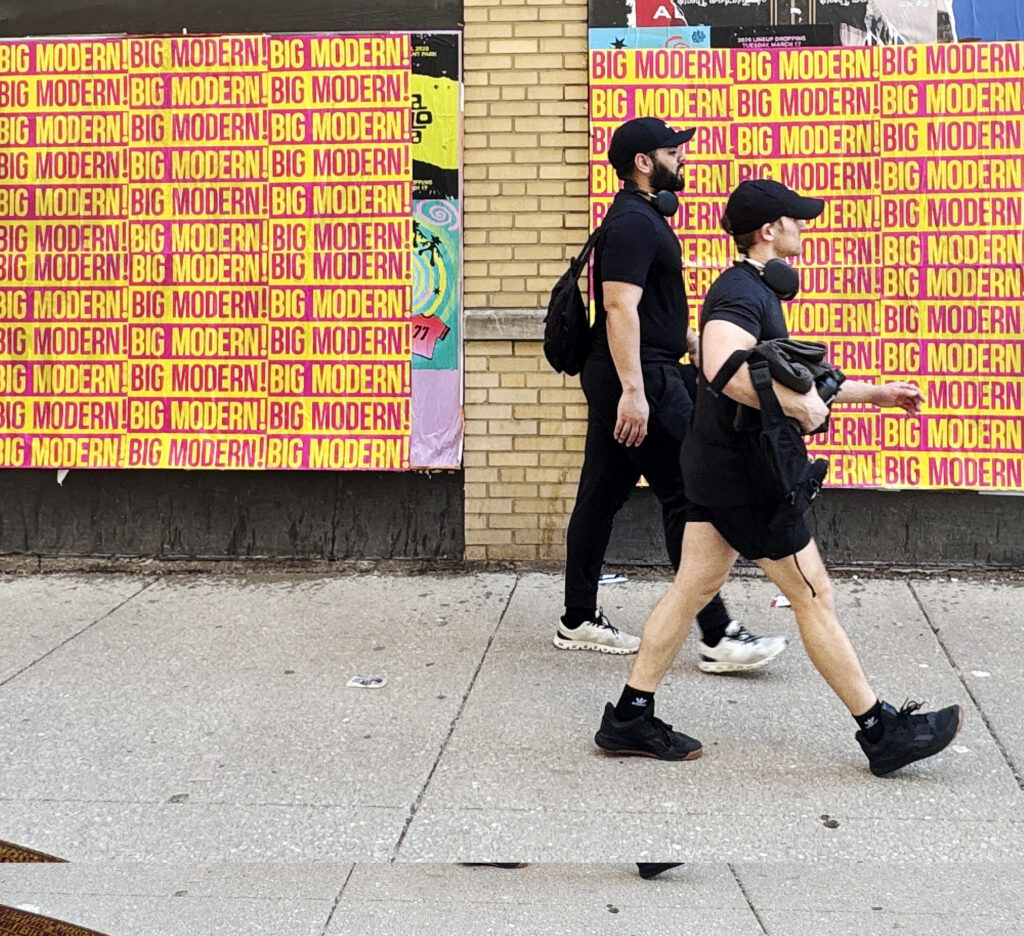
If you’ve run wheatpaste campaigns in US cities — New York, Los Angeles, Chicago, Miami — you already understand the medium’s fundamentals. What you may not know is how much of that knowledge transfers directly to Mexico City, and where you need to update your assumptions.
Some things are the same everywhere. Paste, paper, wall, overnight crew, morning documentation. The physics of wheatpasting doesn’t change by geography. But the operational environment, the cost structure, the regulatory context, the cultural meaning of street posters, and the audience geography are all different enough that experienced US campaign managers who’ve worked in CDMX consistently say it requires its own learning curve.
This guide runs through the key differences and the key similarities, so you’re not learning things the hard way on your first Mexico City campaign.
Cost: The Real Comparison
The standard pitch for Mexico City campaigns from a cost perspective is that they’re dramatically cheaper than US equivalents. That’s largely true at the material level, but the comparison gets more complicated when you account for the full cost structure of a remotely managed international campaign.
| Cost Component |
New York (USD) |
Los Angeles (USD) |
Mexico City (USD) |
| Print (200 sheets, 24×36) |
$600-$900 |
$500-$800 |
$280-$450 |
| Labor (one night, 60 locations) |
$800-$1,400 |
$700-$1,200 |
$350-$600 |
| Wall access (per location) |
$30-$150 |
$25-$120 |
$10-$80 |
| Documentation |
$200-$500 |
$200-$400 |
$100-$300 |
| Operator fee |
$500-$1,500 |
$500-$1,200 |
$400-$1,000 |
The cost advantage in Mexico City is real — roughly 40-55% cheaper than New York at the per-component level. But if you’re managing the campaign internationally and paying for translation, currency conversion, and the additional coordination overhead of a cross-border project, the effective savings narrow to 25-40%.
Currency note: Mexico operates on the Mexican Peso (MXN). Mid-2026 exchange rates put the MXN at approximately 17-18 per USD. Operators who quote in MXN offer significant paper savings, but factor in wire transfer fees and the exchange rate spread when doing the actual USD equivalent calculation.
The Legal Environment: Formal vs. Informal
The regulatory approach to unauthorized outdoor advertising differs meaningfully between major US cities and Mexico City.
In New York, the Department of Sanitation actively enforces anti-postering ordinances, fine amounts are significant, and the penalty falls on both the company whose content appears and the operator who ran the campaign. This has driven most professional US operators toward legal wall programs — licensed surfaces where brands pay for placement and operate within a clearly defined legal framework.
In Mexico City, the enforcement structure is less formalized. The 16 alcaldías each have their own enforcement priorities, and the practical consequence for unauthorized posting is almost always removal rather than fines. The exception — protected historical structures — is genuinely enforced, and operators who know the city stay well clear of those surfaces. For everything else, the risk calculus is different from New York.
This means Mexico City campaigns operate with somewhat more flexibility than comparable New York campaigns, but they’re not legally unrestricted. Working with an operator who has preapproved private walls eliminates most of the risk for brands that need clean legal footing.
Surface Quality: An Unexpected Mexico City Advantage
One of the least-discussed differences between Mexico City and US markets is surface quality for paste adhesion. CDMX has significantly more older building stock — rough concrete, uncoated brick, plaster facades from mid-20th century construction — that bonds with wheat paste exceptionally well. These surfaces hold posters for weeks rather than days.
Major US markets have pushed toward more modern construction, particularly in the areas where most campaigns run. Glass curtain walls, smooth precast concrete, painted metal surfaces — none of these work for paste. Legal wall programs in New York often use pre-installed paper or vinyl surfaces specifically because the natural building surfaces in target neighborhoods don’t accept paste.
In Mexico City, finding good paste surfaces is not usually a challenge. Finding good paste surfaces at the right locations with the right traffic patterns is the skill — but the raw surface material is there in abundance.
The Cultural Register of Street Posters
This is the difference that’s hardest to quantify but most important to understand.
In most US cities, a wheatpaste poster reads as countercultural — or at minimum, as an alternative-media choice. The dominance of digital advertising and the clean aesthetic of licensed outdoor formats mean that a wheatpaste poster in Brooklyn or Echo Park signals something about the brand: DIY, underground, edgy, street-aware. That signal is intentional and valuable for certain brands, but it’s not neutral.
In Mexico City, street posters don’t carry the same countercultural signal. They’re simply how communication has always worked. Concert posters, political announcements, commercial promotions — the walls of CDMX have carried printed paper for generations. A wheatpaste campaign in Roma Norte is not saying “we’re an underground brand.” It’s saying “we’re a brand that exists in this city.”
In New York, a wheatpaste campaign is a statement. In Mexico City, it’s communication. That distinction shapes how you design for it, where you place it, and what you expect from it.
Audience Geography: Different Maps
US wheatpaste campaigns are typically concentrated in specific creative districts — SoHo and the Bowery in New York, Silver Lake and Los Feliz in Los Angeles, Wicker Park in Chicago. These are the zones with the right combination of foot traffic, audience demographics, and cultural receptivity.
Mexico City’s equivalent zones are Roma Norte, Condesa, and Juárez — but the scale is different. Rome Norte alone is larger in area and foot traffic than SoHo. And the adjacent zones (Doctores, Centro Histórico) that are readily accessible by the same operator in the same overnight run are genuinely different demographic environments — not slightly different variations on the same creative class.
This geographic range is one of Mexico City’s real advantages for campaign planning. A single CDMX campaign can credibly cover from Polanco (equivalent to the Upper East Side in economic terms) to Doctores (working-class, music-focused) to Coyoacán (arts and academia) in one operation. Achieving that range in New York would require coordinating across multiple distinctly different neighborhoods with separate operators and dramatically different cost profiles.
Documentation Standards: Variable vs. Consistent
US wheatpaste operators who work with national brands have developed relatively standardized documentation practices — GPS-tagged photos with timestamps, formal campaign reports, location maps. This is partly market-driven (clients expect it) and partly driven by the documentation requirements that come with legal wall programs.
Mexico City documentation quality varies more. Top-tier operators who work with international brands match US documentation standards. Mid-tier operators who primarily work with local clients may deliver photos but not GPS tagging, or a WhatsApp album rather than a formal report. Lower-tier operators may send a handful of images with no location context.
The practical implication: be explicit about documentation requirements in your brief. If you need GPS-tagged images with timestamps and a location-by-location report, specify that upfront and confirm the operator has the system to deliver it. Don’t assume it’s standard.
What Transfers Directly from US Campaign Experience
- File specifications: Print-ready means print-ready everywhere — CMYK, bleed, 150+ DPI at output size
- Campaign timing logic: Post before the event/release, not day-of
- Location quality over quantity: 50 good placements beat 200 bad ones everywhere
- Design for context: High contrast, bold type, minimal information perform better in street environments globally
- Overnight execution: The practical necessity of working in the early morning hours is universal
- Photo documentation: The need for proof of placement doesn’t change by market
Cost and Logistics Differences: CDMX vs US Markets
The cost difference between a Mexico City wheatpaste campaign and an equivalent New York or Los Angeles campaign is significant and real — not a marketing pitch. At current market rates in 2026, Mexico City campaigns run at approximately 40 to 60% of equivalent US campaign costs when measured in USD. That gap is driven by three factors: lower local labor costs, lower print production costs, and a wall access market that hasn’t been as heavily bid up by competition as the New York or LA markets.
What does “equivalent” mean? A Roma Norte campaign covering 80 locations across the creative colonia, professionally executed and documented, typically runs $2,000 to $3,500 USD. A comparable Williamsburg-to-Bushwick Brooklyn campaign with 80 locations runs $4,500 to $7,500 USD. A Silver Lake through Echo Park LA campaign at similar scale runs $4,000 to $6,500 USD. The CDMX campaign reaches an audience of comparable size and demographic quality at meaningfully lower cost.
The print production gap is particularly striking. A 200-poster run at 24×36 inches costs $280 to $450 USD from a Mexico City print vendor. The same run from a New York print vendor costs $650 to $1,100 USD. Local production in CDMX is always the right choice for cost efficiency — shipping printed material from the US adds both cost and lead time with no quality advantage.
AGM’s field team tracks campaign costs across US and international markets. The CDMX cost advantage has remained relatively stable across 2024 through 2026 despite some peso-dollar exchange rate volatility. At the current MXN/USD rate, the local-currency cost of CDMX campaigns has increased modestly in peso terms, but the USD cost has remained lower than equivalent US markets.
Documentation and Accountability Across Markets
One area where CDMX campaigns sometimes disappoint US brands is documentation quality — not because Mexico City operators are less capable, but because the documentation standards US brands expect from US market campaigns haven’t always been applied to international markets.
In the US, GPS-verified photo documentation with contextual street shots is essentially the industry standard for professional wheatpaste operators. The competitive market in New York and LA has driven documentation quality up because clients learned to demand it. In Mexico City, the local market has historically accepted lower documentation standards — photo reports without GPS tags, tight-cropped shots without location context, reports delivered days or weeks after execution.
AGM applies US-standard documentation requirements to all CDMX campaigns. The photo set, GPS coordinate spreadsheet, and location verification report that a US brand receives for a Mexico City campaign is formatted identically to what they’d receive for a New York or LA campaign from us. This consistency is intentional — a US marketing team shouldn’t need to adjust their verification process based on which city the campaign ran in.
What US Campaign Experience Doesn’t Prepare You For in CDMX
Brands with extensive US street campaign experience who run their first Mexico City campaign sometimes encounter differences they didn’t anticipate. Three of the most common:
Property owner relationship timeline: In the US, particularly in New York, most wall agreements are either established building relationships or negotiated quickly through experienced operators. In CDMX, the relationship timeline with new property owners can be longer, particularly in the premium colonias like Polanco and Condesa. Planning campaigns with at least three weeks of lead time is more important in CDMX than in most US markets.
Colonia targeting specificity: A US brand that says “we want coverage in Brooklyn” is giving an operator enough to work with. A brand that says “we want coverage in Mexico City” is giving far too little information. Mexico City’s 16 alcaldías and dozens of distinct colonias have dramatically different demographic profiles, physical environments, and audience characteristics. CDMX campaign planning requires colonia-level specificity, not city-level direction.
Altitude effects on materials: The 7,350-foot altitude affects both paste adhesion and ink longevity in ways that brands used to sea-level US markets don’t anticipate. Paste dries differently at altitude. UV-induced fading is faster. Paper adhesion on some surface types behaves differently than at lower elevations. These are known factors that experienced CDMX operators account for; brands briefing their first CDMX campaign should ask their operator explicitly about altitude-related planning adjustments.
Audience Density Comparison: CDMX vs US Markets
One of the operational advantages of Mexico City over US street campaign markets is the walkability concentration of the key audience colonias. Roma Norte and Condesa together cover a geographic area that’s geographically smaller than comparable audience-dense neighborhoods in New York or Los Angeles, but they pack a comparable audience into that smaller space because Mexico City’s urban density is significantly higher than most US cities.
The practical effect: in Mexico City, 80 placements across Roma Norte and Condesa can reach a daily audience comparable to 120 to 150 placements across a geographically equivalent area in Brooklyn or Silver Lake, simply because more people pass through each location. The pedestrian-first street culture of the Mexican colonia environment — cafés, restaurants, walkable commercial corridors — generates foot traffic density that car-centric US neighborhoods don’t produce at street level.
This density advantage compounds for campaigns that run over multiple days. A Roma Norte resident who walks to their local café, past a poster, and to a restaurant later that same day may encounter the same campaign location three times in a single day. The frequency of exposure per individual is higher in a walkable Mexican colonia than in a geographically equivalent US neighborhood where the same person might drive most routes.
From our experience running campaigns in Mexico City and comparable US markets, we consistently see that CDMX campaigns deliver higher per-location impressions than equivalent US campaigns when measured against the pedestrian traffic data for the specific locations. The combination of higher density and stronger walking culture makes the CDMX street environment more efficient for poster campaigns than most US market equivalents at the same colonia quality level.
The Biggest Differences Brand Teams Notice After the First Campaign
Searchers using a versus query typically want a framework they can take into a meeting. They are not looking for a poetic comparison. They want a clean explanation of what changes between markets and why those changes affect budget, route design, and risk tolerance.
Mexico City and US campaigns share the same medium, but they do not always share the same operating assumptions. The density of posters, the cultural role of the street, the neighborhood logic, and the legal setup can all shift the way a campaign should be planned and evaluated.
- Mexico City often offers denser walkable poster environments than many US markets.
- The legal and permissions language is different, even when the client risk questions are similar.
- Neighborhood selection in CDMX often matters more than citywide count alone.
- Documentation expectations should stay high regardless of which market is cheaper or faster.
A search-aligned comparison page helps the reader decide which market structure fits the goal or how to adapt a US playbook for CDMX. That direct usefulness is what comparison intent usually rewards.
The bottom line for planners is simple: treat mexico city vs us wheatpaste campaigns as a campaign decision with tradeoffs, not as a generic city talking point. The campaigns that usually perform best in CDMX define the audience, route logic, reporting standard, and creative threshold before the first sheet goes to print.
That is also why the best briefs stay specific about neighborhoods, install timing, and proof of posting. In Mexico City, clarity before execution usually matters more than chasing a bigger poster count after the fact.
For brands comparing options, that extra specificity is usually the difference between a route that simply spends budget and a route that genuinely helps the launch, release, or awareness goal.
Frequently Asked Questions
Is it cheaper to run a wheatpaste campaign in Mexico City than in New York?
Generally yes — Mexico City campaigns typically run at 40-60% of equivalent New York campaign costs, driven by lower labor and print production costs. However, the gap narrows when you account for operator coordination fees from international campaign management and currency exchange considerations. The cost advantage is real but not as dramatic as raw material cost comparisons suggest.
How does the legal environment for wheatpasting differ between Mexico City and US cities?
US cities like New York and Los Angeles have more formalized enforcement systems — fines are more consistently applied, and some operators have moved toward licensed legal wall programs. Mexico City’s enforcement is less formalized, more variable by alcaldía, and generally less focused on fines. The practical risk profile differs, but neither environment is risk-free for unauthorized public surface posting.
Are Mexico City wheatpaste walls better or worse than US market walls?
Mexico City has more older building stock with rough masonry surfaces that are ideal for paste adhesion. US cities have more modern construction with smoother, less adhesion-friendly surfaces. For raw paste surface quality, CDMX generally offers better conditions. For location variety and availability of preapproved legal walls, New York has a more developed market.
How does campaign documentation compare between Mexico City and US markets?
Documentation standards in professional US-market wheatpaste operations tend to be more developed. Mexico City operator documentation quality varies significantly by operator tier. Top-tier CDMX operators match US documentation standards; lower-tier operators may deliver inconsistent or incomplete documentation.
What stays the same between Mexico City and US wheatpaste campaigns?
The fundamentals are identical: overnight crew, paste adhesive, large-format paper, wall placement, morning documentation. The physics of wheatpasting doesn’t change by geography. What changes is the operational environment, cost structure, regulatory context, and audience geography.