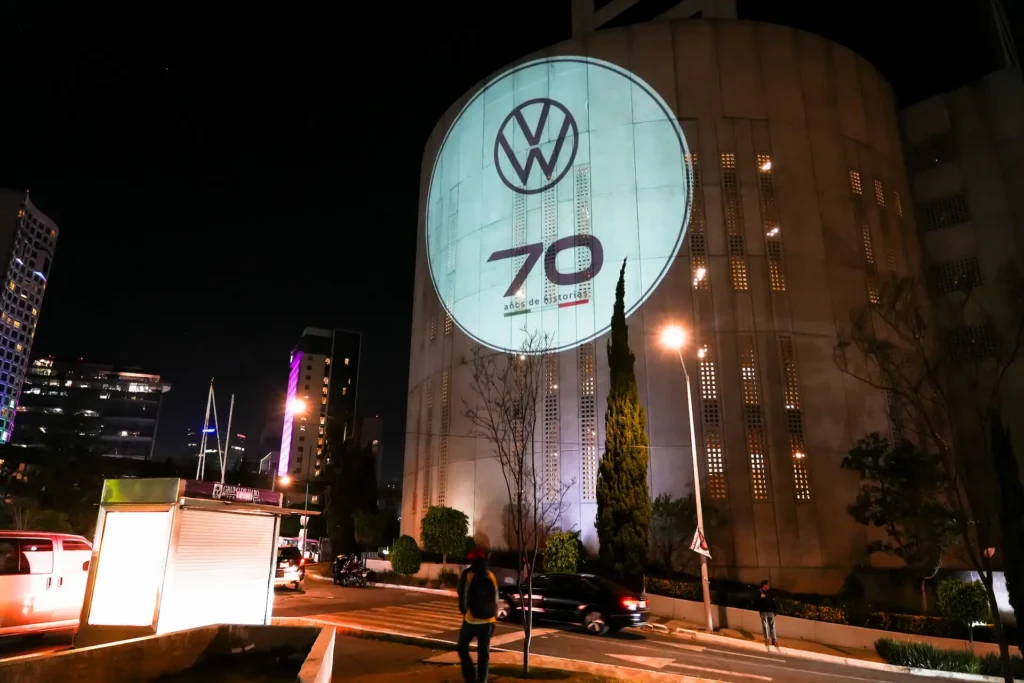
Avenida Presidente Masaryk is Mexico City’s answer to Madison Avenue. The comparison gets made often enough that it has become a cliché, but it is structurally accurate: a wide, tree-lined boulevard in Mexico City’s most affluent neighborhood, lined with the Mexican flagship stores of global luxury brands, drawing a self-selected audience of high-income consumers who are there specifically to engage with those brands. If you want to project in front of Mexico City’s highest-spending luxury consumers, Masaryk is the address.
What makes Masaryk interesting for AGM is that it is also one of the technically demanding projection environments in the city. The famous tree canopy, the polished visual environment saturated with professional luxury retail design, the relatively low building scale compared to Santa Fe or Reforma, and the specific rhythm of weekend pedestrian culture on the central island all require a level of tactical precision that generic campaign planning cannot deliver. A projection on Masaryk that doesn’t account for the trees, the ambient lighting of the luxury retail facades, and the movement patterns of the pedestrian promenade will underperform. One that accounts for all three will reach a captive luxury audience that almost no other outdoor medium in Mexico City can claim.
This post is a deliberate deep dive into the specific mechanics of a Masaryk projection campaign. We cover the physical geography of the avenue, the tree canopy problem and how we solve it, the adjacent cross-street surfaces, the Parque Lincoln extension, the Museo Soumaya northern anchor, the weekday-versus-weekend audience split, and how Masaryk campaigns compare to Reforma and Roma Norte in terms of what they actually deliver.
Masaryk’s Physical Character: What You’re Working With
Avenida Presidente Masaryk runs east-west through the heart of Polanco’s luxury retail district, connecting Avenida Presidente Masaryk (from its eastern terminus near Avenida Presidente Masaryk and Ejercito Nacional) to the western end near Parque Lincoln and beyond. The avenue is four lanes of vehicle traffic divided by a wide central pedestrian island planted with mature trees, with sidewalks on each side flanked by the luxury retail buildings.
The buildings on Masaryk are predominantly four to six stories, which is shorter than Santa Fe’s towers or Reforma’s high-rises but creates a human-scale canyon effect appropriate to luxury retail. Ground floors are entirely given over to retail flagships, restaurants, and showrooms. Upper floors are typically office or residential. The facade material is typically polished stone, premium stucco, or glass-and-metal retail storefront systems — all of which are reflective and designed to look expensive, which creates the ambient lighting challenge for projection campaigns.
Masaryk hosts the Mexican flagship stores of some of the world’s most recognized luxury brands across fashion, jewelry, automotive, and fine dining — making it Mexico City’s highest per-capita spending outdoor audience concentration.
The central pedestrian island is the social heart of Masaryk’s weekend culture. On Saturday and Sunday afternoons, it functions as a promenade where well-dressed residents and visitors walk, sit, and observe the street. Children ride scooters. Couples stroll. Families occupy the benches and the cafe tables that spill from ground-floor restaurants onto the sidewalk. This is a deliberately leisure-pace environment — not a transit corridor where people are hurrying through but a destination where people come to be in the space.
The Tree Canopy Problem and the Solution
Masaryk’s trees are one of the defining visual characteristics of the avenue and one of the primary tactical challenges for projection campaigns. The mature trees planted in the central island and along the sidewalks create a dense overhead canopy that screens much of the street-facing building facades from above. A projector positioned across the street from a building’s front facade will often find the upper third of its throw blocked or filtered by tree branches at certain angles and seasons.
The solution our team consistently uses is to route projection campaigns to the adjacent cross streets rather than the Masaryk axis itself. The buildings facing the cross streets that connect to Masaryk — Calle Julio Verne, Calle Horacio, Calle Tennyson, Calle Newton — have party walls and side facades that are perpendicular to the main avenue axis, which means they’re not screened by the Masaryk canopy. A projector positioned on a cross street with a clean sight line to a building’s blank side wall bypasses the tree issue entirely and reaches pedestrians who are either walking the cross streets or standing at the intersection with Masaryk.
“The tree canopy that makes Masaryk beautiful on Saturday afternoon is the same thing that screens a ground-level projector aimed at the building fronts. The answer is to go around it — the cross streets have the clean surfaces and the sight lines. You give up some direct Masaryk avenue frontage and gain a much better projection geometry.”
This is local knowledge that matters. Agencies that plan Masaryk campaigns from maps and satellite images without physically walking the avenue with a projection crew tend to learn the tree problem expensively, the first time. Our team accounts for canopy coverage in the initial location scout rather than discovering it on the night of a campaign.
The Masaryk Cross-Street Surfaces
The specific buildings that work best for Masaryk-adjacent projections are the ones at the intersections of the major cross streets with the avenue, and the mid-block buildings on those cross streets with visible rear or side facades. Julio Verne, which runs north-south and crosses Masaryk near its midpoint, has several buildings with substantial blank party walls facing the cross-street traffic. Horacio, the parallel street one block south of Masaryk, carries spillover pedestrian traffic from the main avenue and has buildings that face both Horacio itself and the rear approaches to Masaryk’s retail buildings.
Tennyson, the street running north off Masaryk near the Parque Lincoln end, passes through the northern Polanco residential area where the audience shifts toward high-income families rather than leisure shoppers. Buildings on Tennyson are typically four-to-five-story residential structures with exterior walls in the white or light-colored stucco typical of upscale Polanco construction — good surfaces for projection, relatively clean from competing signage, and in view of a residential street that has consistent pedestrian activity throughout the day and evening.
Parque Lincoln: The Adjacent Cultural Anchor
Parque Lincoln sits one block west of the main Masaryk retail corridor and is Polanco’s primary neighborhood park — a formal garden with mature trees, an outdoor theater, a small lake, and regular family activity. The park is surrounded by restaurants, cafes, and residential buildings, and it generates its own pedestrian traffic that partially overlaps with the Masaryk retail crowd and partially represents a separate residential audience doing a neighborhood-scale leisure outing rather than a luxury shopping expedition.
The buildings facing Parque Lincoln on its perimeter are among the most valuable projection surfaces in the extended Masaryk geography. A building facing the park or the park’s approach streets sees a slower-moving, more dwell-oriented pedestrian audience than the retail corridor of Masaryk itself. Parents watching children play, couples having coffee at the park-side cafes, residents walking dogs around the park perimeter — these are people whose attention is not already captured by the retail environment and who have time and space to look at a projection on a nearby building.
A Polanco campaign that coordinates projections on the Masaryk cross streets with a simultaneous projection on a Parque Lincoln-facing building creates a geographic envelope around the entire central Polanco pedestrian area. Anyone moving through the district on a weekend evening will encounter the campaign from multiple directions.
Weekday Masaryk: The Power-Lunch and Corporate Visitor Audience
The weekday character of Masaryk is substantially different from its weekend persona. Monday through Friday, particularly during the midday lunch window, Masaryk’s restaurants fill with the corporate executive and financial professional crowd that works in Polanco’s office buildings and the surrounding corporate addresses. This is the same demographic that Santa Fe captures during the commute but in a leisure and dining context rather than a transit one.
Polanco has a significant concentration of corporate headquarters beyond its retail identity. Major banks, financial firms, media companies, and multinational Mexican operations maintain Polanco office addresses, and their employees move through Masaryk at lunch and after work. The presence of premium automotive showrooms — several of Mexico City’s flagship dealerships for European and American luxury brands are on or immediately adjacent to Masaryk — further marks this as an address where purchase decisions for high-ticket items happen regularly.
Weekday projections on Masaryk cross streets target this corporate-professional-in-leisure-mode audience. A projection that runs from 12:30 PM to 3:00 PM on a weekday catches the lunch crowd at the window when they are most relaxed and most likely to spend time with the visual environment around them. Evening projections from 6:30 PM to 9:00 PM on weekdays catch the post-work transition to dining, when the same executive audience has shifted from work mode to social mode.
Masaryk’s restaurant row sees significant corporate executive traffic at weekday lunch, with major banks, financial firms, and multinational headquarters in the surrounding Polanco district sending professional-grade consumers into the avenue’s commercial environment daily.
Weekend Masaryk: The Promenade Audience
Saturday and Sunday on Masaryk bring a different character that is arguably more valuable for many luxury campaigns. The central pedestrian island becomes a genuine promenade — an intentional leisure activity in itself — and the retail stores attract browsers alongside buyers. The pace is slow. The audience is visually engaged with the environment around them. Families from Polanco and surrounding neighborhoods like Anzures, Chapultepec Morales, and Granada fill the avenue in a way that doesn’t happen on weekdays.
Weekend foot traffic on Masaryk includes a higher proportion of families with children, which shifts the brand categories that work best. Luxury automotive, premium real estate, high-end children’s and family lifestyle brands, and premium consumer goods that families consume together all find a more complete household unit audience on weekends than on weekdays. The family-formation household is the most valuable unit for many luxury consumer brands, and Masaryk on a Saturday afternoon is where that household chooses to spend its leisure time.
The visual attentiveness of the weekend Masaryk crowd also makes it a better organic amplification environment. People walking a promenade are already in photography mode — they’re photographing the avenue, the buildings, the street scene. A striking projection on a cross-street building that can be seen from the central island or the main sidewalks will be incorporated into those street photography sessions naturally, generating organic social media content at rates that the commuter-mode weekday audience does not produce.
What a Full Polanco Projection Night Looks Like
A full Polanco projection evening — running simultaneously across the Masaryk axis and the Parque Lincoln area — is one of the most coordinated single-night operations AGM executes in Mexico City. The logistics involve multiple projector positions, each requiring its own site preparation and sight-line confirmation, with creative that is calibrated for the specific surface and viewing distance at each location.
A typical full Polanco evening would activate three or four positions: one on a cross-street building visible from the Masaryk central island (a Julio Verne or Horacio party wall), one on a Parque Lincoln perimeter building, and one or two additional positions on the northern Tennyson residential corridor. This configuration means that a pedestrian walking the standard Polanco leisure circuit — down Masaryk, past Parque Lincoln, back via Horacio — encounters the campaign at multiple independent moments, which creates a repetition effect that single-placement campaigns cannot achieve.
The creative for a multi-position Polanco night needs to work at each individual placement while also creating a coherent campaign impression across all of them. Our team typically runs the same core creative at all positions with slight adaptations for surface size and viewing distance, rather than running entirely different creatives at each location. Consistency creates the saturation effect; adaptation ensures quality at each individual site.
The Museo Soumaya Extension: Northern Polanco
The Museo Soumaya on Plaza Carso sits north of the traditional Polanco neighborhood boundaries, in a position that is technically part of a different urban development — the massive mixed-use Plaza Carso complex developed by Carlos Slim. But the Soumaya’s visual identity — the aluminum-tile-covered curved building designed by Fernando Romero — has made it one of Mexico City’s most photographed architectural landmarks, and the surrounding Plaza Carso complex draws significant visitor traffic that overlaps with the Polanco audience.
For projection campaigns that want to extend their Polanco geography northward, the Plaza Carso and Soumaya area offers surfaces that receive cultural tourism traffic — visitors who have come to photograph the museum, shoppers in the adjacent commercial development, and the residential and office population of the surrounding Nuevo Polanco development. A projection near the Soumaya captures a slightly younger, more architecture and culture-oriented audience than the core Masaryk luxury retail crowd, which can be valuable for brands that want both the established luxury consumer and the aspirational affluent young professional.
The Nuevo Polanco Connection
Nuevo Polanco — the name used informally for the urban redevelopment along Ejército Nacional north of traditional Polanco — has emerged over the past decade as a significant complement to the Masaryk corridor. Major corporate headquarters (including the Televisa campus), large-format retail, and a growing residential tower population have created a secondary Polanco audience geography that campaigns increasingly include alongside the traditional Masaryk strip.
The scale difference is significant: Nuevo Polanco has tower-format buildings like Santa Fe, which means projection geometry is more like a corporate district than a retail promenade. But the audience remains Polanco-adjacent in income and lifestyle profile, and the Ejército Nacional traffic corridor connecting Nuevo Polanco to the traditional Masaryk corridor creates natural flow between the two environments that a coordinated multi-site campaign can use.
Building Heights and Facade Types on Masaryk
The buildings that work best for projections in the immediate Masaryk area are not the luxury retail flagships on the avenue itself — those buildings are too well-lit, too architecturally detailed, and too much in competition with their own expensive facade design to work as projection surfaces. The optimal surfaces are the upper-floor rear walls of Masaryk-facing buildings visible from cross streets, the party walls of buildings at cross-street intersections, and the residential building facades on the north-south streets one or two blocks from the main avenue.
The height profile of the cross-street buildings in Polanco — predominantly four to eight stories, in white or light-colored stucco — produces a specific projection aesthetic that works well for luxury brand campaigns. The smoothness of Polanco building exterior finishes means projection images are sharp and clean, without the textural variation of the older concrete surfaces in Tepito or Doctores. The color of the stucco (whites and off-whites are dominant in Polanco’s residential buildings) provides a close-to-neutral base that allows accurate color reproduction for brand campaigns with precise color requirements.
| Location |
Surface Type |
Best Viewing Audience |
Notes |
| Julio Verne cross-street party walls |
Matte stucco, 4-6 stories |
Masaryk promenade pedestrians |
No tree canopy interference |
| Horacio parallel street buildings |
Mixed stucco and stone |
Spillover pedestrians, residents |
Good sight lines toward Masaryk |
| Parque Lincoln perimeter buildings |
Premium stucco, 4-6 stories |
Park visitors, leisure crowd |
Very slow-moving audience |
| Tennyson residential corridor |
Light stucco, 4-5 stories |
High-income residential |
Lower volume, very high quality |
| Plaza Carso near Soumaya |
Modern commercial facades |
Cultural tourism, Nuevo Polanco |
Northern geography extension |
How Masaryk Compares to Reforma and Roma Norte
Any serious CDMX projection planning discussion eventually compares these three environments, because they are the three that come up most often for brands targeting Mexico City’s middle-to-high income population. They are not interchangeable — each delivers something the others can’t — and understanding the differences prevents campaigns from being planned on assumptions that don’t match reality.
Reforma is a volume play. The boulevard runs from Chapultepec Park through the city’s central business district, and it carries a daily volume of vehicle and pedestrian traffic that dwarfs any single neighborhood in CDMX. But the audience on Reforma is a cross-section of the entire city — commuters, tourists, office workers, transit users across all income levels. Reforma delivers reach; it does not deliver audience quality in the specific sense that Masaryk does. A luxury brand that projects on Reforma is reaching many people, most of whom are not their customers.
Roma Norte is a creative and cultural resonance play. The audience — urban professionals, creative industry workers, young entrepreneurs, international residents — has strong social media amplification behavior and engages deeply with visual content in the built environment. Roma Norte campaigns travel online better than almost any other CDMX neighborhood. But the income profile is professional rather than luxury, and the purchase behavior for high-ticket luxury goods is significantly lower than Masaryk’s audience.
Masaryk is the quality play. Lower volume than Reforma, less organic amplification culture than Roma Norte, but the most consistent concentration of luxury-purchase-capable consumers per square meter of any outdoor environment in Mexico City. For a luxury automotive brand, a high jewelry launch, a premium real estate offering, or an international fashion brand entering the Mexican market, Masaryk’s audience quality makes the lower raw volume worth it.
“Reforma sells you volume. Roma Norte sells you culture. Masaryk sells you the customer. Know which one your campaign actually needs.”
Campaign Creative Standards for the Masaryk Environment
The Masaryk environment sets a high standard for creative quality because the ambient visual environment is professionally designed at every point. The luxury retail flagships, the polished restaurant fronts, the premium automotive showrooms — everything on Masaryk is designed by specialists and maintained at a level that signals significant investment. A projection campaign with mediocre creative will look out of place in this environment in a way that it wouldn’t in Tepito or Doctores, where the rawness of the street environment is part of the aesthetic.
Our team recommends that Masaryk campaigns be designed to the same visual standards as the luxury print and out-of-home advertising that premium brands use in their primary markets. Typography should be precise and scaled appropriately. Color accuracy matters more here than anywhere else in CDMX because the audience has the most developed eye for quality in brand design. Animation and motion content, if used, should be smooth and polished rather than energetic and kinetic — the Masaryk audience responds to quiet confidence more than to spectacle.
The physical scale of Masaryk-adjacent projection surfaces also requires creative designed for medium-distance viewing rather than close-up examination. The optimal viewing distance for a cross-street building projection visible from the Masaryk central island is 30 to 60 meters. At that distance, fine detail becomes less important than overall composition and impact. Campaigns designed around a single strong visual statement — a brand image, a product hero, a few words of copy — perform better than complex multi-element layouts that lose clarity at viewing distance.
Creative for Masaryk projection campaigns should meet luxury print advertising standards — precise typography, accurate color, strong composition — because the ambient visual environment of Polanco’s luxury retail flagships sets a quality bar that generic commercial creative will not clear.
Frequently Asked Questions
What is Avenida Presidente Masaryk and why is it important for luxury projection campaigns?
Avenida Presidente Masaryk is Polanco’s primary luxury retail boulevard, often compared to Madison Avenue in New York or Rue du Faubourg Saint-Honore in Paris. It is a wide, tree-lined avenue with a central pedestrian island that becomes a weekend promenade for affluent Mexico City families and visitors. The retail tenants — international luxury fashion houses, jewelry brands, premium automotive showrooms, and fine dining — define the street as Mexico City’s highest-end consumer address. Projection campaigns here reach a self-selected luxury consumer audience at the exact location where they make high-ticket purchase decisions.
How does the tree canopy on Masaryk affect guerrilla projection placement?
Masaryk’s famous avenue trees create significant canopy coverage at street level, which screens ground-level and lower-building projections partially or completely from street-facing views. Our team routes around this constraint by focusing projections on the blank party walls and building sides on the cross streets adjacent to Masaryk — Julio Verne, Horacio, Tennyson — where projectors can find clean sight lines without tree interference. The canopy screening actually filters out lower-quality projection attempts and rewards teams with the local knowledge to work around it.
What is the difference between weekday and weekend audiences on Masaryk?
Weekday Masaryk is a business-hours destination for corporate executives, financial professionals, and the power-lunch crowd that frequents the neighborhood’s high-end restaurants. The pace is professional and purposeful. Weekend Masaryk is a leisure environment — families from Polanco and surrounding affluent neighborhoods walk the central pedestrian island, couples window-shop, and the atmosphere shifts from transactional to recreational. The weekend pedestrian audience is larger, slower-moving, and spending more time with the visual environment of the avenue, which generally makes it more effective for brand awareness projection campaigns.
How does the Museo Soumaya extend the Polanco projection geography?
The Museo Soumaya on Plaza Carso, located north of the traditional Polanco boundaries, is one of Mexico City’s most architecturally distinctive buildings and draws significant tourist and local visitor traffic. Its presence anchors a northern extension of the Polanco projection geography that includes the Plaza Carso commercial development. Campaign elements placed near the Soumaya can capture cultural tourism visitors who may not be in the core Masaryk corridor but are in the same high-income geography.
How does a Masaryk projection campaign compare to campaigns on Reforma or in Roma Norte?
Reforma delivers very high traffic volume but a mixed audience across all income levels — it is a city-wide transit corridor rather than a neighborhood audience. Roma Norte delivers a creative and professional audience with strong organic amplification culture but at significantly lower income levels than Masaryk. Masaryk delivers lower volume but much higher audience quality in terms of per-capita income and luxury purchase behavior. The three serve different campaign objectives: Reforma for reach, Roma Norte for cultural resonance, Masaryk for luxury audience quality.