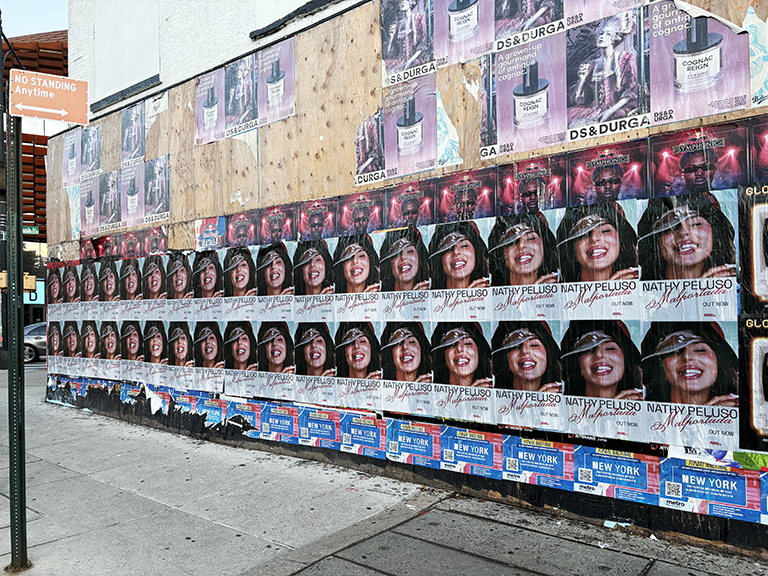
Fly posting advertising is one of the oldest and most durable forms of street-level brand promotion. Paste-applied paper posters on construction hoardings, building walls, and licensed posting surfaces have been part of urban advertising for more than a century, and they remain an active, professionally managed advertising channel in 2026 — not because of nostalgia, but because the format delivers something digital advertising cannot: physical presence in the spaces where audiences actually live.
The professional fly posting market looks very different from the unauthorized posting that gave the term its edgy reputation. Today’s licensed campaigns are planned using surface networks, executed by professional crews with GPS documentation, and reported to clients with the same accountability standards expected from any other media buy. If you are evaluating fly posting advertising for the first time, this guide covers everything you need to know to make an informed decision: what the format is, which surfaces are used, which markets are strongest, what compliance looks like, and how to build an accurate campaign budget.
American Guerrilla Marketing runs fly posting campaigns across 50+ U.S. markets. We have been executing licensed poster programs since our founding in Brooklyn, New York, and our team brings operational depth to every market we work in. This is the format explained by people who actually deploy it.
What Fly Posting Advertising Actually Is
Fly posting is paste-applied paper poster advertising. A crew applies adhesive to a surface, presses a paper poster against it, smoothes out any air pockets, and optionally applies a top coat of adhesive for additional weather resistance. The result is a poster bonded directly to the surface, resistant to wind and moderate rain, and visible at the natural eye level of a pedestrian passing by.
Format Differences: Fly Posting vs. Other Outdoor Formats
Fly posting differs from other outdoor advertising formats in several key ways. Unlike traditional billboard advertising, fly posting operates at street level, in the pedestrian sightline rather than elevated above traffic. Unlike digital out-of-home screens, it is a static format that holds a single creative execution for the campaign duration. Unlike snap-frame or pinned poster displays, paste-applied posters create a seamless, mural-like appearance that blends with the urban visual environment in a way that framed displays do not. This visual integration with the street environment is part of what gives fly posting its cultural credibility, particularly in markets and categories where street authenticity matters.
Surface Types for Professional Campaigns
Professional fly posting campaigns operate on three primary surface categories. Construction site hoardings are the wooden or plywood barriers around active building projects, typically located at pedestrian eye level in high-traffic urban corridors. Building walls are exterior surfaces where property owners have executed agreements with posting operators. Purpose-built posting boards are installed specifically for rotating advertising programs in retail or entertainment districts. Each surface type has different access requirements, audience profiles, and visual characteristics.
Where Fly Posting Advertising Works Best
Not every market or location is equally strong for fly posting. The format works best in environments with high pedestrian density, slow pedestrian traffic (people walking, not driving), and a culture of visual engagement with street-level media. Here is how to think about market and location selection.
Urban Core vs. Suburban Markets
Fly posting delivers its strongest performance in urban core environments — the dense, walkable neighborhoods in major and mid-size cities where pedestrians move through commercial and residential streets on foot. Suburban markets with low pedestrian density and car-oriented travel patterns are not well suited to the format. The impression model for fly posting depends on pedestrians moving past fixed surfaces at close range, which is a function of urban density rather than population size alone.
Top Markets for Fly Posting Campaigns
American Guerrilla Marketing’s highest-volume fly posting markets include New York City, Los Angeles, Chicago, Miami, Austin, Nashville, Washington D.C., Boston, Philadelphia, Seattle, Portland, Denver, Atlanta, and San Francisco. Each market has distinct neighborhood-level surface availability and audience profiles. Our team’s operational knowledge in each market means we can identify the highest-value surfaces for any given campaign objective, not just the surfaces that appear in a general location database.
Neighborhood Targeting Within Markets
Within any major market, fly posting performance varies significantly by neighborhood. A fashion brand campaign in New York needs posters in SoHo and the Lower East Side, not across all five boroughs indiscriminately. A music campaign in Los Angeles should be concentrated in Silver Lake, Echo Park, and the Fairfax district, not the San Fernando Valley. Neighborhood selection based on audience concentration is as important as market selection. Our guerrilla marketing services include audience-driven location planning as a standard campaign element.
Compliance: How Licensed Fly Posting Works
The compliance distinction in fly posting advertising is the most important thing for buyers to understand. Licensed, authorized campaigns on approved surfaces are legal, professionally managed, and low-risk. Unauthorized posting creates regulatory, legal, and reputational exposure that professional brands should not accept regardless of cost savings.
Surface Authorization
Every surface used in a licensed fly posting campaign has explicit authorization. Construction hoardings require agreement with the construction company or developer. Building walls require property owner consent. Purpose-built posting boards operate under agreements with the board network operator. These agreements define what can be posted, in what size, for how long, and at what cost. Our team maintains active relationships with surface operators across all markets and confirms authorization before any crew is scheduled.
Permit Requirements
Some municipalities require permits for outdoor advertising installations, including fly posting campaigns. Permit requirements vary by city, surface type, and campaign characteristics. Our team researches permit requirements in every market as part of campaign planning, and permit applications are filed and approved before deployment begins. Campaigns that skip this step create liability for both the agency and the brand.
Documentation as a Compliance Tool
GPS-tagged photography of every placement is both a client reporting tool and a compliance record. Our documentation provides proof that every poster in the campaign is located on an authorized surface, that placements comply with any size or content restrictions applicable to the surface, and that the campaign ran as planned. In the event of any compliance question from a municipality or surface operator, our documentation record provides immediate, verifiable evidence of campaign operation.
Fly Posting Costs: What to Budget
Professional fly posting campaign budgets are built from several cost components. Understanding each component helps you evaluate proposals and make informed budget decisions.
Location and Surface Costs
Access to licensed posting surfaces typically involves a fee paid to the surface operator or location network. Surface costs vary significantly by market and location quality. High-traffic licensed surfaces in Manhattan command premium rates compared to similar surfaces in secondary markets. Construction hoarding agreements are typically negotiated per installation or per linear foot. Building wall agreements are negotiated individually with property owners. These location costs are quoted as part of any campaign proposal.
Production and Print Costs
Poster printing for fly posting campaigns uses large-format digital printing on uncoated paper stock appropriate for paste application. Print costs depend on poster size, quantity, and any custom finishing requirements. Our team coordinates print production and logistics as part of every campaign, eliminating the need for clients to manage a separate print vendor relationship.
Crew and Deployment Costs
Field crew costs include crew scheduling, supervision, and deployment labor. Crews typically deploy during early morning hours for the best surface conditions and lowest pedestrian traffic interference. Crew costs vary by market and campaign complexity. Multi-location campaigns that require coordinated deployment across multiple neighborhoods in a single night require larger crews and more complex coordination.
Fly Posting Campaign Creative: What Works at Street Level
Creative execution is as important as location selection in determining whether a fly posting campaign achieves its objectives. A perfectly located poster with weak creative underperforms; strong creative in the right location creates a genuine impression. Here is how to design fly posting creative that works at street level.
The Pedestrian Viewing Context
Fly posting creative is viewed at close range — typically three to ten feet — by pedestrians moving at walking speed. The viewing context is radically different from billboard advertising seen from a moving vehicle or digital creative consumed on a screen held in the hand. This close-range, medium-speed viewing context means that fly posting can carry more detail than a highway billboard, but less than a print ad or website page. A clear hierarchy — headline, visual, secondary information — ensures that a three-second glance at your poster delivers the most important message even if the pedestrian does not stop to read the full creative.
Poster Format Standards
Standard fly posting formats include the one-sheet (27 x 40 inches), the two-sheet (54 x 40 inches), and larger multi-sheet formats for high-impact hoarding installations. The one-sheet is the workhorse of professional fly posting campaigns — it fits the majority of licensed urban surfaces, ships efficiently, and creates a clean single-image presentation. Multi-sheet formats create impact through scale but require coordination between panels at installation and are best suited for dedicated hoarding arrangements with sufficient continuous surface area. Our team recommends format selection as part of campaign planning based on the specific surfaces confirmed for each market.
Paper Stock and Print Specifications
Fly posting uses uncoated or matte paper stock that accepts paste adhesion more reliably than coated or glossy stock. Uncoated paper is also more forgiving in outdoor conditions — it accepts a top paste coat for added durability without the silvering or blistering that can occur with coated stocks in moisture. Print resolution for outdoor fly posting should be at least 150 DPI at final size for clean visual reproduction at viewing distance. Creative files should be supplied as print-ready PDFs with bleeds at the document specifications provided by the print vendor coordinating with the campaign.
What to Look for When Evaluating a Fly Posting Agency
Not all agencies that offer fly posting campaigns deliver the same quality, compliance, or accountability. Here is a practical buyer’s checklist for evaluating proposals from fly posting agencies.
Surface Authorization Documentation
Ask specifically: How does the agency confirm that every surface in the campaign is authorized? A credible agency can describe a specific authorization process — direct agreements with property owners, operator network agreements, permit records — and can provide examples of the authorization documentation they use. Agencies that answer this question vaguely or describe authorization as implicit rather than documented are telling you something important about how their campaigns actually operate.
GPS Documentation Standard
Ask what the documentation deliverable looks like. A credible fly posting agency delivers GPS-tagged photography of every placement with metadata showing location coordinates and deployment timestamp. Agencies that deliver a gallery of photographs without metadata, a summary count of placements without individual location records, or documentation that cannot be independently verified are operating below the standard that media buyers should accept for any physical advertising channel.
References from Comparable Campaigns
Ask for references from clients whose campaigns are comparable in market, category, and scale to the campaign you are evaluating. A fly posting agency with genuine operational depth in a market can provide references from campaigns that demonstrate their specific market knowledge. References from different categories, markets, or scales than yours provide limited useful information about the agency’s relevant capability.
Campaign Formats: Single Market vs. Multi-Market
Fly posting campaigns range from targeted single-neighborhood programs to coordinated national campaigns across dozens of markets. Here is how program scope affects planning and cost.
Single-Market Programs
Single-market programs are the most common entry point for brands testing fly posting for the first time. A well-executed single-market program in New York, Los Angeles, or Chicago delivers meaningful impression volume, provides campaign documentation that can be used to evaluate ROI and plan future campaigns, and costs significantly less than a multi-market program. Start with one market, execute well, document thoroughly, and use the results to make a data-informed decision about expansion.
Multi-Market Coordinated Campaigns
For brands with national launch objectives or campaigns tied to multi-city events and tours, coordinated multi-market programs allow simultaneous deployment across all target cities. American Guerrilla Marketing coordinates these programs through a single project manager with standardized deployment documentation in every market. Clients receive a unified campaign report covering all markets, rather than coordinating reports from separate market-level vendors. Our wheatpaste poster campaigns are available in all 50+ markets we serve, with the same documentation standard applied in each.
Integrating Fly Posting with Broader Campaigns
Fly posting campaigns work best when integrated with complementary street-level and digital elements. Here is how to build an integrated program that multiplies the impact of your poster investment.
Combining Fly Posting with Street Teams
Deploying street teams in the same neighborhoods as your poster campaign creates a two-channel physical presence that reinforces the poster impression with human interaction. Street teams can distribute campaign materials, direct people to a QR code or URL, or simply engage with pedestrians to build awareness in neighborhoods where your posters are visible. The combination of passive poster impressions and active human engagement creates a richer campaign experience.
Combining Fly Posting with LED Billboard Trucks
LED billboard trucks routed through your poster neighborhoods during peak traffic hours amplify the fixed poster campaign with a moving, high-visibility display. Pedestrians who saw your poster on a wall see the same creative in motion on an LED truck, creating a frequency effect that increases brand recall. LED trucks are particularly effective in markets with high vehicle traffic alongside pedestrian corridors, where the truck reaches audiences that do not walk past fixed surfaces.
Fly Posting Pricing Transparency: What Agencies Should Tell You
The fly posting industry has historically had less pricing transparency than most other advertising channels. This has created an environment where buyers without direct market experience find it difficult to evaluate whether a proposal is reasonably priced or significantly marked up. Here is a straightforward breakdown of what drives fly posting campaign costs and how to evaluate proposals against realistic benchmarks.
Surface access costs are often the largest single line item in a fly posting budget. In premium urban markets, licensed hoarding and building wall access fees can represent 30-50% of the total campaign cost. These fees are real costs that agencies pay to surface operators, and they vary significantly by market and location quality. A proposal that does not break out surface access costs separately from production and labor should prompt a specific question about how location costs are accounted for in the total budget.
Print production costs for a standard one-sheet fly posting campaign are relatively transparent — commercial print vendors quote large-format uncoated paper stock at consistent price points, and any competent agency can obtain competitive print pricing. Where print costs vary significantly between proposals, it is usually a function of quantity, paper specification, or vendor relationship rather than market-specific pricing. Clients who want to verify print costs can request itemized production line items and compare against direct print vendor quotes for the same specifications.
Labor and crew costs reflect crew size, deployment hours, travel in larger markets, and supervisory overhead. These costs are less transparent than print costs because they depend on local labor market rates that vary by city, crew experience level, and the complexity of the campaign’s geographic spread. For multi-neighborhood campaigns requiring multiple simultaneous crews, crew coordination costs can be significant. Our team breaks out crew costs by deployment session for campaigns where this level of reporting detail is requested.
Frequently Asked Questions
What is fly posting advertising?
Fly posting advertising is a form of street advertising in which paper posters are adhered to surfaces using paste — typically a wheat flour and water mixture. The format is used by professional agencies for licensed, compliant campaigns on authorized surfaces including construction hoardings, building walls, and purpose-built posting boards.
Is fly posting advertising legal?
Fly posting on licensed, authorized surfaces with property owner or operator consent is legal. Unauthorized posting on city-owned property or private surfaces without permission is not. Professional agencies like American Guerrilla Marketing operate exclusively on licensed surfaces.
How much does fly posting advertising cost?
Fly posting campaign costs range from approximately $3,500 for a small single-neighborhood program to $30,000+ for large multi-market campaigns. Cost depends on placement volume, market, poster size, material, and campaign duration.
What industries use fly posting advertising most?
Entertainment (music, film, streaming), fashion, consumer brands, events, food and beverage, cannabis brands in legal markets, and tech and app launches are among the most active categories for professional fly posting campaigns.
How long does a fly posting campaign run?
Standard campaign durations range from one to four weeks. Duration is driven by campaign objectives, surface availability, and budget. Some surfaces rotate on fixed schedules; others allow extended placements.
How do I start a fly posting advertising campaign?
Contact American Guerrilla Marketing at (646) 776-2770 or through our contact page. Our team handles planning, location scouting, permits, production coordination, crew deployment, and GPS-documented reporting.