
September 20, 2023
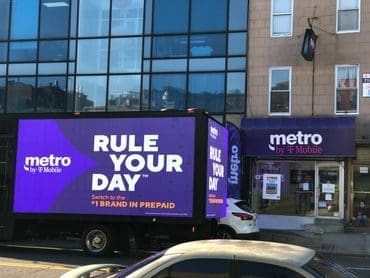
LED billboard trucks drive attention to your business by putting your brand’s message on a large-format moving display that follows your customers to the locations they actually visit, their neighborhood on a Saturday, the stadium before a game, the concert venue on Friday night, or the competitor’s storefront any day of the week. Unlike fixed billboards, an LED truck is a media placement you can aim. AGM operates LED billboard trucks and has deployed mobile billboard campaigns in 30+ markets across the US and Canada. This guide covers exactly how LED trucks work, what they cost, how to route them effectively, and what results to expect.
LED billboard trucks are a flexible format but they require upfront planning to perform. Here’s how to structure a campaign that gets results.
Step 1: Map your target zones
LED trucks work best in high-density corridors: downtown cores, major arterials, entertainment districts, near stadiums or arenas during events. Map the specific streets you want covered, the times of day those streets peak in traffic, and whether your audience is commuting traffic, foot traffic, or venue-going crowds. The truck route is as important as the creative on the screen.
Step 2: Set your schedule around peak audiences
Morning commute (7–9 AM) and evening commute (5–7 PM) produce high vehicle impressions. Lunch hours (11 AM–1 PM) in commercial districts produce high foot traffic impressions. Event timing (pre-event 2 hours, post-event 1 hour) produces the highest-value contextual impressions. A 4-hour block timed to the right event beats a full 8-hour deployment in a generic location.
Step 3: Design for moving display
Creative for LED trucks needs to work at a glance from 50 to 100 feet. Use large text (single message, 5 words maximum), high contrast, and minimal background complexity. Animation should be simple: a fade, a rotation, or a slide. Complicated motion sequences lose legibility when viewed at an angle from a moving vehicle. Test your creative on an actual LED display before the campaign launches.
Step 4: Document with GPS and field photography
A professional LED truck operator provides GPS-confirmed route logs and field photography. This is your proof of performance and your data for optimizing the next campaign. If an operator doesn’t provide both as standard deliverables, find one who does. See real guerrilla marketing examples that combine mobile formats with street-level execution.
An LED billboard truck is a commercial vehicle, typically a box truck or flatbed, carrying one or more high-resolution LED panel displays on the vehicle’s exterior. Standard configurations: dual-sided (one panel per truck side), three-sided (driver side, passenger side, and rear), or single large-rear panel. Panel sizes typically range from 10’×6′ to 16’×8′ per face, with combined display area of 100–200 square feet per truck.
LED panel resolution for outdoor mobile billboard applications typically runs 6–10mm pixel pitch, sufficient for clear brand imagery and readable text at viewing distances of 15–100 meters. Full-color RGB LED capability means your creative plays in full broadcast-quality color, not limited by static print constraints. Content loads via USB or remote upload to the truck’s onboard media player, which cycles your creative on a defined loop (typically 6–30 second creative loops).
LED billboard trucks generate impressions from two audience types simultaneously: vehicle traffic (drivers and passengers who see the truck’s panels as it routes through traffic) and pedestrian traffic (people on sidewalks and in commercial areas who see the truck passing or parked). The combination makes LED trucks particularly effective in dense urban environments where both traffic and foot traffic are high.
Industry data from LED truck media companies shows 300,000–500,000 daily impressions for well-routed trucks in major metro markets. AGM’s own tracked campaigns in markets including New York, Chicago, Los Angeles, and Miami confirm this range for full-day deployments on high-density routes. CPM for LED truck campaigns in major markets runs approximately $3–$8, significantly below premium digital display ($8–$25 CPM) and premium fixed OOH ($5–$25 CPM depending on market and location).
A fixed billboard is where it is. You buy a specific location and accept the audience that passes that location. An LED truck can be where your audience is, routed to specific neighborhoods, events, competitor locations, transit hubs, or the exact streets where your target demographic concentrates. That routing control is the fundamental LED truck advantage over any fixed OOH format.
We’ve run LED truck campaigns that specifically park outside competitors’ locations during their busiest hours. We’ve routed trucks to run the exact streets that lead from our client’s customer demographic’s residential zones to downtown commercial areas. We’ve parked trucks outside venue exits after events, reaching 10,000+ concentrated event-goers in a single evening. None of those targeting strategies are possible with a fixed billboard.
Fixed billboard creatives require weeks of production lead time. An LED truck can run new creative within 24 hours of receiving a finished file. For time-sensitive campaigns, product launches, event promotions, price changes, competitive responses, LED trucks can be activated and redirected faster than any other OOH format.
Creative can also be changed mid-campaign without production cost. If day 1 results show one message outperforming another (tracked through QR codes on different creative versions), day 2 can run exclusively the higher-performing message. That’s A/B testing capability in out-of-home, genuinely unusual for traditional OOH formats.
LED trucks are self-illuminated, they’re actually brighter and more visible in low-light conditions than in direct sunlight. Evening deployments in entertainment and dining districts capture consumers in social spending mode with exceptional visual clarity that no print format can match. An LED truck in Wicker Park on a Friday evening or on South Beach after dark generates extremely high visual engagement from pedestrian-heavy crowds moving through those environments.
Sports stadiums, concert venues, convention centers, and festival grounds concentrate exactly the audience most brands want to reach, in large numbers, at predictable times, in a high-energy state. LED truck routing to venue approaches 2 hours before events, and to venue exits immediately after events, generates some of the highest impression-per-hour rates of any deployment scenario. AGM has run LED truck deployments at NFL games, NBA playoffs, major music festivals, and political conventions, event-adjacent is consistently our clients’ highest-performing routing scenario.
Routing an LED truck to park outside or repeatedly pass a competitor’s location during their peak traffic hours is one of the most aggressive and effective competitive marketing tactics available. No other format gives you this capability, you can’t put a billboard in a competitor’s parking lot, but you can route an LED truck past their front door every 30 minutes for 4 hours on a Saturday afternoon. Brands in automotive, retail, and financial services have used this tactic effectively in AGM campaigns to capture competitor shoppers at the point of comparison.
For brands building local awareness in a specific neighborhood, a restaurant promoting its launch, a gym targeting the surrounding residential zone, a real estate developer marketing a new building to the local catchment, routing an LED truck to make repeated passes through the target neighborhood’s main commercial and residential streets creates high-frequency exposure to the most relevant audience. A single-neighborhood saturation route (5–7 miles of repeated loops through the target zone) can generate 15,000–30,000 neighborhood-specific impressions per 4-hour window.
For mass-market brand awareness campaigns where geographic concentration matters less than total impression volume, routing on the city’s highest-traffic arterials, freeways during rush hour (with local vehicle stop regulations in mind), major commercial boulevards during midday, downtown grid patterns during peak pedestrian hours, maximizes total daily impressions at the expense of targeting specificity.
Design for 3-second legibility. The average vehicle pass of an LED truck creates 3–8 seconds of viewing time. Your creative must communicate its primary message in the first 3 seconds: brand name, key message, and action if applicable. Detailed body copy, complex imagery, and small text are invisible at highway speed. Design for immediate comprehension, not reading.
High contrast above all else. Bright daylight is the LED truck’s most challenging viewing condition. Designs with maximum contrast ratios (white on black, yellow on dark blue, red on white) maintain legibility in direct sunlight at highway viewing distances. Low-contrast creative becomes invisible in afternoon sun.
Use the loop structure strategically. Most LED truck campaigns run a 10–30 second creative loop. For a single-message campaign, fill the full loop with the one message at multiple sizes and angles. For a two-message campaign, split the loop 60/40 between primary and secondary messages. Don’t try to run 5 creative messages in a 15-second loop, no individual message gets enough time to register.
Include a QR code, but only on parked deployments. A QR code on a moving truck is unscanneable for vehicle passengers. On a parked truck, outside an event venue, at a busy street corner, a prominent QR code is extremely effective for capturing digital actions from pedestrian audiences. AGM designs QR deployment strategy based on whether the truck is in motion (no QR needed) or positioned statically (QR is a high-value addition).
AGM’s official LED truck pricing is $250-$300 per hour with an 8 hour minimum. If the route, market, or campaign length needs a custom plan, contact AGM for pricing.
Verify panel quality. Not all LED truck panels are equivalent. Ask for pixel pitch specification (6–10mm is the quality standard for outdoor viewing), panel brightness rating (3,500 nits minimum for daylight visibility), and refresh rate. Panels with too low a brightness rating wash out in daylight, your creative becomes invisible on sunny days.
Confirm GPS route logging. A reputable LED truck company provides GPS route logs showing every street the truck covered and the time spent in each zone. Without this, you have no way to verify that the truck actually covered the route you paid for. AGM provides GPS-logged route reports for every campaign we deploy.
Get resolution-appropriate creative production. Provide creative files in the exact pixel dimensions of the truck’s LED panels. Low-resolution creative stretched to fit a large LED panel creates visible pixelation that damages brand appearance. AGM provides detailed creative specifications for every truck platform we deploy.
How LED Billboard Trucks Can Drive Attention to Your Business generates better results when placement, timing, creative, and local execution all work together. These questions cover the details brands usually need before launch, during rollout, and while evaluating performance.
For bus, the strongest campaigns usually come from tight geographic targeting, message discipline, and enough repetition to be remembered. Market conditions, neighborhood flow, event calendars, commuter behavior, and production logistics all change how the tactic performs, so the planning details matter as much as the idea.
In major markets: 5–10 business days minimum for scheduling in existing markets. For large campaigns (multiple trucks, multiple markets, extended runs): 2–3 weeks for coordinated scheduling and creative review. Rush bookings under 5 days are possible at a coordination premium. Contact AGM as early as possible for event-adjacent deployments where specific dates are fixed.
Yes, LED trucks are fully operational 24 hours a day, and night deployments often generate the highest per-impression brand impact due to the truck’s self-illuminated display standing out dramatically against darker environments. AGM runs evening deployments routinely in entertainment districts, restaurant rows, and venue approaches.
Primary measurement: GPS route log (verifies coverage), estimated impressions based on traffic count data for routes covered, and any digital actions attributable to QR codes or specific campaign UTM parameters on the truck’s creative. For campaigns with specific conversion objectives, AGM cross-references truck route dates with client sales or traffic data to identify post-exposure lift.
Start with audience location, not creative ideas. If you can name the blocks, venues, campus gates, stations, or event windows where attention is concentrated, the campaign can usually be built into something measurable. If the audience is vague, the spend drifts and results get fuzzy fast.
The most common issue is spread. Brands buy a handful of placements across too many neighborhoods instead of owning one route. A tighter footprint with stronger repetition beats a scattered footprint almost every time, especially for event promotion, launches, and local service awareness.
That depends on the traffic environment. Fast moving traffic calls for a short awareness message with one visual anchor. Slow pedestrian traffic can support a QR code, a stronger offer, and more direct response copy. The format should match the pace of the audience, not the other way around.
For event driven pushes, the best window is often the 7 to 14 days before the date. For evergreen brand building, two to four weeks works better because repetition does the heavy lifting. Weather, removals, and local conditions still matter, so timing should always be part of the plan.
Use QR scans, coupon redemptions, landing page traffic, geofenced audience lift, survey responses, and direct field photos. Street work is easier to defend when the campaign is built with proof from day one instead of trying to backfill measurement after the fact.
Both matter, but placement usually wins the argument. A decent design in the right corridor will outperform a beautiful design placed where the right people never see it. Street media is a placement game first and a design game second.
Ready to Run Your Campaign?
Call us or email us. We’ll tell you exactly what we can do in your market and what it costs.
American Guerrilla Marketing — Los Angeles
Street-level campaigns in Los Angeles and nationwide. Wheatpasting, LED trucks, street teams, and more.
(646) 776-2770
June 22, 2026
June 22, 2026
June 22, 2026
June 22, 2026
June 22, 2026
