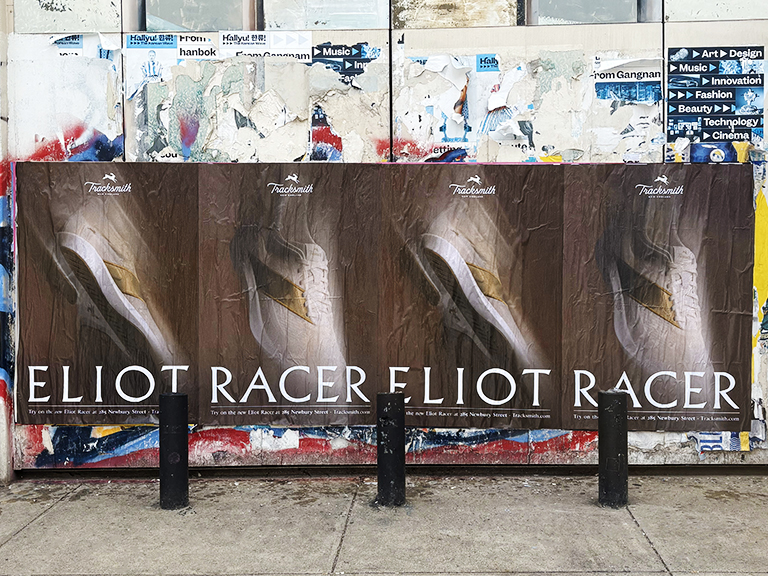
Fashion brands understand something about London that many other categories don’t: this city’s consumers move through specific neighborhoods in predictable patterns, and those neighborhoods are not randomly distributed across the 607 square miles of Greater London. The person who buys a Palace skateboard or a Wales Bonner piece or a Martine Rose jacket walks specific streets, shops at specific stores, and spends time in specific neighborhoods. They have done so consistently enough that their geography is knowable, and that knowledge makes wheatpaste campaigns one of the more efficient tools in London fashion marketing.
Physical street presence in Shoreditch or on Carnaby Street does something for a fashion brand that a paid Instagram campaign cannot. It places the brand in the same visual register as the street art, the independent shops, and the cultural identity of the neighborhood. It communicates belonging — that this brand is part of the physical fabric of these streets, not just a message delivered by an algorithm to someone scrolling on their phone. For fashion brands, particularly those building or maintaining credibility with trend-aware younger consumers, that belonging is commercially valuable in a way that’s hard to quantify but easy to recognize.
This guide covers the full picture of fashion brand wheatpasting in London — the neighborhoods, the timing relative to collections and fashion weeks, the formats that work for fashion imagery, and how the campaign architecture differs from other categories.
Fashion Geography in London: Where the Audience Is
Shoreditch and Brick Lane: Streetwear and Contemporary
Shoreditch is the primary zone for streetwear brands. The combination of Supreme’s former popup presence, the concentration of independent footwear and apparel shops along Bethnal Green Road, the vintage clothing market culture of Brick Lane, and the demographic of young, brand-aware consumers who walk these streets makes this the essential starting point for any streetwear or contemporary fashion campaign.
Brick Lane in particular has a long history of fashion-brand postering. The walls around the vintage markets on Cheshire Street, the northern end of Brick Lane near the Truman Brewery, and the streets connecting to Spitalfields have been used by brands from Nike and adidas (for trainer drops) to small independent labels launching their first London campaign. The audience here knows what a campaign looks like and engages with it accordingly.
Carnaby Street and Soho: Established Fashion
Carnaby Street in the heart of Soho has been a fashion destination since the 1960s — Mary Quant, Vivienne Westwood, the mod and punk revolutions all passed through here. It remains a retail destination with a concentration of fashion-engaged foot traffic, particularly from tourists who have come specifically to shop and younger Londoners who treat the Carnaby Street area as a fashion destination. Campaigns for established brands with some heritage or cultural weight perform well here.
Notting Hill and Portobello Road: Premium and Vintage-Adjacent
The Portobello Road market on Saturdays draws a fashion-specific crowd from across London. Vintage buyers, premium-brand shoppers, and the affluent Notting Hill resident population make this a strong zone for campaigns targeting a 28-45 demographic with disposable income and fashion literacy. Surface access on Portobello Road itself requires sensitivity to the residential character of the surrounding streets — campaign operators who know this area well will know which surfaces are available and which aren’t.
Peckham: Emerging Brands and Youth Market
Peckham has become a genuine fashion destination in the last five years. The concentration of young designers, independent labels, and vintage shops around Rye Lane and the market arcades has created a consumer base that’s actively looking for what’s next rather than buying into established brand names. Emerging fashion brands — particularly those with south London roots or that want to build south London credibility — find receptive audiences here.
London Fashion Week generates approximately £100 million in direct economic impact during each edition, with global media coverage reaching an estimated 7 billion impressions annually. The UK fashion industry contributes approximately £28 billion to the UK economy and employs around 890,000 people. London is one of the four major fashion capitals alongside Paris, Milan, and New York.
Timing: Collections, Drops, and Fashion Week
London Fashion Week (February and September)
LFW creates a specific two-week window when the fashion conversation is at maximum intensity in the city. The shows typically concentrate in Soho, Fitzrovia, and South Bank, with industry parties and events distributed across west and central London. Wheatpaste campaigns running during LFW are reaching not just the general public but the industry buyers, journalists, stylists, and influencers who set the seasonal narrative.
For brands showing at LFW, a coordinated street campaign in the show neighborhoods creates ambient presence that reinforces the show invitation and press materials. For brands not showing at LFW but wanting to participate in the fashion week conversation, street campaigns position them as culturally engaged with the season even without a runway show.
Seasonal Collection Drops (SS and AW)
Spring/Summer and Autumn/Winter collection launches create predictable campaign windows for most fashion brands. The SS drop typically runs from late January through March; the AW drop from July through September. Brands that time their wheatpaste campaigns to launch alongside their collection releases — two weeks before the collection is available to buy — use the street presence as a teaser that builds anticipation in the neighborhoods where their customers are.
Specific Product Drops
Streetwear brands in particular operate on a drop model where limited availability and specific release dates drive purchase urgency. Wheatpasting for a product drop should go up in the 48-72 hour window before the drop, concentrating in the neighborhoods where the brand’s core audience is most concentrated. The goal is not broad awareness but activation of an existing audience that already knows and cares about the brand — getting the drop date and location in front of people who will queue for it.
“Fashion campaigns in London don’t just sell clothes — they claim space in a neighborhood. The brand that appears on the right Shoreditch wall is making a statement about which conversations it’s part of, which community it belongs to. That’s not marketing copy. It’s physical fact.”
Design for Fashion Wheatpaste Campaigns
Fashion imagery is among the most visually demanding content to translate to street scale. Campaign photography is often produced for editorial use — high-resolution detail, subtle lighting, complex composition. These qualities work in a magazine. On a wall, they require careful adaptation.
Fashion campaigns that work at street scale tend toward:
- Strong, decisive photography with a single dominant subject
- High contrast between subject and background
- Minimal text — brand name, collection season, and nothing else
- Color choices that are either maximally saturated or maximally reduced (black and white campaigns can work exceptionally well in Shoreditch’s visual environment)
- Compositions designed for the vertical format that most London walls present
The brands that commission street-specific photography — rather than adapting editorial photography — consistently produce better street campaigns. The visual language of street and the visual language of editorial are different, and treating the wall as a medium rather than an afterthought shows in the result.
Flagship Store Openings and London Market Entry
Fashion brands opening London flagship stores use wheatpaste campaigns as part of the opening moment. The concentrated visibility in the neighborhoods surrounding a new store location — and in the neighborhoods where the store’s target customer lives — creates the sense of arrival that a store opening needs to generate foot traffic in the first weeks of trading.
For US fashion brands entering the London market for the first time, a wheatpaste campaign coordinated around the UK launch creates street presence that signals to London’s fashion community that the brand is serious about the market. London’s fashion gatekeepers — the stylists, journalists, and influential buyers who determine whether a brand is embraced or ignored — are aware of brands that invest in physical London presence and tend to respond to it more favorably than brands that arrive with digital-only marketing.
What Fashion Searchers Want Beyond General Street Hype
Fashion brand queries usually come with a strong expectation that place and timing matter. Search results around Shoreditch, Brick Lane, and London Fashion Week repeatedly emphasize visual impact, cultural association, and launch relevance. That means the content should focus on where fashion campaigns feel credible in London and how poster runs support drops, pop-ups, and seasonal moments.
The most common ranking angles combine style context with execution detail. Searchers want to know which neighborhoods signal streetwear versus premium fashion, whether poster campaigns should align with London Fashion Week or a product drop calendar, and how image-led creative performs in highly photographed East London zones. They also care about what makes a fashion poster memorable on the street: a strong single visual, limited copy, repetition across a compact area, and enough density that the campaign becomes part of the neighborhood conversation.
To match intent, this article should read like a planning guide for brand and agency teams, not a generic ode to urban cool. Helpful H2 topics include best London areas for fashion posters, how timing changes around launch windows, what creative styles cut through mural-heavy streets, and how to document placements for internal recaps. The closer the page gets to real campaign decisions, the more useful it becomes for searchers evaluating London as a fashion visibility market.
Fashion teams also tend to evaluate campaigns through photography and after-the-fact recaps, so the article benefits from emphasizing not only placement but documentation quality. That detail lines up with how brand, PR, and retail stakeholders actually judge whether a London street run worked.
Frequently Asked Questions
London’s Fashion Geography and What It Means for Campaigns
Fashion in London doesn’t live in one place. The industry is distributed across neighborhoods that each carry a distinct aesthetic identity and attract a specific customer profile. A campaign that makes sense in Carnaby Street does not automatically translate to Brick Lane or Portobello Road, even though all three neighborhoods are “fashion” in a broad sense.
Carnaby Street and Soho (W1)
Carnaby Street and the surrounding Soho streets carry mainstream fashion brands targeting the tourist-heavy, mass-market fashion consumer. The foot traffic is high and international — this corridor sees heavy tourist density year-round. Campaigns here need to work at a global brand communication level rather than speaking to a sophisticated local fashion audience.
Brick Lane and Shoreditch (E1, EC2)
East London fashion is independent, streetwear-influenced, and brand-conscious in a different way from the West End. The audience on Brick Lane and in Shoreditch’s commercial streets is younger, more style-literate, and more likely to respond to a campaign that feels embedded in the culture rather than marketed at it. We’ve placed campaigns here for streetwear drops, small-batch collection launches, and independent designers that would not have worked on Carnaby Street.
Portobello Road and Notting Hill Gate (W10, W11)
Portobello Road’s antique market and the broader Notting Hill neighborhood attract a fashion-aware, higher-income demographic. Saturday mornings on Portobello Road are the peak foot traffic window. The aesthetic here is more vintage, heritage-influenced, and independent than Shoreditch — the right territory for campaigns targeting premium independent fashion brands, sustainable collections, and craft-influenced design.
London Fashion Week draws approximately 5,000 industry professionals to the city twice annually (February and September). The street campaign window around LFW — specifically the two weeks before each season — is one of the highest-value windows for fashion brand wheatpaste campaigns, when the city’s concentration of fashion industry professionals and fashion media is at its peak.
London Fashion Week Campaign Strategy
Fashion Week transforms London’s fashion geography temporarily. Industry professionals from across Europe and globally concentrate in specific neighborhoods: Mayfair hotels, Soho restaurants, Shoreditch show venues, Covent Garden showrooms. A wheatpaste campaign timed to land in the week before LFW reaches an audience with global fashion industry influence — buyers, journalists, influencers, and brand decision-makers who are in the city specifically for fashion content.
We recommend a LFW campaign running across: Soho (W1), Shoreditch (EC2/E1), and Mayfair (W1). That triangle covers the industry accommodation, entertainment, and show venue geography. Print at 150gsm minimum — the fashion industry audience will notice paper quality. Design with the LFW context in mind: this is not the moment for generic brand imagery, it’s the moment for seasonal campaign artwork that speaks to the collections being shown that week.
How AGM Runs Fashion Campaigns in London
Fashion clients have specific documentation needs. Beyond the standard GPS photo report, fashion campaigns often require photography that positions the wheatpaste placement in the context of the surrounding street — editorial-quality images showing the poster in its urban environment, suitable for brand social media and campaign documentation. Our crews carry DSLR cameras on fashion posting runs specifically to deliver this quality of documentation.
We’ve run campaigns for both international fashion brands entering the UK market and UK independent designers launching collections. The briefing process is different for each. International brands typically arrive with completed artwork and need surface and placement guidance. UK independent designers often need more support at the artwork stage — scaling up from a lookbook image to something that works at A0 or larger requires decisions that affect the final visual impact significantly.
From what we’ve seen in the field, fashion campaigns that perform best in London are the ones where the creative director has actually walked the surfaces before approving the artwork. What looks right on a screen looks different on a Shoreditch brick wall in October light. The brands that send someone to walk the route understand this in a way that remote briefings can’t fully convey.
Integrating Street Campaigns with Fashion Week Activations
London Fashion Week generates a concentrated burst of industry attention twice per year (February and September) that street campaigns can plug into efficiently. The industry professionals in town for the week — buyers, journalists, photographers, influencers — are deliberately looking for brand signals that indicate which labels are active and culturally present. A wheatpaste campaign in Shoreditch or Mayfair during LFW week reaches this professional audience at the moment of maximum receptivity.
The brands that use LFW street campaigns most effectively are the ones that coordinate the creative between the show or presentation and the street campaign. If the runway creative direction uses a specific color palette or visual motif, the street campaign artwork should carry through the same vocabulary. The brand is trying to create a coherent visual moment — LFW in the showroom, street campaign in the neighborhoods where the industry socializes — and consistency between those touchpoints amplifies the effect of both.
We’ve facilitated LFW campaigns for brands ranging from emerging independent designers with tight budgets to international brands making a significant UK market investment. The format scales: an emerging designer might run 15 precisely chosen Shoreditch locations; an international brand might cover Soho, Shoreditch, and Mayfair simultaneously. Both approaches work if the targeting is right and the artwork is strong.
Post-Campaign Social Analysis for Fashion
Fashion campaigns generate more organic social documentation than almost any other category. The audience actively photographs and shares encounters with strong street campaigns, and the visual nature of fashion makes wheatpaste campaigns particularly well-suited to organic social amplification. After every fashion campaign we run in London, we monitor for organic social sharing of the campaign — not as a formal metric but as an operational input to inform future campaign placement recommendations. Walls that consistently get photographed and shared get prioritized for future campaigns. Walls that don’t, even with good foot traffic, get deprioritized.
Why do fashion brands use wheatpaste campaigns in London?
Fashion brands use London wheatpaste campaigns to build street-level credibility that digital advertising cannot replicate. Physical presence in Shoreditch, Carnaby Street, or Brick Lane communicates that a brand belongs in those cultural spaces — a form of endorsement from the neighborhood itself. For trend-aware younger consumers in London, that physical presence in the right neighborhood signals authenticity that algorithmic advertising cannot manufacture.
Which London neighborhoods work best for fashion brand wheatpasting?
Shoreditch and Brick Lane for streetwear and contemporary fashion; Carnaby Street and Soho for established fashion brands with heritage; Notting Hill and Portobello Road for premium and vintage-adjacent labels; Peckham for emerging brands targeting younger south London consumers; Dalston for fashion brands with strong music and subculture crossover. The choice depends on which London consumer the campaign is actually trying to reach.
When do fashion brands typically run London wheatpaste campaigns?
Collection launch campaigns align with London Fashion Week (February and September) and seasonal drops. Streetwear brands run campaigns in the 48-72 hours before specific product drops to activate existing audiences. Flagship store openings and major retail partnerships (with Selfridges, Liberty, Browns, Dover Street Market) are also common triggers for London street campaigns.
What size posters work best for fashion brand wheatpasting in London?
Fashion campaigns tend toward the larger end of the format range. A0 is the baseline; campaigns that can afford multi-sheet installations (4×2 A0 tiles) on major Shoreditch or Carnaby Street walls create particularly strong visual impact because fashion photography rewards large-scale display. Tall vertical compositions (2×1 A0 tiled) work well on narrow building frontages in the West End.
How does wheatpasting fit into a fashion brand’s London Fashion Week campaign?
Street campaigns during LFW reach both the industry audience attending shows and the broader London consumer who knows fashion week is happening. Posting in show neighborhoods (Soho, Fitzrovia, South Bank) creates cultural presence during the most fashion-focused week of the London calendar. Brands showing at LFW use street campaigns to extend their show’s visual identity into the street; brands not showing use it to participate in the season without a runway.