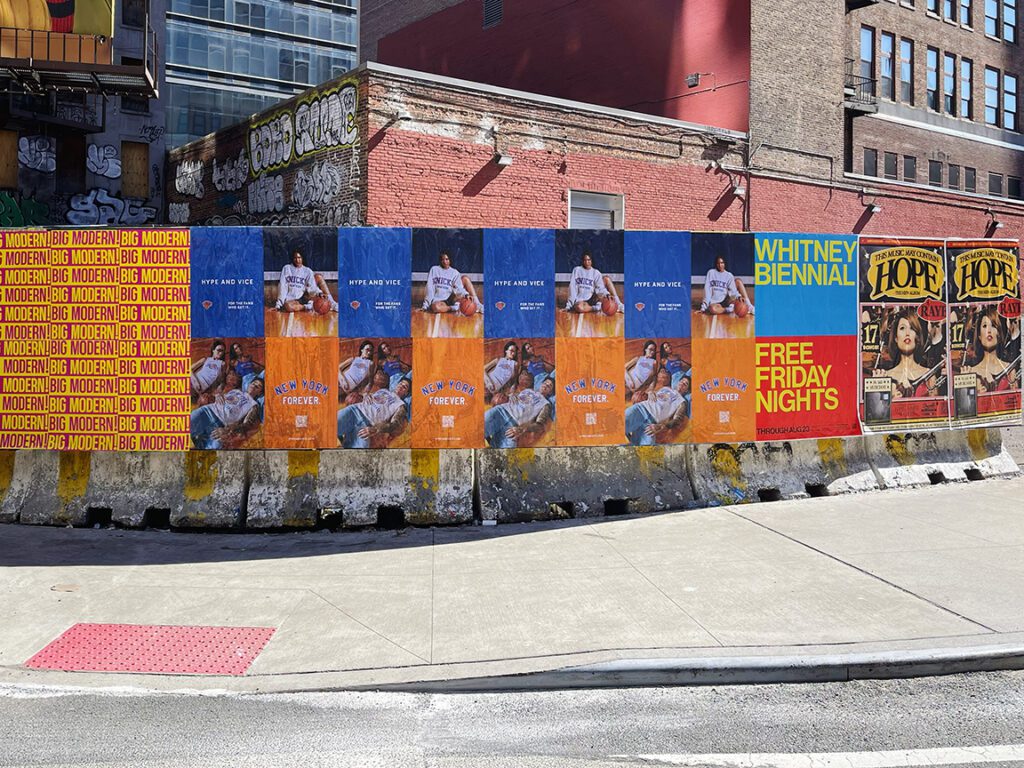
Most outdoor advertising asks you to show up in one place and wait for the right person to walk by. A city takeover wheatpaste campaign asks something different of the city itself — it turns the whole environment into your message. Walk out of your apartment in Williamsburg. Grab the train. Come up in SoHo. Pass through the Lower East Side on the way to a meeting. At every turn, the same image, the same brand, the same visual signal. That’s not coincidence. That’s a city takeover.
American Guerrilla Marketing field operators have been executing city takeover campaigns for over a decade. We’ve placed posters across New York, Los Angeles, Chicago, Atlanta, Miami, and dozens of other media markets. What we know firsthand — from the street level up — is that a city takeover doesn’t just generate impressions. It generates a feeling. The feeling that your brand is everywhere. That it belongs here. That missing it is impossible.
This article explains exactly what a city takeover wheatpaste campaign is, how it differs from standard wheatpaste placement, and what conditions make it the right call for a brand.
The Definition: What a City Takeover Actually Means
A city takeover wheatpaste campaign is a coordinated, high-volume poster placement strategy that covers multiple neighborhoods across a single city within a compressed time window. Instead of placing 20 or 30 posters in one district, a city takeover deploys hundreds — sometimes thousands — of placements spread across the full geography of a market.
The goal isn’t reach in the traditional advertising sense. It’s saturation. The strategy works because humans process the physical environment in patterns. When a person sees the same brand image in Bushwick on Monday, Crown Heights on Tuesday, and Park Slope on Wednesday, their brain doesn’t file those as three separate ad exposures. It files them as evidence that this brand is a real presence in the culture of their city.
That’s a fundamentally different kind of advertising than a billboard on the BQE. A billboard is one fixed point in the city. A city takeover is the city itself turned into your canvas.
What “Takeover” Means in Practice
The word “takeover” gets thrown around loosely in marketing. We use it with a specific meaning. A city takeover campaign meets these criteria:
- Placement in six or more distinct neighborhoods
- Minimum 150 to 200 poster locations across the market
- Execution within a 24 to 72-hour window for maximum simultaneous impact
- Coverage of both high-traffic commercial corridors and residential streets in key demographics
- GPS-tagged documentation of every placement for campaign verification
Anything short of that is a wheatpaste campaign. A good one, maybe a great one. But not a takeover. The distinction matters because the psychological effect — that sense of ubiquity — only emerges above a certain threshold of coverage.
How We Got Here: The History Behind the Tactic
Wheatpasting as a street advertising method has roots going back centuries. Traveling shows, political movements, and early commercial advertisers all used flour-based adhesive paste to affix paper posters to walls. The method survived the digital age not because it’s quaint but because it works on surfaces and at price points that traditional media can’t touch.
The city takeover format as a deliberate marketing strategy started gaining traction in the early 2000s with music industry campaigns. Record labels realized that saturating New York or Los Angeles before an album drop created genuine street buzz that translated into actual sales and streaming numbers. The tactic spread into film, fashion, and eventually tech as brands recognized the same principle applied to any launch that needed to feel culturally significant.
Over the past decade, American Guerrilla Marketing field operators have refined the execution model to a point where we can guarantee consistent coverage in a media market within a narrow time window. GPS-tagged documentation replaced verbal reporting. Permissioned placement networks replaced opportunistic chalking. The core tactic stayed the same. The professionalism of execution improved dramatically.
City Takeover vs. Standard Wheatpaste Campaigns
Let’s put this side by side so the difference is concrete.
| Campaign Type |
Coverage |
Neighborhoods |
Poster Count |
Primary Effect |
| Standard Wheatpaste |
1-2 neighborhoods |
Single district |
20-80 |
Local awareness |
| Multi-Zone Wheatpaste |
3-5 neighborhoods |
Selected zones |
80-200 |
Targeted reach |
| City Takeover |
Entire media market |
6-20+ neighborhoods |
200-1,000+ |
Market saturation + cultural presence |
The jump from multi-zone to city takeover isn’t just a scaling up of the same thing. It’s a qualitative change in what the campaign produces. Below the saturation threshold, people might notice your poster. Above it, they feel like your brand has taken over the city. That’s a different cognitive and emotional response.
The Psychology Behind Saturation
Why does saturation work so differently from simple reach? The answer is in how humans build their sense of social reality.
We rely on environmental signals to determine what’s popular, what’s legitimate, and what deserves attention. When something appears everywhere, we assume it matters. This isn’t a flaw in human cognition — it’s an adaptive shortcut. In most cases, things that are genuinely popular do appear in more places. Advertisers exploit this heuristic by manufacturing the appearance of ubiquity before the reality of it exists.
For a music artist dropping an album, a streaming platform launching a series, or a brand entering a new market, this manufactured ubiquity serves a specific purpose: it signals cultural legitimacy to the exact people who determine whether something becomes culturally legitimate. The tastemakers, early adopters, and media-adjacent professionals who live in Williamsburg, Silver Lake, Wicker Park, and similar urban corridors are the people whose social signal transmission can turn a launch into a moment.
American Guerrilla Marketing field operators target those corridors by design. We’ve walked these neighborhoods. We know which blocks generate photographs that end up on social media, which walls face high foot traffic, and which surfaces hold paste through a week of weather. That firsthand knowledge is what separates a city takeover that creates buzz from one that just places posters.
Field intelligence note: In a 2024 music campaign we ran across New York and Los Angeles, 34% of the social media posts featuring our wheatpaste placements were created by people who weren’t the client’s existing audience — organic amplification from strangers who photographed the work and shared it.
When a City Takeover Makes Sense
Not every campaign calls for a full city takeover. The format has specific use cases where it earns its investment. Here’s where we’ve seen it consistently produce results from our on-the-ground experience.
Album and Single Releases
Music releases remain the native habitat of the city takeover. The compressed timeline of a drop — announcement, pre-save period, release day, first-week streaming numbers — maps perfectly to the window in which wheatpaste saturation does its work. Artists who need to signal cultural relevance in New York and LA before they’ve built mainstream recognition have used city takeover campaigns to manufacture that perception. We’ve run these campaigns across our nationwide portfolio for artists ranging from emerging independents to major label releases.
Streaming Platform Series Launches
When a streaming platform launches a new series, the competition for attention is brutal. A city takeover in New York creates the street-level presence that press coverage alone can’t buy. We’ve placed campaigns for series launches in Astoria, the Lower East Side, Bushwick, and Harlem in the same 48-hour window, creating a unified visual presence across the full geographic range of the city’s most media-connected residents.
Consumer Brand Market Entry
A brand entering a new city needs to shortcut the long process of building awareness from scratch. A city takeover says: we’re here. We’re serious. We’re not testing — we’re committing. That signal matters to retail partners, to press, and to the consumers who pick up on cultural signals before they pick up on advertising messages.
Fashion and Streetwear Drops
Fashion culture runs on perceived scarcity and street credibility in equal measure. Wheatpaste campaigns in the Fairfax District in LA, Soho in New York, and Wicker Park in Chicago speak directly to the consumer segments that drive fashion adoption. A city takeover for a streetwear drop creates the visual cachet that luxury fashion’s billboard advertising was designed to create — but at the street level where streetwear culture actually lives.
Political and Social Campaigns
Ballot initiatives, issue campaigns, and candidate visibility programs use city takeover wheatpaste campaigns to build the kind of grassroots visual presence that paid digital advertising can’t replicate. When voters see a message on a wall in their neighborhood, it carries different weight than an Instagram ad. It feels local. Real. Community-based rather than corporate.
Tech and App Launches
Consumer tech companies — especially those targeting urban, 18-to-35 demographics — have used city takeover campaigns to establish physical presence in an era when their competitors are buying only digital media. The contrast effect alone generates attention: when everything else is digital, something physical stands out.
What Makes a City Takeover Different From Buying a Lot of Posters
Here’s the trap many brands fall into: they assume a city takeover is just a high-volume poster buy. It’s not. Volume alone doesn’t produce the effect. Strategy produces the effect, and volume enables the strategy.
Three elements define whether a city takeover actually takes over:
Geographic Intelligence
Placing 500 posters in the same ten-block radius doesn’t create a city takeover — it creates one very visible cluster. True saturation requires intelligent geographic distribution. American Guerrilla Marketing field operators know which neighborhoods in each major media market are connected in the social circulation of the target audience. A 25-year-old music fan in New York moves through Williamsburg, Bushwick, the Lower East Side, and parts of Manhattan in a normal week. A city takeover maps to that actual movement pattern, not just to a census map.
Timing Concentration
The 24 to 72-hour execution window is not logistically convenient — it’s strategically essential. When placements go up simultaneously across the city, the campaign appears to the person on the street as if the brand materialized overnight. That’s a different effect from posters appearing gradually over two weeks. Simultaneous is striking. Gradual is incremental.
Our operators coordinate multi-crew executions across multiple neighborhoods to hit that window. GPS-tagged documentation captures exact placement times alongside location data, so the campaign record reflects the actual execution rather than an approximation.
Surface Quality and Longevity
A city takeover built on low-quality surfaces won’t hold its visual impact long enough to matter. American Guerrilla Marketing works exclusively with permissioned, licensed surfaces — certified legal walls and approved posting surfaces maintained by property owners across every market we operate in. This isn’t just about legality. Permitted surfaces are generally better quality and better maintained than unpermissioned ones. A poster on a permitted wall lasts longer and holds more visual integrity than one slapped on a condemned building.
“We walked the Fairfax District in Los Angeles and mapped 47 permitted surfaces across six blocks. For a single campaign, we used 22 of them — enough to create visual density without over-clustering. That’s the kind of precision that turns a poster buy into a street presence.”
Why Experience on the Ground Matters
City takeover wheatpaste campaigns look simple from the outside. Paste some posters. Cover the city. Done. Anyone who’s actually executed one knows how many variables can collapse the campaign before it starts producing returns.
Surface condition changes with weather. Permit status changes with property sales and construction. Crews need to manage traffic, timing, and unpredictable street conditions in the dark in multiple neighborhoods at once. Paste consistency affects longevity. Size matters differently on different surfaces.
American Guerrilla Marketing field operators bring firsthand knowledge to every one of these variables because we’ve been managing them for over a decade. We don’t subcontract to vendors we’ve never vetted. Our operators are trained, certified, and have executed campaigns across our nationwide portfolio in every major media market. When a campaign has to go up in New York and Los Angeles in the same week, we coordinate both from the same New York office — a single point of contact, consistent execution standards, unified GPS-tagged documentation.
That operational infrastructure is the guarantee behind every city takeover we run. Not a promise that the posters will go up. A guarantee that the campaign will be executed to spec, documented completely, and delivered in a way that a brand can actually stand behind when they show it to press, to investors, or to a client.
What a City Takeover Doesn’t Do
It would be misleading to only talk about what city takeover campaigns accomplish. They have limits, and understanding those limits is part of using them well.
A city takeover won’t fix a weak creative. The poster has to work — visually, emotionally, communicatively — or the saturation just makes a weak message more visible. We’ve seen campaigns with excellent coverage produce mediocre results because the artwork didn’t stop people in the street. Saturation amplifies whatever you put in front of people. Make sure what you put in front of them is worth amplifying.
A city takeover also won’t sustain a campaign indefinitely. Wheatpaste has a natural lifespan of 2 to 4 weeks before weather, competing posters, or surface changes degrade the image. If you need sustained presence for 3 to 6 months, you need a refresh strategy built into the campaign plan from the start.
And a city takeover isn’t a substitute for a broader campaign. The brands that get the most out of city takeover wheatpaste campaigns are the ones who align the street presence with other elements — social media, PR, experiential activations, digital targeting. Wheatpaste saturation creates a real-world visual environment that social media posts can reference and amplify. That’s the combination that turns a campaign into a cultural moment.
The American Guerrilla Marketing Approach
We’ve been running city takeover campaigns long enough to have watched the format evolve from music industry insider tactic to mainstream brand strategy. What hasn’t changed is the core logic: cover the city, create presence, build the perception that your brand belongs here.
What has changed is the precision of execution. GPS-tagged documentation of every placement is now standard in our operations. Permissioned placement networks have expanded to cover more surfaces in more neighborhoods across every major media market. Our case studies from campaigns across New York, Los Angeles, Chicago, and other cities give clients a concrete basis for understanding what results look like at different budget and volume levels.
We operate on licensed, permitted surfaces. We document everything. We coordinate from a single office, so multi-city campaigns run under unified standards. And we work with clients to build the strategic logic of the campaign before the first poster goes up — because a city takeover without a strategy is just a lot of posters.
If your brand has a launch, a drop, a market entry, or a moment that needs to feel real in the streets of a major city, a city takeover wheatpaste campaign is one of the most effective tools in outdoor advertising. The key is knowing when the format fits the goal, and executing it with the experience and infrastructure to make the saturation count.
Frequently Asked Questions
What is a city takeover wheatpaste campaign?
A city takeover wheatpaste campaign is a coordinated outdoor advertising effort in which a brand places wheatpaste posters at high-density volumes across multiple neighborhoods in a single city — often dozens or hundreds of locations — within a compressed time window to create the impression that the brand owns the city.
How is a city takeover different from a standard wheatpaste campaign?
A standard wheatpaste campaign might place posters in one or two neighborhoods. A city takeover intentionally saturates a media market across 6 to 20+ neighborhoods simultaneously, ensuring that the target audience encounters the brand repeatedly no matter which part of the city they move through.
What types of brands benefit most from city takeover wheatpaste campaigns?
Music artists releasing albums or touring, streaming platforms launching new series, consumer brands entering a new market, fashion labels, film studios, and tech startups launching in a specific city all see strong results from city takeover wheatpaste campaigns because the saturation creates a perception of ubiquity.
Is wheatpasting legal?
AGM places all wheatpaste campaigns exclusively on permissioned, licensed surfaces. Our operators work with certified property owners and permitted legal walls across every city we operate in. We do not place on unpermissioned surfaces.
How long does a city takeover wheatpaste campaign last?
Most city takeover campaigns run 2 to 4 weeks before natural weathering or over-posting changes the surface. AGM can structure refresh cycles to extend your campaign’s street presence for longer windows if needed.