Stadium advertising is one of the most consistently underrated media formats in brand marketing, and that disconnect between its actual performance and its perceived value creates a meaningful opportunity for brands willing to invest intelligently. The core insight is simple: a stadium audience has no skip button. They paid for tickets, traveled to the venue, and committed 2.5 to 4 hours of their undivided attention to a shared experience. Every minute of that experience, your brand is present in the same visual field as the thing they care most about. No digital format, no subscription platform, and no streaming service can replicate that combination of attention quality, dwell time, and emotional context. This guide covers every stadium advertising format, realistic pricing at each venue tier, the broadcast television amplification factor that most analysis misses, and how to build a stadium advertising strategy that delivers measurable returns.
Why Stadium Audiences Are Different From Every Other Advertising Audience
The average American spends more than seven hours per day consuming digital media. In that environment, attention is the scarcest resource in advertising, and every platform is competing for the same eyeballs simultaneously. Advertisements are ambient, running alongside videos, news feeds, and search results in an endless stream of content designed to capture engagement for microseconds before moving on.
A stadium reverses every one of those dynamics. An event attendee has made an active, paid commitment to be physically present in a specific location for several hours. They are not multitasking. They are emotionally invested in what is happening on the field, court, or stage. The shared experience with 20,000 to 100,000 other people creates an emotional amplifier that individual media consumption cannot replicate. And throughout all of it, from the moment they enter the venue to the moment they leave, your brand is present on the perimeter boards, the scoreboard, the concourse signage, and the in-stadium screens.
Dwell time at stadiums averages 2.5 to 4 hours per event. During that window, the same audience sees the same advertising multiple times across distinct phases of the experience: pre-game arrival, in-play, halftime or intermission, and post-game departure. Frequency without fatigue, a combination that is genuinely difficult to achieve in any digital channel, is structurally built into stadium advertising.
Stadium Advertising Formats: The Complete Breakdown
Perimeter LED Boards
The perimeter LED board is the most visible advertising format in professional sports venues. These are the rotating digital displays that line the field boundaries, baselines, or sidelines of NFL, NBA, MLB, MLS, and NHL venues. They rotate through multiple advertisers during game play, typically in 8 to 15-second slots, and are positioned at exactly the line-of-sight level where camera angles capture live game action, which means they appear in broadcast television coverage of every game.
That broadcast visibility is the format’s most significant advantage and the one most analysis misses. A brand running perimeter LED advertising in an NFL stadium is not just reaching the 65,000 to 85,000 fans in the seats. They are reaching every viewer watching on ESPN, CBS, Fox, or NBC, audiences that range from 200,000 to 20 million viewers per game depending on market and matchup. For brands where broadcast amplification matters, perimeter LED delivers television-scale reach with the production cost of a digital sign. Major NFL stadium perimeter LED packages run $200,000 to $750,000+ per season, but the reach delivered across 8 home games plus playoff potential makes the CPM competitive with direct broadcast buys.
Scoreboard and Video Board Advertising
The main video scoreboard or halo board is the highest-attention real estate in any stadium. When play stops, timeouts, between innings, halftime, replay reviews, every eye in the building tracks to the scoreboard. Scoreboard advertising runs as 15- or 30-second video spots and captures the full attention of the complete attendance during stoppages. There is no competing content, no adjacent scroll, no other screen competing for the same attention. Every person in the building is watching the same screen you’re on.
Premium scoreboard advertising in major market NFL, NBA, and MLB venues runs $50,000 to $150,000+ per season for a defined number of spots per game. Mid-market professional venues run $15,000 to $50,000 per season for scoreboard rotation. College football and basketball venues, where the audience can be as large as a professional venue but pricing is significantly lower, run $5,000 to $25,000 for a full season of scoreboard placement at major programs.
Static Concourse and In-Bowl Signage
Static signage throughout the venue, concourse walls, entry plazas, seat back panels, and in-bowl tunnel signage, provides continuous 360-degree brand presence across the entire attendance at every event. Unlike rotating digital formats, static signage delivers guaranteed share of voice: your creative is visible at all times, not competing for rotation slots. Concourse signage is particularly valuable during the 45-minute to 60-minute pre-event arrival period, when fans are walking, exploring, and buying concessions with attention available that isn’t focused on the field.
Concourse signage packages in major professional venues run $25,000 to $100,000 per season. Secondary and minor league venues offer concourse static packages starting at $3,000 to $12,000 per season, accessible price points for regional brands that want consistent presence across a full event season.
Naming Rights
Stadium naming rights represent the most premium and most permanent stadium advertising format. Recent examples include Crypto.com Arena (Los Angeles Lakers/Kings, $700M over 20 years), Allegiant Stadium (Las Vegas Raiders, $25M annually), and SoFi Stadium (Los Angeles Rams/Chargers, $625M over 20 years). Naming rights deals embed the brand into the permanent identity of the venue, in every media reference, every navigation app result, every spoken reference to the location, the brand name appears. This is brand presence at a scale and permanence that no other advertising format achieves.
Major market naming rights deals cost $15M to $30M+ annually. Mid-market arena and stadium naming rights, regional venues in markets like Columbus, Salt Lake City, Raleigh, and Oklahoma City, run $1M to $5M per year. Minor league naming rights start at $50,000 to $250,000 annually and represent outstanding community brand association value for regional advertisers.
Activation and Sponsorship Zones
Branded fan zones, sponsored concession stands, activation tents in plazas, and halftime experience sponsorships give brands interactive touchpoints beyond passive signage. A brand that sponsors the halftime shot competition, the postgame autograph session, or the pre-game fan experience zone creates a direct memory association between the brand and the peak emotional moment of the fan experience. These activations are priced individually and can be combined with media packages for complete event sponsorship.
The Five Core Benefits of Stadium Advertising
Benefit 1: Unavoidable, Repeated Impressions Over Extended Dwell Time
A stadium audience sees the same advertising many times across a 3-hour event. This involuntary repetition in a high-attention environment builds brand recall at rates that digital frequency capping cannot match. Nielsen OOH effectiveness research consistently shows that OOH impressions in high-attention environments, stadiums, arenas, transit hubs, generate higher brand recall per impression than digital display formats in equivalent demographic audience groups. The recall differential is not marginal; it is structural to the attention quality of the environment.
Benefit 2: Highly Concentrated Demographic Audiences
Stadium audiences are not random. A Major League Baseball stadium in a mid-sized market skews 30 to 55 years old, male-skewing, above-market household income. An NBA arena in a major metro skews younger, more diverse, more urban, and more tech-engaged. An NHL arena draws a predominantly 25- to 54-year-old professional audience in most markets. Concert programming at a stadium venue maps directly to the fan demographic of the headliner artist. Advertisers can select the event types, venues, and markets that match their target audience with precision unavailable in most other OOH formats.
Benefit 3: Broadcast Television Extension at Print Cost
Perimeter LED and scoreboard advertising in televised professional sports venues extend brand reach beyond the in-stadium audience to television viewers at a marginal additional cost. The same signage that reaches 65,000 fans in the seats reaches 500,000 to 3,000,000+ regional broadcast viewers and potentially millions more on national broadcasts. For regional brands with primarily local audience goals, the regional sports network broadcast amplification alone can justify the perimeter LED investment when measured against direct broadcast advertising CPMs.
Benefit 4: Positive Emotional Context Transfer
Advertising effectiveness research across multiple methodologies consistently demonstrates that advertisements received in positive, high-arousal emotional states generate higher brand favorability than the same advertisements received in neutral or negative contexts. A fan watching their team in a playoff game, or experiencing a favorite artist at a stadium concert, is in a state of peak emotional engagement. Your brand’s association with that emotional peak creates a subconscious linkage between the brand and the positive experience. This is not a minor effect, it is a structural advantage of event-context advertising that no digital format can replicate.
Benefit 5: Community Identity and Local Market Belonging
In most U.S. markets, the local professional sports team is among the strongest shared identity anchors in the community. Supporting or sponsoring that team associates your brand with community pride and shared identity in a way that national brand campaigns directed at the same market from outside cannot achieve. Regional banks, healthcare systems, local restaurant chains, real estate developers, and automotive dealers consistently find stadium advertising their most effective format for building community trust and local market familiarity. The brand is perceived as a community partner, part of the local fabric, rather than a commercial vendor seeking a transaction.
Stadium Advertising Costs by Venue Tier
Minor League and College Venues
Minor league baseball stadiums (Triple-A, Double-A, Single-A), college football stadiums, college basketball arenas, and semi-professional sports venues offer advertising packages accessible to regional and local brands.
Static signage: $2,500 to $15,000 per season. Scoreboard advertising: $3,000 to $20,000 per season. Naming rights (minor league venues): $50,000 to $250,000 per year. Activation sponsorships: $2,000 to $10,000 per event package. College football venues at major programs (SEC, Big Ten) can approach professional venue pricing for prime placements.
Mid-Market Professional Venues
NBA G-League, AAA baseball, MLS primary markets (not top-tier cities), AHL hockey, and mid-market NFL, NBA, and MLB franchises in markets outside the top 10 DMAs.
Perimeter LED or digital signage packages: $30,000 to $150,000 per season. Scoreboard advertising: $15,000 to $50,000 per season. Full-season static signage: $10,000 to $40,000. Complete sponsorship packages including multiple formats: $50,000 to $250,000 per season.
Major Market Professional Venues
NFL, NBA, MLB, and NHL franchises in New York, Los Angeles, Chicago, San Francisco, Boston, Dallas, Houston, Miami, Seattle, Denver, and Philadelphia.
Perimeter LED packages: $200,000 to $750,000+ per season. Scoreboard advertising: $50,000 to $150,000+ per season. Full-package stadium sponsorships: $500,000 to $5,000,000+ per season. Naming rights: $10,000,000 to $30,000,000+ per year. Event-specific premium placements (playoffs, championship games, All-Star events): separate negotiation, significant premium over regular season rates.
How to Maximize Stadium Advertising ROI
Stadium advertising alone is powerful. Combined with complementary channels targeting the same audience, it becomes significantly more effective. AGM regularly coordinates the street-level components of campaigns that include stadium media.
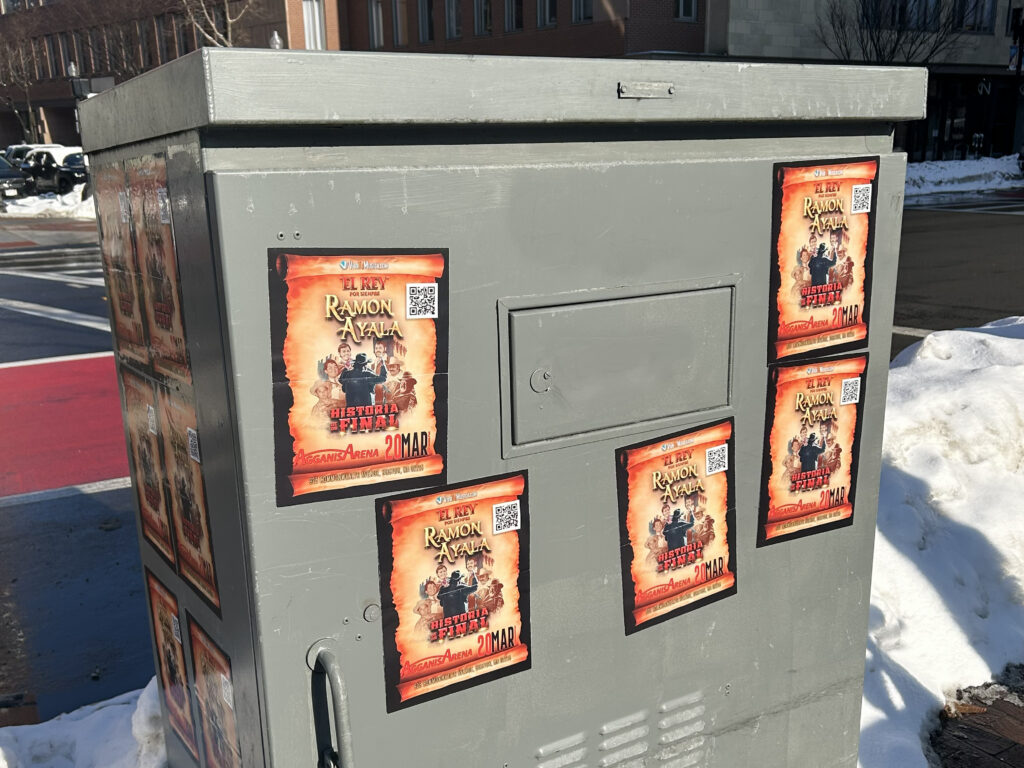
Pair stadium advertising with out-of-home along ingress and egress corridors. The audience arriving at and departing from a stadium passes through specific highway corridors, surface streets, and parking structures. Billboards on the primary arterials leading to the venue, bus shelter advertising at transit stops serving the venue, and street-level street poster advertising in the stadium-adjacent entertainment districts all reach the same audience before and after the in-venue experience.
Layer mobile programmatic advertising geo-targeted within the stadium footprint on event nights. Running programmatic mobile display campaigns within a quarter-mile radius of the venue during game windows delivers digital brand reinforcement to every device in the building simultaneously. The combination of physical in-venue signage and mobile digital advertising at the same location creates cross-channel frequency that drives brand recall measurably above single-format campaigns.
For brands that want stadium audience reach without stadium inventory prices, AGM executes street team and street poster campaigns in the neighborhoods immediately surrounding major venue locations on game and event nights. A street team working the pedestrian corridors around Fenway Park on a Red Sox game night, or the Wrigleyville neighborhood on a Cubs game night, reaches the event audience at street level without a stadium media buy. Contact americanguerrillamarketing.com/contact for venue-adjacent guerrilla campaign planning.
Frequently Asked Questions About Stadium Advertising
Is stadium advertising worth it for a mid-sized regional brand?
Yes, at the right venue tier. Minor league and college venues provide professional-quality advertising environments at price points accessible to regional brands spending $10,000 to $50,000 per year on marketing. A full season of concourse static signage at a Triple-A baseball stadium or major college basketball arena delivers consistent community brand presence across 30 to 70 home events, more total exposure hours than most digital campaigns at comparable budgets.
How do I buy stadium advertising?
Contact the sponsorship sales team directly at the venue or franchise. Major venues have dedicated partnership sales staff. For multi-venue or multi-market stadium advertising programs, agencies with established team and venue relationships can negotiate packages across multiple properties simultaneously. Programmatic DOOH platforms (Vistar Media, Place Exchange) now provide access to some digital stadium inventory without direct venue negotiation.
What’s the minimum spend for professional stadium advertising?
Minor league and college venues start at $2,500 to $5,000 for a partial-season static placement. Full professional league venues typically require $25,000+ for any meaningful presence. Major market venues are generally unreachable for brands spending under $100,000 annually in stadium media.
Can I advertise in stadiums without a full-season commitment?
Yes. Event-specific placements, playoff packages, and single-game sponsorships are available at most venues, particularly for marquee events. Single-game sponsorship minimums at major professional venues start at $5,000 to $25,000 depending on the event’s profile and the placement type requested.
How does stadium advertising compare to digital advertising on ROI?
Stadium advertising is primarily a brand-building format measured by recall, favorability, and community presence, not direct-response click attribution. Its ROI is best evaluated through brand lift studies, regional awareness surveys, and community perception tracking, not last-click conversion data. Brands that fund stadium advertising from performance marketing budgets and measure it on direct response metrics consistently undervalue the format’s actual brand-building impact.
Which sports deliver the best demographics for stadium advertising?
It depends on your target audience. NFL delivers the broadest, highest-income audience with the largest broadcast extension. NBA skews younger, more diverse, and more urban. MLB skews older, suburban, and runs the longest season. NHL skews toward professional, higher-income markets in the Northeast and Midwest. MLS skews younger and multicultural. College football and basketball deliver highly loyal regional audiences with strong alumni network characteristics.
How far in advance do I need to plan a stadium advertising campaign?
Full-season and naming rights deals are typically negotiated 6 to 12 months before the season begins. Individual event sponsorships can sometimes be arranged with 4 to 8 weeks notice. For premium events (playoffs, bowl games, All-Star weekends), desirable inventory is committed months in advance, planning a playoff advertising campaign during the regular season is leaving it too late.
Can small businesses advertise at stadiums?
Yes, at the right level. Minor league sports venues and college athletics programs actively seek local business advertisers for concourse signage, program advertising, and local broadcast sponsorships. A local restaurant, dealership, or service business can build meaningful community brand presence through a $3,000 to $8,000 annual minor league or college venue advertising package, far more event exposure than any equivalent digital spend would produce for a locally-known brand.
Frequently Asked Questions
The Benefits of Stadium Advertising: Reaching a Captive Audience That Can’t Skip Your Brand generates better results when placement, timing, creative, and local execution all work together. These questions cover the details brands usually need before launch, during rollout, and while evaluating performance.
Why is stadium advertising valuable for brands?
Stadiums gather large audiences who stay in one place for an extended time, which gives brands repeated exposure before, during, and after the main event. That mix of attention and scale is hard to match elsewhere.
What types of stadium advertising are most common?
Common options include scoreboard placements, concourse signage, field level boards, sponsored fan zones, digital screens, sampling, and branded activations tied to the event experience.
How do brands choose the right stadium for a campaign?
Start with the audience, team affiliation, event calendar, and market relevance. A smaller venue with the right fan base can outperform a bigger stadium that reaches the wrong crowd.
Is stadium advertising only useful for sports brands?
No. Automotive, healthcare, retail, finance, food, and local service brands all use stadium media when the audience and event environment line up with their goals.
How long should a stadium campaign run?
It depends on the goal. A one game splash can support a launch, while a season long presence usually builds stronger recall through repeated exposure.
What makes stadium creative effective?
Simple messaging, high contrast visuals, and clear branding are essential because people are moving, distracted, and often seeing the ad from a distance.
Can stadium advertising drive direct response?
Yes, especially with QR codes, promo codes, app downloads, or event specific offers. It works best when the action is easy to take from a phone in the moment.
What is the biggest mistake in stadium advertising?
Treating it like a static billboard without considering the fan experience is a common mistake. The strongest campaigns connect to the event, crowd energy, or team culture.
How do you measure stadium advertising results?
Use attendance, impression estimates, scans, offer redemptions, social mentions, sales lift, or traffic changes in the surrounding market to judge performance.
Should stadium advertising include on site activations?
If budget allows, yes. Sampling, contests, branded photo moments, or live fan engagement usually make the media buy more memorable than signage alone.
Related Pages and Articles