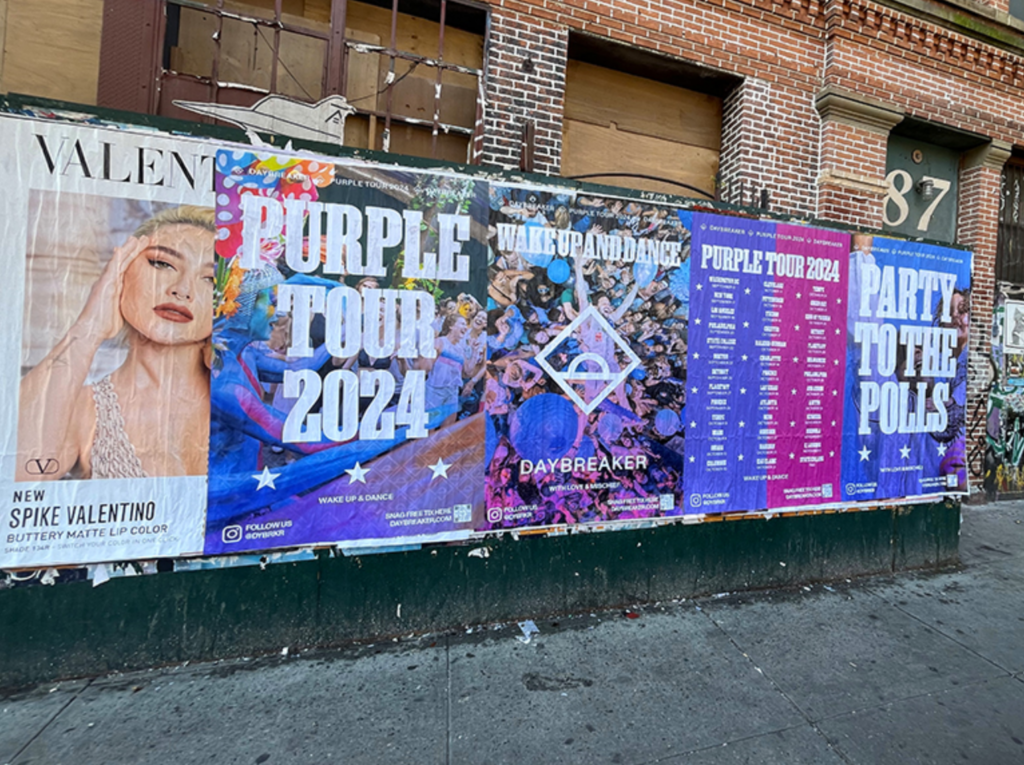
Florida’s advertising market is far more complex than it appears from the outside. What looks like one state is actually five or six distinct media markets, Miami, Orlando, Tampa, Jacksonville, Fort Lauderdale, and the university towns, that each behave differently, require different creative approaches, and carry different cost structures for street poster advertising and street-level campaigns. We have run poster advertising campaigns across every major Florida market, from wheat paste installations in Wynwood to snipe campaigns in Ybor City to brand activations on Orlando’s International Drive. This guide covers what actually works in each city and why, with the specific streets, neighborhoods, and seasonal windows that make the difference between a campaign that lands and one that disappears into the Florida space.
Why Florida Works Exceptionally Well for Poster Advertising
Florida’s year-round warm weather eliminates the winter campaign viability problem that limits outdoor advertising programs across the northern half of the United States. Wheat paste posters maintain visual quality for two to four weeks consistently across all Florida markets regardless of season. No frozen surfaces, no ice-compromised adhesion, no snow-obscured placements. The operational calendar runs year-round without the seasonal gaps that compress campaign windows in Chicago, New York, or Minneapolis.
Tourism fundamentally amplifies Florida’s outdoor advertising reach in ways that purely residential markets cannot replicate. A poster campaign in Miami Beach during Art Basel (early December) does not just reach Miami residents, it reaches 80,000 or more international art industry visitors over a single week. A campaign near the Universal Orlando theme park corridor on International Drive reaches tourists from every US state and dozens of countries simultaneously. For brands with national or international awareness objectives, Florida’s tourist-heavy markets provide a multiplied reach audience whose geographic diversity no other US outdoor market matches.
Florida’s population growth compounds this advantage. The state added more than 300,000 net new residents in 2024 alone, the highest annual population gain of any state. New arrivals are active consumers establishing brand relationships in their new markets, and street-level advertising that reaches them early in their Florida residency creates associations that persist across years of subsequent local purchasing behavior.
Miami: Florida’s Most Valuable Poster Market
Wynwood Arts District (NW 2nd Avenue Corridor)
Wynwood, the corridor centered on NW 2nd Avenue between NW 20th and NW 36th Streets, is the single strongest street poster advertising environment in Florida and one of the most productive in the country. The neighborhood’s mural culture, gallery concentration, and international arts reputation make large-format poster placements on permitted walls genuinely part of the cultural space rather than advertising intrusions. Campaigns that look like art succeed here; campaigns that look like conventional corporate advertising are ignored or photographed as examples of brand tone-deafness.
We have run wheat paste campaigns in Wynwood for music labels, fashion brands, entertainment companies, and product launches. The neighborhood’s organic social sharing culture means high-quality poster creative placed on the major permitted wall surfaces on NW 2nd Avenue, NW 23rd Street, and the surrounding blocks gets photographed and shared by the thousands of visitors who walk through the district each week, generating social impression multipliers that significantly exceed the direct street-level reach.
During Art Basel week in early December, Wynwood’s pedestrian traffic spikes dramatically with an international audience of collectors, curators, gallery directors, and creative professionals. A campaign that goes up in the week before Art Basel and stays through the week of the fair reaches one of the most globally connected street-level audiences available anywhere in the United States. For luxury, fashion, art, and entertainment brands with international awareness objectives, Wynwood during Art Basel is a uniquely concentrated global opportunity.
Little Havana (Calle Ocho, SW 8th Street)
Little Havana’s SW 8th Street corridor between SW 14th and SW 17th Avenues is a high-pedestrian commercial district serving one of the most concentrated Latino communities in the United States. Service walls along SW 8th Street provide excellent wheat paste adhesion surfaces, painted masonry and plywood-faced commercial buildings on the corridor accept paste well and hold campaigns for two to three weeks in Miami’s climate. Dense foot traffic from residents, restaurant visitors, and the cultural tourism that the Calle Ocho neighborhood generates creates consistent impression delivery throughout the day and into the evening.
For brands targeting the Hispanic and Latino demographic in South Florida, Little Havana poster placements with bilingual creative are among the most contextually relevant outdoor placements available in any Florida market. Spanish-language creative on this corridor does not just reach a linguistic audience, it communicates genuine community respect in a way that English-only advertising in this zone does not. Campaigns that acknowledge the neighborhood’s character and cultural identity consistently outperform generic national creative in Little Havana.
Brickell and Downtown Miami
Miami’s financial core in Brickell and the surrounding downtown office corridors attract a professional, higher-income commuter and resident audience during business hours and through the evening. The ongoing development boom in Brickell has produced extensive construction hoarding along Brickell Avenue and around the Brickell City Centre and the surrounding high-rise corridor, providing some of the best large-scale paste surfaces in South Florida. We prioritize hoarding surfaces in the Brickell zone for professional-demographic campaigns because the surfaces are fresh, flat, and in direct line-of-sight for the pedestrian traffic moving between transit stops and office towers.
South Beach (Lincoln Road and the Washington Avenue Corridor)
South Beach’s pedestrian corridors, Lincoln Road Mall (fully pedestrianized between Alton Road and Collins Avenue) and Washington Avenue between 5th and 16th Streets, concentrate international tourist audiences alongside Miami Beach’s affluent resident population. Lincoln Road’s open-air mall format creates genuine pedestrian dwell time that few other Florida corridors match. Poster placements near the Lincoln Road and Collins Avenue intersection reach an audience composed predominantly of tourists with leisure time and discretionary income in active discovery mode, a highly receptive audience for fashion, food, entertainment, and lifestyle brands.
Art Deco Historic District designations in South Beach create permitting complexity for adhesive placements on some surfaces. Water-soluble chalk stencils and washable applications are more broadly viable than adhesive vinyl in the SoBe corridor; adhesive programs require careful surface selection and property owner coordination. AGM works through these parameters before committing placements in South Beach, we do not run adhesive campaigns on protected historic surfaces.
Orlando: Tourism, Students, and the Entertainment Corridor
International Drive and the Convention Center Zone
International Drive, the entertainment corridor connecting Universal Orlando, the Orange County Convention Center, and the Icon Park complex, handles millions of visitors annually and represents the highest single-corridor tourist concentration in Florida outside of South Beach. For consumer brands, entertainment companies, and tourism-related businesses, the I-Drive audience is unmatched in Florida for tourist reach density. Street teams, brand activations, and mobile LED truck campaigns perform exceptionally well in the I-Drive zone, particularly during convention and trade show periods when the Convention Center adds a business-traveler audience to the baseline tourism traffic.
Mills 50 District (Mills Avenue and East Colonial Drive)
Orlando’s Mills 50 district, the corridor around the Mills Avenue and East Colonial Drive intersection extending west toward downtown, is the city’s most creatively engaged neighborhood. Independent restaurants, boutiques, vintage shops, and creative businesses attract the 25 to 40 demographic that most brand campaigns target when looking for early-adopter, culturally influential reach in Central Florida. Poster placements throughout Mills 50 on the permitted wall surfaces and construction hoardings consistently outperform tourist-corridor placements on QR scan rate and social sharing because the local audience is genuinely attentive to neighborhood-level advertising in a way that tourists moving through I-Drive are not.
University of Central Florida Corridor
UCF’s enrollment of over 70,000 students makes the university corridor along Alafaya Trail and University Boulevard east of downtown Orlando one of Florida’s highest-concentration youth demographic zones. For entertainment, food and beverage, app, and lifestyle brands targeting 18 to 24 year olds in Central Florida, UCF-adjacent poster campaigns provide the demographic precision and volume that other Orlando zones cannot offer. The university environment creates a natural poster advertising culture, students pay attention to what is on walls and poles near campus in ways that suburban commuter audiences do not.
The optimal posting radius around UCF concentrates on the Alafaya Trail and McCulloch Road corridors within a half-mile of the main campus entrance, the student apartment complexes along Alafaya Trail between University Boulevard and Colonial Drive, and the commercial strip on East Colonial Drive serving the student population. A campaign that places 150 to 200 snipe and poster placements across this radius reaches the UCF population with genuine frequency over a two-week campaign window.
Tampa: Ybor City and the Channelside District
Ybor City (7th Avenue)
Ybor City’s 7th Avenue historic district is Tampa’s most active street-level advertising zone for entertainment, nightlife, and lifestyle brands. The neighborhood’s bar and restaurant strip generates consistent Thursday-through-Sunday evening foot traffic from a young, entertainment-seeking audience. Permitted wall surfaces on and around the 7th Avenue corridor accept wheat paste well on the painted masonry of Ybor’s historic commercial buildings.
We have run posting campaigns on 7th Avenue in Ybor City for music tours, restaurant openings, and entertainment venue launches where the target audience is specifically the nightlife and entertainment crowd that makes Ybor City their Thursday and Friday evening destination. In each case, placements installed mid-week reach the audience fresh during the weekend peak, the timing alignment between installation and audience density is one of the most controllable variables in any posting campaign.
Water Street Tampa and Channelside
Water Street Tampa, the new mixed-use development district adjacent to the Amalie Arena and the Channelside neighborhood, is Tampa’s fastest-evolving commercial zone. Amalie Arena (capacity 19,000) generates event-night audience concentrations that make the surrounding streets productive for street poster advertising and mobile LED truck campaigns tied to specific shows or sporting events. The Tampa Bay Lightning NHL home game schedule and major concert dates provide a predictable calendar of high-audience-density nights when the Water Street corridor reaches its peak pedestrian density.
Jacksonville: Riverside and Springfield
Jacksonville’s size, the largest city by land area in the contiguous United States, fragments its advertising space. Street-level campaigns need to concentrate on specific commercial nodes rather than attempting broad geographic coverage. Riverside and Avondale, the historic arts and restaurant districts along King Street between Post Street and Dancy Street and along Willow Branch Avenue, are Jacksonville’s most walkable neighborhoods and the strongest environments for poster advertising targeting culturally engaged local audiences.
The Bier Garten corridor on King Street in Riverside concentrates some of Jacksonville’s strongest independent restaurant and bar foot traffic. Placements on the permitted surfaces along this stretch reach the neighborhood’s above-average-income young professional audience during their most leisure-receptive moments. For brands targeting Jacksonville’s creative and professional community, Riverside placements carry contextual relevance that a generically placed Jacksonville campaign does not achieve.
Springfield, Jacksonville’s oldest residential neighborhood undergoing active revitalization along Main Street, represents an emerging posting zone. For brands that want early-mover positioning in a Jacksonville neighborhood whose demographic profile is shifting toward younger, arts-engaged residents, Springfield’s Main Street corridor offers placement access before the market pricing fully reflects the neighborhood’s rising profile.
Florida Campaign Logistics and Climate Considerations
Summer Paste Formula Modifications
Florida’s summer climate, 90°F or higher with humidity above 80% from June through September, requires adjusted paste formulas and installation timing. Standard wheat paste applied to a wall that has been sitting in direct Florida sun can begin surface-drying before the poster is fully bonded, creating adhesion voids beneath the paper. We use methylcellulose-modified paste in summer Florida campaigns and run all installs during the early morning hours (4 to 7 AM) when wall surface temperatures are at their daily minimum.
In Miami’s Wynwood and Brickell districts specifically, the dense urban canyon effect retains heat overnight, some shaded walls may not cool adequately by 4 AM during heat wave periods in August. We carry a non-contact thermometer on Florida summer install runs and test wall surface temperature before committing materials. Surface temperature above 95°F requires either waiting for a cooler window or relocating to a shaded alternative surface.
Hurricane Season and Campaign Planning
Active Atlantic hurricane season runs June through November, with the highest storm risk concentrated in August and October. Individual storm tracks are unpredictable, but the pattern of heavy rainfall events associated with storm systems and tropical weather means Florida campaigns planned for late summer and fall should account for weather-related poster damage as normal operational reality. We schedule refresh audits every 7 to 10 days during hurricane season campaigns and budget for replacement materials at the campaign planning stage.
Tourist Season vs. Resident Season
Florida’s tourist influx peaks in two windows: December through March (snowbird season) when northern retirees and vacationers arrive, and July through August (family vacation season) when theme park and beach tourism peaks. For brands targeting the tourist audience, these windows are when South Beach, International Drive, and Wynwood reach their highest audience densities. For brands targeting Florida’s resident and local population, the shoulder seasons (April-May and September-November) deliver the same resident audience with reduced tourist competition for attention and at lower posting demand pressure on permitted wall networks.
Frequently Asked Questions About Florida Poster Advertising
What is the best city in Florida for street poster campaigns?
Miami’s Wynwood district is the strongest street poster advertising market in Florida for creative brands targeting arts-engaged and culturally influential audiences. For tourist-reach objectives, South Beach and Orlando’s I-Drive corridor provide high-volume visitor audiences. For authentic local community reach in each market, Ybor City in Tampa, Mills 50 in Orlando, and Riverside in Jacksonville are the highest-performing street-level zones.
How much does poster advertising cost in Florida?
Campaign costs vary by market, scale, and duration. Contact AGM at americanguerrillamarketing.com/contact for a Florida-specific campaign quote.
Does AGM run poster campaigns across Florida?
Yes. We run wheat paste posting, snipe campaigns, sidewalk stencils, and street team programs across Miami, Orlando, Tampa, Jacksonville, Fort Lauderdale, and throughout Florida. We have crew relationships, permitted wall networks, and documented market knowledge in all major Florida markets.
What is the best Miami neighborhood for a brand targeting young professionals?
Brickell and the Downtown Miami corridor reach the professional and financial services demographic during commute and lunch-hour windows. Wynwood reaches the arts-engaged creative professional community. The Design District along NE 39th and 40th Streets reaches the luxury-consumption-oriented professional audience. Each neighborhood requires different creative approaches, what reads well in Wynwood is different from what reads well in Brickell.
Can street poster advertising be done during Art Basel in Miami?
Yes, and this is one of the highest-impact outdoor campaign windows in the country. The week of Art Basel Miami Beach (typically first week of December) concentrates 80,000+ international art and culture professionals in the Miami Beach, Wynwood, and Design District areas simultaneously. Campaigns installed the week before Art Basel reach the pre-event crowd and sustain through the fair’s peak period. Lead time for Art Basel-adjacent campaigns should be 6 to 8 weeks for wall confirmations and material production.
How does Florida’s humidity affect wheat paste poster longevity?
High humidity slows paste curing, which extends the vulnerability window during which rain can wash out fresh installations. We use methylcellulose-modified paste for all Florida summer campaigns to improve water resistance during the extended cure window. With proper modifications and timing, posters in Florida hold two to three weeks through normal summer weather. Tropical storm events require post-storm assessment and replacement of any compromised placements.
What is the average cost of a Miami street poster campaign?
Contact AGM at americanguerrillamarketing.com/contact for a Miami-specific campaign quote. We structure programs based on posting count, geography, duration, and creative requirements, there is no single universal rate for Miami street poster campaigns because the variables affecting cost span too wide a range.
Does AGM have relationships with specific Wynwood wall owners?
Yes. We maintain permitted wall relationships in Wynwood and throughout Miami’s major posting zones. These established relationships provide surface access, fair pricing, and compliance assurance that brands negotiating wall access independently often cannot secure. Our Wynwood network includes high-visibility surfaces on NW 2nd Avenue and the surrounding cross streets that have hosted campaigns for major entertainment and consumer brands.
Frequently Asked Questions
Poster Advertising in Florida: The Complete Guide to Street-Level Campaigns Across the Sunshine State generates better results when placement, timing, creative, and local execution all work together in Florida, New York. These questions cover the details brands usually need before launch, during rollout, and while evaluating performance.
Which Florida cities are strongest for poster advertising?
Miami, Orlando, Tampa, Jacksonville, and Fort Lauderdale are common starting points because they combine population density, tourism, and active street culture.
How should poster campaigns change for Florida weather?
Use durable stock, strong paste, and install around the forecast when possible. Heat, humidity, and summer storms can shorten poster life if the crew is not prepared.
What neighborhoods matter most in Miami for posters?
Wynwood, Downtown, Brickell, the Design District, and event-heavy areas near Miami Beach each serve different audiences. Route choice should match the brand, not just the city name.
Is Orlando mainly a tourist poster market?
Not only. Tourist zones matter, but local districts, college routes, and nightlife corridors can be more efficient depending on the product and timing.
When should brands book around Art Basel or big Florida events?
Start weeks in advance because premium walls and local production capacity tighten up quickly. Event-season campaigns usually reward early planning.
What poster sizes are most practical in Florida street campaigns?
Standard one-sheet and larger multi-sheet builds are both common. The right size depends on wall type, viewing distance, and whether the route is mostly pedestrian or vehicle-facing.
How long should a Florida poster run stay up?
Two to four weeks is a practical planning window for many campaigns, with monitoring if the event or season makes the timing especially important.
Do tourist markets need different creative than local markets?
Yes. Tourist-heavy zones reward simpler, faster messages while local neighborhood routes can support more cultural nuance and repeated exposure.
How should a Florida poster campaign be measured?
Track photo proof, route density, QR or landing-page response, and any local sales or search lift tied to the active period. The best measurement matches the campaign goal.
What is the most common Florida poster planning mistake?
Treating the whole state like one market. Miami, Orlando, Tampa, and Jacksonville each behave differently and should be planned that way.
Related Pages and Articles