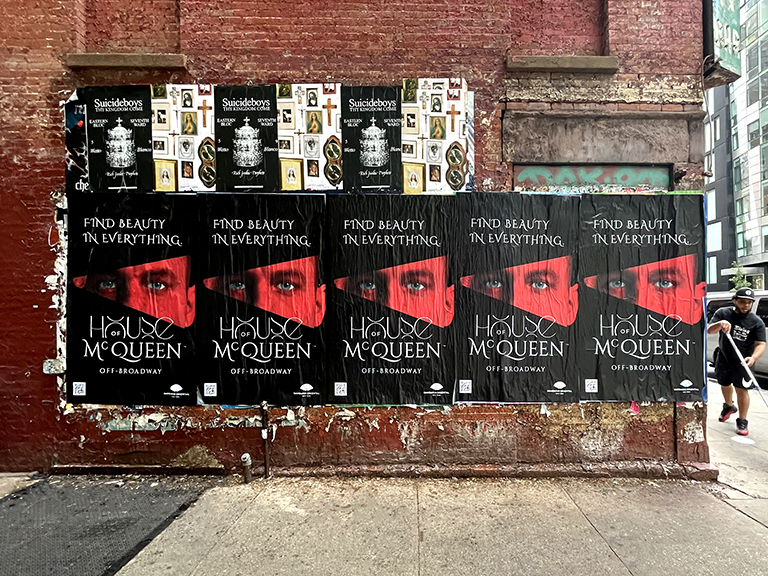
Wheatpasting in London’s Theater District: Poster Strategy for Shows starts with matching the right streets, surfaces, audience, and campaign timing. The West End theater district is one of the most densely programmed entertainment zones in the world. Shaftesbury Avenue alone contains the Lyric, the Apollo, the Gielgud, the Queen’s, the Palace — five major theaters within a quarter mile. Add St Martin’s Lane (the Noel Coward, the Duke of York’s), Drury Lane (Theatre Royal), the Strand (the Adelphi, the Vaudeville, the Savoy), and the surrounding streets, and you have more than forty major theaters operating within roughly a square kilometer of central London.
This concentration creates both the opportunity and the challenge for wheatpaste campaigns in the theater district. The opportunity is obvious: the streets around these theaters are walked by theatergoers, by tourists who have come to London specifically for the West End, by the working professionals who work through these streets daily, and by the arts community for whom the West End is both workplace and entertainment venue. The challenge is that this is Westminster Borough — the most actively enforced flyposting zone in London — and the regulatory environment requires clean surface permissions in a neighborhood where those permissions are more restricted and more carefully policed than in Shoreditch or Brixton.
This guide is specifically about running a wheatpaste campaign in the theater district itself — the streets around Shaftesbury Avenue, St Martin’s Lane, and Drury Lane — rather than in broader London neighborhoods. It covers surface access in Westminster, the timing dynamics of the theater audience, and how in-district campaigns complement the broader London neighborhood campaigns that theater productions typically run alongside them.
The Theater District Geography
The West End theater district occupies a relatively compact area. Its boundaries are roughly:
- North: Oxford Street / New Oxford Street
- South: The Strand and Aldwych
- East: Charing Cross Road (with theaters up toward High Holborn)
- West: Regent Street and the Leicester Square area
Within this area, Shaftesbury Avenue is the primary theater street. St Martin’s Lane runs parallel to it one block west. Drury Lane extends north from the Aldwych through Covent Garden. The maze of streets connecting these major arteries — Bow Street, Earlham Street, Long Acre, Neal Street — carry the foot traffic that moves between theaters, restaurants, and tube stations before and after performances.
London’s West End district hosts approximately 15 million theater visits per year, making it the world’s highest-density theater market by audience volume. Show time foot traffic on Shaftesbury Avenue — the pedestrian surge between 7:00pm and 7:30pm on performance nights as audiences arrive — can exceed 10,000 pedestrians per hour on the busiest nights of the week.
Surface Access in Westminster
Westminster Borough is the London authority most associated with active flyposting enforcement. The council employs dedicated environmental wardens who patrol for unauthorized advertising, and the concentration of tourists, high-end retail, and premium commercial real estate in Westminster makes the borough’s management of its visual environment particularly rigorous.
Legitimate surface access in the theater district exists through several channels:
Construction Site Hoardings
London is always under construction somewhere, and the West End is no exception. Development projects around Covent Garden, Soho, and the surrounding streets regularly produce hoarding panels that operators with hoarding access arrangements can use. These are the most accessible surface type in the theater district and generate high visibility on busy pedestrian streets. Availability varies by project stage and requires an operator with current knowledge of what hoardings exist and which have access arrangements.
Private Property Walls
Some West End property owners allow postering on their buildings as part of ongoing commercial arrangements or arts-support programs. These are less numerous than in East London but exist for operators who have cultivated the relationships. The surfaces tend to be on side streets rather than main frontages, which limits the foot traffic value slightly but still provides in-district presence.
Licensed Advertising Sites
Some locations in Westminster are licensed for temporary advertising displays under the town planning system. Campaigns that need guaranteed, regulation-compliant placement in the theater district area sometimes use these rather than privately negotiated wall access.
Evening Traffic Patterns in the Theater District
The theater district has a specific temporal rhythm that differs from residential or daytime commercial neighborhoods. The relevant periods for campaign visibility are:
Pre-Show (5:30pm-7:30pm)
Audiences arriving for evening performances, many of them having traveled from across London. This is the primary foot traffic window for in-district campaign visibility. Audiences are on foot, often moving from tube exits (Leicester Square, Covent Garden, Charing Cross) toward their venue, and have heightened receptivity to theater marketing they encounter en route.
Post-Show (9:30pm-11:00pm)
Audiences leaving performances and dispersing into Soho for dinner and drinks or heading to transport. This is secondary traffic — the audience has already committed their evening — but post-show exposure builds consideration for future visits.
Matinee Days (Wednesday and Saturday)
Wednesday and Saturday matinee performances generate afternoon foot traffic from 12:00pm-2:00pm that’s distinct from the weekday daytime baseline. Saturday matinee plus Saturday evening doubles the foot traffic on that day, making it the highest-value day for theater district campaign visibility.
“A poster on Earlham Street in Covent Garden at 7pm on a Saturday has an audience walking past it who have specifically organized their evening around going to the theater. There’s no audience in London more receptive to a theater campaign than one that’s already in the neighborhood to see a show.”
In-District Campaign Strategy
An in-district theater campaign concentrates placements within the theater district boundary — primarily in Covent Garden, around Leicester Square, and on the streets between Shaftesbury Avenue and the Strand. The audience reached is already in theater territory, which gives the campaign a specific kind of relevance. Seeing an advertisement for a show playing three streets away, while walking through Covent Garden before dinner, is a qualitatively different encounter than seeing the same advertisement on the tube.
In-district campaigns work best when they include:
- Venue name on the poster (audiences need to know where to go as well as what to see)
- Short URL or QR code that goes directly to the booking page (friction reduction at the moment of highest intent)
- Performance schedule or booking information that makes the action step clear
Combining In-District and Broader London Campaigns
Most effective theater campaigns combine in-district placements with broader neighborhood campaigns that reach potential audiences in their home and work neighborhoods before they’ve made their evening plans. The two approaches serve different moments in the audience decision process:
- Shoreditch, Islington, South Bank: Reach the audience weeks before opening night, in their home neighborhoods, building consideration before they’ve made any specific theater plans
- Theater district: Reach the audience on the night, when they’re already committed to spending the evening at the theater and may be deciding between options for the next visit
Neither approach without the other captures the full opportunity. The neighborhood campaign plants the seed. The theater district campaign waters it.
How Theatre District Intent Differs From General West End Queries
This search phrase is more location-specific than a broad West End theatre marketing term. The reader wants to understand how poster campaigns behave inside the central theatre zone itself. Search-adjacent results stress iconic imagery, high pedestrian volumes, and competition for attention around venue clusters. That makes campaign focus and placement logic especially important.
To align with intent, the page should speak to the central streets where theatregoers, tourists, and hospitality traffic overlap. Searchers want to know how close posters should sit to venues, whether central density beats broader city spread, and how a show can stand out when every block is already selling entertainment. Common winning subtopics include poster creative for walking-speed recognition, launch windows before previews or press nights, and supporting neighborhood extensions into Soho, Covent Garden, and Seven Dials.
The best title patterns for this type of query combine the phrase theatre district with a clear payoff like strategy, guide, or best locations. The article works best when it keeps the focus on show marketing decisions in central London and avoids drifting into general neighborhood commentary. That is what the searcher is really paying attention to.
Keeping the geography tight is especially important here. Searchers using theatre district language are telling you they care about central-zone tactics, not London at large. The content should keep rewarding that specificity.
That specificity also creates better title and heading alignment. When the page keeps returning to show launches, central foot traffic, and theatre-adjacent visibility, it stays much closer to what the searcher actually means by this query.
Searchers using this phrase usually want tactical reassurance that the central zone can still be worked intelligently despite the clutter. A page that keeps answering that point will feel far more relevant than one that treats the district as just another generic London area.
That tighter central focus is what gives the query its value. The reader is not looking for all-purpose London advice. They want theatre-district street strategy that feels built for live show marketing and central foot traffic.
Frequently Asked Questions
The Theater District’s Physical Advertising market
The London theater district — concentrated along Shaftesbury Avenue, St Martin’s Lane, and Drury Lane — operates within some of the most tightly regulated public space in the city. Westminster Council’s enforcement presence means unauthorized flyposting in this area is detected and removed quickly. The professional campaign model, using documented private surface access, is not just preferable here — it’s the only model that works.
AGM’s crews have worked the theater district for productions ranging from major Lloyd Webber revivals to independent transfers from Edinburgh. The surface knowledge we’ve built in this specific geography is the reason we can guarantee placement durability in an area where unauthorized posters rarely survive 48 hours.
Approved Surface Types in the Theater District
The theater district’s approved surfaces cluster into three categories: hoarding panels around the ongoing construction that perpetually reshapes the area (there are always active construction hoarding sites within five minutes of Shaftesbury Avenue), private commercial walls on side streets where property owners maintain ongoing permission agreements with postering operators, and designated street culture zones in Covent Garden where the local authority has accommodated commercial poster placements as part of the broader street arts programming.
The West End theater district encompasses approximately 40 licensed venues within a one-mile radius. Shaftesbury Avenue alone hosts eight major theaters. The immediate catchment streets — Wardour Street, Charing Cross Road, Long Acre, New Oxford Street — collectively handle millions of pedestrian journeys weekly.
Timing Campaigns Around Theater Audiences
Theater audiences in the district move in predictable patterns. Pre-show traffic (6pm-7:30pm Tuesday through Saturday) is the most concentrated window of theater-going foot traffic on any given week. The audience arriving for evening performances comes from the tube at Covent Garden, Leicester Square, and Tottenham Court Road and walks to venues. Post-show traffic (9:30pm-11pm) is dispersed and less predictable.
The implication for campaign timing: posters need to be fresh and visible for Tuesday through Saturday evening audiences. Weekend matinee traffic (Saturday and Sunday afternoons) adds a secondary peak. Our recommendation for theater district campaigns is a Wednesday overnight posting run — posters are fresh for the peak Tuesday-through-Saturday evening traffic for the full first week.
Seven Dials: The Neighborhood That Theater Audiences Walk Through
Seven Dials, at the junction of seven streets in Covent Garden, is positioned between the West End’s residential (Soho) and entertainment (Shaftesbury Avenue) zones. Theater audiences, pre-show diners, and post-show bar-goers all move through it. The central column at the junction is a landmark, and the radiating streets — Neal Street, Shorts Gardens, Mercer Street — have walls that face foot traffic from multiple directions simultaneously.
We’ve placed theater campaigns in Seven Dials for both commercial West End productions and independent companies using the area as a general entertainment district campaign. The foot traffic here includes a high proportion of pre-committed entertainment consumers — people who are already out for the evening, already spending on culture and food, and receptive to discovering what else is on.
What Makes Theater District Campaigns Work
The theater district’s sophisticated, arts-engaged audience responds to quality. A poorly printed poster on a poorly chosen wall does not just underperform — it actively damages brand perception for a production that has invested significantly in its overall marketing. The barrier to doing it right is not high, but the basics have to be in place.
High-quality print stock (150gsm minimum), accurate color representation, a clean installation, and a location that respects the neighborhood’s visual context are the fundamentals. Beyond that, the campaigns that stand out in the theater district are the ones with genuine creative ambition — artwork that treats the wall as the medium, not as a flat backdrop for a poster designed for another context.
From what we’ve seen in the field, theater productions that invest in quality street campaigns in Seven Dials and Soho generate more organic social media coverage of their campaigns than productions spending the same money on tube card advertising. The street context invites photography. The tube does not.
The Link Between Street Campaigns and Audience Discovery
The West End theater district attracts audiences from across London and from international tourism. But audience discovery — the moment a potential theater-goer learns that a production exists — happens in dispersed environments, not just in the theater district itself. Street campaigns in the areas where the target audience lives and socializes create discovery moments that precede the decision-making process, building familiarity before the audience actively searches for something to see.
This is the specific value that wheatpasting provides for theater that above-the-line advertising in the theater district itself does not: the campaign follows the audience to where they already are, rather than waiting for them to enter the theater district. A commuter who walks past a production’s campaign in Dalston or Islington on their way to the tube is building familiarity with the show before they ever consult a listings website or walk down Shaftesbury Avenue.
Budget Allocation for Theater District Campaigns
The question of how much of a production’s marketing budget to allocate to street campaigns is production-specific, but there are some useful benchmarks from the campaigns AGM has managed for theater clients.
For a standard West End commercial production with a full marketing budget, street campaigns typically represent 5-15% of total media spend. That allocation covers the theater district core, two or three adjacent neighborhood campaigns, and one residential reach campaign. The total spend is relatively modest against the full marketing budget, but the visibility it generates — particularly the earned media through social sharing and press encounter — consistently delivers above the proportional allocation.
For smaller productions and Fringe transfers with tight marketing budgets, street campaigns can represent a higher proportion of total spend precisely because they deliver high visibility per pound. A £3,000-£4,000 wheatpaste campaign in the right neighborhoods can reach more of the target audience than the same spend in digital display advertising, particularly for arts-engaged demographics who run ad blockers and tune out online advertising.
AGM’s crews have placed for theater district campaigns across Shaftesbury Avenue, Seven Dials, and the South Bank. The productions that get the most from the format are the ones that bring their creative director into the surface selection conversation — the people who understand both the artwork and the walls consistently make better placement decisions than a generic media buy.
Where exactly is the West End theater district in London?
The West End theater district is concentrated along Shaftesbury Avenue from Piccadilly Circus to High Holborn, with major theaters on St Martin’s Lane, Drury Lane, the Strand, and surrounding streets in Soho and Covent Garden. The area is bounded roughly by Oxford Street to the north, the Strand to the south, Charing Cross Road to the east, and Regent Street to the west. More than forty major theaters operate within this concentrated area.
What surface access is available for wheatpasting in the West End theater district?
Surface access in Westminster requires documented permission from property owners. The primary options are construction site hoardings (available when active development projects are producing hoarding panels), private property walls where owners have established postering arrangements, and licensed advertising sites. Westminster is London’s most actively enforced flyposting zone, so clean permissions are essential and cannot be improvised.
How does theater district wheatpasting differ from broader London campaigns?
The theater district has high evening foot traffic from theater-going audiences who are already in a theater-related mindset. The audience reached in-district is at a different stage of their decision process than audiences reached in residential neighborhoods. In-district campaigns reach people who are already committed to a theater evening; neighborhood campaigns reach people before they’ve made that decision. Both approaches are valuable but do different work.
What is the best time to post in the West End theater district?
Between midnight and 4am on weeknights, when post-show crowds have dispersed and the streets are quieter for the crew to work efficiently. Friday night posting ensures fresh placements for Saturday’s matinee and evening performances, which see the highest foot traffic of the week. Tuesday overnight is the lowest-competition posting time because Monday and Tuesday see the lowest show attendance in the West End.
Should a West End show post in the theater district or in other London neighborhoods?
Both, for maximum effect. Theater district placements reach audiences who are already in the theater-going zone, at the moment of highest intent for next-visit booking decisions. Broader London neighborhood placements in Islington, Shoreditch, and South Bank reach potential audiences in their home neighborhoods before they’ve made evening plans — building consideration over a longer period. The two approaches are complementary, not duplicative.