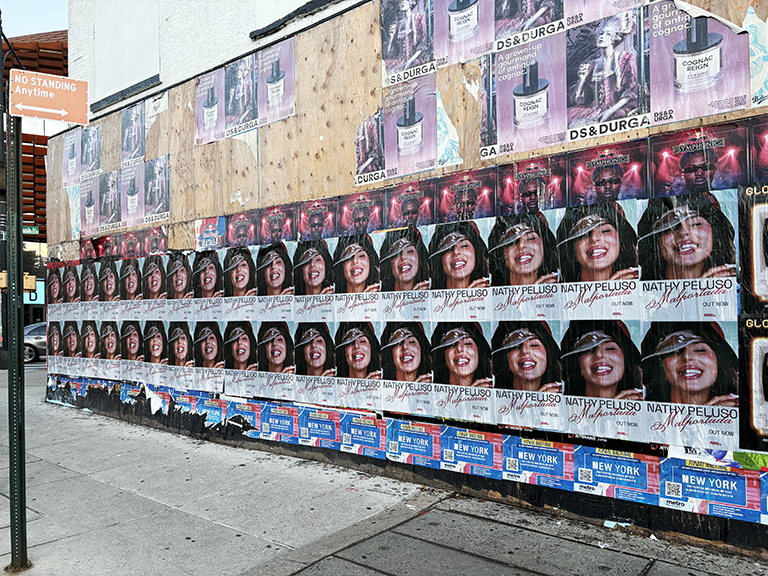
Music and London walls have been in conversation for a long time. Before streaming, before Spotify editorial playlists, before the algorithmic recommendation engine decided what 30 million people heard next, there were posters. The ones taped to lampposts in Camden announcing a Clash gig at the Electric Ballroom. The ones pasted on Brixton walls for sound system events at Fridge. The hand-lettered ones in Dalston windows. Street postering was how the music got from the artist to the audience before the internet flattened the distribution of that information.
That mechanism still works. Not for the same reasons — physical posters in 2026 are not how people discover music in the way they might have in 1982. But the physical presence of an artist’s artwork on a London street does something specific that a Spotify pre-save campaign cannot: it makes the release feel like an event happening in the real world, in a specific place, for a specific community. When a grime artist’s campaign goes up on the walls in Dalston in the week before an album drops, the people walking those streets who are part of that artist’s world know that something is happening. That awareness is not algorithmic. It’s physical, it’s local, and it carries weight that digital reach can’t fully replicate.
This guide is about how music campaigns work in London — how labels and artists use wheatpaste campaigns to build that street-level presence, which neighborhoods deliver for which genres, and how to structure a campaign that creates genuine buzz rather than just posters.
Genre-Specific Neighborhood Targeting
London’s music geography is not uniform. Different genres have different home neighborhoods, different venue ecosystems, and different fan demographics. The most effective music wheatpaste campaigns in London are the ones that understand this geography and concentrate placements where the audience actually is.
Grime, UK Garage, and Afrobeats: South and East London
Grime emerged from east London council estates — Bow, Stepney, Hackney — in the early 2000s. The genre’s community, its production, and much of its audience remain concentrated in east and south London. Campaigns for grime, UK garage, and Afrobeats artists should prioritize Dalston, Hackney, Stratford, and the south London corridors through Brixton and Peckham. The O2 Academy Brixton, the Drumsheds in Tottenham, and Fabric in Farringdon are the venue poles for this audience, and the streets connecting these venues to the residential neighborhoods where the fan base lives are the right postering zones.
Electronic, Techno, and Club Music: East London and Hackney Wick
London’s electronic music scene is concentrated in a specific geography — Hackney Wick, Dalston, Bethnal Green, and the handful of warehouse venues that have survived the sustained pressure from developers. Fabric on Charterhouse Street pulls from across London, but its core audience has a strong east London center of gravity. Campaigns for electronic acts should concentrate in Hackney Wick, along the canal from Hackney to Bow, and in the Dalston Junction area where many of the community’s key venues and record shops are located.
Indie, Alt, and Rock: North London and Shoreditch
Indie and alternative music campaigns historically concentrated in Camden. That’s still relevant, but the north London music scene has dispersed slightly north toward Kentish Town (the Forum), Islington (the Assembly Hall, the Union Chapel), and the residential areas feeding into those venues. Shoreditch connects the indie audience with the tech and creative industry demographic that follows guitar music from streaming. A campaign covering Camden, Islington, and Shoreditch reaches the full indie demographic range.
Jazz, Folk, and Contemporary Classical: South Bank and Beyond
London’s jazz and contemporary classical scene is anchored by the Barbican, the Southbank Centre (including the Royal Festival Hall and Queen Elizabeth Hall), and venues like Ronnie Scott’s in Soho and Pizza Express Jazz Club. Campaigns for this audience should concentrate in the South Bank corridor, Soho, and Bloomsbury — neighborhoods where arts-engaged, educated, professional Londoners in the 30-55 age range are concentrated.
London has approximately 150 active music venues across its boroughs, from 100-capacity rooms to the 20,000-seat O2 Arena. The city generates an estimated £1 billion annually in live music revenue and hosts around 40 million music-related audience visits per year, making it one of the three largest live music markets in the world.
Types of Music Campaigns and How They Use Street Posting
Album Launches
Album campaigns have the longest campaign window and the most defined release moment. Two to three weeks of street presence before release date is the standard. First posting round creates anticipation. Second posting round (if budget allows) lands on or just before release day. The artwork for album campaigns should be the album cover itself — the visual that audiences will associate with the music when it appears in streaming apps, in press coverage, and in social media posts. Consistency across all channels at street scale is part of what makes an album launch feel coordinated rather than scattered.
Tour Announcements
Tour campaigns are more time-sensitive than album campaigns because the conversion goal — buying a ticket — has a hard deadline (the show date, and often a sales window before tickets sell out). Wheatpasting for tour campaigns should go up on the day of the announcement or the day after, when the news is freshest. The poster needs to include the London date, the venue, and a URL or QR code that goes directly to the ticket page. Three-week lead time between the announcement campaign and the show date is the sweet spot — enough time to create awareness, not so much time that the campaign feels stale before the show.
Single Releases
Single campaigns are shorter by nature. One or two posting rounds, concentrated in the artist’s primary London fan base zones. The design for single campaigns often features the track title prominently — the campaign is asking people to find and listen to a specific piece of music, so the title needs to register clearly enough that someone will recognize it on a streaming platform after seeing it on a wall.
“The best thing that can happen to a London music wheatpaste campaign is for a fan to photograph it and post it. That social share is worth ten times the physical placement in terms of reach. Design for the photograph, not just the wall.”
The Social Media Amplification Loop
London’s music community is highly active on social media, and the visual culture around music — the artwork, the typography, the aesthetic identity of artists — is something fans engage with. A well-designed wheatpaste campaign in Dalston or Peckham will be photographed and shared by fans, by music journalists, and by people who simply find the art compelling. That organic amplification is not guaranteed, but it’s predictable enough with the right combination of location, design quality, and artist community size to factor into campaign planning.
Some labels specifically design their wheatpaste artwork to be photogenic from the perspective of the people walking past it — incorporating the street environment into the composition, using design elements that reward close inspection, or creating a visual that feels specific to the neighborhood it’s posted in. This approach generates more organic sharing than a straightforward poster drop because it gives people a reason to post beyond simple promotion of an artist they like.
Record Shops as Campaign Anchors
London’s independent record shops — Rough Trade East in Brick Lane, Sounds of the Universe in Soho, Sister Ray in Soho, Phonica in Soho, Reckless Records in Soho, Flashback Records in Islington — are cultural institutions that maintain loyal weekly audiences of music-engaged Londoners. Wheatpaste placements within a few hundred meters of these shops are reaching people who are actively engaged with music culture, who make deliberate purchases rather than passive streams, and who influence the listening habits of their social networks.
This is not a metric — there’s no tracking pixel on a poster. But if you’re running a campaign for an independent release that wants to move physical sales or build word-of-mouth within the record-collector and music-serious community, postering near independent record shops should be a specific targeting decision rather than a side effect of broader neighborhood coverage.
What Music Release Searchers Usually Want to Plan
Music-release searches tend to revolve around timing and scene fit. Search results touching this space highlight album launches, tour promotion, nightlife adjacency, and the power of repeated street exposure in areas where fans already gather. That means a page targeting this keyword should speak directly to release-week planning, not just general brand awareness.
The best ranking angle is campaign rhythm. Searchers want to know when posters should go up before a release, whether the goal is streams, ticket sales, or culture-building, and which London neighborhoods best match the artist type. Camden, Shoreditch, Brixton, and Dalston do not mean the same thing to audiences. A useful page helps labels and managers connect genre, audience, and geography. It should also cover why poster creative for music usually needs a single memorable image, minimal text, and enough repetition to become part of the week’s visual noise.
Common H2 topics in adjacent results would naturally include best neighborhoods for music campaigns, album-versus-tour messaging, how posters support organic social sharing, and what documentation matters to managers or label teams. Users searching this term are often looking for a launch tool that feels more cultural than digital display. The article should meet that expectation directly.
That is why the page should keep tying neighborhood choice back to fan behavior and release timing. Searchers in this space are usually trying to convert street presence into a sense of momentum, scene relevance, and talk value around the release week.
Frequently Asked Questions
How London’s Music Scenes Map to Wheatpaste Neighborhoods
London’s music scene is not one thing — it’s a constellation of micro-scenes with distinct geographic anchors. The campaign that works for a grime artist from Hackney doesn’t map onto the same neighborhoods as one for a jazz musician based in Soho, and neither looks like a campaign for a pop act targeting the mainstream Radio 1 audience. Understanding which neighborhoods correspond to which music cultures is what separates a targeted campaign from a generic one.
Urban Music: East and South London
Grime, UK drill, Afrobeats, and the broader urban music scene is anchored in specific London neighborhoods: Hackney Wick, Homerton, Dalston, Peckham, Brixton, Stockwell. Wheatpaste campaigns for artists and labels in these genres belong in these neighborhoods — not in Soho or Covent Garden, which are the wrong social geography for the intended audience. We’ve placed urban music campaigns on the walls around the Hackney Empire (Mare Street, E8), along Coldharbour Lane in Brixton (SW2), and on the Rye Lane corridor in Peckham (SE15) for precisely this reason.
Electronic and Club Music: East London
The electronic music scene clusters around East London’s nightclub geography: Fabric (Farringdon), Corsica Studios (Elephant and Castle), Fold (Canning Town), Village Underground (Shoreditch). Campaigns for DJ-led releases, club nights, and electronic label compilations belong in Shoreditch, Dalston, and the Old Street corridor where the audience lives and socializes. We’ve run release campaigns on the walls around Village Underground on Holywell Lane and on Great Eastern Street facing the Old Street roundabout.
Rock and Alternative: North London
Camden remains the center of gravity for rock, indie, and alternative music in London. The Roundhouse on Chalk Farm Road, the Electric Ballroom on Camden High Street, and the Kentish Town Forum are the key venues. Walls on Chalk Farm Road and Camden High Street are the natural campaign territory. We’ve placed tour announcement campaigns here for bands playing 2,000-5,000 capacity venues, and the density of music fans in this corridor means the audience-to-placement ratio is as high as anywhere in London.
The O2 Academy Brixton (5,000 capacity), the Roundhouse (1,700 capacity), and KOKO Camden (1,500 capacity) are three of the UK’s most important mid-size venues. Campaigns placed in their immediate geographic orbit reach pre-qualified live music audiences who have already demonstrated willingness to spend on tickets.
Album Release Campaign Timing in London
Music campaigns have a specific timing logic. The standard album release cycle — pre-release single, album announcement, pre-order period, release day — maps to a street campaign timeline that runs differently from film or theater campaigns.
Pre-Order and Announcement Phase
We recommend a teaser campaign at the album announcement stage: minimal artwork, artist name or logo, release date. This creates street-level anticipation without revealing the full visual campaign. We’ve run teaser campaigns in Shoreditch and Brixton using single-color treatments that generate speculation and online conversation about what’s coming, which extends the campaign’s media value beyond its physical presence.
Release Week Campaign
The primary wheatpaste run lands two to three days before the album release date, so posters are fresh on the morning of release. This is the highest-spend placement — full artwork, all target neighborhoods, maximum location count. The goal is saturation in the specific neighborhoods where the artist’s fanbase is concentrated.
Post-Release Sustain
For albums with strong opening-week performance, a secondary posting run in the second or third week maintains street presence through the touring announcement or single promotion that follows the album release. We’ve seen this extend campaign value significantly for labels willing to invest in a two-phase street approach.
Our operators have run music release campaigns in Brixton, Dalston, and Camden consistently over multiple years. The campaigns that build the most genuine street-level buzz are the ones where the artwork feels right for the neighborhood — not a generic press release poster, but something that looks like it belongs on that specific wall in that specific place.
Coordinating Music Campaigns With London Venue Schedules
The most efficient music campaign timing in London aligns street presence with live performance. A wheatpaste campaign that lands two weeks before a sold-out Roundhouse show, an O2 Academy Brixton date, or a Village Underground residency reaches an audience that is already in a music-buying frame of mind. The street campaign doesn’t need to sell the ticket — the show does that. The campaign builds the artist’s name recognition and visual identity in the neighborhoods where the fan base lives, so that by the time the show arrives, the artist feels like a presence rather than a stranger.
We coordinate campaign timing with venue show dates as standard practice for music clients. The surface selection also references venue location: campaigns for shows at the O2 Academy Brixton prioritize Brixton and Stockwell surfaces; campaigns for the Roundhouse go to Camden and Kentish Town; campaigns for Village Underground and Fabric focus on Shoreditch and Old Street. The geographic relationship between campaign and venue creates a coherent physical presence in the city that reinforces rather than diffuses the campaign’s impact.
Label vs. Artist Campaign Models
Independent labels and major label divisions approach London wheatpaste campaigns differently. Independent labels typically have smaller total budgets and a single-artist focus — a campaign for one release in specific neighborhoods, executed lean and targeted. Major label division campaigns sometimes cover multiple artists in a single posting run, using different artwork per artist across overlapping neighborhoods. We’ve run both models and have views on which works better in practice: single-artist focused campaigns in tightly defined neighborhoods consistently outperform multi-artist spread-thin campaigns at equivalent total spend.
Our operators have run music release campaigns in London across every major genre and at every scale from bedroom independent to major label. The geography changes by genre and artist, but the principle is consistent: put the campaign in the neighborhood where the audience actually lives, not where you think the audience ought to be.
Do music labels still use wheatpaste campaigns for London releases?
Yes. Major labels (Universal Music UK, Sony Music UK, Warner UK), independent labels (Ninja Tune, XL Recordings, Domino, Warp, Beggars Group), and artist-managed campaigns regularly use wheatpaste campaigns for London album launches and tour announcements. The format is particularly effective for genre-specific campaigns that benefit from neighborhood demographic targeting.
Which London neighborhoods work best for music wheatpaste campaigns?
The right neighborhood depends on the genre: Brixton and Peckham for grime, Afrobeats, and UK garage; Shoreditch and Dalston for electronic, indie, and alternative; Camden and Kentish Town for rock and punk; Hackney Wick and Bow for underground electronic; South Bank and Soho for jazz and contemporary classical. Every music campaign should define its genre-neighborhood fit before finalizing the surface list.
When should a music label launch a wheatpaste campaign relative to a release date?
Album campaigns typically post two to three weeks before release with a possible second round on release week. Tour announcement campaigns should post the day of or immediately after the announcement, while the news is still breaking. Single campaigns post on or just before release day. The goal in each case is to align the street presence with the moment of maximum audience attention.
Can wheatpaste campaigns drive streaming numbers for music releases?
Street campaigns don’t directly drive measurable streams, but they generate the ambient awareness and social media amplification that makes streaming more likely. When an artist’s artwork appears on London walls before a release, fans photograph and share those images — creating organic social reach that complements algorithmic promotion. The street presence makes the release feel like a real-world event, not just a digital upload.
How much does a music wheatpaste campaign cost in London?
A genre-targeted single-neighborhood campaign runs £1,500-£3,500. A multi-neighborhood campaign covering the artist’s primary London fan base zones (typically two to four neighborhoods) runs £4,000-£9,000. Major label releases with full UK campaign support should budget London wheatpasting as one line in a broader multi-city street budget. Contact us at [email protected] for a specific quote.