July 6, 2026
By Millie Phillips, Campaign Architect at American Guerrilla Marketing
Most brand managers come to us after a bad experience. They hired someone, got a mural that looked nothing like the mock-up, had no documentation to show for it, and ended up with a wall the property owner painted over in six weeks. The artwork question came up, and nobody had a straight answer.
The mural industry does not have the same guardrails as other advertising categories. There is no rate card you can pull from a media platform, no standard measurement unit, and no trade association vetting who calls themselves a mural company. That makes the hiring process matter a lot more than it does when you are booking a billboard.
This guide is for brand managers, marketing directors, and agency producers who need to commission a mural and want to do it right. You will learn the difference between the types of companies in this space, the questions to ask before you sign anything, what red flags look like in proposals, what you should actually pay, and how a well-run commission works from wall sourcing to final documentation.
A mural company facilitates the creation of large-scale painted or printed artwork on building exteriors and interiors, typically on behalf of a brand, property owner, or public institution. But that description covers a lot of ground, and it obscures real differences in what different types of companies actually deliver.
At the most basic level, a mural company connects a brief to a finished wall. That means sourcing a wall, negotiating access with a property owner, selecting and briefing an artist, managing the production, and documenting the result. In practice, some companies do all of that and some do almost none of it.
The term “mural company” gets used for freelance artists who paint walls as side projects, boutique studios that specialize in branded interiors, large outdoor advertising companies like Colossal Media that hand-paint hundreds of brand murals per year, and street art agencies that commission murals as one piece of a broader campaign. These are not the same thing, and they do not produce the same output.
If you are a brand commissioning a mural for marketing purposes, you need to know which category you are dealing with before you send an RFP. The production expectations, timeline, rights management, and documentation standards are completely different.
These agencies commission murals as part of street-level brand campaigns. They are not primarily painters. They are campaign operators who use murals — alongside wheatpaste, projection, experiential, and other guerrilla formats — to put a brand in front of a specific urban audience.
The key difference: a street art agency brings campaign thinking to the wall. They are choosing the wall because of foot traffic, demographics, and social media backdrop potential, not just because it is available. They are briefing the artist against a brand objective, not just a visual direction. And they are building documentation into the process because the campaign has to be reported back to a media plan.
American Guerrilla Marketing operates in this category. We commission murals and run large-format wheatpaste as a mural-adjacent format across major US markets. Every placement comes with GPS-tagged installation photos, condition reports, and a proof-of-delivery package.
Mural studios are artist-led businesses that specialize in creating standalone murals for commercial and private clients. They might work on office lobbies, retail environments, restaurant interiors, or building exteriors. Their strength is the quality and craft of the artwork itself.
If you are commissioning a mural for a permanent brand environment like a corporate headquarters or a flagship store, a mural studio is often the right call. They have deep experience managing the creative process, working with multiple artists, and delivering a finished piece that meets brand standards.
Where studios can fall short: they are not always set up to manage the outdoor advertising logistics. Wall access, permitting, property owner relationships, and media-style documentation are not always in their wheelhouse.
Larger out-of-home advertising agencies sometimes include murals as part of broader media plans. They have the infrastructure to manage large campaigns across markets, negotiate with property owners, and provide standard media reporting.
The trade-off is that murals can be an add-on for these companies rather than a core product. The creative quality and artist relationships are often thinner than what you get from a specialist. If you are looking for a mural that generates social media traction because of its artistic quality, a general OOH agency may not be your best option.
| Company Type | Best For | Watch Out For |
|---|---|---|
| Street Art / Guerrilla Agency | Brand campaigns, multi-city rollouts, social media content | May not do permanent interior murals |
| Mural Studio | Permanent brand environments, high-craft artwork | May lack outdoor permitting and media logistics experience |
| Full-Service OOH Agency | Large media plans with mural as one line item | Creative quality and artist curation may be weaker |
| Freelance Muralist | Budget projects, small local commissions | No production management, no documentation, no insurance |
These are not polite conversation starters. They are diagnostic questions that separate companies who have a real process from ones who are improvising.
You want recent work, not a greatest hits portfolio. A company that painted six impressive murals four years ago and has been coasting on that reputation is not the same as one that has an active production pipeline right now. Look at the quality of the documentation photos, not just the artwork. If the only evidence is a cell phone shot from across the street, their production process is probably as casual as their photography.
This is the most common place projects fall apart. Some companies quote a mural fee and assume you are going to hand them a wall. Others have existing property owner relationships and handle the wall sourcing and negotiation as part of their service. Know which situation you are in before you sign anything. In major markets, securing a legal wall in a premium location can take four to eight weeks on its own.
This one trips up brands constantly. Under US copyright law, the artist retains copyright to a mural unless they explicitly sign it over. That means the brand cannot reproduce the image in advertising, on product, or in social media content without a license. A well-run mural company builds artwork rights into the contract. Make sure you know what you are getting: a license for a specific use, a broad license for all brand marketing, or a full assignment of copyright. The answer matters when your campaign photographer shoots the mural and you want to run the photo in paid media.
You need proof of performance. At minimum, that means GPS-tagged installation photos taken on the day of completion, a condition report, and a duration confirmation if the wall is time-limited. If you are running a multi-city campaign, you need this documentation for every market. A company that cannot tell you exactly what the proof-of-delivery package looks like does not have a serious production operation.
This happens. Property owners change their minds, a building sells, a new tenant moves in. A good mural company has a protocol for this: they negotiate a minimum display period into the wall agreement, they carry that risk in their contract with the property owner, and they have a remediation process if the wall is lost early. If the answer is “we will try to fix it” with no specifics, that is not good enough.
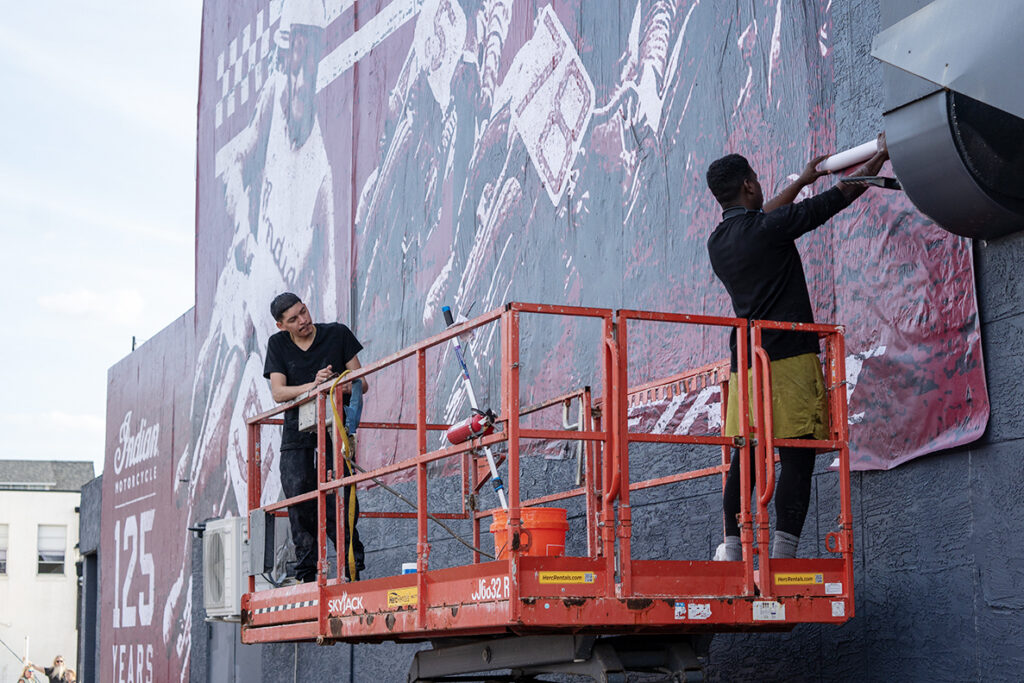
Large-scale murals require work at height. Scissor lifts, scaffolding, and boom lifts are all standard equipment. The company should have general liability coverage, workers’ comp for their painters, and appropriate equipment certifications. If they do not, any incident during installation becomes your problem.
You can tell a lot about a company from how they write their proposals. Here is what to watch for.
A well-run mural commission has six clear phases. If any of these are missing or undefined, the project is at risk.
The mural company identifies candidate walls based on your market, foot traffic requirements, demographic profile, and size constraints. They assess each wall for structural condition, surface prep requirements, access logistics, and permitting status. They negotiate a wall agreement with the property owner that includes a display duration, a maintenance commitment, and a process for early termination.
In major markets, a premium wall in a high-traffic neighborhood with strong social media backdrop potential can cost $18,000 to $38,000 for a four-week cycle. Private walls with less foot traffic or lower brand value run $1,800 to $3,600 per month.
The company presents a shortlist of artists whose style is appropriate for the brief. You review portfolios, select a direction, and agree on an artist. The artist is briefed directly against the campaign objectives, not just handed a design to reproduce.
This distinction matters. An artist who understands what the campaign is trying to accomplish will make better creative decisions during execution than one who is simply painting to a spec sheet.
The artist develops concepts based on the brief. This typically goes through two to three rounds of revisions before a final design is approved. The brand’s legal team should review the final design for trademark clearance, and the artwork rights agreement should be executed before production begins.
Do not skip the legal review. A mural in a public location is a public statement. Any trademark, logo, or intellectual property in the design needs to be cleared.
The wall is prepped: cleaned, patched, primed as needed. The design is transferred to the wall using a grid, projection, or vector template. Painting typically takes two to seven days depending on scale and complexity. A production manager is on-site for the duration, and the company coordinates any permitting, equipment permits, or street closure requirements.
On completion, the production manager captures GPS-tagged photographs from multiple angles, including street-level, elevated, and contextual shots showing the surrounding environment. A condition report is filed. Any touch-up work is scheduled.
Over the course of the display period, the company conducts scheduled condition checks and documents any changes. At the end of the campaign, a final documentation package is delivered that includes installation photos, condition reports, a display period confirmation, and any social media performance data the company has tracked.
We run mural campaigns in major markets nationwide. Hand-painted murals, large-format wheatpaste, and multi-city rollouts. Every placement comes with GPS-tagged documentation and a proof-of-delivery package.
Mural pricing has three components: wall access, design and artist fees, and production and labor. Brands are often surprised that the wall itself can cost as much as the painting. That is the reality of premium outdoor locations in high-traffic urban markets.
Hand-painted murals by professional commercial artists in major markets run $15,000 to $75,000 and above, depending on scale, surface complexity, artist profile, and market. Here is a more specific breakdown:
| Design Complexity | Typical Price Range | Notes |
|---|---|---|
| Simple (flat graphics, limited color) | $18,000 to $24,000 | Good for logo-forward brand statements |
| Mid-level (detailed illustration, gradients) | $28,000 to $55,000 | Most brand campaign work falls here |
| Premium (3D, photorealistic, large-format) | $72,000 to $110,000+ | High-profile brand launches, marquee locations |
Labor costs beyond the lead muralist add up: assistants typically run $1,200 to $2,200 each, and a dedicated project manager runs $1,500 to $2,000. Equipment costs for scissor lifts, scaffolding, and boom lifts vary by job scale but are real line items on any serious production budget.
Printed vinyl murals applied to building exteriors are faster to produce and easier to change than hand-painted work. They run $5,000 to $20,000 depending on size and surface type. The trade-off is that vinyl does not have the cultural credibility of hand-painted work and can look like what it is: a printed wrap. For brands trying to earn street credibility or organic social media pickup, vinyl is usually the wrong choice.
Large-format wheatpaste is a mural-adjacent format that delivers street-level presence at a different price point. At AGM, wheatpaste campaigns start at $4,500 for 100 standard posters. Large-format 48×72-inch pieces run $10,500 to $13,500 for a full deployment. This format works well for brands that want multi-location saturation across a market or need a faster turnaround than a painted mural allows.
Wall fees are separate from production costs and are often the line item that surprises brands. Premium city-permitted walls in high-visibility locations run $18,000 to $38,000 for a four-week display period. Private walls secured through direct negotiation run $1,800 to $3,600 per month. The right wall in the right location is worth paying for. A beautifully painted mural on a low-traffic side street will not generate the foot traffic or social media pickup that justifies the production cost.
Not every city has the same mural infrastructure. These five markets have the highest density of premium walls, established artist communities, and strong foot traffic for brand murals.
Wynwood is probably the most photographed mural district in the country. The Wynwood Walls art installation transformed the neighborhood, and brand murals here generate enormous social media volume. Wall access is competitive and premium pricing reflects that demand. Best for brands targeting the fashion, lifestyle, and luxury sectors.
Bushwick has one of the highest densities of hand-painted murals in the country, with a strong street art community and significant organic foot traffic. Colossal Media has operated here since their founding, and the neighborhood has a genuine cultural reputation that translates to brand credibility. Best for brands targeting young urban consumers who value authenticity.
The LA Arts District has expanded significantly in the past decade. It benefits from proximity to the entertainment industry, a strong creative community, and frequent foot traffic from media and production workers. Best for entertainment, tech, and consumer brands.
Pilsen has a deep tradition of public mural art with roots in the Chicano mural movement. For brands that want genuine community resonance rather than pure visual impact, Pilsen offers a cultural context that most other mural districts cannot match. Best for brands with authentic community and cultural positioning.
The Mission has a similar community mural tradition to Pilsen, with strong ties to Latin American public art. It also benefits from proximity to the tech industry, which drives significant foot traffic from an affluent demographic. Best for tech, food, and lifestyle brands.
AGM is a street-level campaign agency. We do not paint murals for office lobbies. We commission them as part of brand campaigns designed to generate foot traffic, social media content, and earned media.
Our mural process starts with the campaign objective, not the wall. We are asking what the brand is trying to achieve in a specific market before we go looking for walls. That means the wall selection, the artist selection, and the design brief are all informed by a campaign strategy.
We run mural campaigns in major markets nationwide. Our network of property owner relationships lets us move faster on wall sourcing than brands trying to negotiate directly. Our artist roster covers a range of styles, from photorealistic to abstract to typographic, and we have experience briefing artists against commercial brand standards without killing the work’s cultural authenticity.
We also run large-format wheatpaste as a complement to mural work. For a brand that wants to dominate a market with street-level presence, combining a hand-painted mural at a marquee location with a 100-piece wheatpaste deployment across surrounding neighborhoods can be more effective than a single large mural on its own.
Every campaign we run includes a full documentation package: GPS-tagged installation photos, condition reports, and a proof-of-delivery summary. That is not optional. Our clients need to close the loop on their media spend, and documentation is how that happens.
Our mural advertising service page has more detail on formats and markets. You can also reach us directly at (646) 776-2770 or through our contact form.
Documentation is where most mural companies fall down. It is also one of the most important things to nail down before you sign a contract.
Here is what a professional documentation package should include:
When you are evaluating a mural company, ask to see an example documentation package from a recent campaign. A company that has never been asked this question does not have a standardized documentation process.
The best mural company for your campaign is not necessarily the one closest to your office. It is the one with the strongest wall network, artist relationships, and production infrastructure in the market where you want to be.
If you are looking for a commercial mural company in New York, Miami, Chicago, Los Angeles, or San Francisco, those markets have the deepest supply of experienced operators. In secondary markets, the pool is thinner and you may be working with a company that is strong on artistic execution but weaker on campaign logistics.
When you search “mural company near me,” you are likely to find a mix of boutique studios, freelance artists, and a few agencies. The filtering process described in this guide applies regardless of where they are based. What type of company are they? Do they have documented commercial work? Can they handle the logistics of your specific project?
National agencies like AGM operate in markets across the country without being physically headquartered in every city. For multi-city campaigns, working with a single agency that has existing relationships in all your target markets is usually more efficient than stitching together local vendors in each city.
A mural advertising company specifically positions itself as a media option, not just a creative service. The key distinction: they are selling you audience reach and brand exposure, not just artwork.
For a mural advertising company, the relevant questions include: How do they measure the audience for a specific wall? What foot traffic data do they use to justify a location recommendation? How does mural advertising integrate with your broader media plan? Can they provide comparable audience metrics to what you would get from a traditional OOH buy?
Not all companies in this space have rigorous answers to those questions. Colossal Media, as the largest hand-painted mural advertising company in the US, has the most developed media infrastructure. Smaller agencies and studios are often selling the creative value of mural work rather than a media audience guarantee.
Be clear about what you are buying: creative execution, media audience, or both. The pricing and the right company depend on your answer.
A mural company manages the full production process: wall sourcing, property agreements, artist briefing, permitting, installation logistics, and documentation. A mural artist paints the wall. For brand campaigns with commercial requirements, you generally need a company with production infrastructure, not just an individual artist, though some companies are artist-led and have built that infrastructure around their practice.
Display durations vary. Temporary campaigns are often structured around four-week or eight-week windows, consistent with outdoor advertising buying cycles. Permanent murals commissioned for branded environments or public art purposes have no defined end date, though property changes and building renovations eventually affect them. Always confirm the minimum display duration in writing before production begins.
It depends on the city and the specific wall. Many cities require sign permits for commercial advertising murals, while non-commercial or public art murals often have different rules. In some markets, there are specific legal wall programs that streamline the permitting process. A qualified mural company should handle permitting as part of their scope. If they tell you it is your responsibility to figure out permits, that is a service gap worth noting.
For a single-market campaign with a mid-level hand-painted mural, a realistic all-in budget including wall fees, design, production, and documentation runs $40,000 to $70,000 in a major metro market. Multi-city campaigns scale from there. Wheatpaste campaigns start significantly lower, with large-format deployments of 100 pieces starting around $4,500 and scaling up based on format size and market.
Only if your contract includes the appropriate rights. Photos of a mural include the artwork, which is copyrighted by the artist unless otherwise agreed. Make sure your contract grants you a license to photograph the mural and use those photos in your marketing and advertising. This should be settled before production begins, not after the mural is painted.
Most mural commissions transfer a license for the brand to use the work in specified ways, while the artist retains copyright. Full copyright assignment is less common and typically comes at a premium. The specific scope of what you can do with the artwork (social media, paid advertising, product use, press materials) needs to be spelled out explicitly in the contract.
A mural is painted directly onto a wall surface and is semi-permanent. Wheatpaste advertising uses printed posters adhered to walls, utility boxes, and other surfaces. Wheatpaste is a mural-adjacent format that delivers high-impact street presence at a lower cost per placement and with a faster turnaround. For multi-location campaigns or situations where a permanent wall is not available, wheatpaste is often a practical alternative or complement to a flagship mural.
For major markets (New York, LA, Miami, Chicago, San Francisco), there are established mural companies with deep local wall networks and artist rosters. For national campaigns, working with an agency like AGM that operates in multiple markets is typically more efficient than sourcing a local vendor in every city. The criteria remain the same regardless of location: documented commercial work, clear production process, proper contracting, and a professional documentation package.
American Guerrilla Marketing runs mural campaigns and large-format street advertising in major US markets. We handle wall sourcing, artist selection, permitting, production, and documentation. Every campaign includes a full proof-of-delivery package.
American Guerrilla Marketing is a New York-based street-level advertising agency operating nationwide. We specialize in mural advertising, large-format wheatpaste, wild posting, and guerrilla marketing campaigns for consumer brands.
Ready to Run Your Campaign?
Call us or email us. We’ll tell you exactly what we can do in your market and what it costs.
American Guerrilla Marketing — Los Angeles
Street-level campaigns in Los Angeles and nationwide. Wheatpasting, LED trucks, street teams, and more.
(646) 776-2770
July 6, 2026
July 6, 2026
July 6, 2026
July 6, 2026
July 6, 2026